
The Power of Three
Braque, Picasso, and Gris: exploring key concepts of Cubism with its pioneering exponents
Cubism is one of the major movements of Modernism. It was a radical departure from long-established academic approaches and, in more ways than one, took art in exciting new directions. The core concepts that defined the genre grew from the work of three influential painters. Here we will track the early development of the style by taking a glance at a chronological selection of key works by George Braque, Pablo Picasso and Juan Gris…
Georges Braque is a very important artist whose career touches upon, and consolidates, many Modernist styles. His earlier works are considered Fauvist due to the vibrant use of structural colour, strong line and lack of traditional perspective. Like much of the work being produced in the first decade of the Twentieth century, by his fellow French painters like Henri Matisse and André Derain, Braque’s earlier paintings are clearly influenced by the Post- and Neo-Impressionist styles present in the works of Vincent van Gogh… and, just like many of those pioneers, his work was initially misunderstood.
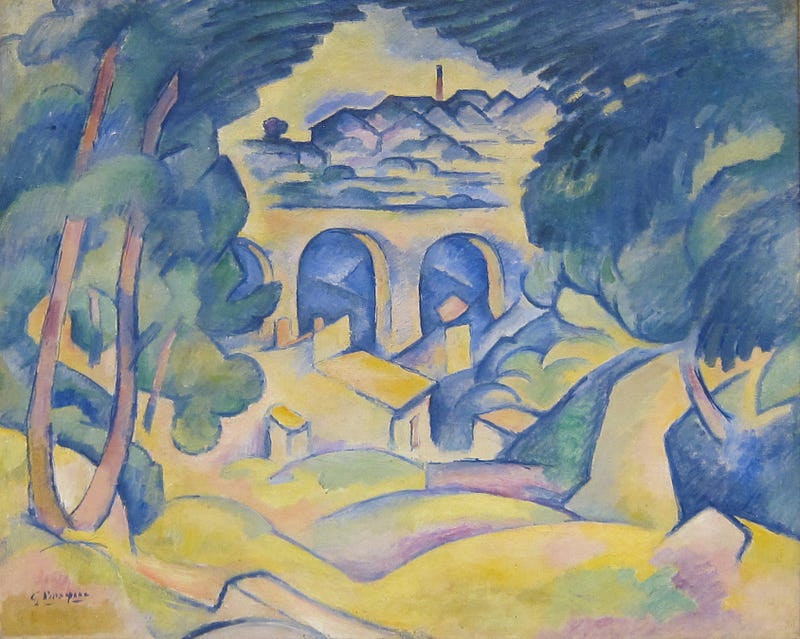
In Braque’s 1907 painting of the viaduct across the valley of L’Estaque, the influence of Paul Cézanne is very clear — a flattened canvas where the rounded shapes of organic nature contrast with the angular shapes of stone and artificial structures. There is an effective sense of depth, though this is created purely by composition and not traditional perspective.
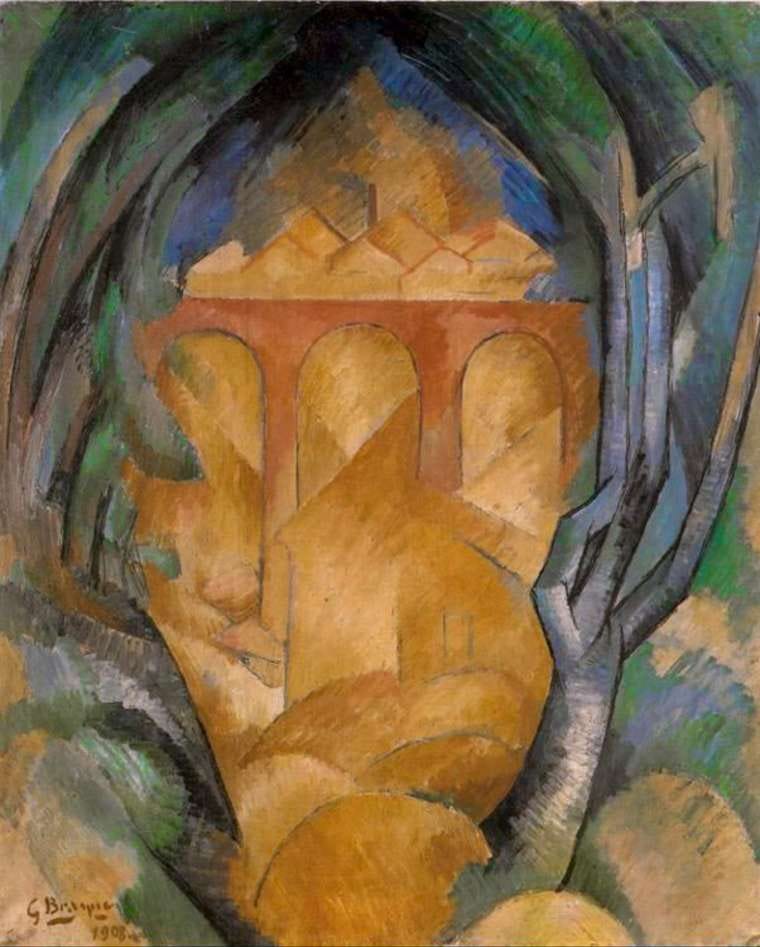
The following year, he returned to this subject and produced another painting of the same scene. Here, we can see the clear beginnings of Braque’s distinctive Cubist style including false perspective and a dynamic interplay of horizontal, vertical and diagonal lines.
The use of planes that seem to pass through each other (en passage) is a method of creating a solidity and depth that Braque extended from the study of Cézanne’s ‘reductionist’ techniques. Braque used this approach to give his compositions an energy that directed the viewer’s eye to different parts of the canvas and gave the impression that some forms were rupturing the picture plane, jutting out of the canvas and into the space of the viewer. A sense of depth is achieved by this new approach.
The influence of Henri Matisse is also evident. Although when they were rejected by a Salon exhibition in 1908, it was Matisse who, reportedly, dismissed Braque’s paintings as no more than “little cubes”. This pejorative was repeated by critics in reviews of Braque’s work at later exhibitions and so a new art term was ‘coined’. That’s how George Braque became the first Cubist. What began as a derogatory description stuck and became a ‘rallying cry’ for a group of young revolutionary artists at the vanguard of Modernism.
Pablo Picasso was one of those young artists and is, for many, the first name that springs to mind when they think of what Cubism might be. He went on to become one of the most influential and well-known artists of the Twentieth Century. He had a talent for recognising the important innovations in the work of his contemporaries and distilling those developments into bold, sometimes confrontational paintings.
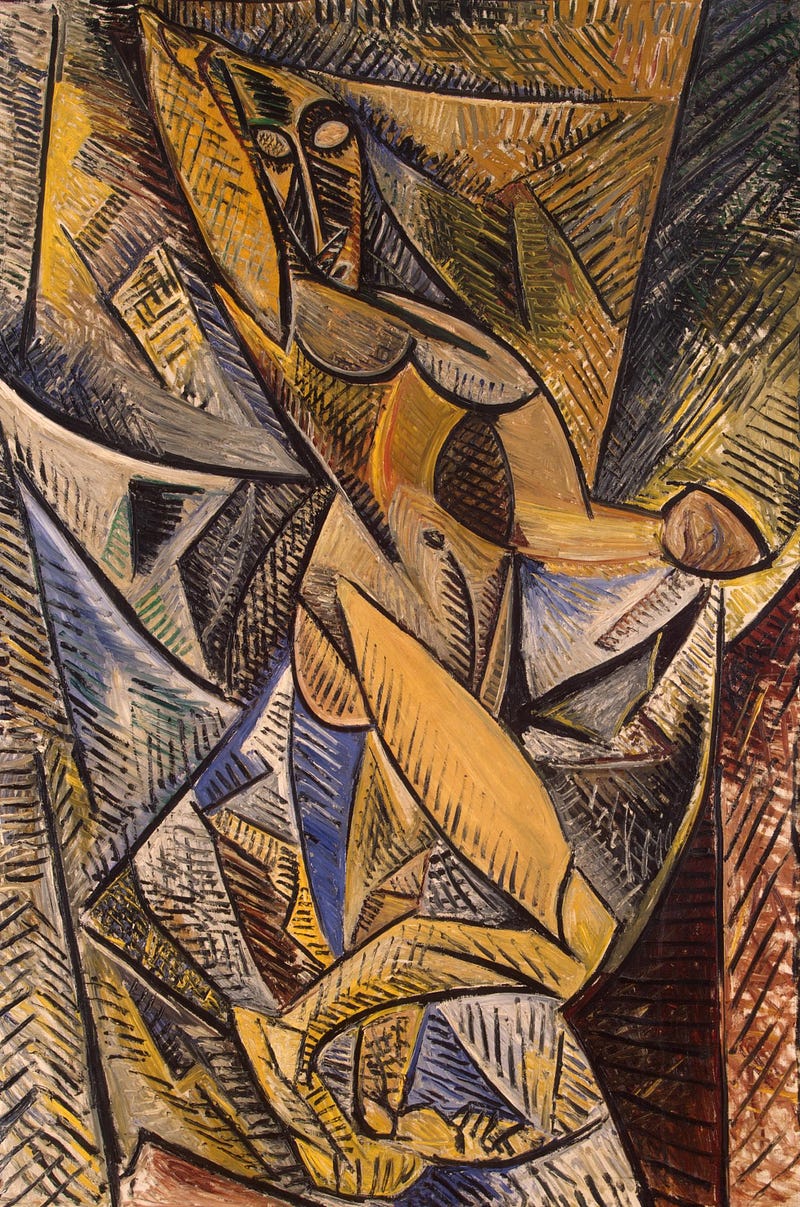
His Dance of the Veils, painted in 1907, is aggressive and expressionistic. Picasso has utilised both positive and negative space to hold this dynamic piece together. Although his palette is subdued, he’s used line to ‘liberate colour from the duty of form’, proclaiming the influence of Matisse. He also added strong hatching to suggest some shadow and also movement.
Much of this approach was developed in collaboration with Marcel Duchamp, who was also applying Cubist methodology to the figure and introducing elements of Dynamism to imply motion — particularly evident in the series of paintings of a Nude Descending Staircase that Duchamp produced a couple of years later.
There’s also a link to Aubrey Beardsley’s Salome illustrations: here we see Salome doing the ‘erotic’ dance, yet she appears far from seductive! The forms are sharp and angular. The veils are not diaphanous, suggesting instead a vortex of swirling blades. The hand is reduced to a hammer-like fist and the face seems ‘sly’. The influence of African art is evident in the design of the face that resembles a wooden tribal mask, which serves a narrative purpose, telling the viewer that the woman is masking her intentions. Picasso is portraying both the inner and outward appearance of the woman who performs the dance with scheming and murder in mind. So, this is a work of Expressionism as much as Cubism.
All these approaches were explored further in his famous painting Les Demoiselles d’Avignon, also produced in 1907, which is seen as one of the most important works in the development of several major Modern trends.
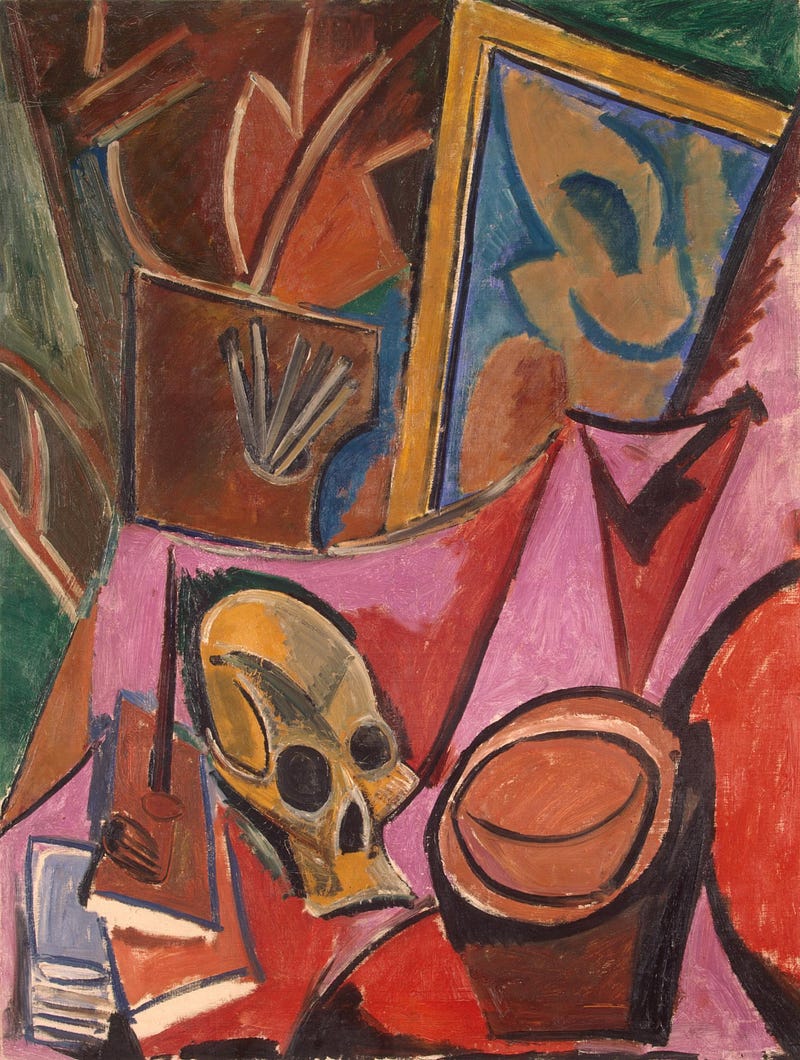
This still life featuring a skull is one of Picasso’s Fauvist paintings of a very traditional subject, and perhaps a homage to the early paintings of Cézanne, but its treatment has all the hallmarks that would become associated with Cubism such as distortion, false perspective, multiple viewpoints, structural use of negative and positive space, strong line enclosing blocks of bold colour.
Picasso also includes the tools of his trade, brushes, palette, other paintings in the studio, making a comment about the nature of art itself: these tools are simply objects like those others he has chosen to paint. They are as dead as the skull. It is the role of the artist to ‘bring them to life’ on the canvas and to imbue a picture with emotion, integrity and meaning.
Picasso became a friend of Braque and they developed the ground-rules of Cubism together. Reputedly, when dealers later presented Picasso with unsigned works for authentication, he sometimes signed ones he liked, even when he knew they were by Braque! Possibly apocryphal, but the anecdote helps to underline the parallel progression of their styles. Picasso’s early career was full of innovation and experiment, though he later became a ‘brand’ falling into a commercially successful, recognisable-though-repetitive, style that he himself felt trapped by.
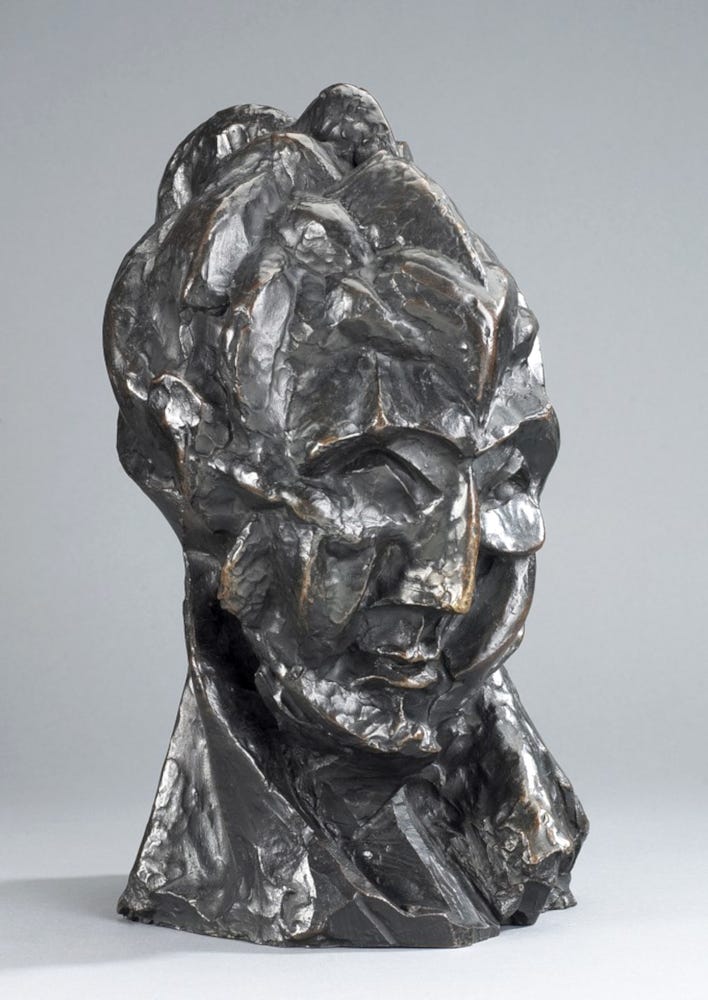
Picasso’s 1909 sculptural bust, Head of a Woman, Fernade, is one of the radically Modern pieces of work that the Italian Futurist, Umberto Boccioni is known to have seen. Combined with his experience of works by Marcel Duchamp, this was the biggest aesthetic influence upon his own early sculptures such as Antigraceful and Unique Forms of Continuity in Space (both 1913).
Apparently influenced by the caricature busts of Honoré Daumier (1808–1879), Picasso tackled the problem of expressing personality when only dealing with a physical surface by extending the plains of certain features, implying movement and also emphasizing how he saw the subject. Already, as Cubism was just finding its form in paintings, Picasso was lifting it back into 3D by using formal aspects of the approach in his sculptures. Again, something that his contemporary, Henri Matisse was exploring with his Blue Nude series of paintings and sculptures…
Around the same time, George Braque was interrogating representations of positive and negative forms where both the objects and the space surrounding them were indicated by paint on an equally solid surface… He realised that the tangible reality of the painted canvas meant that all the forms were, technically, of equal integrity…
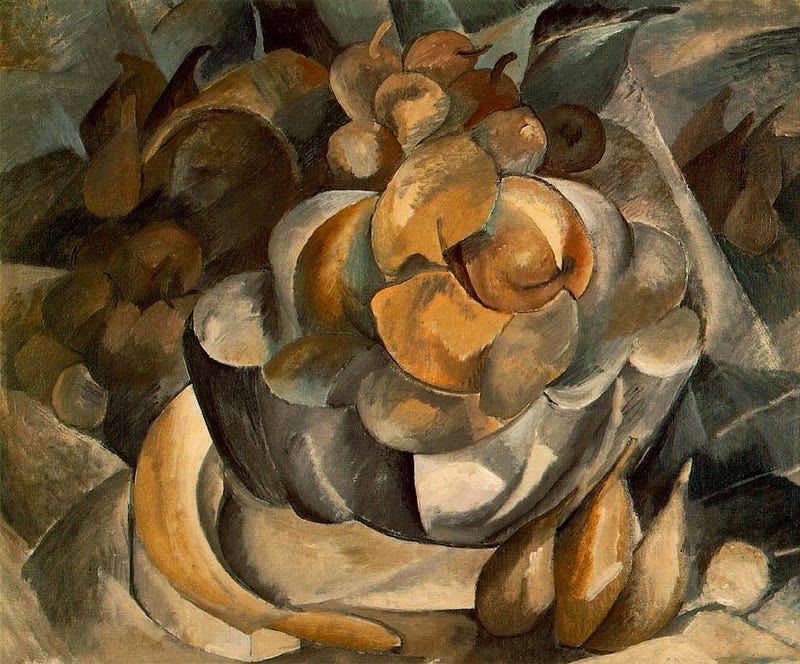
With his 1909 still life of a Fruit Dish, the influence of Cézanne can be clearly seen, though here, Braque is beginning to define form in the ‘negative’ space as much as the objects depicted. There is also the characteristic use of multiple points of view and false perspective. Whereas Cézanne distorted space and gave us the impression of maybe a second view point, Braque has fragmented space and offers many.
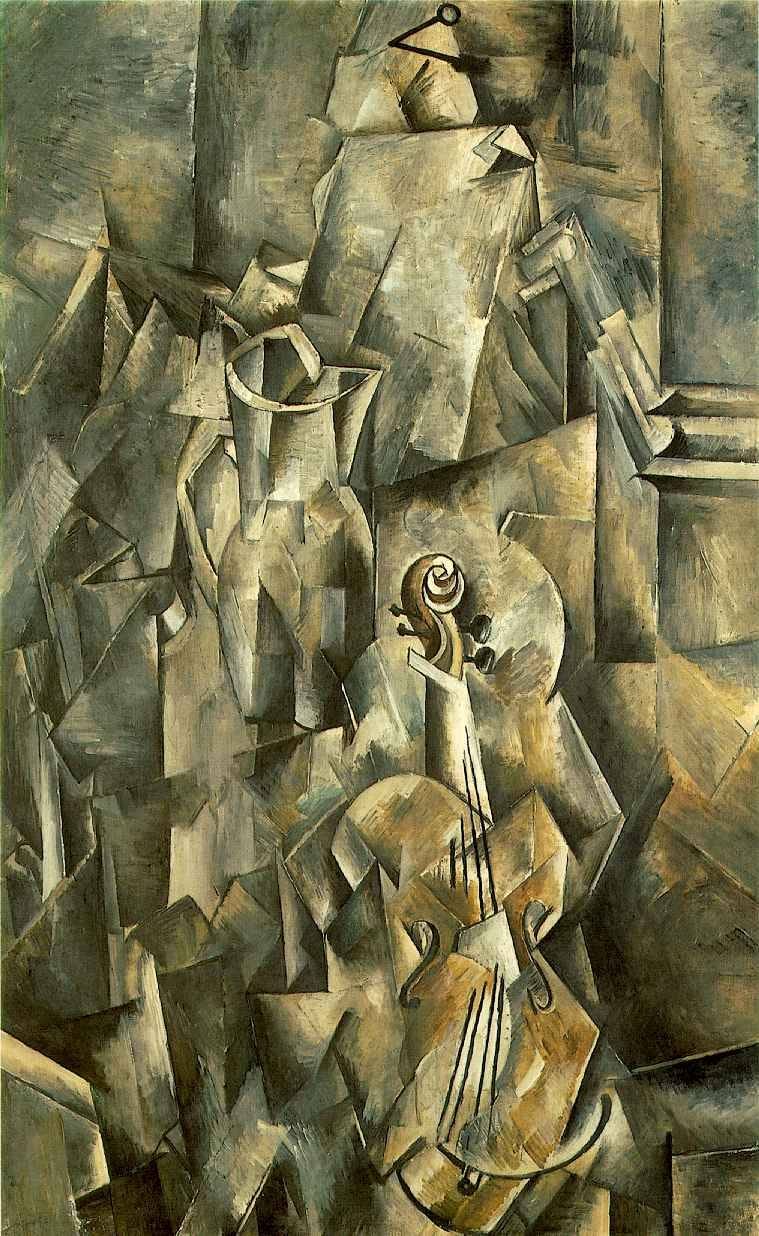
Another good example of this approach is seen in his 1910 still life of a Violin and Pitcher. Here, negative space is as important in the structure of this canvas as the objects themselves. If an artist fragments the view to such an extent, there is a danger of losing the cohesion and integrity of a composition. Braque uses the almost sculptural qualities of the spaces between the objects to hold the canvas together and creates a new view of reality, which is as much defined by ‘the space between’ as by ‘the tangible’.
Partly to avoid the compositions becoming too frenetic and ‘noisy’, he moved away from his Fauvist roots and tended to keep his palette somewhat subdued, often relying almost entirely on grey-scale. Braque often chose to paint musical instruments in this way, perhaps hinting at the direct link he saw between visual composition and musical composition. We even use similar language to discuss the two art forms — rhythm, tone, harmony, discord… composition. This link has been exploited by many important artists since, from Wassily Kandinsky to Jackson Pollock.
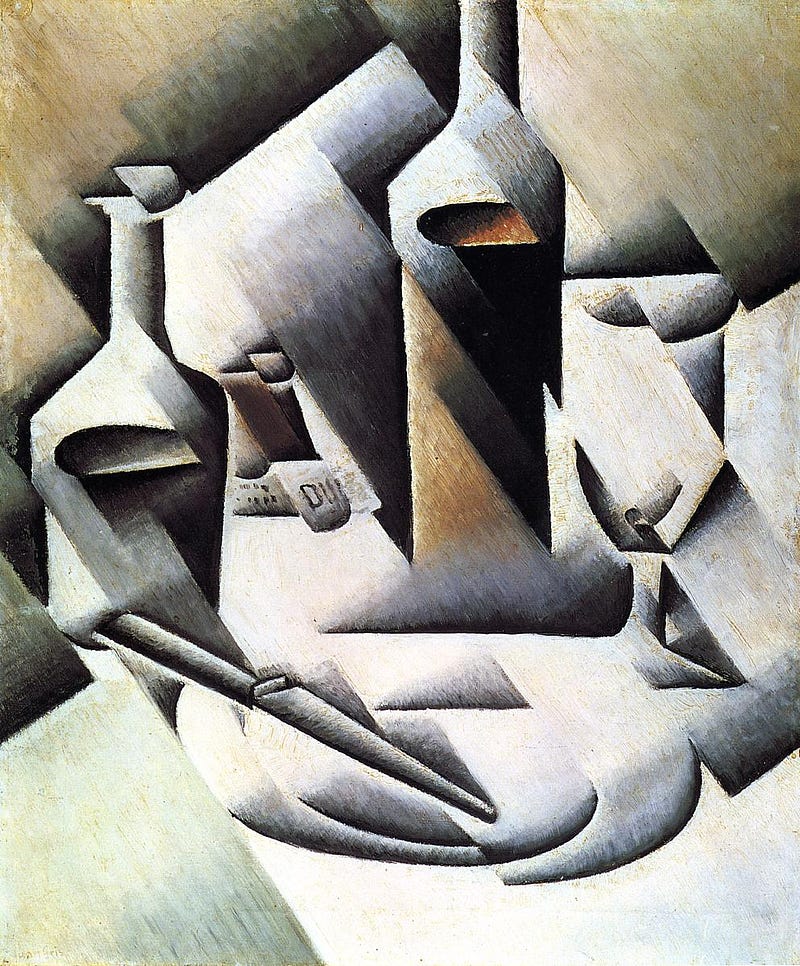
Juan Gris picked up on Braque’s development of Cubism and became one of its foremost practitioners. His paintings were dynamic compositions presenting a visually interesting array of view points in an attempt to reveal the essence of a thing, rather than merely how it looks. For example, in his still life of 1911, Bottles and Knife, the ‘slashing’ diagonal refers to the knife’s function and the hard curves of the bottles and plates interplay with this dynamic, as if the image itself had been sliced-up and served to us on a canvas...
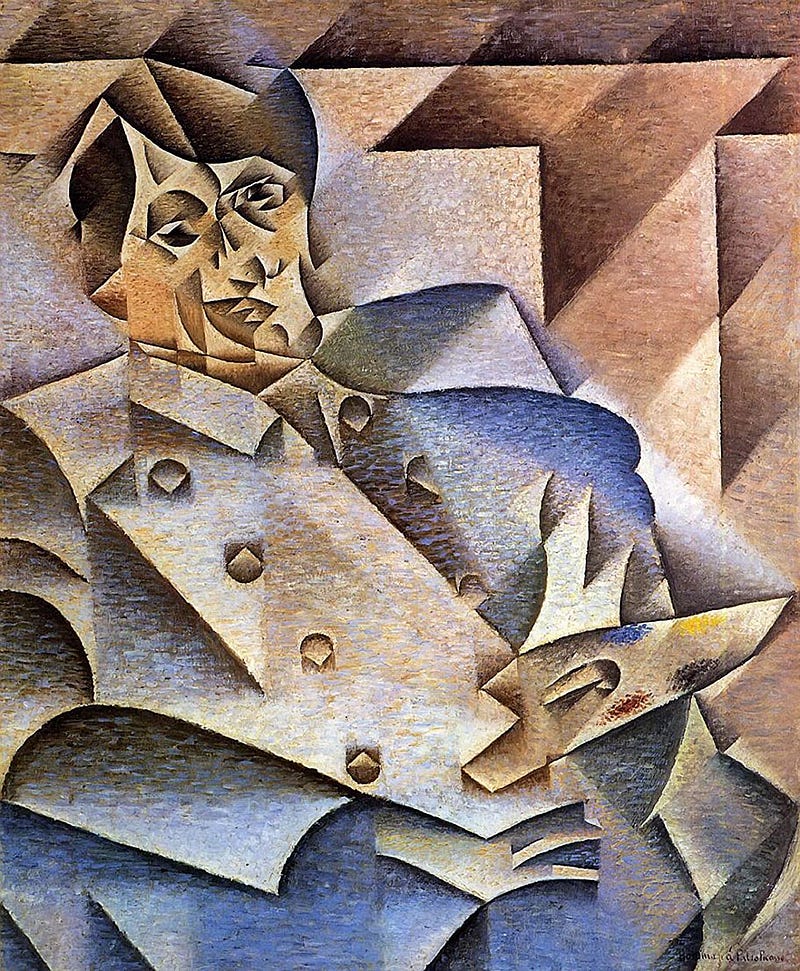
In his 1912 portrait of his fellow Spanish Cubist, Picasso, Juan Gris has expressed positive and negative space in an equally bold manner. Form is suggested by graduations of shading, and even surfaces that were probably flat are implied as curved by this technique. The face is shown as a multi-faceted collection of views where profiled features interact with a frontal view. It’s as if Picasso did not sit ‘dead-still’ but was fidgety and full of life!
The influence of Picasso’s earlier Cubist style is obvious and Gris has deliberately ‘quoted’ this as a comment on the personality of the sitter. Even in this example, Gris has taken the style a step further and made it his own, rather than a Picasso pastiche. He was soon recognised as a true pioneer of the style in his own right and one of the ‘three musketeers of Cubism’ along with Braque and Picasso.
Again, strong links with Italian Futurism can be detected. Also, Vorticist photographers were to adopt the Cubist structuring found in the work of Juan Gris. His distinctive grids with strong diagonals could, potentially, be used as a pattern to create similar ‘crystalline’ structure in paintings, photographs and graphics.
Unlike many Cubists, Juan Gris developed a very bright colour scheme in his works. The colours have a boldness that is similar to Fauvism, but he does not reject naturalistic colour entirely. In fact, he often quotes the natural colour of objects and especially favoured warm colours. By doing this, he hoped to avoid the ‘clinical’ and analytical coolness of some cubist paintings and instead convey some warmth and emotion that would more readily engage the viewer. There is a strong structural connection with the work of his contemporary, Franz Marc, who also created images that followed a crystalline pattern.
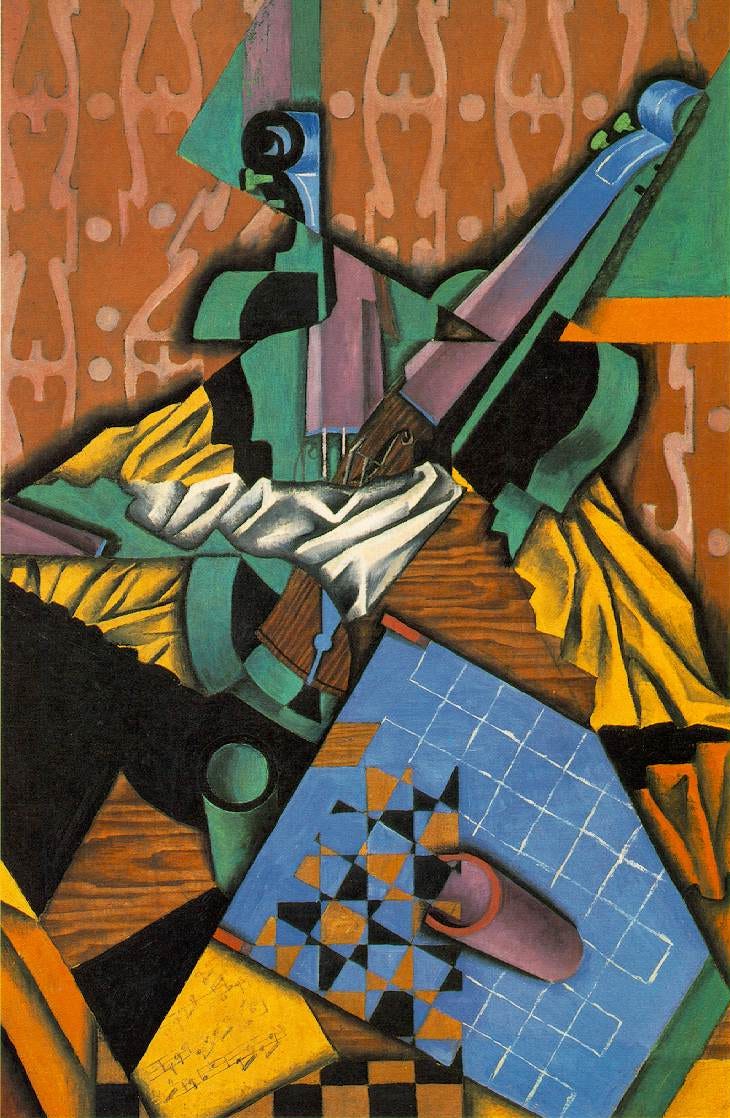
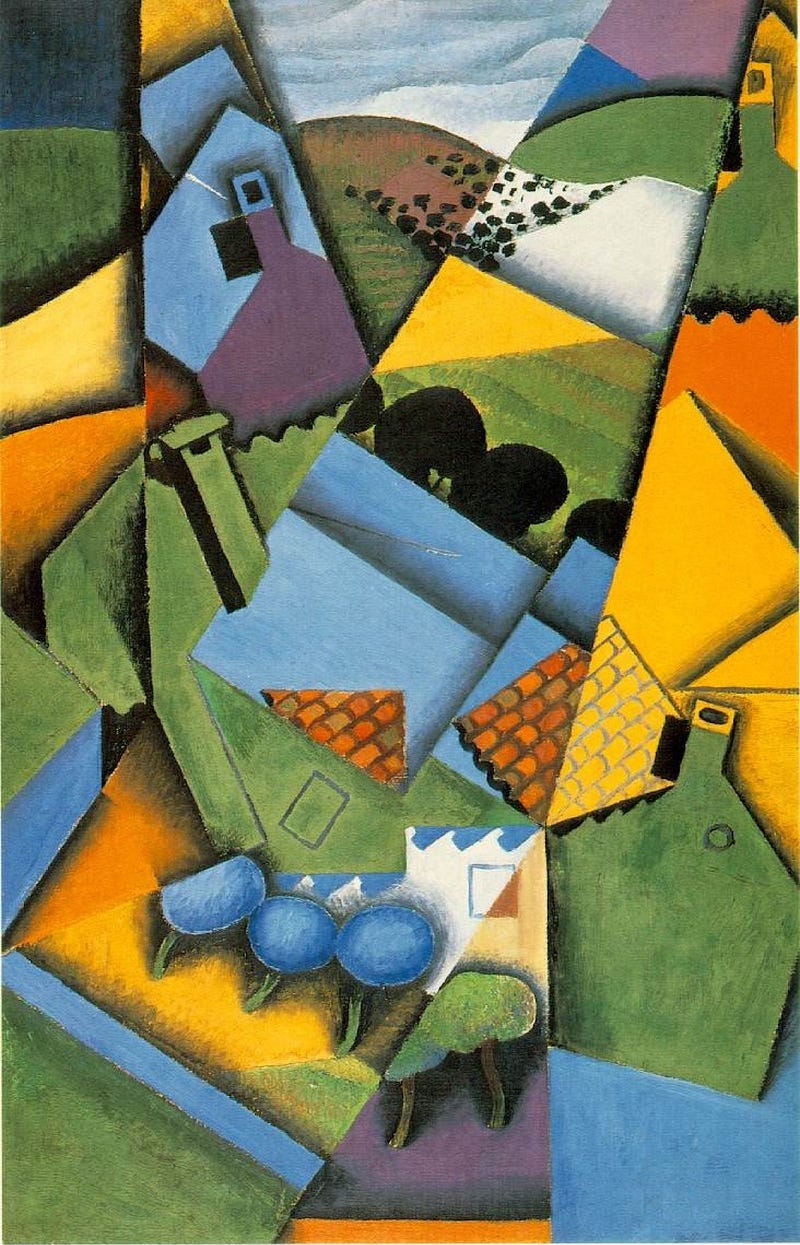
In the two examples above, his colours are characteristically vibrant and are a mix of natural and non-naturalistic. The recognition of surface and its design are of prime importance and here Gris has pushed Cubism into a sort of ‘cut-up’ composition that plays with several viewpoints and varying scale. In many ways, there’s a strong connection with the later ‘cut-up’ techniques of Surrealist writers, the American Beats, and there’s a direct link to the photo-montages created by David Hockney in the 1980s.
For me, the ‘way in’ to understanding what Cubism is, lies in the equal integrity granted to the representation of positive and negative forms, along with understanding that there is no absolutely ‘realistic’ way of representing the three-dimensional world on a two-dimensional plane. I’ve explained it to students of art history thus: imagine placing a box made of tracing-paper over a subject’s head and drawing their profile from each side, a view from above and behind, and one more face-on. Then unfold the box and lay it flat. Their 3D head has now been translated into a 2D representation and there’s nothing preventing one from cutting up the drawings and rearranging them into a more interesting composition. The result would be just as ‘realistic’ as any, maybe more so. Because, in the ‘real’ world we can move around and see a subject from different angles.
By the mid-1930s, Cubism was a dominant approach in Modernism, known and recognised internationally. The style overflowed from the world of art and into graphic design and broader, ‘everyday’ visual culture. Certainly, one of the ‘three musketeers of Cubism’ had become a ‘household’ name, and in 1937, Picasso unveiled one of the genre’s greatest triumphs, Guernica…
Arguably, Picasso’s strongest work, this large oil painting is a Modern masterpiece. A fragmented jumble of contorted figures and limbs sprawl across a canvas nearly eight metres wide. At the left, a distraught mother attempts to hold her dead child to her breast — this is a visual quote of the traditional Pietà images of Mary holding the dead Christ and this thematic image recurs in the work of Picasso as a symbol of grief and suffering, eventually leading to another well known work, Weeping Woman, painted later the same year.
Across the lower part of the canvas is a fallen warrior with gauntlet and broken sword — the gauntlet was drawn from an example that a friend of his had found amidst the rubble of the town during the aftermath clean-up and passed on to him. The deformed hands and feet of other figures remind us of similar images found in paintings of the crucifixion. Amongst the chaotic crowd are the bull, symbol of the Basque region of Spain and a horse, or perhaps a donkey, symbol of the Catalan region. All these figures are interlocked in a strong Cubist composition using a limited range of grey tones within bold, black outlines. The final work was intended as the design for a permanent mural and was developed from more than 50 preparatory sketches.
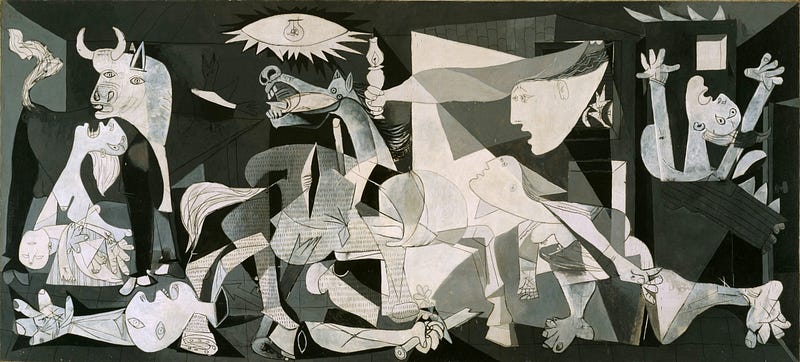
The painting was a response to the bombing of Gernika-Lumo, a Spanish stronghold of anti-Franco freedom fighters during the Civil War there. Seeing a solution to the problem of resistance in the Basque region, the dictator Francisco Franco allowed the Nazi German air force to practice one of their ‘Blitzkrieg’ attacks on this town. Bombs were dropped in a ‘lightning attack’ on civilians during market day, the death toll is estimated at eight hundred, and it took three days for the fires to burn out. The Nazis repeated this tactic on many other targets throughout the Second World War.
Picasso was invited to submit a work for the 1937 World Fair in Paris and delivered this eloquent protest against the atrocity that had been perpetrated earlier in the year. Picasso was open in his support of left-wing politics and, given the political climate in Europe and the rise of fascism around him, was very brave to make such a bold visual statement.
Apparently, when he was later interviewed by German Military Police, he was confronted with a print of Guernica and asked, “Did you do this?” to which the artist replied, “No, you did.”
* All images are used with license or presented here for educational purposes under fair usage policy.
This article is based on several short articles originally published in my book Evolution of Western Art (Questing Beast Books, 2012).


,_oil_on_canvas,_65.1_x_80.6_cm,_Minneapolis_Institute_of_Arts.jpg)
,_oil_on_canvas,_73_x_60_cm,_private_collection.jpg)
,_modeled_on_Fernande_Olivier.jpg)


