
The Dazzling Vortex
Some Vorticists flirted with Fascism, but their art also helped defend the allied navies…
The British Vorticists shared many of the ideas set out by the Italian Futurists. Their art celebrated the artifice of the modern world, its industry and cities. In much the same way as Cubism showed us objects and people from many different angles, Vorticism applied this multiple point-of-view to their surroundings. Typically, they painted abstractions made up of architectural elements from the interiors and exteriors of buildings, viewed from above, from the street, from within…
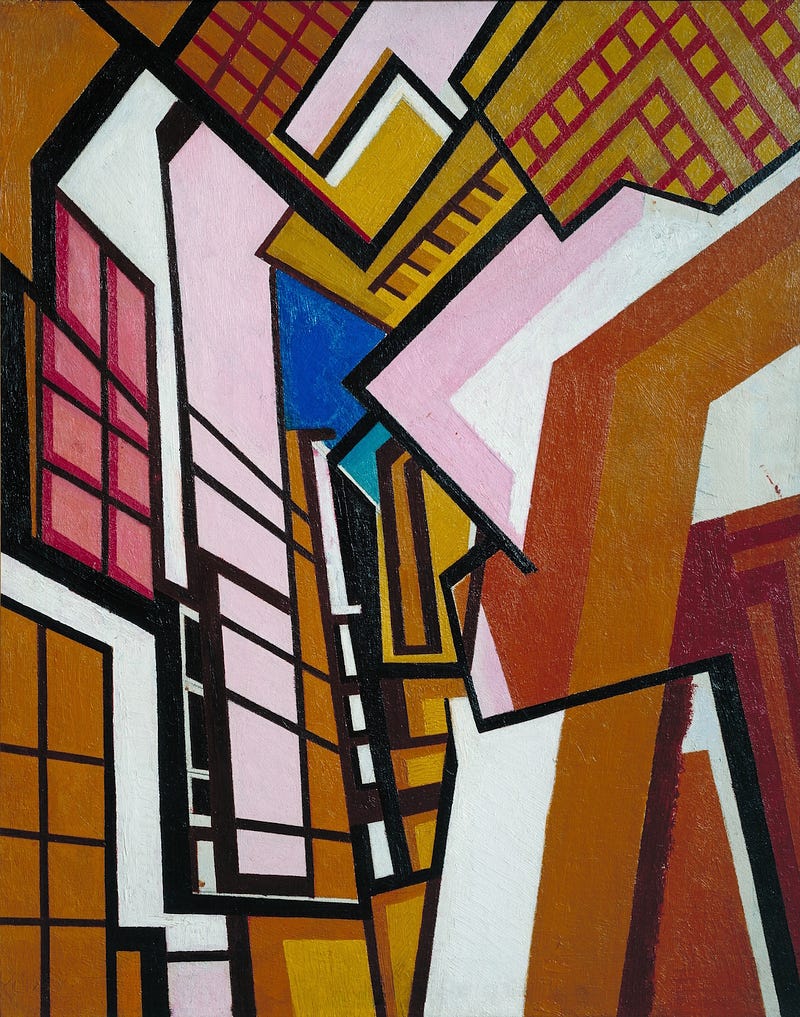
Percy Wyndham Lewis was one of the founders of the movement and published two issues of Blast, a short-lived literary magazine. Blast First, published in 1914, served as the Vorticist Manifesto and, in tone, reads rather like the first Futurist Manifesto of F.T Marinetti published five years earlier, in 1909.
Just like the Futurists, Vorticists thought of buildings and cities as huge ‘machines for living’ that took on an evolving life of their own as they were developed and expanded. Humans were seen, poetically, as components or the living cells, of these great metropolitan machine-creatures. They thought cities were exciting places, filled with the energies that made cultural development possible, leading to shared creativity and increased productivity.
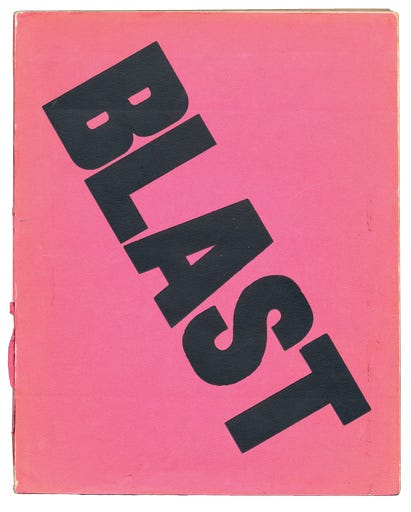
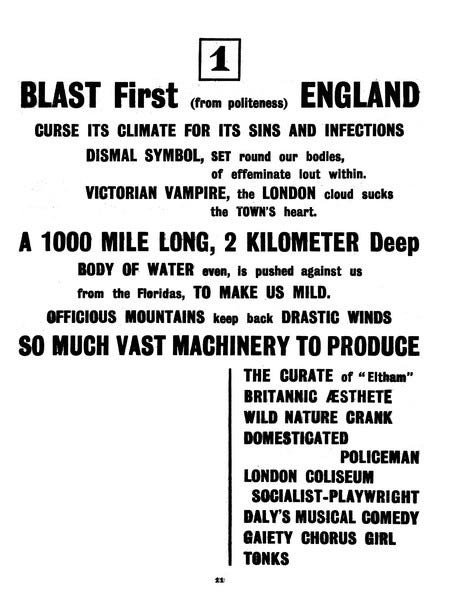
It was the American author and influential editor, Ezra Pound, who coined the term ‘Vorticism’ to describe the energy and visual dynamics of the group of British artists. At the time, he was working in London as foreign editor for several USA-based literary magazines and was listed as one of the signatories of the Blast First Manifesto.
Later, in the mid-1920s, Pound moved to Italy where he vociferously supported the Italian Futurists along with the fascism of Benito Mussolini and Adolph Hitler. He met Mussolini in 1933 and by the 1940s he was writing and broadcast antisemitic rants on Radio Roma in which he verbally attacked the USA and spoke in support of Oswald Mosley, the English Conservative MP who became leader of the the British Union of Fascists.
After the Second World War, Ezra Pound was arrested, though he was deemed mentally unfit for trial and instead spent the next 12 years in a psychiatric hospital. This highlights the close association of Futurism with Fascism, though it’s ironic that most of the Italian Futurists were finally condemned as “degenerate” by Mussolini’s regime, regardless of their role in popularising its earlier ideologies. Luckily, things took a different path for the British Vorticists…
Another important early influence upon the Vorticist aesthetic came from one of Ezra Pound’s compatriots. Alvin Langdon Coburn was a photographer who celebrated the beauty of the new, high-rise cities that were being built across the USA. He was attracted to the ideas of the Vorticists and, in response, he developed his distinctive ‘Vortograph’ approach, which he’d used to produce a few portraits of fellow American, Ezra Pound.
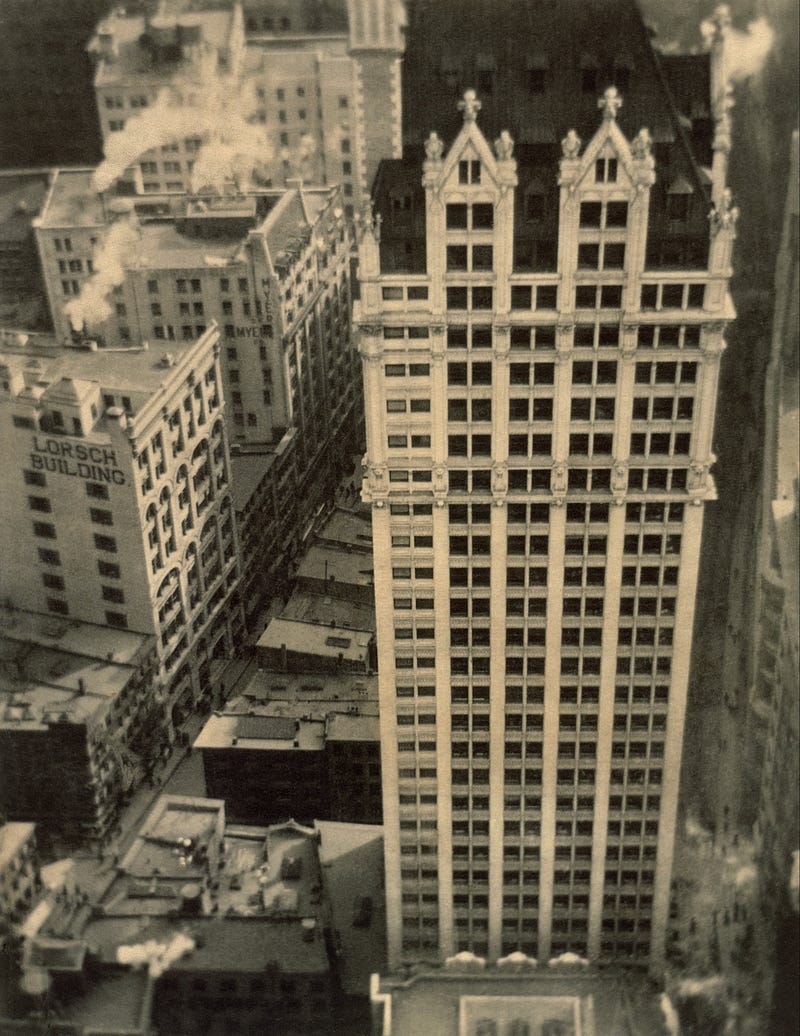
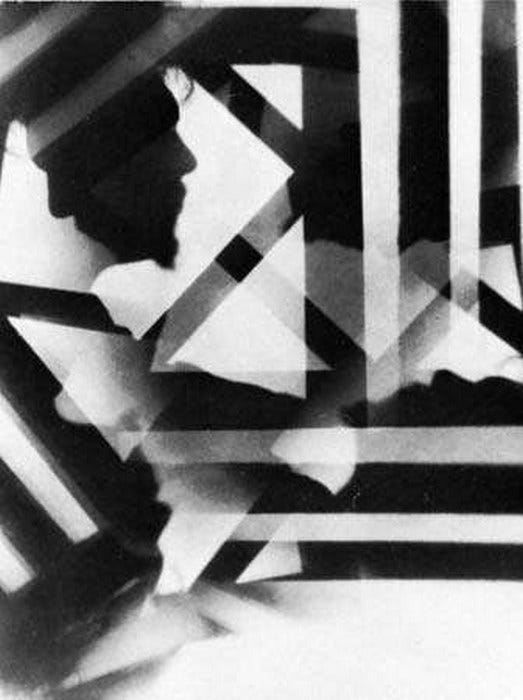
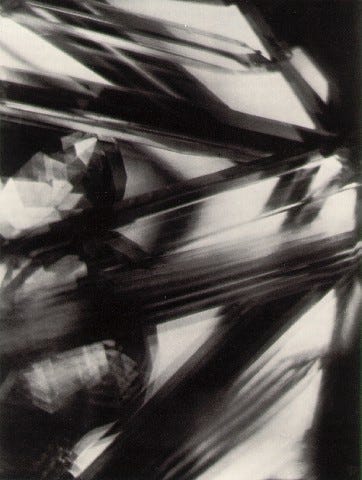
The composition of Coburn’s photographs of cities, such as House of a Thousand Windows (1912), was similar in spirit to the paintings of the Voticists, celebrating the energy, dynamism, and structure of the modern artificial environment. His later series of Vortographs (1917) were abstracts created using mirrors, prisms and crystals, often employing multiple exposures.
These photographs mimicked the structuring found in the work of Juan Gris and other pioneers of Cubism, and templated the fragmentation adopted by the Vorticists. The faceted grids seen in his Vortographs could, potentially, be used as a pattern for similarly crystalline-structured paintings.
It was when the British Vorticists lifted these patterns from the flat surface of the canvas and applied them to massive three-dimensional forms that they produced their most significant and unique art… Dazzleships.
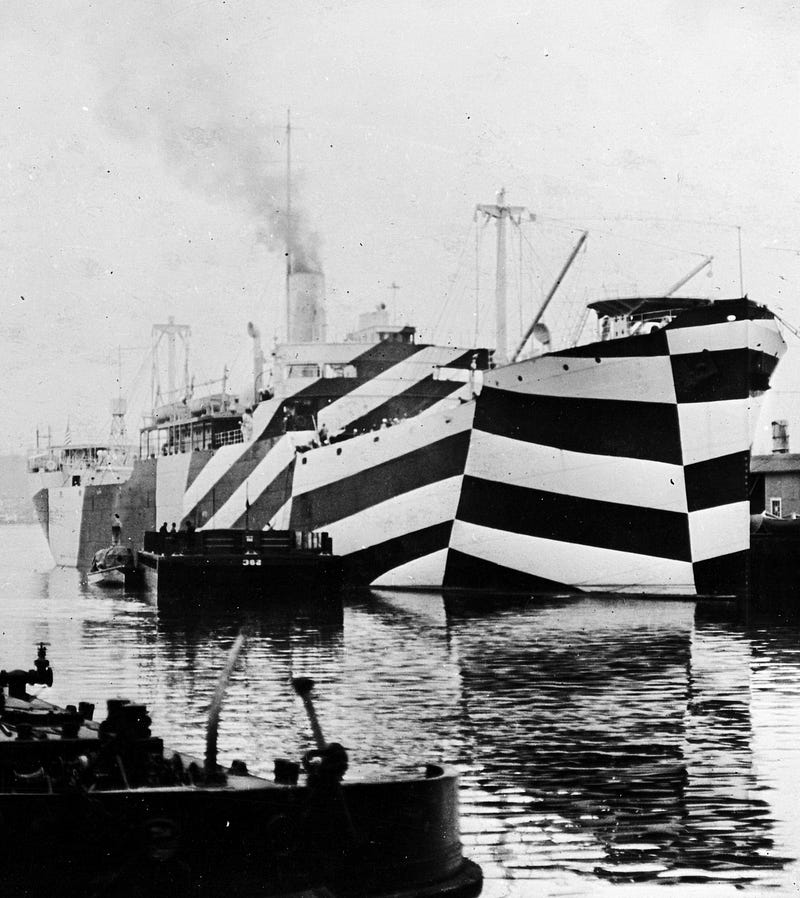
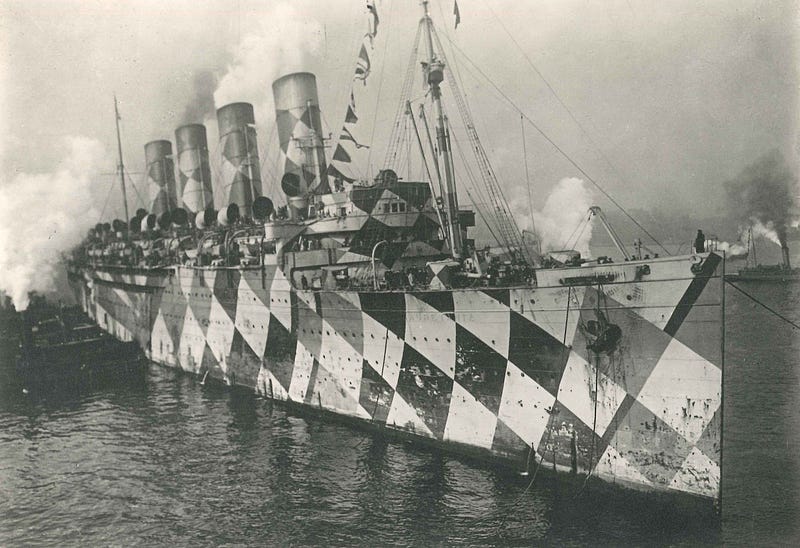
During sea battles, the ancient Greeks would use their polished shields to reflect the sunlight and dazzle attacking vessels. Taking this as their inspiration, the allied navies experimented with ‘dazzle’ camouflage during the First World War. These striking, often colourful Dazzleships, were created by Vorticist artists and were intended to hinder the identification of ships and also to break up the outline, thus making targeting more difficult.
The interplay of geometric patterns and curves made it difficult for enemy vessels to identify a ship conclusively and also to ascertain its heading. The designs made it hard to measure the angle of approach and also to see where the ship’s prow was pointing. These effects could be especially misleading when observed through a periscope. U-boat captains knew that if they fired and missed their target, they would’ve given away their own position. Therefore, they were more reluctant to launch torpedoes in the first place, and more likely to miscalculate trajectories when they did.
The initial concept has been attributed to the painter, Norman Wilkinson. Artists were commissioned to create this type of camouflage because they better understood visual effects and it was thought that their creative, artistic approach would more effectively confound the rational military mind. Dazzleships were more successful at surviving torpedo attacks from U-Boats than their ‘drab camouflage’ counterparts. So, more and more ships were painted in this way during the war, including the Cunard Line’s Mauritania…
This is a rare example of art, abstract art at that, having a proven and quantifiable function.
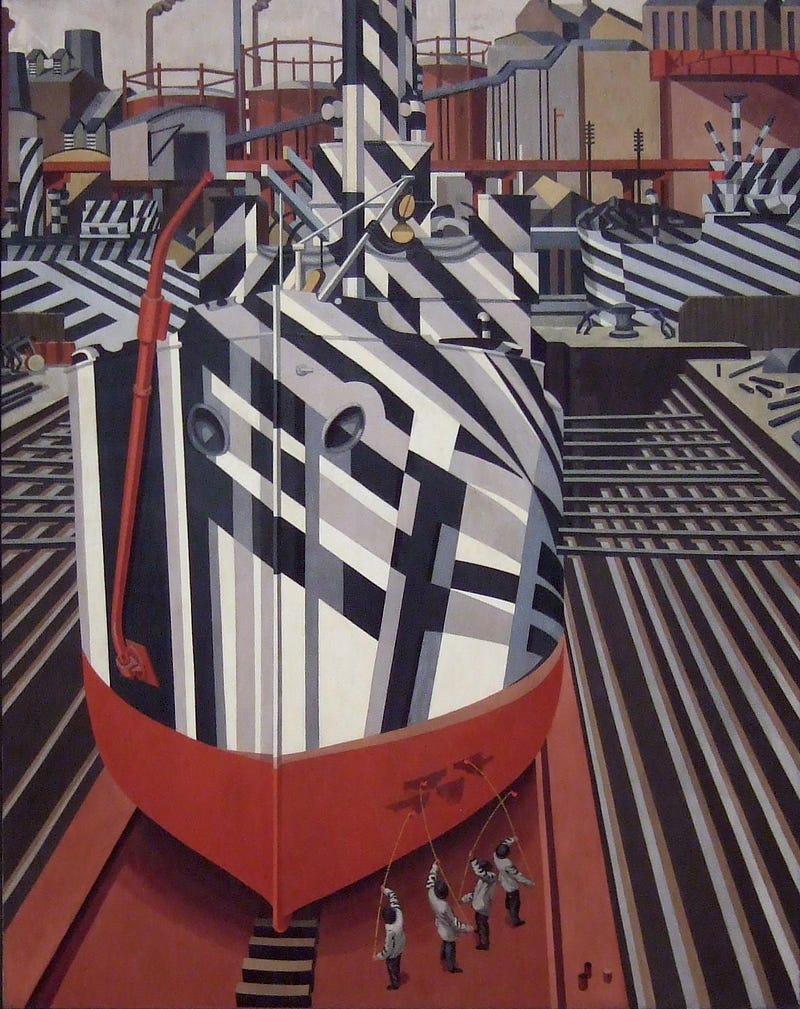
With his painting, Dazzleships in Drydock, Liverpool (1919), Edward Alexander Wandsworth, expresses the quintessential Vorticist ideal. This is a painting of a real ship, being painted with Vorticist designs, in an environment of beautiful mechanisms, with two other Dazzleships in the background.
In one respect, this is a realist painting, yet it has all the abstract appeal of a classic Vorticist work due to the choice of subject and composition. It’s visually unclear where the great ship ends and the dockside structures begin. Of course, the pattern shown on the ship is an abstract, so this may not be an abstract painting but it is a painting of an abstract. The ongoing cycle of art reflecting and affecting tangible reality continues...





_cropped.jpg)

