
The Failure of the Futurists
Are the Futurists of the past still relevant today? A brief overview of one of the most influential, and contentious, movements in Twentieth Century art.
In February 1909, the Italian Futurists published a provocative, iconoclastic, manifesto in several major newspapers, including Le Figaro. In it, founder F.T Marinetti (over)stated their philosophy and tenets. It was overtly fascist, pro-war, anti-feminist, and declared the belief of beauty in violence, aggression and strife. It was pro-industrial and proclaimed a passion for all things mechanical and powerful. They urged their potential followers to destroy the art of the past by actively flooding or burning down galleries and museums…
German philosopher Friedrich Nietzsche has been cited as a major influence on initial Futurist ideology, but was the manifesto what they truly believed or were they merely being provocative — perhaps a little of both?
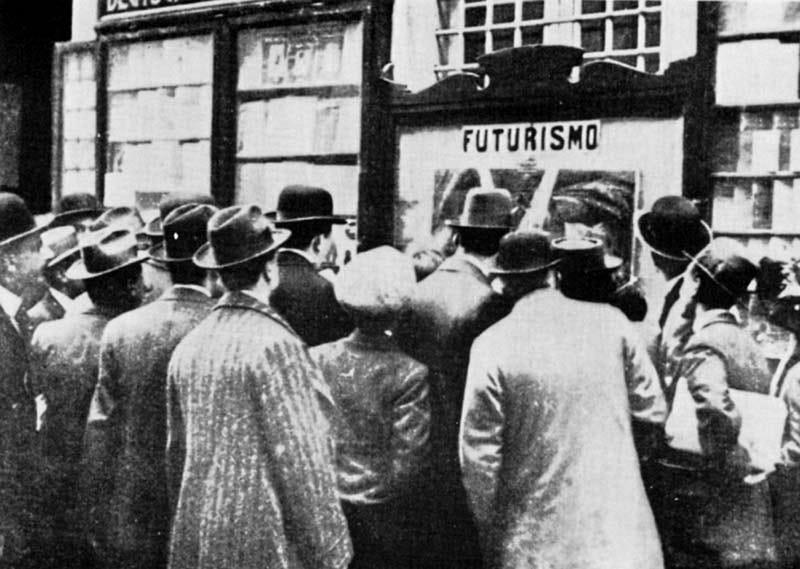
They also believed that art went beyond theory and aesthetics and should be an integral part of a holistic lifestyle to integrate the personal and the political, the individual and the nation. Their radical approach and constant self-publicity caused quite a stir and attracted much public interest. They also stated that the artists involved with Futurism should be ‘discarded’ within ten years and their art overturned by a new, equally passionate set of younger artists…
They thought that if this did not happen, they would have failed as agent-provocateurs. So it is perhaps unfortunate they are still one of the most important influences upon the art that was to follow and an essential entry in any histories of art.
It wasn’t that they were the first group of artists to issue a manifesto. I think that would be Die Brücke (The Bridge) in 1906. Though the Futurists were the first to use the idea of a manifesto as a work of art in itself. They were to publish many more on subjects such as painting, sculpture, architecture, music, fashion, food, theatre, cinema… including a Feminist Futurist Manifesto, written by the women Futurists, in response to some of the misogynist sentiments expressed by Marinetti. This indicates that the manifestos were not meant as dogma, but were intended to stimulate discussion and bring about change.
This makes them one of the earliest art movements to be consciously ‘Transmedia’, prepared to spread their works through the international Mass Media and express concepts across various formats. The recent term ‘Hype Art’ could also be applied to their provocative approaches. In this way they prefigure many other important art movements, such as the Manifesto of Surrealism, published by André Breton in 1924 and, much later, the founding manifesto of the Situationist International, in 1957.
In the following article, I have selected a handful of key-works that exemplify the development of some important Futurist ideas. It becomes clear that, although one may be uncomfortable with many of their associations, the Futurists were a radical movement and an important influence on the evolution of western art.
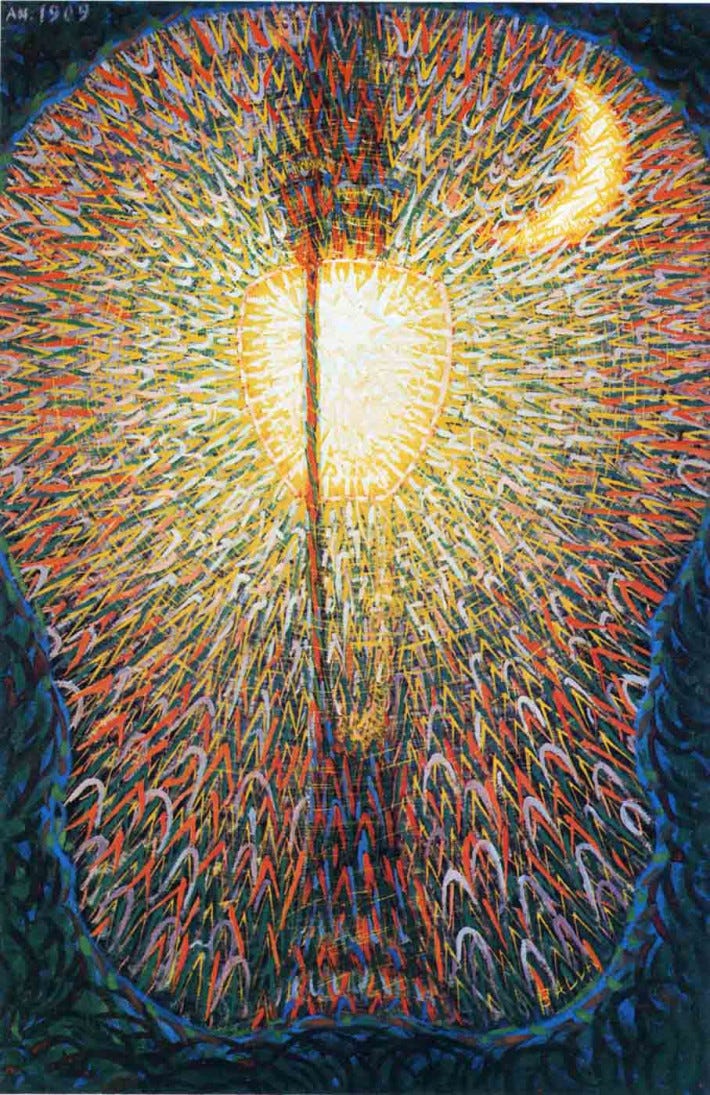
To the Futurists, everything could be an expression of energy and all things had a dynamism, whether they were in motion or not…
Above, we have a composition that may have been influenced by Wassily Kandinsky and Paul Klee. The electric, artificial light outshines that of the moon indicating a belief in science before sentimentality.
The light is shown using energetic, short flecks of colour that begin in the white of the lamp and split into the prismatic colours of the spectrum and eventually to black — a visualisation of the scientific composition of light, indicating that the beauty of the universe is revealed through knowledge and understanding.
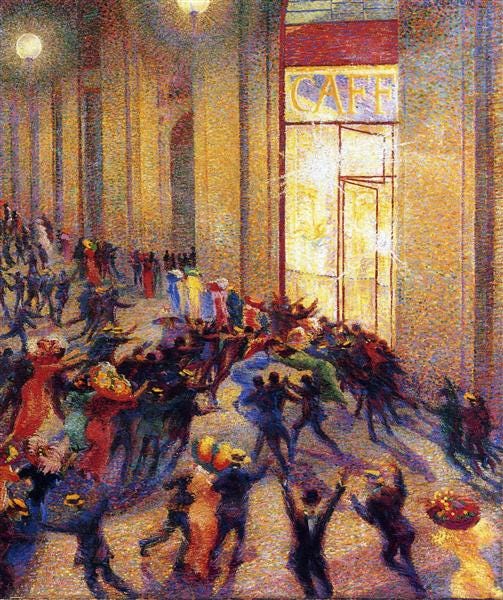
Futurists proclaimed beauty in violence.
A heavy influence from the Post-Impressionists can be seen in this Fauvist approach to Pointillism. This ‘grainy film’ feel and the elevated point of view was unusual for the time and gives a feeling of news reportage to the image.
The scene is bright, energetic and confused between violence and choreography: in many ways this looks as much like a carnival as a riot, and embodies the Futurist’s concept of ‘beautiful violence’. Chances are, such a concept detaches itself from the art and elicits both an emotional and intellectual response when considered?
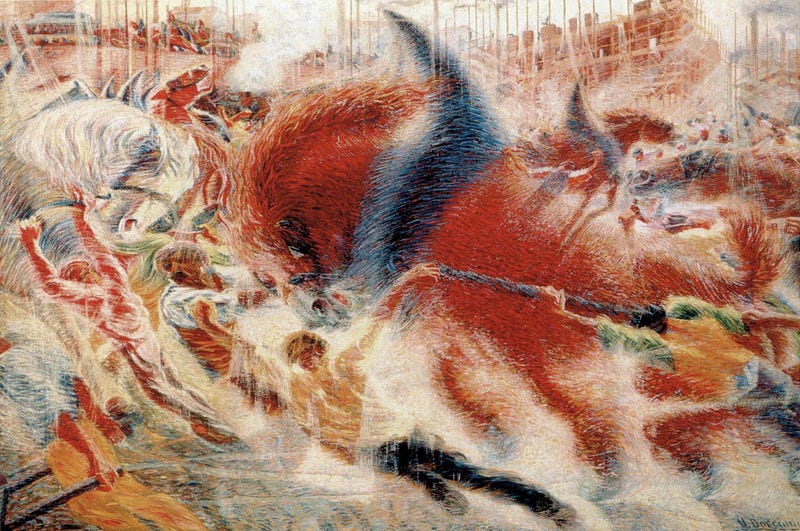
Clear away the old to make way for the new: demolish towns and build the mega-cities.
This is an energetic and dreamlike painting that could almost be Surrealist. The blues and reds swirl in smoky vortexes. The painting has the initial impact of an abstract, then we see powerful workhorses and expressively posed figures emerge from the cloud-like composition.
Above, the glorious industrial city dominates the scene. The harnesses of the horses resemble wings, referencing Pegasus of Greek myth and aligning this ‘heroic’ work with a Romantic tradition… The hard labour of visionaries results in the building of the Modern metropolis and heralds a new age.
The Futurists believed that the growth of cities was both unavoidable and desirable. They also proposed that cities should be planned and built anew, rather than growing in a chaotic process. Old towns should be cleared to make way for the new cities that would bring people together and so speed up progress.
To the Futurists, cities were where things happened: there were enough people to perpetuate culture and pool scientific ideas, and enough (heroic) manpower to put new ideas into practice. Cities were thought of like huge machines in which we became components, all working together to generate the future…
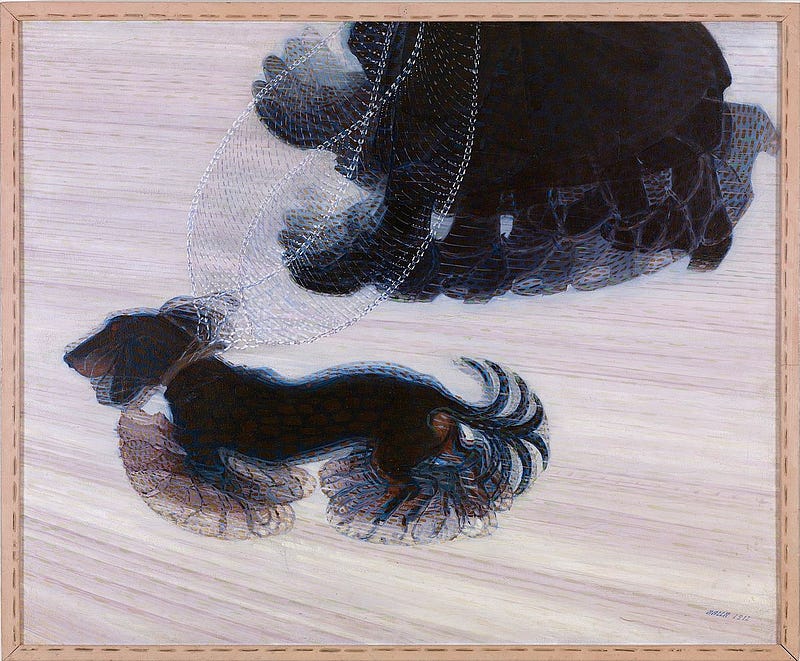
A dog in motion is as thrilling as a speeding automobile.
As Cubists showed subjects from multiple viewpoints, the Futurists often showed subjects in multiple moments. In the same way that we know a 3D object from different angles, so we also see things in motion. Attempting to show movement and the dynamism of forms was thought to be more real, and revealing, than the familiar photo-real ‘freeze-frame’ style painting. This approach also led to Futurist experiments with photography, using multiple exposures and blurring of movement…
This painting also has a lot of humour and is an early hint that Futurists were not as bleak and extreme as their first manifesto might imply. Their outrageous statements could be understood as an extension of Dada concepts and many of the founding Futurists looked to artists like Marcel Duchamp, Pablo Picasso and Francis Picabia for models of radical art. The fascination with dynamism was something picked up from works such as Duchamp’s Coffee Mill (1911) and Nude Descending a Staircase (1912).
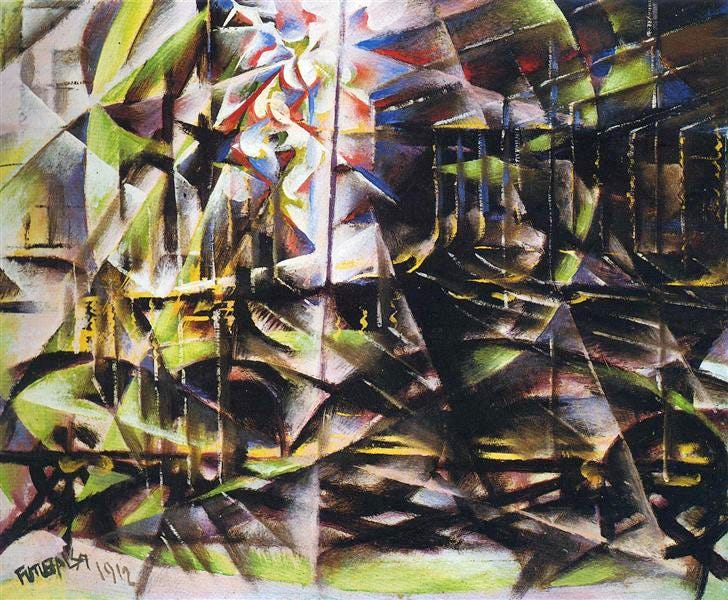
An ode to motor cars and machine guns.
Their love of speed and theories on dynamism led to paintings that looked and ‘felt’ like abstract expressionism. The Futurists thought that a speeding automobile was more beautiful than a Classical Greek statue (such as Winged Nike aka Victory of Samothrace) and the rhythm of a machine gun could stir the human spirit more than any great symphony. They even went as far to suggest that a car crash had theatrical beauty and a twisted wreck had sculptural merit.
Here we are presented with a fragmented view of a street as seen from inside a fast car as it rounds a bend. At the same time we see aspects of the vehicle itself as if we are a slow pedestrian watching it speed past. This fusion of street and car is painted in bands that imply the compression of sound known as the Doppler Effect. The excitement of speeding through a city requires more than just the car, there also has to be the infrastructure of the city and the road…
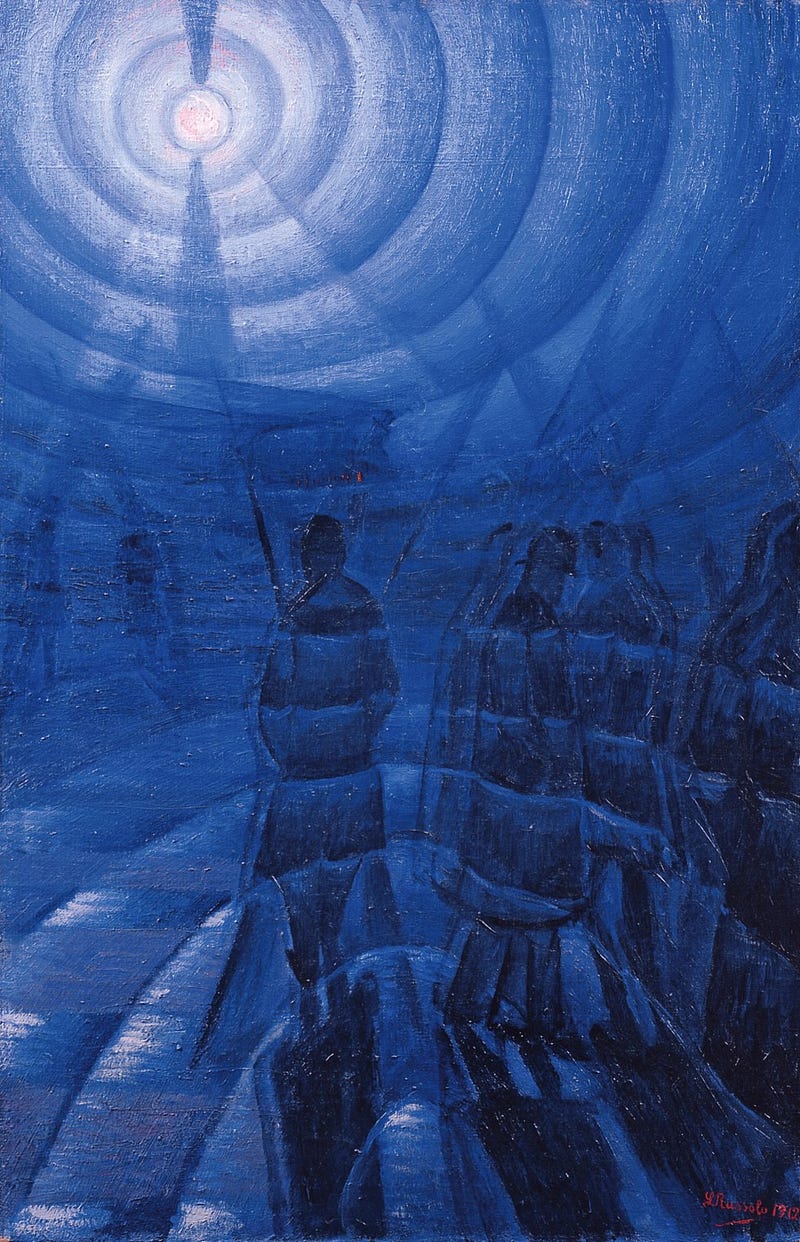
There are no empty spaces in the city.
This evocative and complex painting is Impressionist in that it conveys the feeling of being on a cold street in thick fog that blurs light and muffles sound. It also depicts negative space as positive form…
Fog fills the spaces between buildings making this ‘negative’ space visible and can make solid forms appear less substantial whilst giving form and apparent substance to light and shadow. This effect echoes the approach of the Cubists in their attempt to render negative space with the same integrity as positive form. Fog also swirls and eddies around movement in an expression of dynamism.
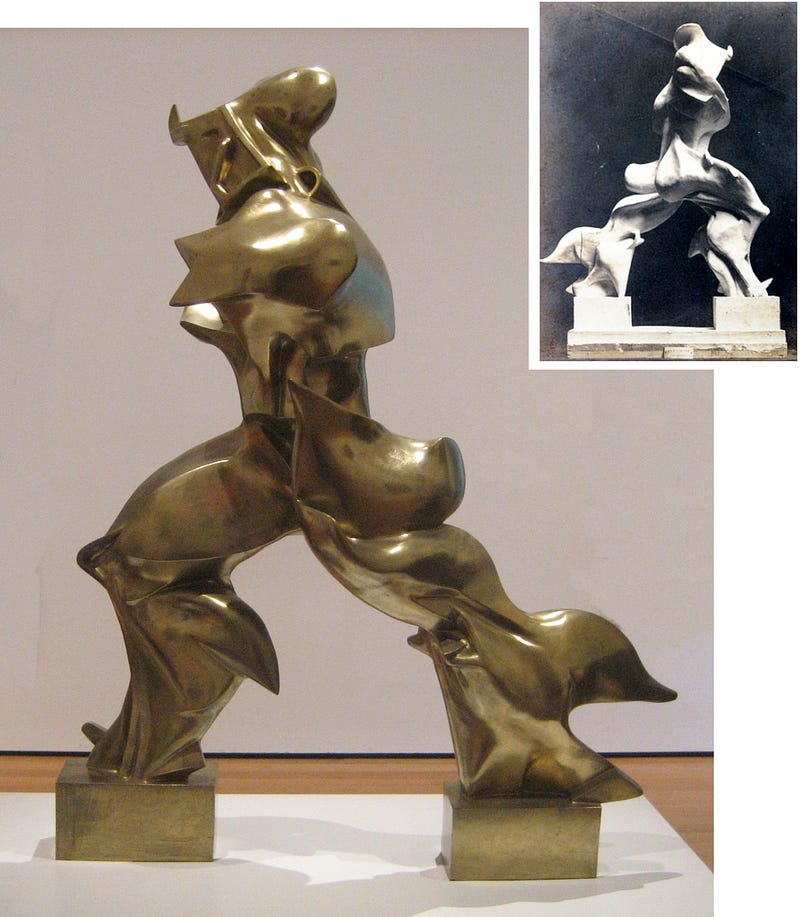
This art is no longer relevant.
A most striking sculpture! This humanoid figure strides powerfully forward to meet, greet and create the future. The Futurists admired the Cubist technique of showing the human form from different angles, and were hugely influenced by the dynamism in paintings by Marcel Duchamp, such as his aforementioned Nude Descending a Staircase series. They intended to take this further, to flay and lay open the human body and its processes.
This piece also includes elements that look like armour, or components of a robot: a fusion of man and machine, metal and flesh. It looks monstrous and unstoppable, possessing a terrible beauty. The sculpture also lifts the approach of Cubist painting off the canvas and back into the realm of 3D, bringing the concept around ‘full-circle’…
Bronze casts made in 1931 were finished by polishing, giving the piece a sleek, gleaming, ‘futuristic’ look. The inset in the above image is a newspaper photograph of the original 1913 version, carved in plaster. This is one of the few of Boccioni’s sculptures to be cast in bronze. He worked mainly in plaster because he believed that art should be temporary and would not have any lasting appeal to the next generation of radical artists.
This is one of the most important works in the development of figurative sculpture and although it is not a large piece (112 cm tall), it is a powerful one that dominates any space in which it is exhibited.
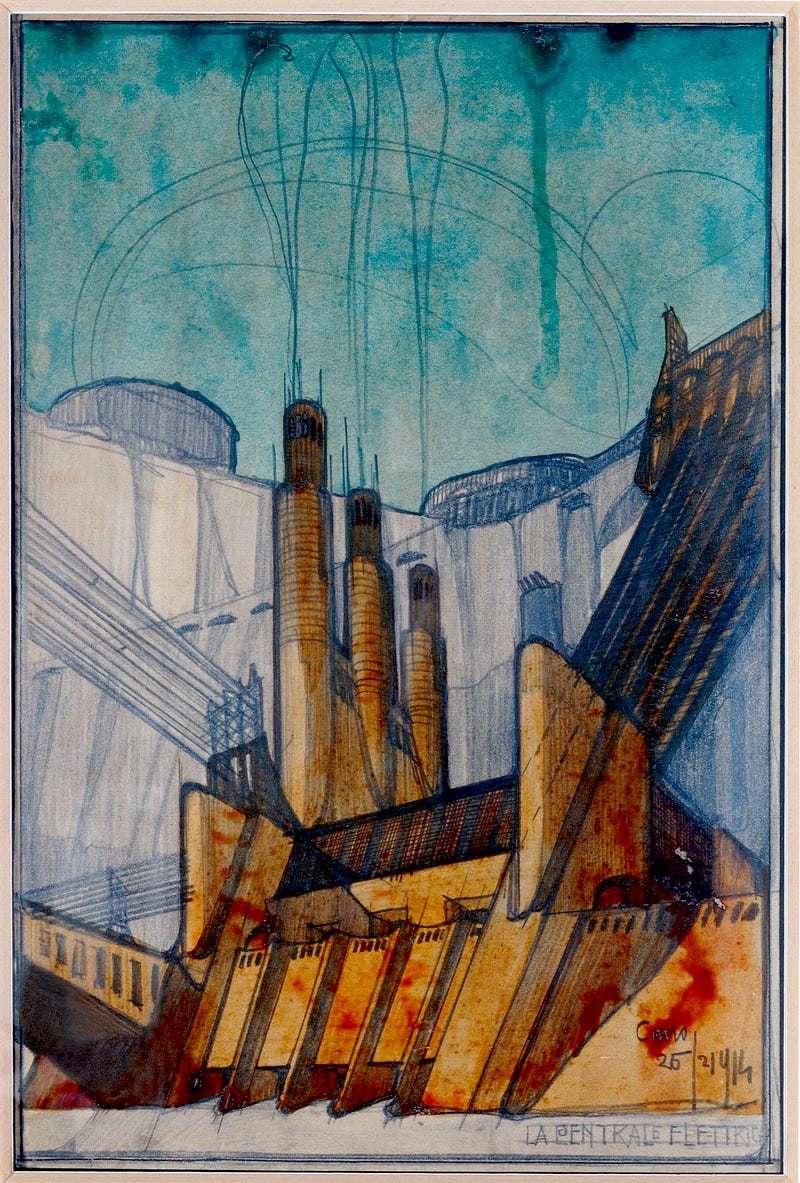
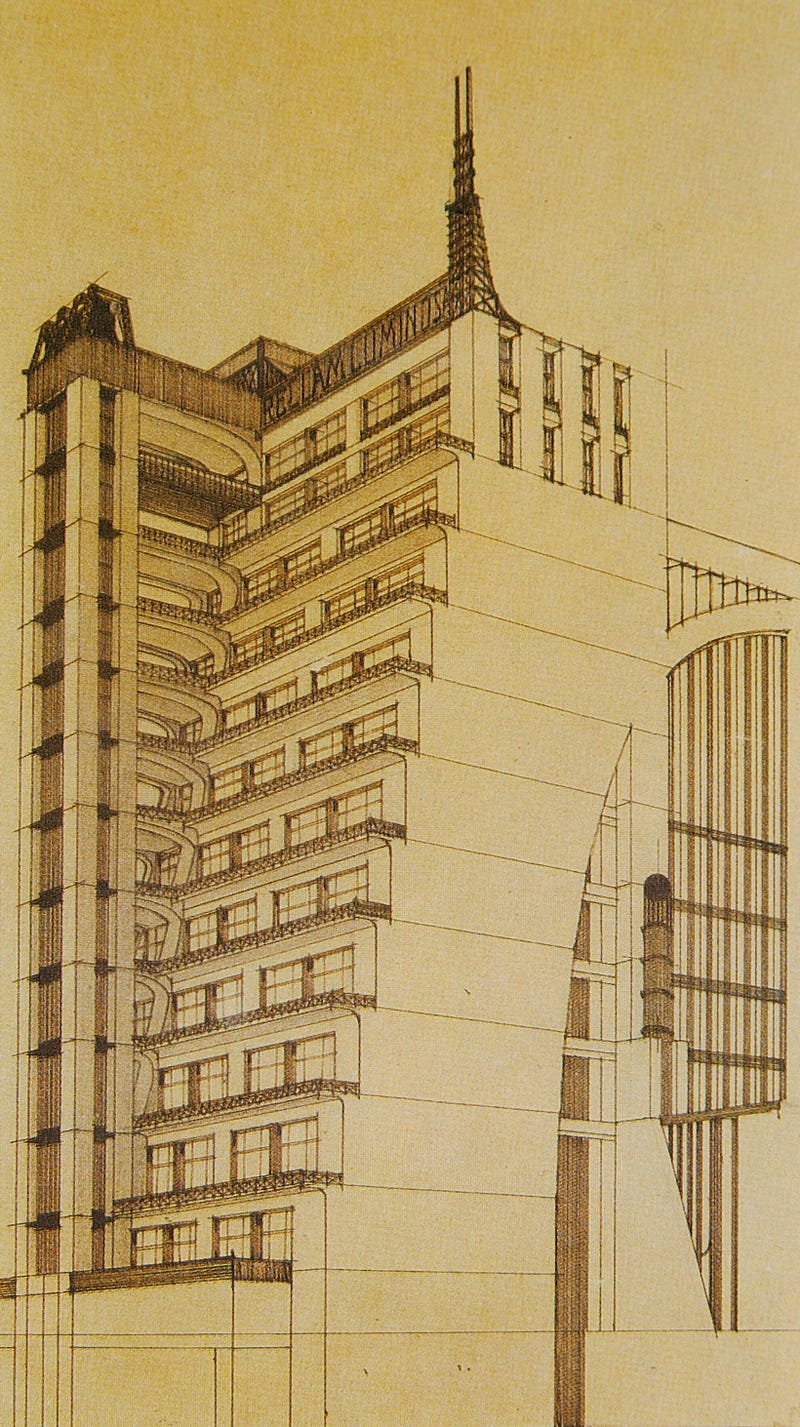
The future is a city...
These architectural drawings expressed a concept central to Futurism. The power station would be the heart of the city, pumping energy through a network of cables. Such power stations would be on a grand scale, ‘cathedrals’ to modern industry, supplying the huge amounts of energy needed to drive the factories and power the systems of the city such as trams and trains, elevators, household appliances, lighting, and so on…
The Futurists claimed that concrete was beautiful and that rivers should be harnessed or paved over. Forests, they said, should be cleared to make way for cities and factories. These designs remained largely conceptual and never saw construction.

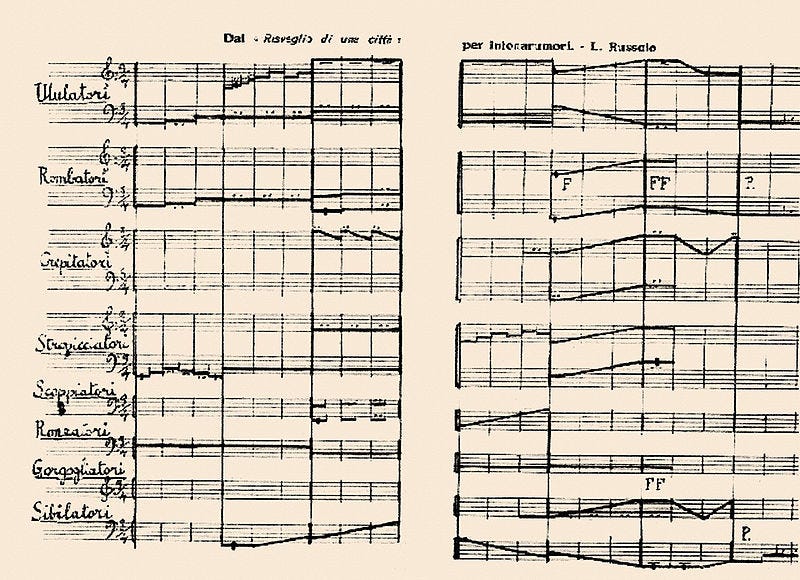
Seeking new sounds and a new form of beauty.
The Intonarumori were ‘noise machines’ and were used to perform specially composed music to express the ‘Art of Noises’. Each box contained different mechanisms for making and controlling sound and were showcased in concert at the London Coliseum in 1914. The set-up looked like a cubist sculptural installation and in combining this with sound composition, sound-sculpture found its early Modern from.
The futurists also developed a kind of musical notation for playing these machines that was based on line, this meant that the ‘score’ was also a drawing and that drawings, and any visual material with definite lines could be ‘played’ as music…
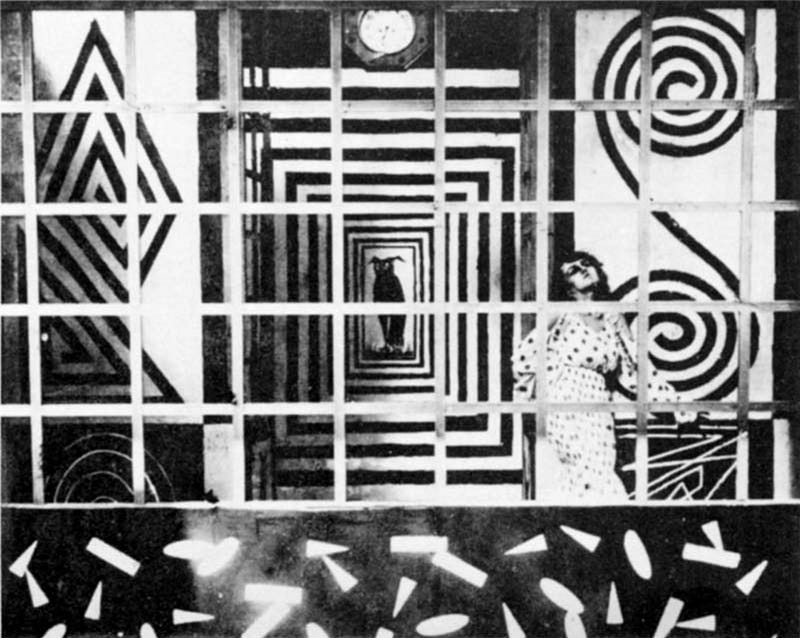
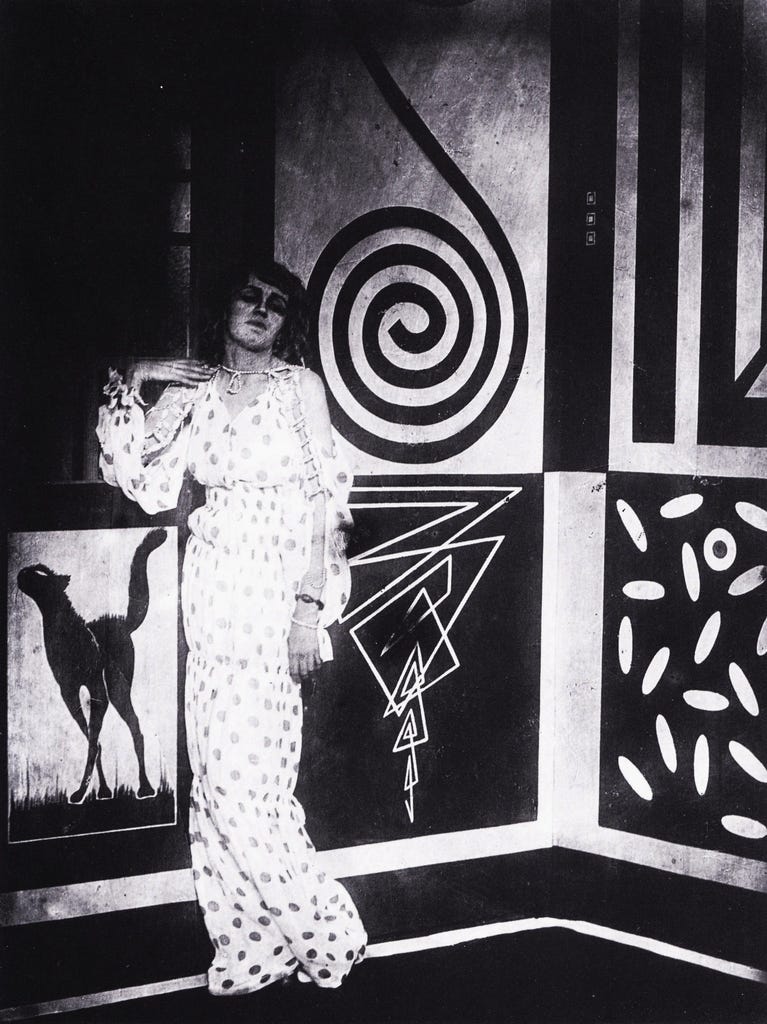
The only true art is polyexpressive!
Photography was a perfect medium for capturing dynamism of movement by the use of various techniques, such as long exposure and multiple exposures, plus the ability to create photo-montage in the darkroom. The Futurists embraced new materials and processes and condemned other Modernists for being slow to respond to modern techniques such as photography and film-making.
Bragaglia experimented with photography, theatre and film. Thais (1914–16) was a film that combined live action and sculptural sets by fellow Futurist and experimental photographer, Enrico Prampolini, featuring strong black and white spiral forms and corridor-like backdrops representing the narrative structure of film and, of course, of much of life. There were also key scenes filmed through regular and irregular grids, expressing order and chaos appropriate to the story about the rise and eventual downfall of the eponymous femme fatale character.
Bragaglia also collaborated with other Futurists on a group film, Vita Futurista (1916), in which various artists wrote, designed, directed (or in some way contributed to) a compendium of often surreal episodes. They were the first art movement to use film so prominently and thus invented the ‘art-film’ as a genre.
The Futurists thought that the new medium of cinema had the potential to be the most powerful medium for modern art and what they termed ‘polyexpressiveness’. After all, film combines nearly all other art forms, being a synthesis of literature, drama, performance, painting, sculpture, environment, installation, fashion, photography, dynamism and of course, the actual passage of time makes it a 4D medium.
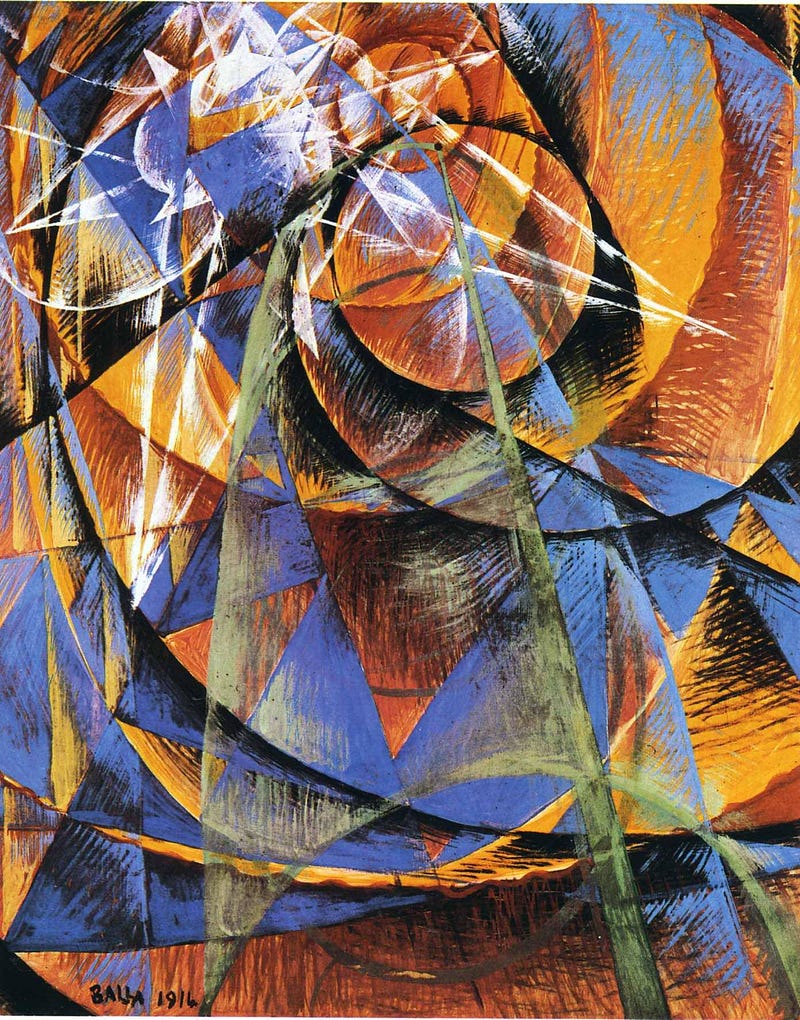
We are all energised by the cosmos.
This abstract composition is inspired by the scientific wonders of the universe. It represents a cosmic event and rejoices in the extreme speeds and energies at work in our solar system.
Everything is filled with energy and dynamism, even as we sit still, we are whizzing through space on a giant spinning ball! The Futurists wanted to energise people out of lethargy and into action! Strong influences from Pablo Picasso and Paul Klee can be seen here.
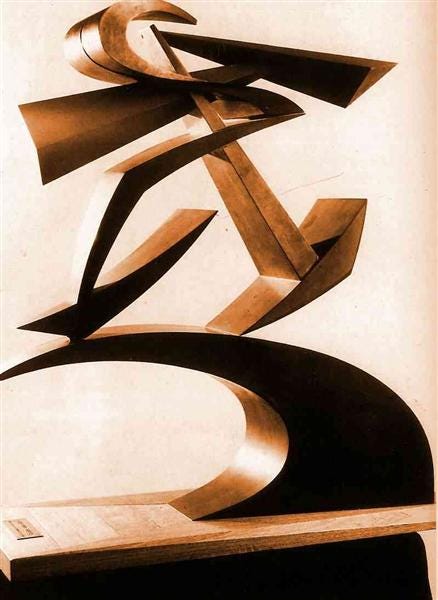
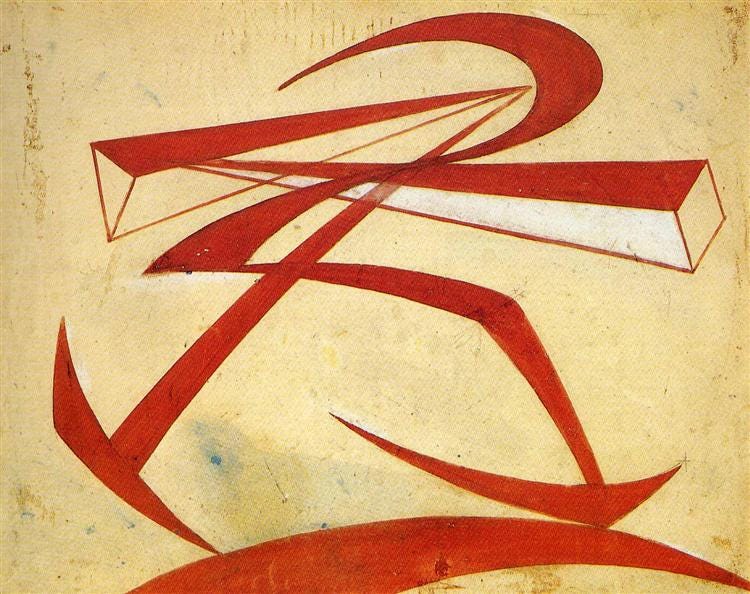
Make a fist, strike a blow for the future!
Futurist sculpture was typically dynamic and solid. Hefty forms that also gave the impression of potential energy and movement, as if the forms possessed some sort of pent-up power that could be released at any moment.
This sculpture uses the negative space under the wave-like curve to create a tension that appears to be sprung. Here the artist’s hand is a metaphor for the power to change: the hammer-like representation of Boccioni’s fist about to strike, indicating that the hand of the artist embodied such power and the results of its movement — which could create paintings or sculptures — could have a great social impact. This is one of the earliest works of abstract sculpture and was hugely influential.
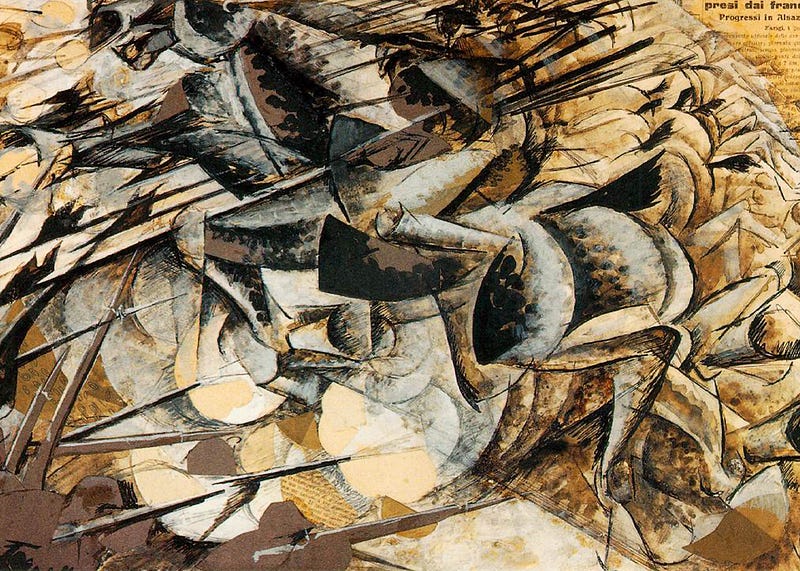
We can be heroes?
This is a highly dynamic painting that borrows heavily from the approaches of Duchamp and Picasso. The use of newspaper, collaged into the composition, aligns it with Dada as well as giving it an ‘of-the-moment’ feeling of relevance.
The scene is one of immense power as the attacking horses fragment with the speed of their charge, pushing the infantry back, crushing them into the bottom corner of the frame. Both sides are depicted as heroic paradigms: the overwhelming, decisive dominance of the lancers and the futile bravery of the foot-soldiers facing defeat.
A Futurist manifesto refers to war as the ‘hygiene of the world,’ an idea that probably stemmed from the writings of Friedrich Nietzsche. They saw battle as something beautiful and a necessary element of humanity, giving men the chance to be courageous, valiant, noble. They also thought that war cleansed the world of the weak, brought about rapid change and and made way for progress.
Conversely, they also believed that fighting against insurmountable odds, and loosing, was just as beautiful and in one way more heroic. This aligned them with ideals shared by the Romantics. For all the blunt polemic of the Futurist manifestos, they were a highly contradictory movement!
Marinetti and many of his fellow Futurists adhered to their principals and volunteered for active service in the First World War, fighting in the Italian services for the allied forces. In 1918, he founded the Futurist Political Party (after writing its manifesto, of course) which officially merged with Benito Mussolini’s party the following year.
Certainly in its early days, Marinetti was vociferous in his support of the Italian Fascist Party. He later rejected their ideology as ‘reactionary’ and far too ‘traditionalist’, and the Futurists continued to encompass diverse political views with its socialist, communist, anti-fascist and anarchist activists, all of whom contributed to manifestos!
Things began to change when Mussolini’s government became ever more right-wing and eventually imported the ideology of ‘degenerate art’ from Nazi Germany in the late 1930s and condemned all Modern Art. Many artists in Italy fell in line with the new oppressive regime in order to continue their work and some ceased to practice publicly. So, after enjoying more than 20 years of celebrity, the Italian Futurists were defeated by the totalitarian regime they helped to establish. Due to their alignment with fascist ideology, the art movement never found favour again after the Second World War.
We may never know for sure, but I like to think that, just maybe, the Futurists had proposed some of their more extreme views in the hope of provoking outrage and opposition. Were they playing Devil’s advocate? Were they disgusted when the society around them readily accepted their blatantly right-leaning polemic and populist propaganda?
The chilling thing, though, is nowadays the same populist approach has been embraced and deliberately deployed by politicians the world over… and sadly, a century later, society still seems none the wiser.
…and to play us out, a demonstration of Luigi Russolo’s Intonarumoris, replicas in a 2012 exhibition at the Museu Coleção Berardo, Lisbon:


![2 ]](https://commons.wikimedia.org/wiki/File:Santelia02.jpg)


