
More Human than Human?
At the dawn of the Classical period, looking more closely at ourselves changed the way we saw others and how we understood our place in the universe.
More than eight centuries after the reign of the Ancient Egyptian Pharaoh Akhenaten, as the late Archaic period blurs into the early Classical, we see signs that artists, particularly sculptors, are once again beginning to really look at the world around them and reflect what they observe.
The use of portraits could be found on mummy cases of the Greco-Egyptian period but these are highly stylised. One artefact has been found that literally embodies a radical new way, not only of observing from life, but in the understanding of life.
Kritios Ephebe aka The Kritian Boy (circa 480 BCE)
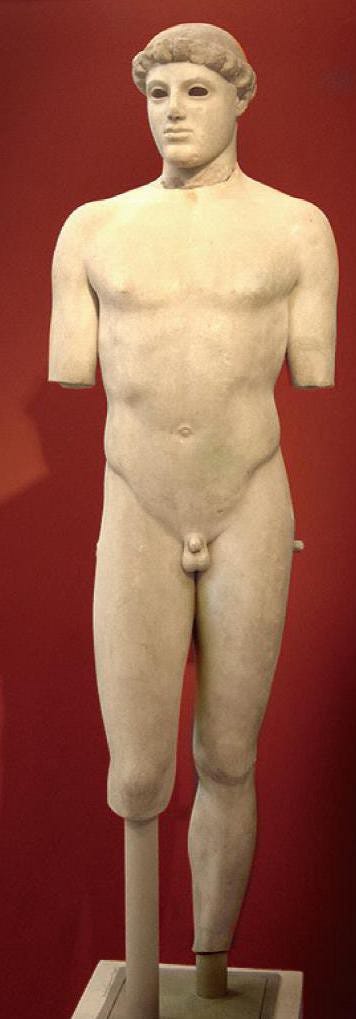
The Kritian Boy, is so named because some scholars attribute it to the sculptor Kritios, due to its resemblance to other works by him and his students.
Remarkable in its naturalistic, anatomical accuracy, this scaled-down statuette (around a metre tall) shows a significant and sudden shift in the way that the human body is represented and is the earliest surviving example of anatomically accurate sculpture created from careful and direct observation of a real subject.
Skillfully carved from white marble, it demonstrates a good knowledge, not only of the surface but also of the underlying skeleton and mechanics, of the body. All the major muscle groups are represented, correctly proportioned and the stance is a realistic, weight bearing one.
This marks the dawn of Humanism in art.
The Riace Warriors (circa 450 BCE)
With the Riace Warriors, a set of two Classical bronze figures attributed to the great Greek sculptor Phideas, sculpture becomes fluid, well-observed and technically ambitious. These soldiers are cast in bronze yet stand in casual, naturalistic poses. Their hard metal surface is sensitively cast to imply the elasticity of flesh.
These game-changing statues are beginning to challenge the boundary between humans and the gods. Though stunningly realistic compared to anything that precedes them, the proportioning appears to have been idealised because the soldier’s are a little too symmetrical and have legs equal in length to their torsos — an unusual attribute in reality — and some of the muscle groups, though accurate in size and position, are unrealistically tense or relaxed for the pose in order to define them more clearly. There was a prominent concept in the Ancient Greek psyche that the gods were perfect beings, and so the closer we could get to perfection, the closer we were to becoming gods ourselves.
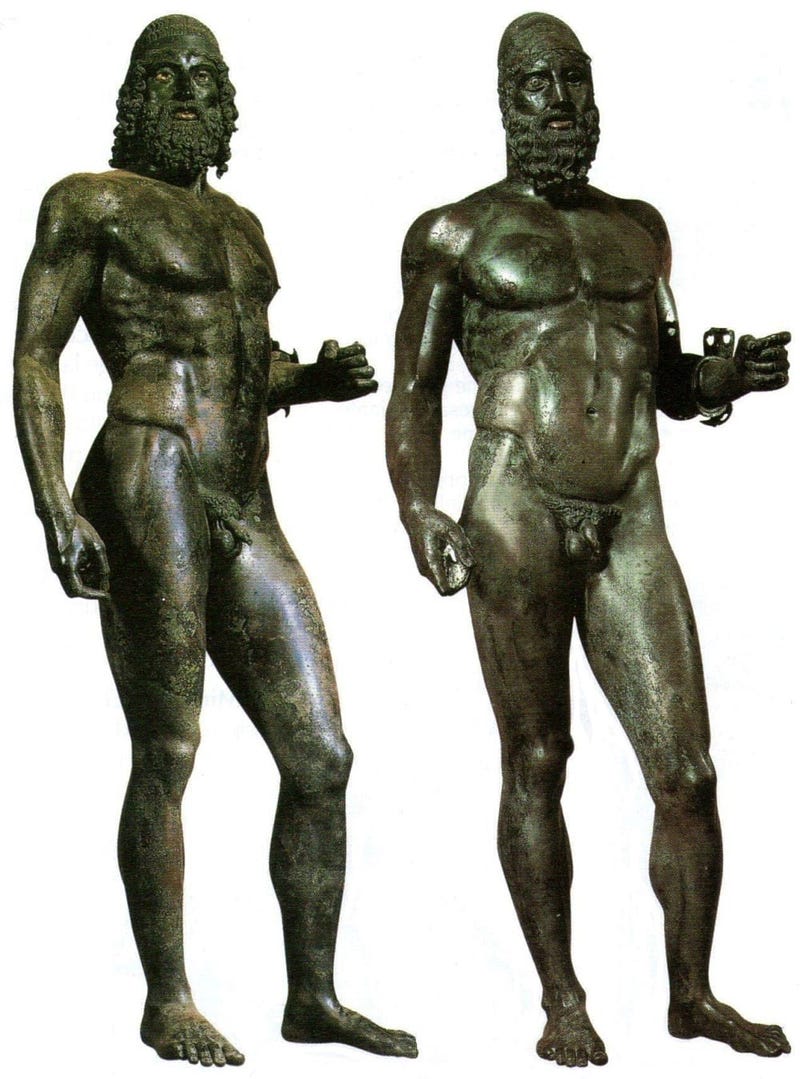
There was an established order of proportioning used in ancient Greek figurative art, probably extended from the figure grids of the ancient Egyptians, from whom the Greeks learned their techniques for colossal sculptures and great temples. Whereas the Kritian Boy was a miniature, the Riace Warriors are proportioned as heroes and are taller than the average man. We know they are warriors because they would have originally held spears and shields and it’s thought that these statues were made to commemorate the Greek victory over the Persians in 480 BCE.
Statues and images of warriors from earlier cultures were nearly always in an action pose holding their weapons of choice, either striking with a sword or in the motion of throwing their spear. Egyptians shown in battle often stood on the vanquished with a club raised ready to stove in their heads. With the Riace Warriors their casual, relaxed stance (contrapposto), along with being nude apart from their helmets, may seem at odds with being warriors. This implies that it’s their human qualities, not their aggression that is being celebrated.
Also, many soldiers of this early period would have gone into battle naked. This was for very good reasons. Some groups of soldiers, such as the elite Hoplites of the Spartans, did sometimes wear very heavy armour. Armour slowed the wearer down and wasn’t actually that effective at protecting them in combat. Most soldiers couldn’t afford armour, and also wanted the speed and freedom of movement in battle, relying only on a shield for protection. In addition to this practical consideration, they also knew that clothing could be a bad thing if the person was injured.
They probably didn’t understand the reasons as we do today, but ancient Greek soldiers would wash their bodies and hair thoroughly before battle. They had observed that anyone injured in battle that wasn’t clean, or who wore clothing, later suffered from infections and was more likely to die from their wounds. It seems that this new idea of careful observation and interest in the human body was paying off in other areas as well as art…
The Classical Period of ancient Greece saw a great many hugely significant changes in the way humans saw their world and thought about themselves.
The key idea being Humanism.
Much of Classical achievement had been hinted at during the heyday of the ancient Egyptians, but it was around 490 BCE, after the Greeks first defeated the mighty Persians at the famous battle of Marathon, that the Classical period begins. This battle indicated a very strong rejection of everything that Persia represented, including religion based on superstition and totalitarian rule by a ‘divine’ king — Darius at the time. The Athenian Greeks led by Callimachus were outnumbered three to one, yet stood successfully against this Persian onslaught. They also out-thought the tactics of the aggressors and after victory at Marathon quick-marched back to Athens to successfully repel another ‘surprise’ attack on their home city.
A decade later, another Persian invasion was successfully defeated, mainly due to the famous stand of just 300 Spartans, led by Leonidas against huge numbers of at least 100,000, though possibly three times that, at the battle of Thermopylae. This time the vast Persian army was actually led into battle by their ‘divine’ king, then Xerxes, who was accompanied by his so called ‘10,000 Immortals’, who were an elite ‘royal guard’. Although the Spartans were (not surprisingly) defeated at this battle, they managed to kill quite a number of the ‘10,000 Immortals’, proving them not to be — immortal, that is. The 300 stood their ground long enough against such insurmountable odds that their profound heroism achieved two really important results.
One was that faith in the superstitious religion and godlike powers of Xerxes were shaken to their core, causing many of the vast Persian numbers, who were made up of soldiers from conquered nations, to desert the army and some to actually turn against their oppressors.
The second significant result was that this damage to the Persian invasion plan allowed other Greek communities time to unify, thus forging the much greater solidarity that led to Classical Greek society.
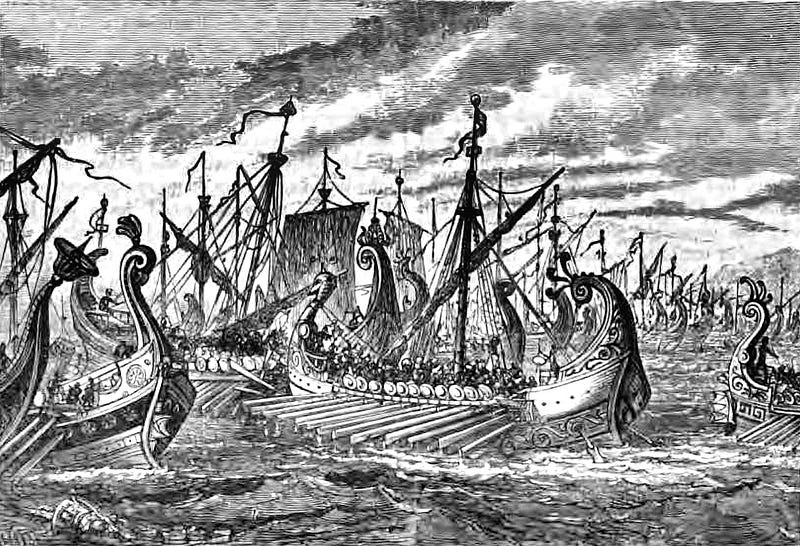
The allied forces of ‘free Greeks’ finally defeated Xerxes and ended the Persian invasion at the naval battle of Salamis where relatively few Greek ships completely devastated the superior numbers of the Persian armada. With the Persian navy destroyed the elite Persian troops stationed on the small island of Psyttelea were stranded and proved no match for the allied Greeks. This was one of the most significant moments in Western history… A barbarian horde led by a despot who ruled by force and fear was defeated and a union of free states was formed.
Modern European culture, indeed Western culture, started here.
The importance in this shift of power and change in thinking cannot be overstated. Among the many radical innovations of the Classical Greeks were:
Democracy — before this, no one thought of asking ‘the people’ what they thought about anything. The king or priests, or divine king, made the decisions and if you disagreed, generally you faced exile or execution. Now there is a senate instead of any over-all king, and important decisions are put to the vote of people whom those decisions may affect. Sure, they only allowed educated men over the age of 40 to vote, but even that was such a huge development and came ‘out of nowhere’. Probably this was a direct result of power sharing between the new union of free states formed after the defeat of Xerxes.
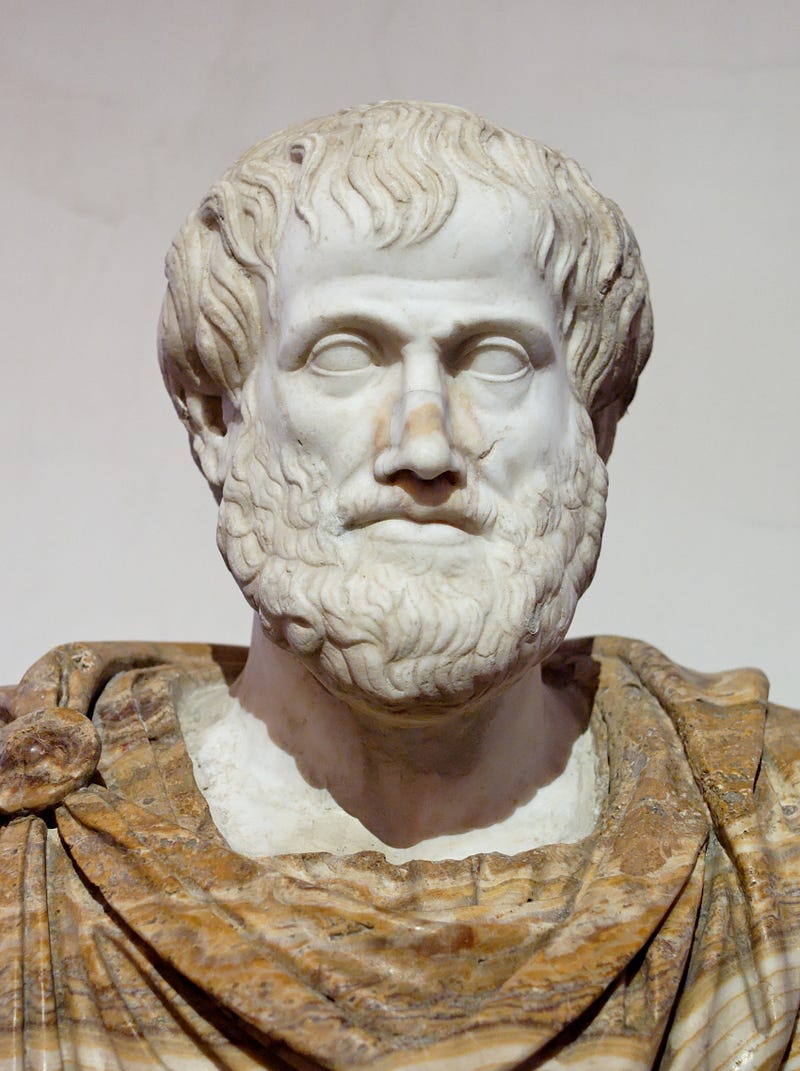
Science — The ancient Egyptians had used observation, mathematics and reason to work out lots of things (they had calculated the circumference of the earth, for example, and knew that there was a tilt in its orbit) but it was Aristotle, along with Pythagoras and Plato, who introduced the scientific methods that we still employ today. The branch of science where a theorem is proposed and then an experiment devised to attempt to prove or disprove that theorem is called ‘Aristotelian Method’.
Medicine — Humanism led to a revolutionary idea that if someone was ill, you treated them according to their illness. The patient was considered, the symptoms observed and then a treatment applied. Hippocrates was seen as the ‘father of medicine’ and that is why, today, anyone qualifying to be a doctor takes the ‘Hippocratic Oath’.
Philosophy — the Classical Greeks saw this as the most important of ‘the arts’ and from which all the others were derived. The arts were perceived to be of two orders. The first order were the liberal arts of grammar, logic, rhetoric, geometry, arithmetic, astronomy, music and philosophy — including the philosophy of aesthetics. The second, and considered lesser, order of arts were the technical arts of architecture, agriculture, painting, sculpture and other manual crafts.
Although the Greeks defined these different areas of arts and sciences, they also knew them to be interdependent and all embodied in us, either physically or intellectually.
We became the centre of our universe: we can only experience, understand and create from a human point of view.
Much of the art of Classical culture reflects this human focus and demonstrates a very high level of aesthetic refinement that was to influence all Western arts until the present day.
*All images used here for educational purposes under fair usage policy.
A version of this article was first published in my book Evolution of Western Art (questing beast books, 2012)


