
We Are the Golden Rule
Nearly all High Renaissance architecture, statuary and paintings was set out according to the Golden Section, embodied in Leonardo da Vinci’s ‘Vitruvian Man’.
In his sketch of the Vitruvian Man (circa 1490) and its accompanying annotation, Leonardo (di ser Piero) da Vinci expresses the kernel of Renaissance aesthetic and the ideal of the ‘Golden Ratio’. The title refers to the classical Roman architect, Vitruvius, who devised the system of proportions according to measurements of the human form that led to the shape of the classical ‘Roman Arch’, famously seen as a repeated motif in the Coliseum of Rome. This system was based on several observations regarding the human form:
- The height of a human body is equal to the span of its outstretched arms.
- The curve formed by bringing the outstretched arms up to meet each other without, bending the elbows, creates a semi-circular arc.
- The hands and feet may be placed equidistant to imply a square.
- This square topped by the semi-circle of the arms makes a pleasing and, more importantly, load-bearing structure in the form of the arch.
This is a clear expression of Humanism in practice.
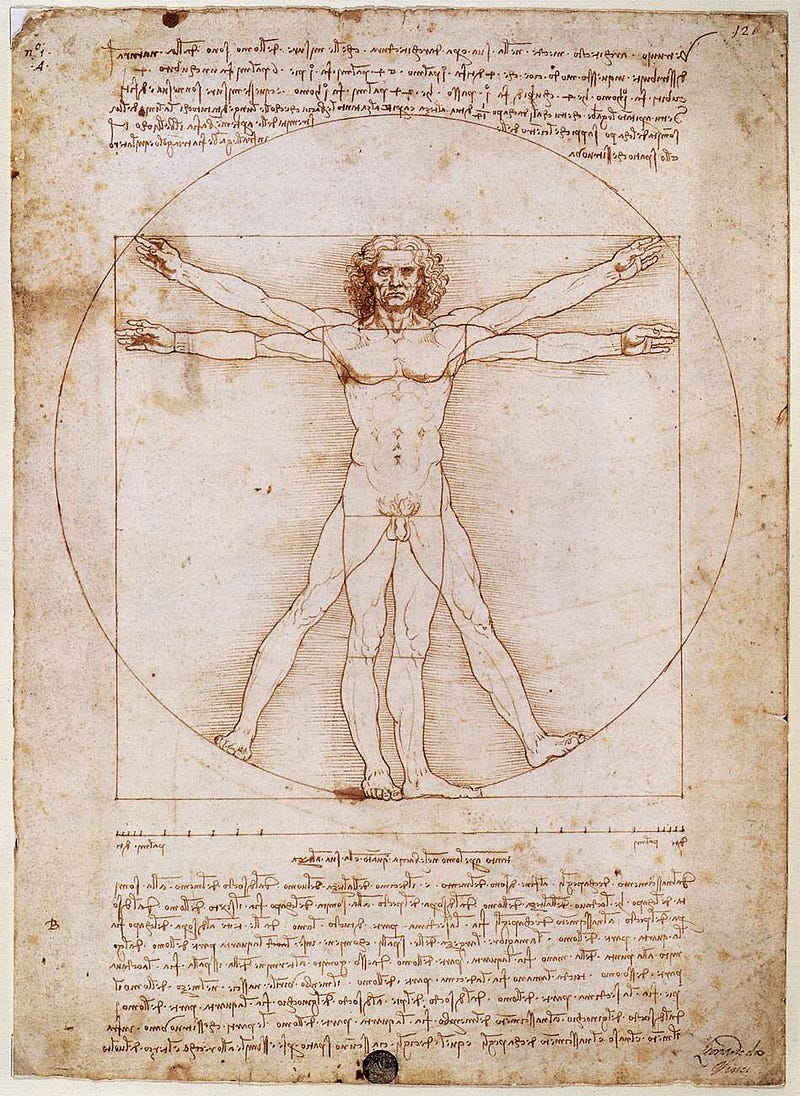
The scholars of the Renaissance, of whom Leonardo was the leading example, took these observations a step further and saw in the proportions of the human form a perfect and repeated expression of the ‘Golden Ratio’, an idea originally expressed by the Classical Greek mathematician Euclid and taken further by the thirteenth century Italian mathematician known as Fibonacci who observed this ratio throughout nature.
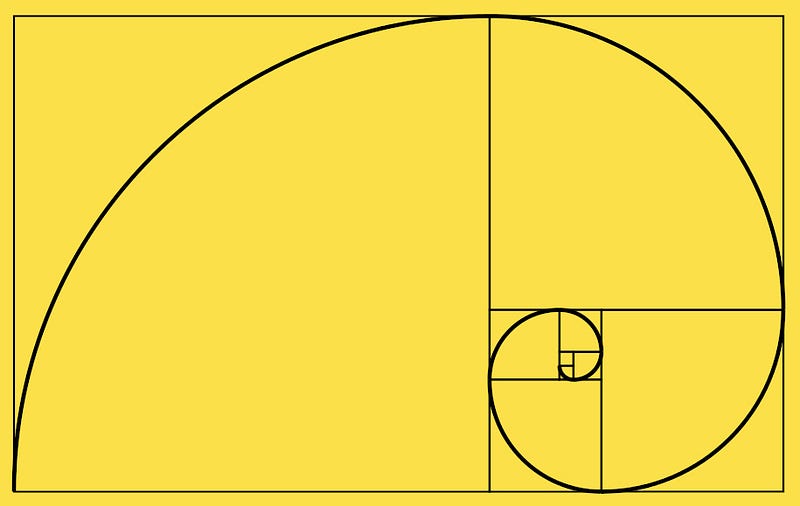
The Golden Ratio is a proportion of a whole created by dividing a total by the formula Φ (phi). Basically, if the whole is taken as 100, then the golden ratio pans out at 38:62. This is almost, but not quite, a rule of thirds.
Many theologians believed that in the Golden Ratio they had found part of the secret code of God’s creation. Renaissance artists saw a universal constant that gave things a pleasing harmony and began to use the Golden Ratio, also called Golden Section, to divide and balance their compositions.
Nearly all High Renaissance architecture, statuary and paintings were set out according to the Golden Section. The size and shape of canvases were ruled by this proportioning as were the formal elements they contained. This rule was taught in all professional workshops and art schools and persisted unbroken in the western tradition until the dawn of Modernism. Painters and sculptors who did not compose according to this golden rule showed their lack of training and were not to be taken seriously.
The expression of the ideal human form in his Vitruvian Man led Leonardo to a more methodical exploration of the body and he obtained a special papal disposition that allowed him to dissect human specimens, using his sharpened thumb-nail as a scalpel!
Leonardo had a scientific approach that he unified through meticulous observational drawings. His detailed sketches exploring the interior of the human body became invaluable resources for many generations of medics that followed.
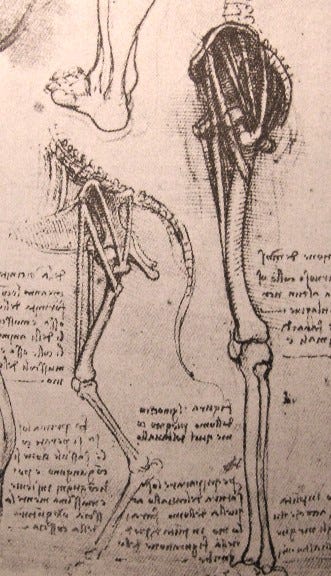
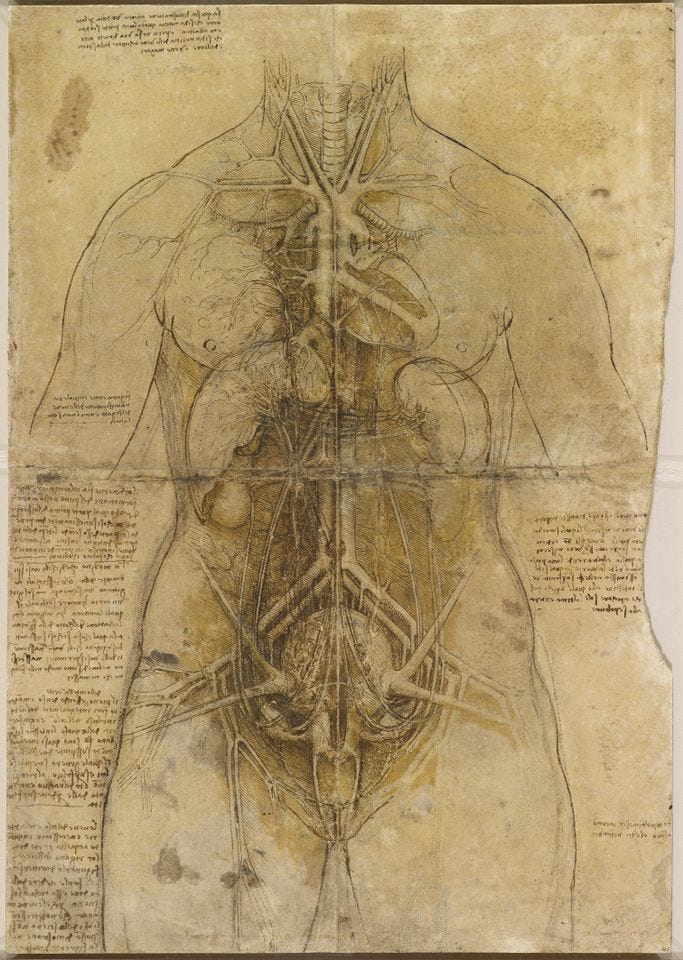
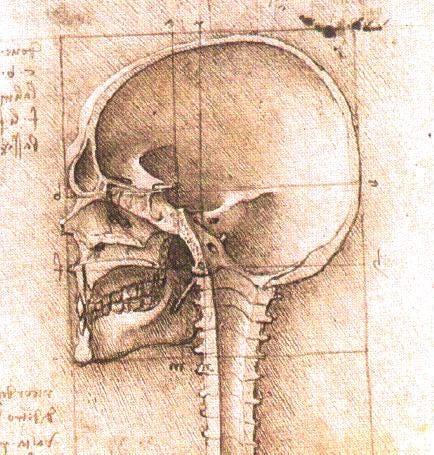
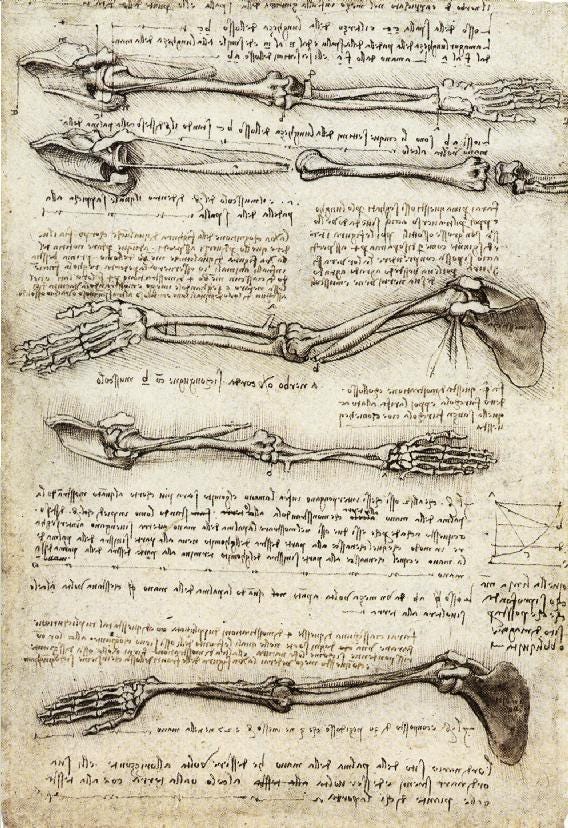
He made many profound discoveries. One was that the female was physically more complex than the male. He found this out by being the first anatomist to dissect a female body. The female had been dismissed by his predecessors as an imperfect version of the male and so not worthy of attention.
He also deduced that a substance from our food passes from the digestive system into the blood where it can build up to hinder blood flow. In effect he discovered cholesterol and a cause of heart disease. These facts were so far ahead of the general understanding of the day that Leonardo was often ignored by his contemporaries, being dismissed as an eccentric artist who merely dabbled in sciences.
Leonardo’s many studies of the body, when seen alongside his observations from almost all aspects of life, demonstrate the holistic view of the world that makes him the definitive ‘renaissance man’. He was forever searching for unifying systems and patterns. He observed that the branching structure of our blood vessels was common in all animals and similar to that of river tributaries and deltas, and also the veins of leaves, the branches of trees, the fork of lightning…
He supported the Humanist theory that the microcosm within us reflects the macrocosm of the universe — by studying ourselves we can understand the cosmos, and vice versa.
Leonardo’s masterpiece, The Mona Lisa, is also discussed by Remy Dean in Signifier


