
A School (of Athens) Reunion
Raphael painted the artists and thinkers of the Renaissance as they saw themselves — successors to the great classical Greek philosophers…
Renaissance is French for ‘rebirth’. The Renaissance was when western culture picked-up from where classical culture left-off… after a hiatus of one-and-a-half millennia. Think of it as ‘western civilisation, the sequel.’
There had been the long mediaeval ‘Dark Ages’ that followed the collapse of the Roman Empire, when most of the knowledge and philosophies of classical Greek culture had been lost or forgotten across Europe. Cultural and scientific progress was negligible for centuries until the Renaissance came about as a result of many coinciding factors. These included, the fall of Byzantium, advances in printing, and a return to Humanist thinking.
Since the early Crusades of the eleventh-century, some aspects of cultural exchange between western and eastern cultures had increased, including a trade in ancient Greek scrolls that had been preserved in the libraries of Islamic scholars. This had led to a rediscovery of the maths needed to build the great Gothic Cathedrals, and so began the slow transition from medieval to early renaissance.
After the Ottoman siege of the Byzantine capital of Constantinople ended with three days and nights of bloody chaos in 1453, it no longer separated the Muslim empire and the rest of Europe. This helped kick-start the Renaissance in two ways. Refugees, many of them learned Greeks and Romans, fled from fallen Byzantium in fear of further persecution, bringing with them knowledge of maths and sciences. Also, motivated by the profit potential of the Silk Road, commerce increased as did exchange of knowledge and ideas.
Around the same time, Johannes Gutenberg was using his printing press to reproduce the Bible. Prior to this, books were generally hand-copied by scribes, who were usually monks. Gutenberg was the first in Europe to combine the use of a mechanical press, oil-based inks, and movable metal type that could be set in a frame and ‘easily’ rearranged.
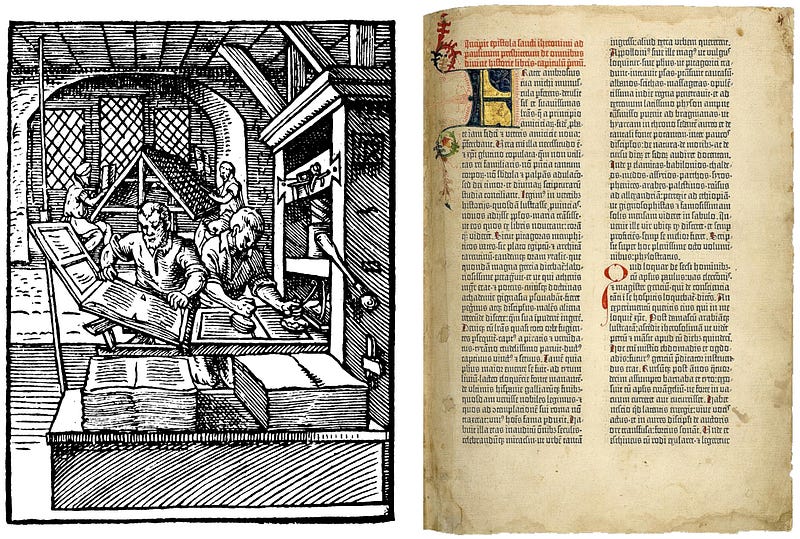
These innovations made book printing very much faster, less labour-intensive, and therefore more affordable. Multiple copies could be run-off, not only of Bibles and prayer books but secular texts and new translations of those rediscovered classical scrolls with their science, maths, and Humanist philosophies… Books and pamphlets became more plentiful and knowledge could be more easily, and more reliably, disseminated. The rate of change accelerated. Cultural and scientific progress picked-up again. It was a renaissance!
The term Renaissance is most readily associated with names like Leonardo, Michelangelo, Donatello, and Raphael. (Yes, I know, cowabunga! to you too.) That’s the Florentine or ‘High’ Renaissance and was the culmination of the several renaissances that spread through Europe from the earlier Northern Renaissance, perhaps best epitomised by Jan Van Eyck’s Ghent Altarpiece, completed around 1432.
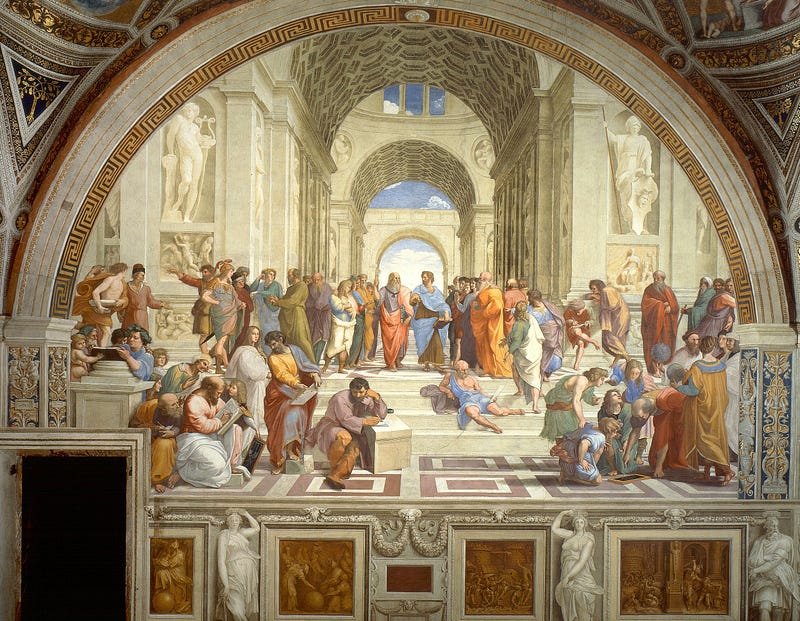
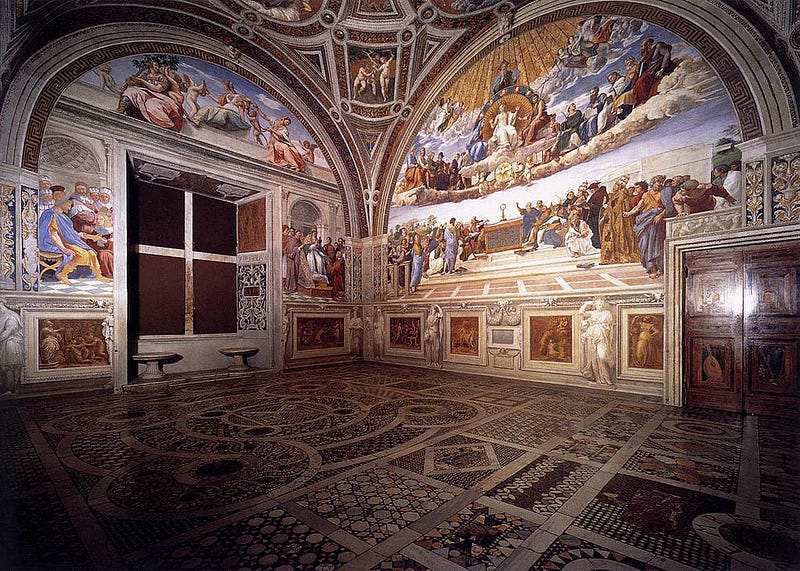
With his painting The School of Athens, completed c.1511, Raffaello Sanzio da Urbino, or simply Raphael, explicitly proclaimed that the Renaissance was indeed the continuation of classical Greek culture. It’s the best known of the sixteen large frescos and panels he and his team were commissioned to paint in 1508 for a suite of four rooms in the Vatican Papal Palace.
It’ a surprisingly subversive picture to be so prominently positioned in the heart of the Vatican and Raphael managed to sneak in some provocative content and still get approval from his patron, Pope Julius II, who also commissioned Michelangelo to paint the Sistine Chapel around the same time. The title refers to the Platonic Academy but mainly to the ‘school of thought’ it represented. The original Akademia was not a building but an area on the northern outskirts of Athens, that had been significant since prehistoric times.
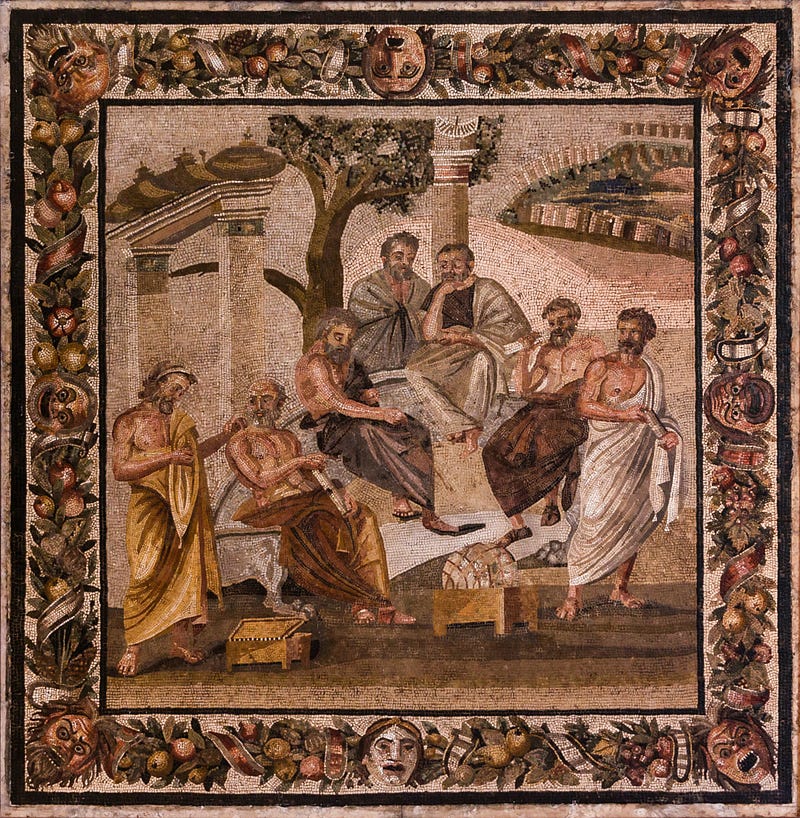
There may have been a modest peristyle — an enclosed ‘cloistered’ courtyard — but that was probably built after the time of Plato who taught whilst strolling among olive groves or sitting in the shade of the trees. This approach led to his most famous student, Aristotle, founding the Peripatetic school of learning, which was deliberately laid out in a series of shaded and part-roofed pathways for talking whilst walking. So, it’s fitting that this pair of original thinkers are right at the centre of Raphael’s composition and seem to be walking toward the viewer, engaged in deep conversation.
Here, he portrays an anachronistic assembly of the great thinkers of antiquity who were responsible for initiating the disciplines that shaped the western world: philosophy, mathematics, astronomy, and other sciences. He aligns himself and some of his fellow artists with their Humanist ideology by using the clever device of combined portraits. Think of it like casting a play where the historical persons are played by contemporary actors. In this way he presents an idealised depiction of the classical scene that is, at the same time, a group portrait of Renaissance figures he admired and whom he considered to be ‘picking up the baton.’
Appropriately, Raphael based Plato on the likeness of his mentor, Leonardo da Vinci, the archaetypal ‘Renaissance Man’ who perhaps best embodied the rebirth of classical philosophy, science and art, with his synthesis of varied elements from many fields of study. Leonardo found everything around him endlessly fascinating and made connections, visual and functional, between the natural world, the human body, engineering, and many other aspects of ‘design’. He was inspired by nature and tried to discover how things actually worked and what basic principals underpinned things such as flight and flow.
Leonardo had taught Raphael perspective and the basic geometry of composition, an influence clearly evident in The School of Athens. The strong vanishing-point perspective creates the illusion of a large space receding beyond the wall, made up of architectural elements from the surrounding Vatican. It implies that Plato and Aristotle have strolled into the new school, of the Church, from their outdoors Academy in the distant past.
Interestingly, the compositional centre of the fresco is not the same as the perspective vanishing point. This is no accident and the interplay between the two is an explicit homage to Leonardo. It directly references Vitruvian Man, a diagram in which da Vinci combined the human body, the square, and the circle to express his concept of cosmografia del minor mondo. He supported the Humanist theory that the microcosm within us reflects the macrocosm of the universe and by studying ourselves we can understand the cosmos, and vice versa. He realised that architecture following the same rules of proportion would feel harmonious.
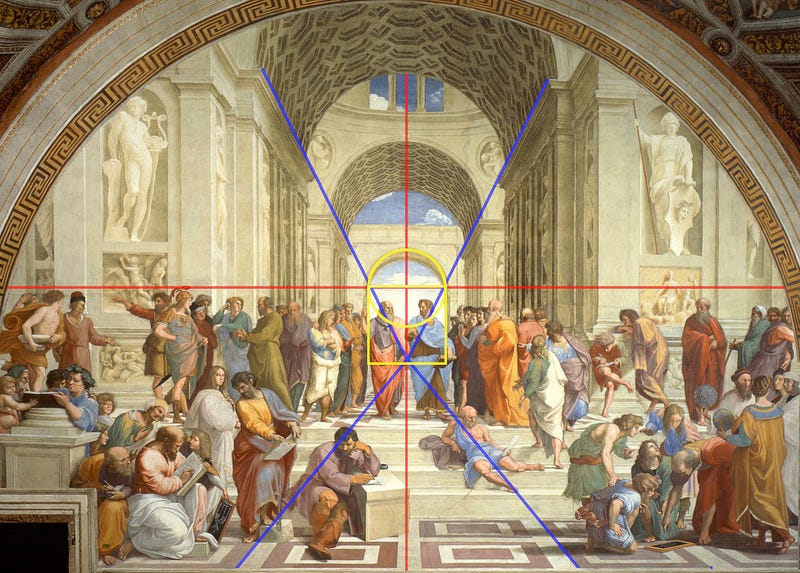
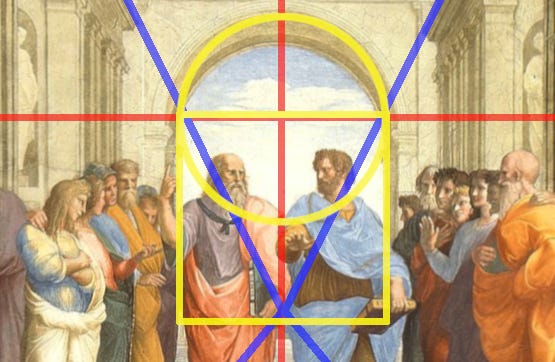
The square and circle forming the most distant archway frames the double portrait of Plato and Aristotle and nothing else except an area of sky (outlined in yellow.) This is a conscious metaphor, but interpretations vary and include, ‘they have their heads in the clouds’, ‘they are close to the heavens’, ‘they were blue sky thinkers’, or it could be alluding to the Divine Presence.
My favoured interpretation is that the exact centre of the composition indicates the most important things in the picture that remain invisible — the words that fill the air between these two great thinkers as they discuss their world-changing theories. If we could see their words, they would be in a speech balloon exactly there.
Other structural features support this reading. The centre line continues down and through Plato’s opus, Timaeus, the book containing the distillation of his life’s works. The perspective convergence (in blue) is also at this point emphasising the importance of the ideas within — those words, made visible and recorded for posterity. Likewise, the bottom right corner of their framing square indicates Aristotle's seminal tome, Nicomachean Ethics.
Their gestures imply the differences in their philosophies that enable them to effectively complement each other. Plato’s hand breaks out of the square to point heavenward to the sphere of spirit whereas Aristotle’s hand, near the centre of the square, indicates all that is physically before them. The square is an alchemical symbol for the element of earth and the material realm and his book breaks its ‘frame’ suggesting the words within will mediate between intangible inspiration and the world we can experience with bodily senses.
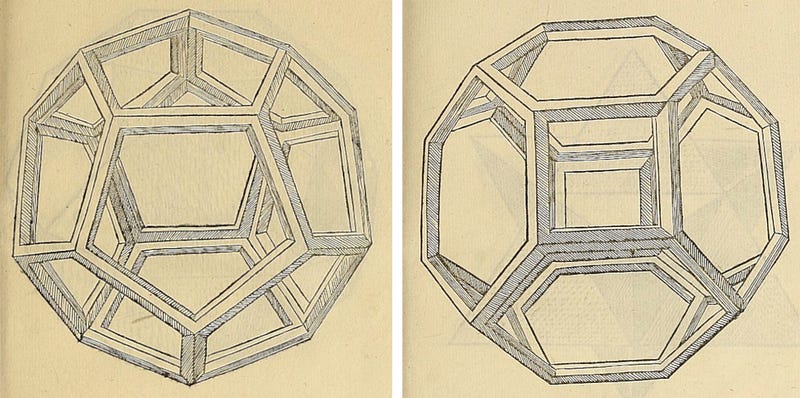
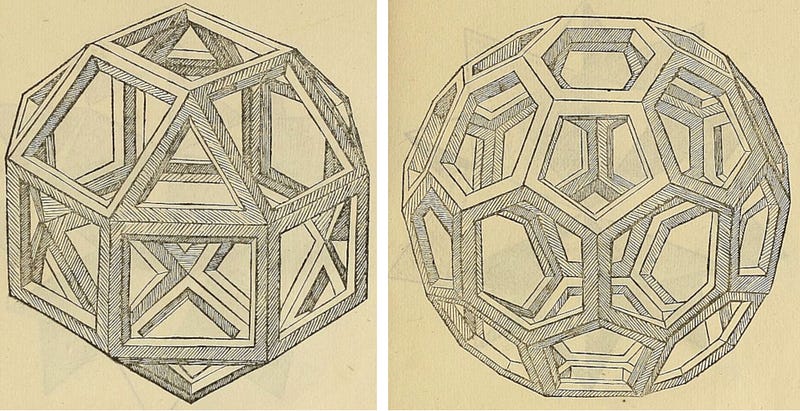
Plato postulated that the universe was born of chaos, yet there were ideal forms, exemplified by his Platonic Solids, that were often reflected in the ‘real world’. When things approached these ideal forms, they created harmony, balance, and beauty. Raphael references this with the arched ceilings of The School of Athens — see if you can match the pattern with one of Leonardo’s illustrations we saw earlier.
Plato thought that something invisible guided the shape of solid things which appeared to have a plan, or form of intelligence. He believed this underlying order could be understood through mathematical formulae. We now recognise these among the first inklings of molecular structure and physical laws.
Aristotle believed that in addition to such theoretical equations, the truth can be sought through direct observation, leading to a theorem, that can then be explored by practical experiments, and thus proved or disproved. Between them these two philosophers had invented science. Ironically, such men were often seen as being at odds with the Catholic Church and, in Raphael’s day, championing science over faith could get one into a lot of trouble!
It’s no accident then, that the horizontal and vertical lines meeting at the centre of the fresco are intersected by the harmonious square and circle to imply the perfectly proportioned Christian cross (marked above, in red). He could tell the Pope this indicated the revolutionary ideas that changed the world may be attributed to divine inspiration…
The rest of the fresco seems to expand outward from the highly significant double portrait at its centre. Its lower half is a showcase of influential thinkers whose ideas were once again driving progress during the Renaissance. Raphael didn’t leave us a definitive list of who’s who and scholars still enjoy debating this, though we do know a few of those included from correspondences and papal orders exchanged during Raphael's work on the four rooms.
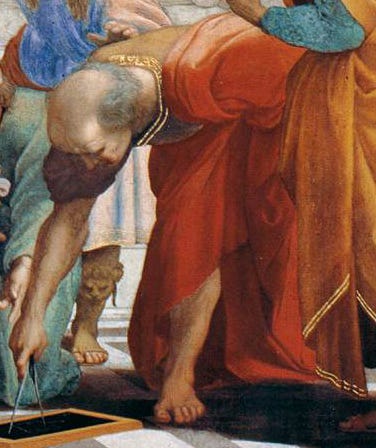
Some are fairly easy to identify by their attributes — the same iconographic approach used to denote the saints. For example Euclid, in the right foreground, can be recognised by his dividers as he demonstrates Geometry by drawing on a slate. The model for Euclid was Donato Bramante, chief architect of Saint Peter’s Basilica. He is visually balanced by Pythagoras in the left foreground, referring to a diagram of his theory of harmonics, also drawn on a similar slate.
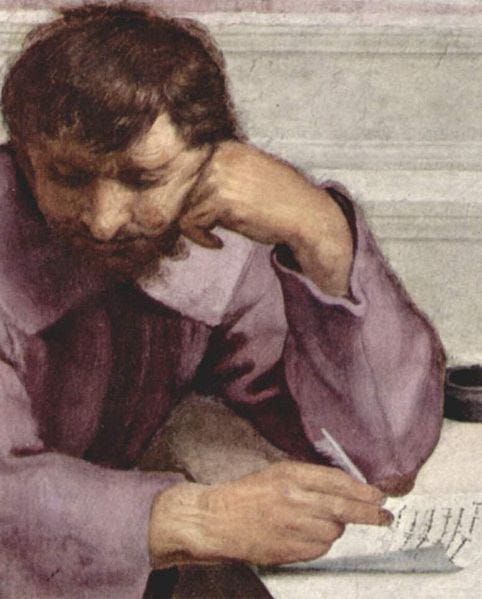
The prominent figure in the foreground, just left of centre, is Heraclitus who has the likeness of Michelangelo. He’s not shown with a book, but with quill in hand as he writes. He wrote only one book, which has not survived, but has been quoted by those he influenced. He was known as ‘The Obscure’ for his use of poetic aphorisms and metaphor that alluded to some truths that he thought too subtle to confine with any immutable definition. The motto of Heraclitus was panta rhei — everything flows. Perhaps his best known quotes is, “No man ever steps in the same river twice,” which is pertinent to the meaning of the painting. The Renaissance can look back to the classical Greek era but must continue to flow on.
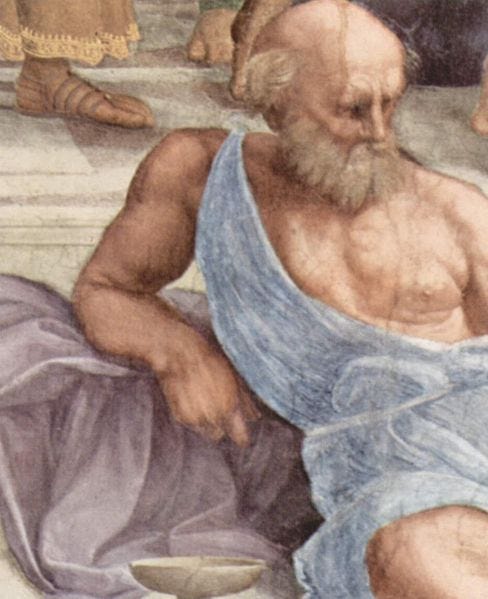
The other philosopher in the foreground, just right of centre, is Diogenes ‘The Dog’, so called because he enjoyed barking at people and lived much of the time in an old barrel. He made a point of questioning and criticising the opinions of others and believed theories were less important than actions. The true nature of a person was revealed by their actions and reactions, rather than anything one said. He had been a pupil of Antisthenes, from whom he learned the disciplines of Asceticism and Cynicism. In turn, he taught Crates of Thebes who then taught Zeno, founder of the Stoics.
Diogenes denounced partisan ideas and disrespected laws that impinged freedom of the many to maintain the power of the few, including property, ownership, and state currencies. Again, another figure that would certainly be at odds with the Church and State at the time of Raphael!
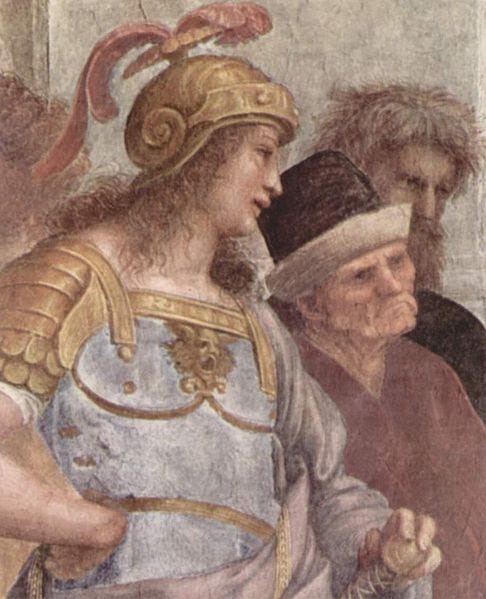
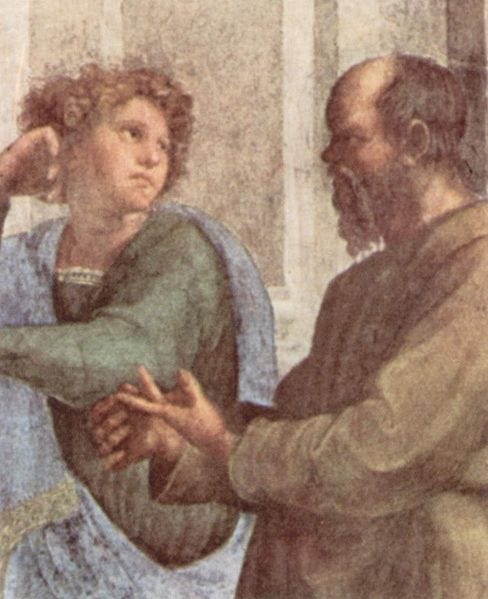
Antisthenes, wearing rust red robes and a pale-brimmed ‘fez’, is included in the group to the middle left, on the top step. They are conversing with Socrates, who wears plain khaki gowns and can be recognised by his famously ‘pug-nosed’ counterpace. Socrates had taught Plato and is thought of as the father of western philosophy.
His ‘Socratic Method’ included the use of dialogues that posed questions, then raised new ones with each answer. Reputedly, he rarely stated anything, but would challenge the views of others with his insightful curiosity that revealed flaws in their reasoning and built better understanding. He would often lead the obstinate to follow their flawed reasoning until they were speaking nonsense, this was Socratic Irony and a cornerstone of Ethics.
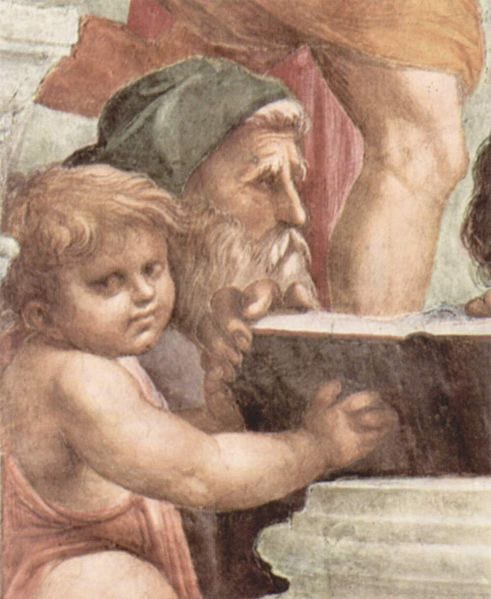
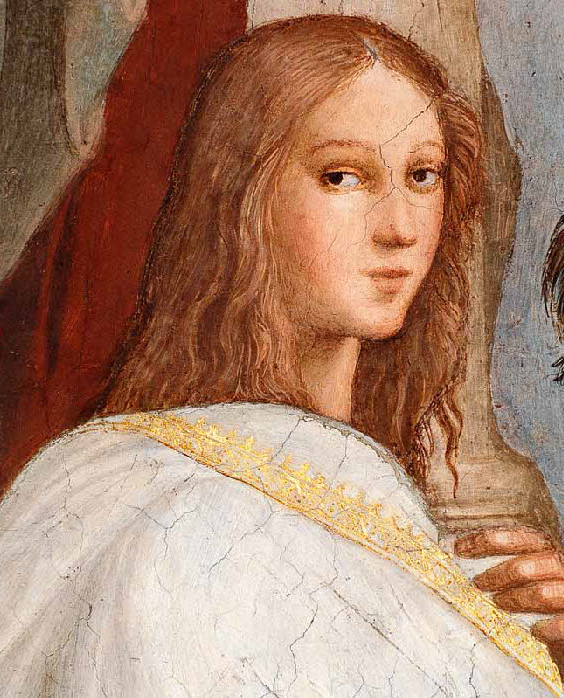
Zeno the Stoic is also present, at the far left, part obscured by the cherubic child who supports the book of Epicurus. The child, who may represent the future, is one of only three figures who look directly out of the fresco, making eye contact with the viewer. If we follow Zeno’s gaze across the picture, we come to a young woman wearing voluminous white robes who also looks directly at us and is possibly the most subversive of Raphael’s radical inclusions.
This is Hypatia and the Pope told Raphael to leave her out. Hypatia was a teacher at the Mouseion school in Alexandria and was associated with scrolls she may have preserved from the legendary Library there. It’s said that, in the tradition of the Academy, she would also walk through the streets, discussing the philosophies of Plato and Aristotle with all who were interested. She made precision scientific instruments, such as astrolabes, and was renowned as the leading mathematician and astronomer of her time.
Hypatia was the last in a line of teaching that stretched back to the classical philosophers and the Academy of Plato. When, in 415 AD, she was dragged through the streets, tortured, killed, and burnt by fanatical Christians, her death presaged the final, rapid descent into the ignorance of the Dark Ages.
Her sadistic public humiliation and murder was probably instigated by Cyril, who had just become the Bishop of Alexandria and condemned her for espousing pagan philosophies. Because of this, Julius II had refused to include the image of a woman known to be heretical and when he questioned the presence of the figure in the final fresco, Raphael told him it was a portrait of the Pope’s young nephew.
This is not the case, although some texts still list the figure as ‘Francesco Maria della Rovere’. On closer inspection, it seems the hair may be held in place by a veil similar to that of Mona Lisa, more obviously present in preparatory sketches. Her throat is almost perfectly smooth, emphasising the lack of any masculine laryngeal prominence, or ‘Adam’s apple’. She is wearing the white robes of a martyr, making her depiction doubly contentious.
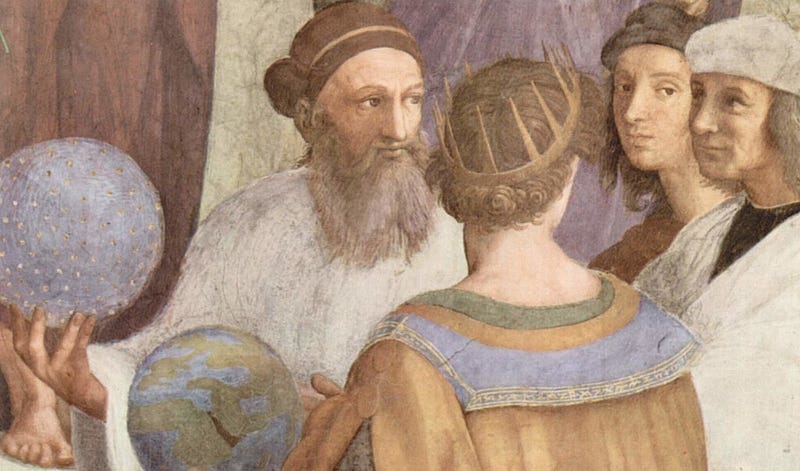
Which brings us the the only other character looking directly at the audience. If we follow the gaze of Zeno, to Hypatia, and continue all the way across to the opposite, right margin of the composition, we come to Raphael’s self-portrait. The artists stands between Zoroaster, holding a heavenly sphere, and Ptolemy, presenting a globe. Rather poignantly, Raphael is looking over the shoulder of Protogenes, reputedly one of the greatest painters of antiquity who worked in the fourth-century BCE, though none of his work survived. Raphael looks to us. Our eyes meet across the centuries. He encourages us to engage with his art, to really look at it, to think about what we see…
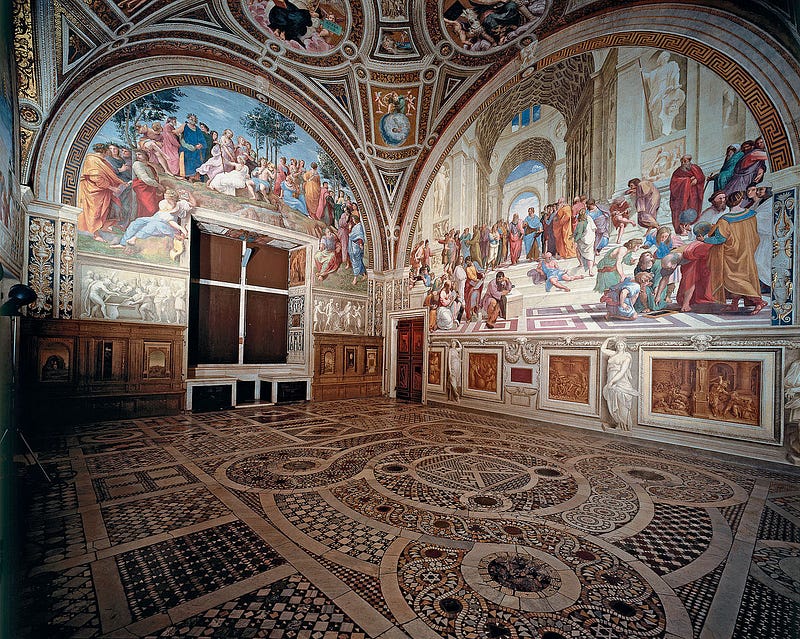
Raphael continued to work on what are now known as Stanze di Raffaello — the Raphael Rooms — until his death in 1520, when his students completed the work according to his plans.


.jpg)
.jpg)


