
Altering Perceptions of Altars
For many centuries, the only public art produced across Europe was either religious or intended to exalt nobility. Many works were both biblical and biographical, placing their patrons within the stories of saints…
The most influential art was to be found in palaces and cathedrals. The portraits of the rich, the bespoke ‘books of hours’ produced for private chapels, and the big statement pieces commissioned by the rich for public display on the altars of churches.
Altarpieces were the ‘blockbusters’ of their day and, in terms of painting, there was no better vehicle to get your work in front of the eyes of a mass (and Mass) audience. One of the most audacious and strikingly original altars, that tells the story of its changing times during the dawning of the Northern Renaissance, was...
Jan Van Eyck’s Ghent Altarpiece (1432)
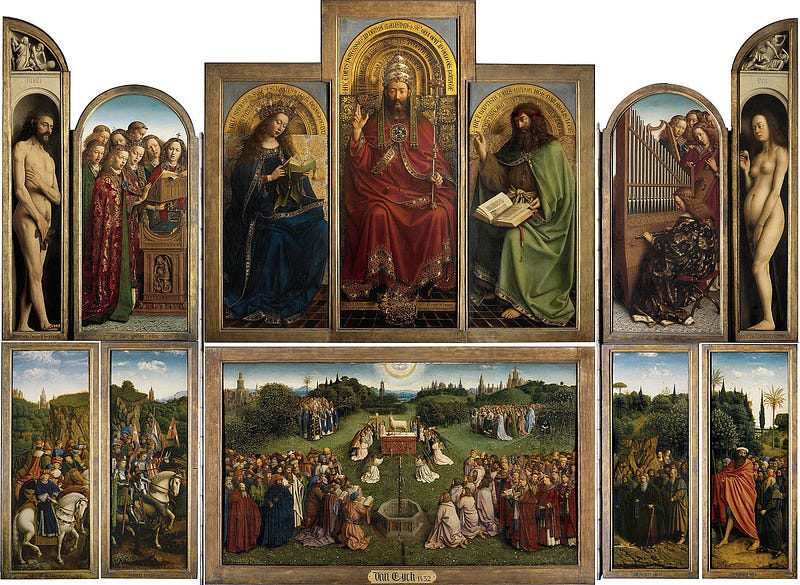

It’s difficult for the modern mind to imagine how weird and wonderful this radical work would have appeared to eyes more accustomed to the ‘Dark Ages’. Though structured in a classic mode, the figures are quite free and naturalistic. For a long while, the human figure had fallen from grace in religious art but here, not only do we have the human form back in prominence, we have the naked figures of Adam and Eve. Indeed, a pregnant Eve as she is depicted here is an even braver and more controversial inclusion. It certainly would’ve shocked at the time and harks back to the figures found in classical art.
This reference to classical style was, in itself, risky for Van Eyck because the emerging strain of Catholic extremism saw such as art as belonging to a pagan ideology. Also, the human form had become so inextricably linked to their emphasis of the concept of ‘original sin’ that it was unusual to portray any faces or figures in churches apart from those of the Holy Family, saints and angelic beings. Our bodies were thought of as things that should only remind us of our shame and inadequacies, making it doubly courageous to include Adam and Eve, the first two humans responsible for that ‘original sin’.
There is a conspicuous avoidance of the dominant blue colour of lapis lazuli, used in a lot of ostentatious religious art of the time, replaced here with a vibrant green and rich red scheme. It’s just as eye-catching, but different by deliberate design to establish a new way of combining colours that immediately marked this piece aside form most of its contemporaries. It was proclaiming a new approach and a new era.
The altar design is made up of a triptych, which was (and is) typical, partly for the practical reason of mechanical stability, and of course the symbolism of the trinity is central to Catholic ritual. It’s also divided horizontally to introduce a binary separation between above (Heaven) and below (Earth). There is a clear division between the biblical persons in the upper panels and the earthly nobility and peasants in the lower panels. Also it is human divinity that is emphasised here, with no explicit figures of Christ, or God…
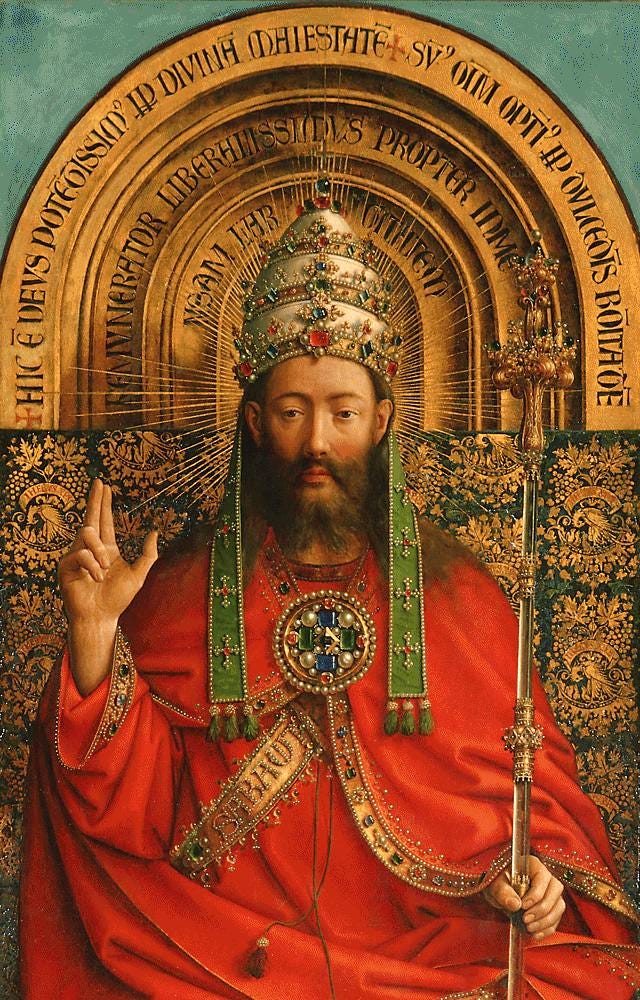
The central figure, often referred to as ‘The Almighty’, is supposed to portray ‘Jesus Christ King of Heaven’, though he wears the regalia of a pope. So, in this figure, Van Eyck renders God, Jesus and the Pope interchangeable and focuses very much on the human aspects of this trinity. This could be seen as signalling a resurgence of Humanism and is certainly an assertion of church authority over civil, as well as spiritual, matters. He is flanked by two humans, the Virgin Mary and John the Baptist.
Though usually attributed to Jan Van Eyck, the general layout was designed by his older brother Hubert, who also painted most of the lower panels, contributing to the dramatic contrast between the upper and lower sections. It is the upper sections, painted by Jan, that are considered the most groundbreaking.
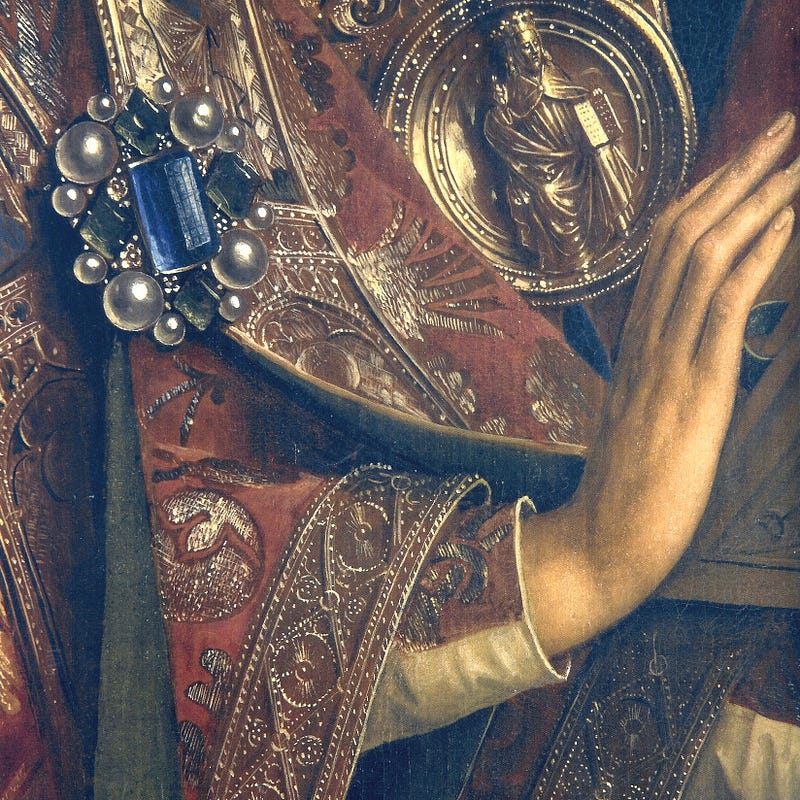
Their luminosity is the first thing that makes them stand out, along with the masterful rendering of highlights. Jan Van Eyck is thought to be the first painter to accurately capture the effect of reflective surfaces. He did this through astute observation and by the deliberate, though selective, application of a gloss varnish.

.jpg)
Also, he is one of the earliest painters to use the fall and fold of fabric to reveal the form beneath. The robes fall realistically around the figures and the resulting folds tell us of the texture of the cloth as they sheen in the light.
This is a rebirth of classical aesthetics, as idealised by Greek sculptures, and with Van Eyck we have some of the earliest inklings of the forthcoming Northern Renaissance. What is often thought of as ‘The Renaissance’ is the Florentine, or High Renaissance epitomised by Raphael, Da Vinci, Michelangelo and Donetello (who later became known to a whole new audience as the ‘Teenage Mutant Ninja Turtles’!) But there was more than one Renaissance, or perhaps think of it more as a sequence, almost like ‘The Renaissance European Tour’…
Though the upper panels tend to get more attention, there is plenty to note in the lower panels too. The duality suggested by the horizontal division is carried through with an unusually balanced and inclusive representation of gender, race and class.
There are both male and female martyrs, saints and worshipers. There are middle-eastern representatives and Jewish writers. We see pagans and alchemists, knights and nobility, monks and peasants. All united in their adoration of the ‘Lamb of God’ and the ‘Fountain of Life’ which has a channel to allow its vital waters to flow ‘out of the picture’ and toward the viewer, thus including you in the vista.
We are all shown as humans together. Although this may seem to imply some inkling of ‘equality’, make no mistake, we are all shown as under the authority of the Church as represented in the upper panels.
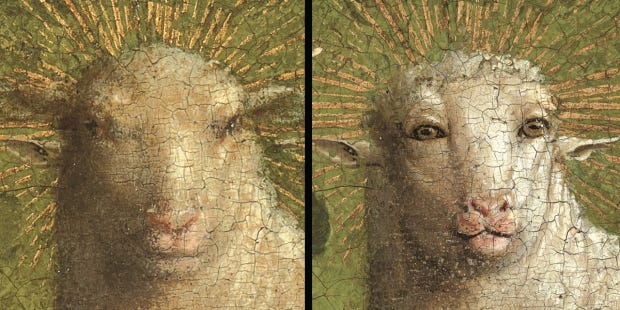
The central motif of the lower panels, ‘Adoration of the Mystic Lamb’, has certainly garnered the most public interest lately with its controversial, ongoing, restoration. The Lamb’s extra ears were recently removed and the original anthropomorphised face revealed. The result polarised opinions…

It is suggested that the Lamb stands on an altar containing the Ark of the Covenant, in which the stone tablets bearing the Ten Commandments, carved by Moses, are kept. (You may remember it from the 1981 movie, Raiders of the Lost Ark?) Placing this so centrally is again emphasising the law as a foundation for all else, including sprituality, though the spiritual aspects of Christ are also here: the empty cross representing Resurrection, the Holy Grail as a vessel for the physically and spiritually healing Blood of Christ, and a pillar which may suggest the one Jesus was tied to for his flogging, now vacant to represent the transcendence of suffering.
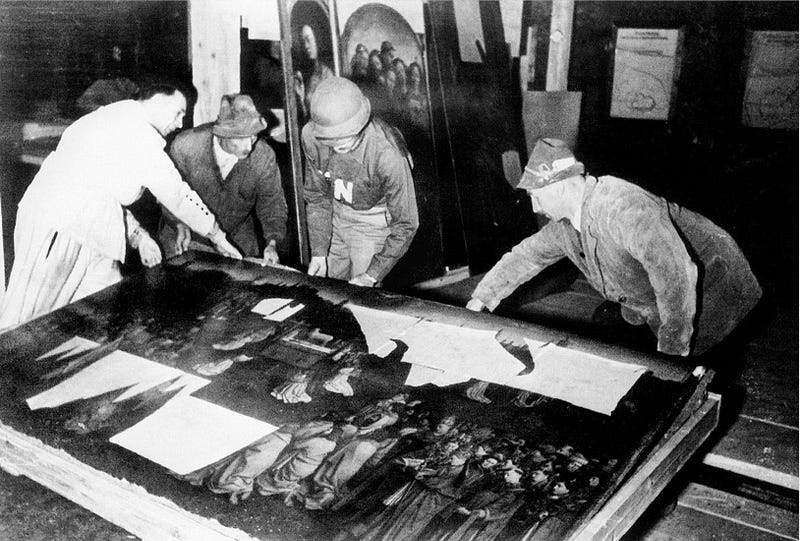
The altarpiece itself has suffered over the centuries, being damaged in fires, having panels sold to fund various war efforts, parts have been stolen, most were recovered, but one was lost. Occupying forces broke it down and looted it during the First World War, but returned the pieces soon after war was over. In the Second World War, the Nazis moved it to a secret castle in Bavaria, but as allied forces closed in, it was hidden deep in a salt mine.
Salt does not mix well with old paints and varnish, so it deteriorated considerably until it was tracked down and rescued by The Monuments, Fine Arts, and Archives Program — a group of allied art experts tasked with finding and preserving art treasures that had been looted by the Nazis. This was the inspiration behind the 2014 George Clooney movie, The Monuments Men.

The back panels, on show when the Altarpiece is closed, are also astonishing for their time. Again, we have the figures in a classical style and not only that, we have two Sybils — prophetesses from ancient Greece, through whom the gods would speak. By including these, Van Eyck is openly embracing aspects of that classical pagan culture and extending the religious narrative further back in history. Christianity is placed in a context of developing from earlier religious and philosophical concepts.
The other two figures shown in the lunettes at the top are the Jewish prophets Zechariah and Micah, both shown with their books in which they foretold the coming of Christ, and the middle panels show the Annunciation — Archangel Gabrial telling the Virgin Mary she is to have a very important baby. His words are written next to the white lilies of purity, positioned as they would be in a comic-book speech bubble. Interestingly, Mary’s reply is also shown in text as if coming from her mouth, but her words are upside down. Because they are being spoken to God, they will be more easily read from heaven, above!
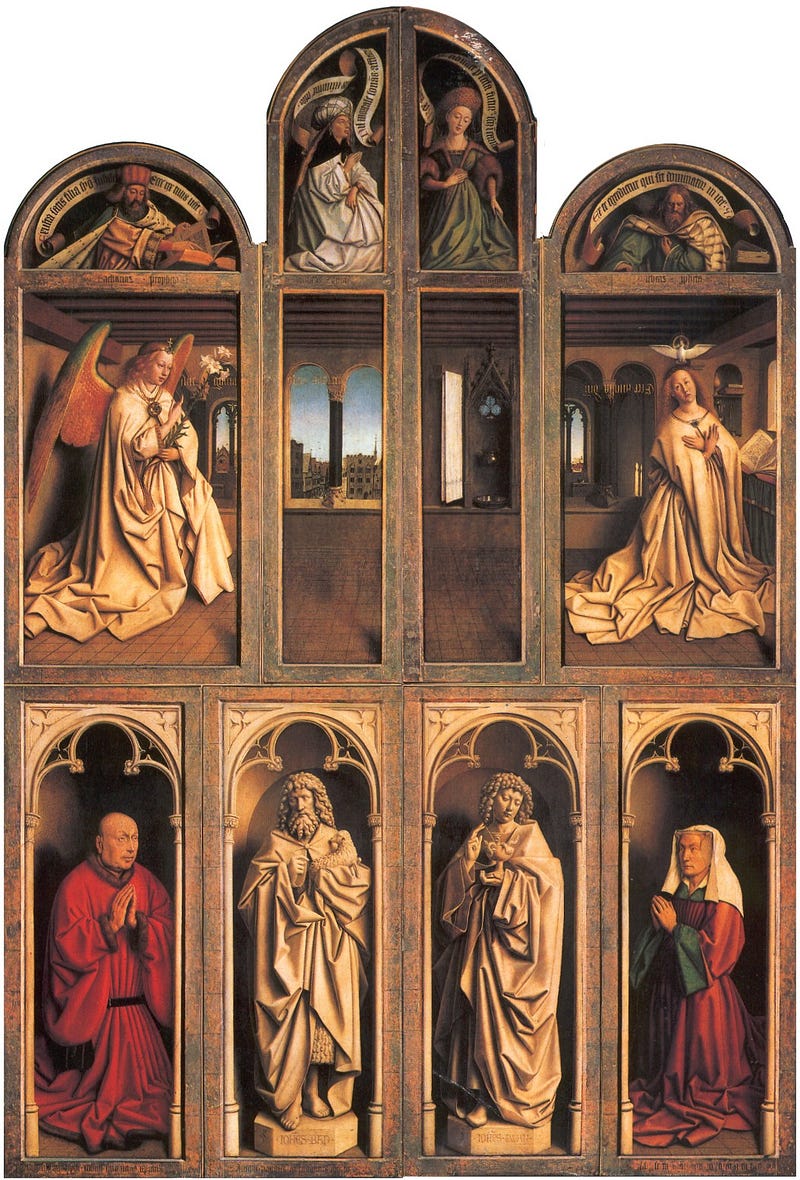

There is also a rather good attempt at using vanishing-point or linear perspective. This technique had only been introduced into art by Florentine painters about 15 years earlier and was not yet widely taught. Here, Van Eyck uses it, not simply for realism, but to emphasis the importance of Mary and Gabriel by making them appear, almost surrealistically huge. This idea of a figure’s importance being indicated by their comparative stature can be traced back to the pre-classical art of Ancient Egypt and had been embraced by icon artists during the middle ages.
The four lower panels show two saints and portraits of the two patrons who commissioned the altarpiece. The kneeling man and woman are the donors Joost Vijdt and his wife Lysbette Borluut. They are being given nods of gratitude by Saint John the Baptist and Saint John the Evangelist. The two saints are painted as trompe-l’œil to appear statue-like, in the classical mode, and in the form most often encountered in their niches and chapel alcoves.
There is one final little nod to the dominance of human authority and power over the spiritual. If the donors were to stand, they would clearly be larger than the saints. In fact they’re the biggest figures of the closed altar view, and would also dwarf Gabriel and Mary. After all, none of it would be there if not for their material generosity.
The Altarpiece was originally installed in the great Gothic Cathedral of Sint-Baafs (Saint Bavo Cathedral) on 6 May 1432, in the Joost Vijd family’s chapel. Later, it was relocated to the Cathedral’s main Chapel where it can be seen today.
A painstaking restoration of the Ghent Altarpiece has been underway since 2012…
…and continues.
For a closer look at the details of the Ghent Altarpiece check-out Inside the Ghent Altarpiece at Google Arts and Culture