
The Garden of Earthly Delights by Hieronymus Bosch
Fantasy art from the first surrealist tells the story of heaven and hell
At the time it was painted, circa 1500, this would have been a stunningly original and modern work. This folding triptych is believed to have been commissioned for the altar of a private chapel in one of the grand houses of Brussels, and it is now restored to its ‘original glory’ and displayed in the Prado, Madrid, where I stood before it on a recent visit.
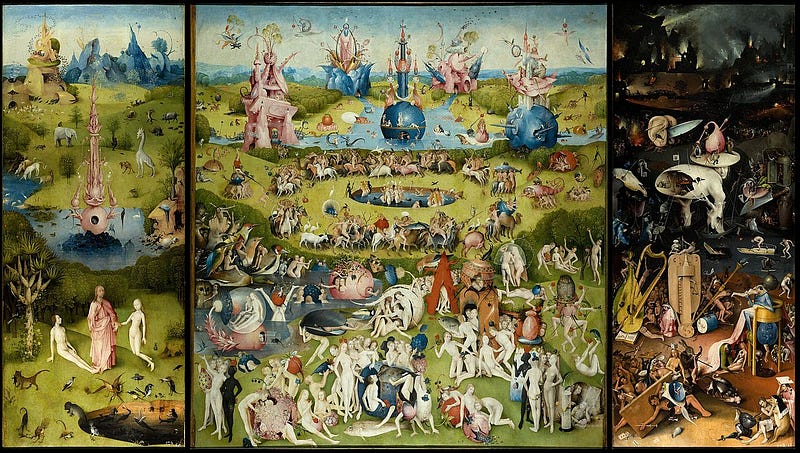
Seen in its gallery room among other late Gothic works, what really strikes the viewer first is the brightness of the colours that leap off the oak panels. The palette appears so modern as does the content: the Surrealists of the twentieth century cited it, along with the sketches of Leonardo da Vinci, as being the earliest expression of their ideology.
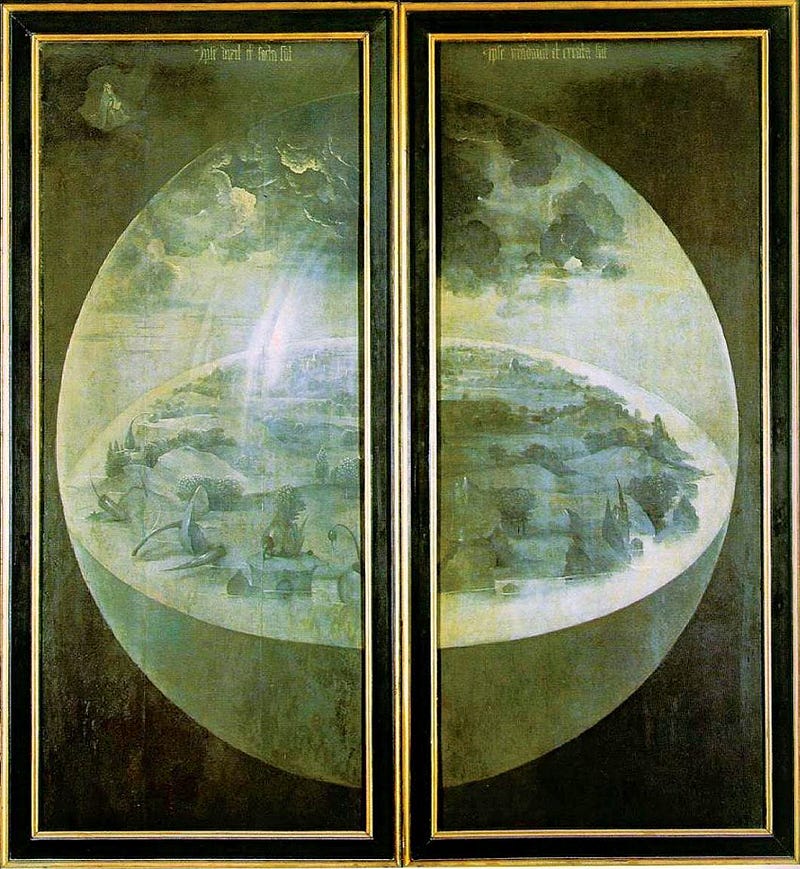
When closed, the piece presents an image of a crystal sphere, with God at the top looking down upon the earthly realm he has created, represented by a disc at the equator of the sphere. Of course, the ‘flat earth’ theory was no longer convincing and when the panels are opened up, among the many strange and wonderful things revealed is an array of exotic fruits, which had only just been discovered in the New World during the voyages of Columbus.
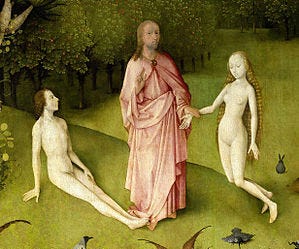
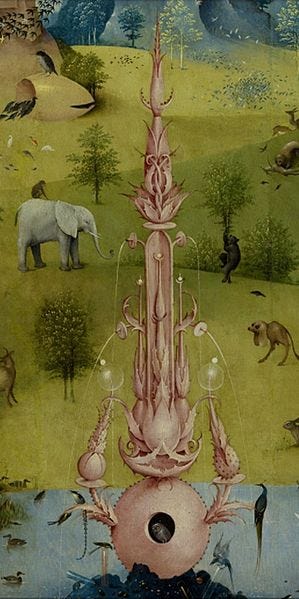
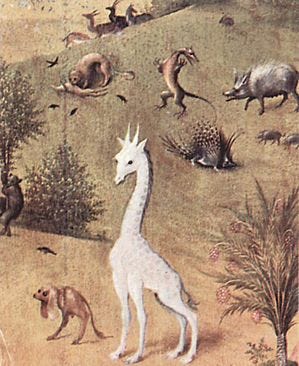
The altarpiece opens like a big wooden book to reveal three linked paintings. The left panel shows God introducing Eve to Adam in the garden of Eden, populated with many animals and fantastical beasts including an albino giraffe, an elephant, a three-headed oriental pheasant, a unicorn and its seahorse equivalent...
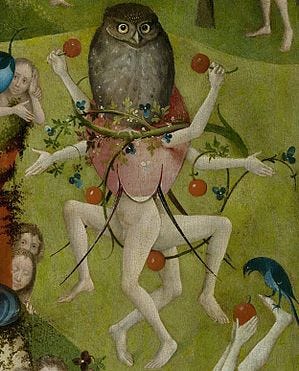
All seems well, but there are couple of tiny details that imply that it may not be perfect after all and harmony is about to be lost: in the background an animal devours a gazelle and in the foreground a cat carries away its prey in its jaws. An owl can also be spotted. At the time, owls were often taken to be symbols of darkness and death and are a recurring symbol here.
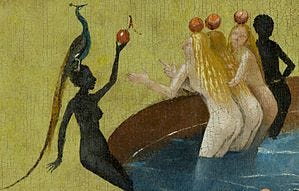
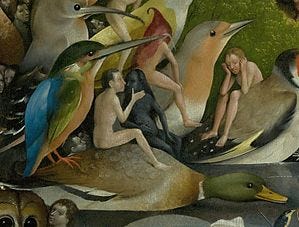
The middle panel shows a scene of orgiastic revelry where the participants have given themselves over, with admirable gusto, to the sensual pleasures. Here too, there are many fantastical animals, including giant birds and some of the people are enjoying the pleasurable sensation of naked flesh against downy feathers. (You know you want to, but you know it’s wrong!) Several others stroke fish or balance fruit on various parts of their bodies, one man offers his bare behind as a receptacle for wild flowers…
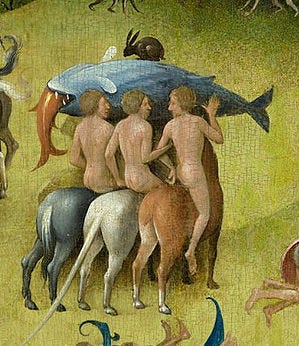
In the background a rider flies on a griffin whilst below men and women frolic with merfolk in a decorative lake. The real animals are all drawn with exceptional attention to detail. Bosch is one of the earliest artists known to sketch ‘in the field’ as a visual exercise in itself. The fantasy creatures are all drawn with exceptional imagination.
Aspects of the landscape are equally inventive, fusing symbolism into biomorphic forms inspired by fruits, anatomy, architecture and alchemical apparatus. There are transparent tubes and glass bubbles in which people sit. This image has been a huge influence on very many fantasy artists and illustrators to this day.
The third panel shows Hell and what awaits those who have surrendered to the sensual pleasures. In the centre of this panel’s composition is a half-tree-half-man figure, afloat on a tar-black lake. On his head is a disc supporting an object that is an amalgamation of internal organ and bagpipes. In the background the cities of the earth are laid waste by war, burning and in ruins.
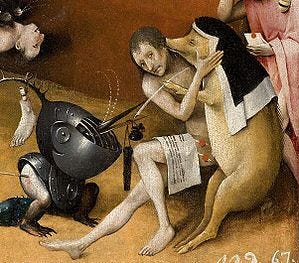
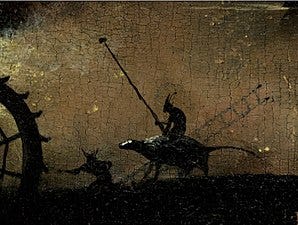
A pack of reptilian hounds tug at the entrails of a fallen knight, whilst one of his comrades is run through by a winged demon. The theme of cleaving and penetration recurs throughout the image and has been foreshadowed in the other two panels. In this final part of the narrative the interaction with animals is less consensual as people are eaten by bird creatures, nibbled at by clothed rabbits and a forlorn sinner attempts to repel the amorous advances of a sow-nun.
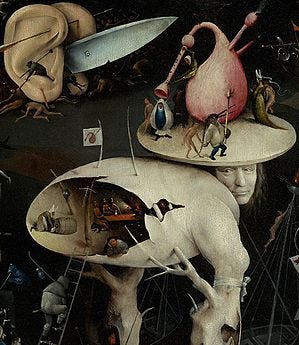
Interestingly, eggs and birds proliferate across all three panels as, perhaps, a narrative of the lifecycle. Also, in several religions the egg or ovoid represents pure potential of spirit in its perfect and uncorrupted form. Eggs appear here in various stages of hatching and ‘corruptions’. There’s a big one in the upper left of the ‘Eden’ panel — where birds seem to be entering through its round portal, representing a constant return to innocence, perhaps. This scene is echoed in the the middle panel where a crowd of men, sometimes referred to as ‘philosophers’, enter a giant egg as they leave the pool. Then there’s the fragile and ruptured egg-shell torso of the tree-limbed man in the ‘Hell’ panel.
It’s like a giant Easter egg hunt for the eyes, though of all the eggs and egg-forms to be found, only one is pure and unhatched. Bosch placed it exactly at the centre of the entire composition, denoting its importance as a symbol of rebirth, renewal, and hope. Or, in keeping with the religious iconography of altarpieces, the promise of the Resurrection.
The hallucinogenic irreverence of much of the imagery would have been astonishing at the time, and was obviously commissioned by a forward-thinking patron and executed with great fervour by the hugely imaginative artist. Not only is the content inventive, the composition is advanced with a strong rhythm of form and visual continuity linking the three panels as a single narrative composition. The technical aspects are also highly advanced and the mixing and application of the paints was done with great skill and attention, meaning that the work has survived in much better condition than most other works from the same era.
All images sourced via wikimedia commons.
A version of this article was first published in my book Evolution of Western Art (questing beast books, 2012)