
Origin Stories
Right from the start, visual art was used to tell our stories and the earliest examples of narrative image-making could be considered the first ‘comic-books'
Humans have a deep urge to tell stories. More like a necessity. It seems we have always used storytelling to explore the nature of our being and to record the wisdom found during those explorations. As soon as we could make marks, we also used visual means to give our stories some sort of visual form outside of the imaginary. Here, we will consider a few examples of pre-historic and ancient narrative art in the context of our modern graphic storytelling that led to comic books and cinema.
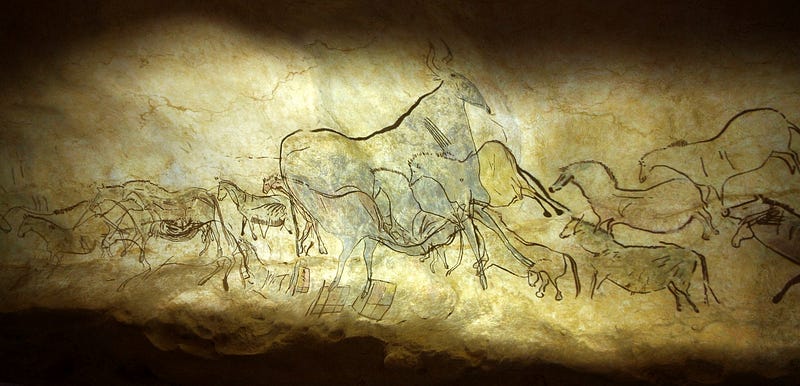

The oldest surviving illustrations were painted onto the walls of caves. We can’t know for sure why the prehistoric people painted them and there are several compelling theories, previously discussed in Signifier. Certainly, the imagery served a variety of social functions but it seems likely that some provided sequential backdrops for our first storytellers.
Maybe, the keeper of the clan’s stories would have led their audience deep into the darkness of the caves as they told tales of hunting, of communing with spirits, of how the seasons changed and repeated. As they spoke, relevant images on the cave walls surrounding them would be revealed by the warm glow of firelight. Many of these pictures are painted high on the ceilings of caves and would've seemed to hover in the darkness over head, like imaginings made manifest. Like thought bubbles of a shared dream.
Some theorists suggest that the stone surfaces were selected for their contours and textures so that, when lit by flickering flames, a sort of simple animation created the illusion of movement, suggesting the pictures had been brought to life by the power of the storyteller.
It seems the the act of painting them also followed a narrative structure as the animals were drawn in a specific order and often this sequence was adhered to each time a cave was decorated and redecorated. Perhaps this had a ritualistic significance — relating to the spirits of the animals represented; a narrative purpose — linked to seasonal migrations; or reflected a bestial hierarchy — charting the significance of the beasts particular to each Neolithic culture.
The paintings exist apart from the tales and have outlived the tellers, so they no longer tell the ‘whole story’. We can only guess at the words, music, movement, that accompanied their ‘performances’. Perhaps, then, they aren’t narrative images per se, but used within a narrative to illustrate and emphasise.
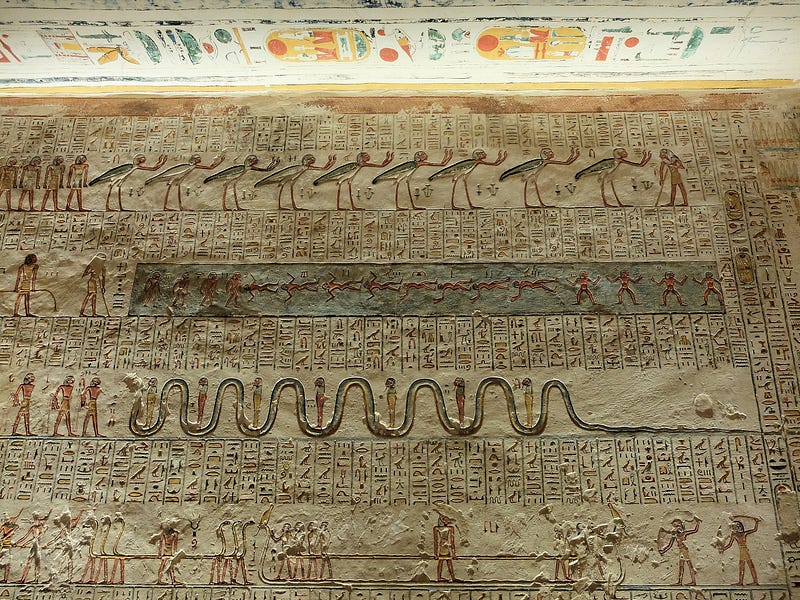
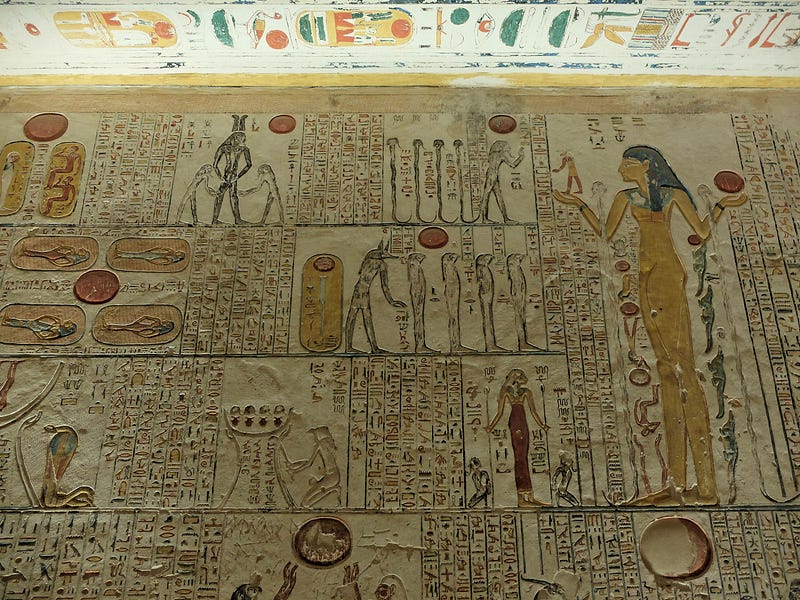


In Ancient Egypt we find extensive narrative image-making in the Books of the Dead, on papyrus and as murals, and even in stone tablets containing recipe tips. Hieroglyphics became the official writing system of the culture and are, in themselves, a fusion of image and text. Certainly the earliest ones were a form of representational ideogram but later developed into a form of writing where some of those images represented phonemes of language as well as, or even instead of, what they looked like. So, when columns of hieroglyphs were introduced into bigger pictures, as narrative labelling, we have one of the earliest surviving examples of sequential captioning that work in tandem with imagery to tell a story.
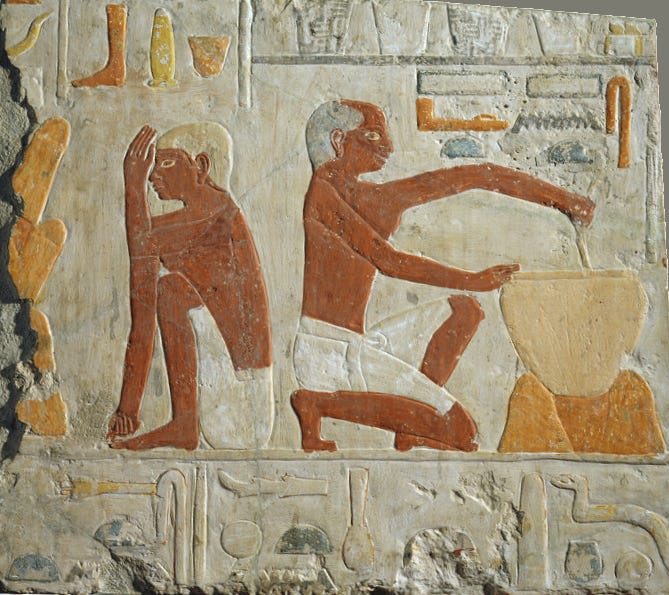
A cartouche, the collections of glyphs to spell a name, is enclosed in a capsule that even resembles a speech balloon. It’s as if the important personage is introducing themselves to the reader. There are also numerous examples of actual quoted speech being placed near to the heads of those speaking the words. One famous example is that of two bakers exchanging bread making tips, with one commenting on how long the process is taking.
In the epic parietal ‘books’ that adorn the chamber walls in the tombs of pharaohs, we have stories told in narrative images that are recognisable, even to our modern eyes, as a form of graphic novel. They read in a consecutive order and are divided into panels. Some include reported speech of characters, placed near to their representations — an intuitive format that persists to this day in our visual communications, most clearly in comic-books.
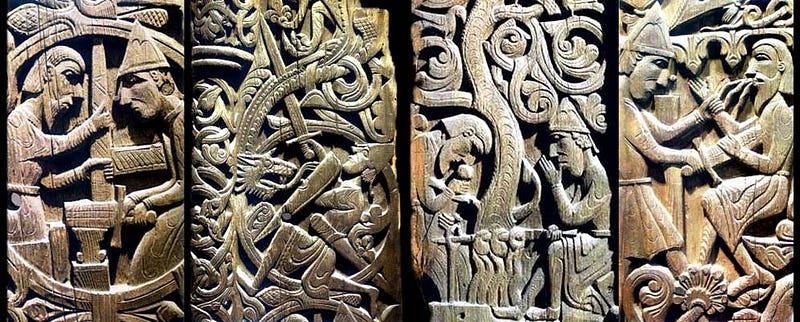
Carved Viking saga panels have been discussed previously in Signifier. Like the prehistoric cave paintings, they were intended to illustrate tales told by a live storyteller. Probably, during or after a gathering to feast, as the fires burnt low, the Viking bard or skald would recount the heroic saga depicted by deep relief carvings into the panels of the hall walls. The light from the storyteller’s torch would reveal the scenes in sequence and its flickering flames would set the shadows dancing to imply movement. Again, we have an early form of animation or primitive motion pictures. Around the same era as these graphic stories were being performed in the cold north of Europe, and entirely separate society across the Atlantic were creating the first recognisable comic books on paper…
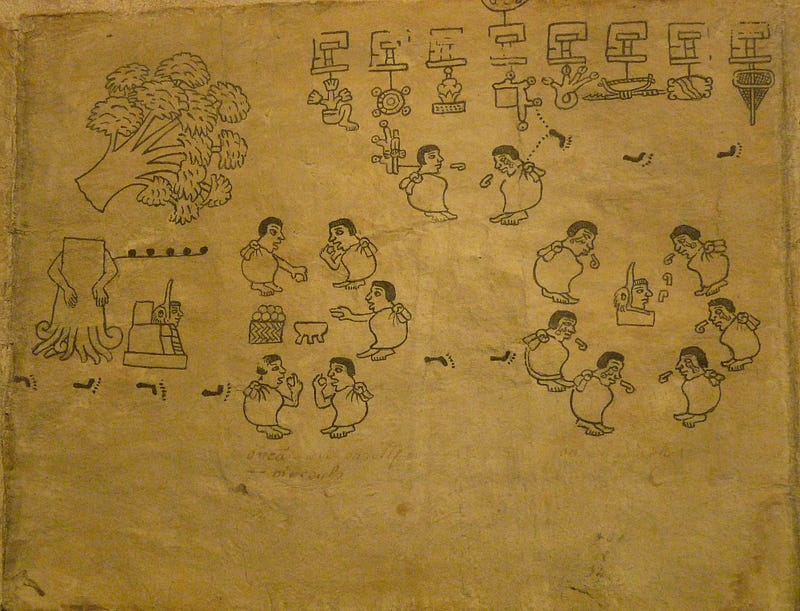
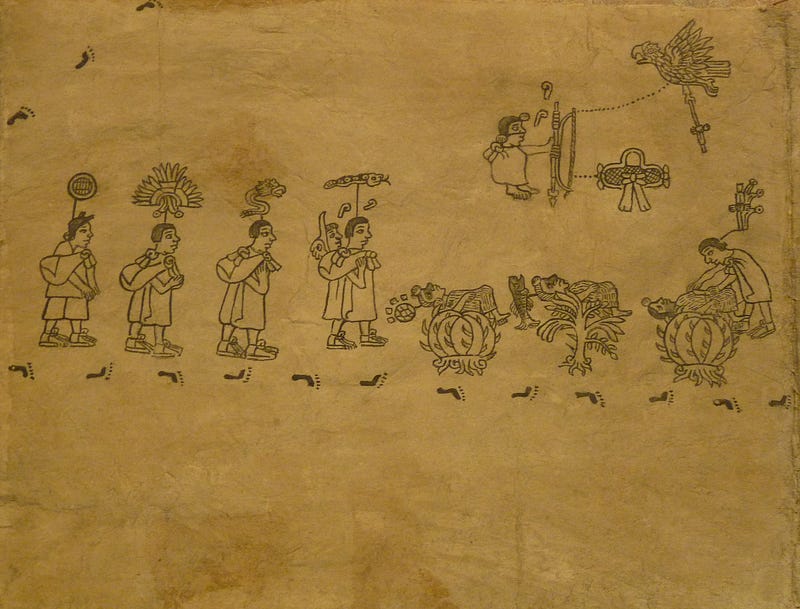
The Mexica Codex Boturini is among the first documents that could be accurately called a ‘graphic novel’. It recounts the migration of the Azteca between 1168 to 1355, though it was probably set-down sometime later. An exact date of making has not been agreed upon by scholars. Through comparing its style with other manuscripts, it’s generally believed it was drawn around the time of the Spanish Conquest, probably just before, which places it in the early sixteenth century. However, its storytelling conventions indicate an already long-established tradition.
The style has many similarities with Egyptian hieroglyphs, including the names of chiefs and priests hovering above the appropriate heads, very much like cartouches. Its iconography is much more intuitive, though, such as footprints to indicate long walks between each ‘chapter’ as the peoples move from one place to the next on their historic journey. They meet other tribes and deities along the way including the god Huitzilopochtli, to whom they offer the first human sacrifices.
.JPG)
.JPG)
It certainly tells an epic narrative, intended to be read page-by-page, presented in a concertina-folded book drawn onto amate — a type of paper made from tree bark. It includes the use of graphic devices that look remarkably like like speech balloons. Characters who speak are shown with scrolls coming from their mouths and this method of pictorially representing spoken language dates back as far as the sixth-century BCE among ancient Mesoamerican cultures.
The speech scrolls are usually blank but the conversation is implied by what is depicted in their surroundings and often by imagery denoting the characteristics of what is being said, rather than the actual words. For example a pictograph of a flint dagger tells us the talk is aggressive — a verbal attack. A feathered scroll tells us the person is talking softly or sometimes, given the cultural connotations of feathers, the words may be valuable or the language magical. Kings and high priests spoke with scrolls that were serpents — they talked the language of gods.
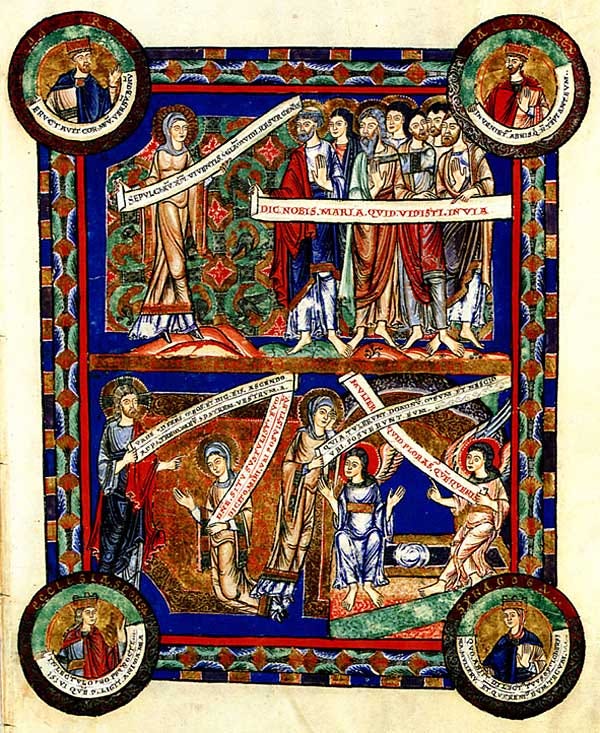

A visually similar solution to representing speech had developed independently in Medieval Europe. Scroll-like ‘banderols’ appeared in art to carry written text representing speech, particularly in religious narratives like the biography of Jesus and the lives of the saints. In early examples, these elongated scrolls were presented by the figure saying the words, they held them in their hands, taking ownership of the words. This eventually developed into placing the scrolls as if emanating from the mouth of the speaker. As art became more sophisticated, the scroll disappeared and the words seemed to float through the air, just as words do...
By far, the most striking early examples of this ground-breaking approach to graphic storytelling can be found in a codex known as Electorium Parvum seu Breviculum de Raimundus Lullus. Produced in the early 1320s, it was a collection of selected writings and a biography of the philosopher Ramon Lull, accompanied by a sort of ‘for beginners’ comic-style summary in 12 large ‘miniatures’. I know, confusing terminology. ‘Miniatures’ in medieval illuminated manuscripts are so called because of the prominent use of the red-lead pigment minium, intended to make important illustrations stand out. Indeed, they were often small, causing an etymological confusion.
The ‘miniatures’ of Electorium Parvum seu Breviculum de Raimundus Lullus are beautiful, full-page panels incorporating speech as text within the illustrations that are cited as the finest example of fourteenth-century French illumination. They are certainly innovative, highly distinctive, and appear astonishingly modern. Their subject, Ramon Lull of Palma, was a renowned philosopher who believed that it was possible to unite all faiths around a universal truth. He wrote some 200 works in Latin, Catalan, and Arabic, making him one the first important figures to write extensively in the vernacular, ensuring his ideas were more universally accessibly.
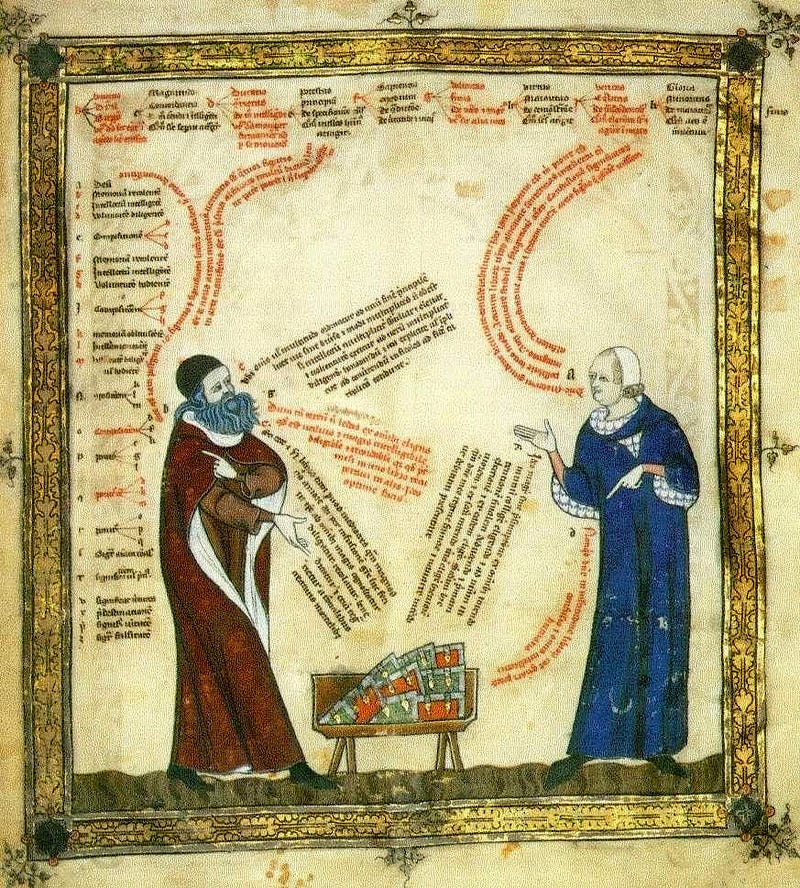
He was an intriguing, highly contradictory character. On one hand, he’s cited as among the first to propose the concept of the Immaculate Conception, and to support it with a persuasive argument, which led to it becoming a major doctrine of the Catholic Church. On the other, he’s credited with setting out the framework of computational logic we still use today! He proposed a device that would compute truthful answers to any given question using formal logic.
His book Ars Magna / The Great Art includes plans to make paper maquettes for Lullian Circles, mechanism of concentric rings that rotate and align to indicate answers. These are the first mechanical devices intended to propose fresh solutions arising from an existent data set. He hoped they could be used to discover common truths that would unite various philosophies and conflicting faiths. Lull is now recognised as a pioneer of modern computing.
The idea of Lullian Circles inspired the ‘alethiometer’, central MacGuffin of Philip Pullman’s His Dark Materials series of novels, and also the titular Box of Delights in John Masefield’s 1935 novel — filmed by the BBC in 1984 as the much loved Christmas classic starring Patrick Troughton, as ‘Ramon Lully’. Fascinating… but I digress!
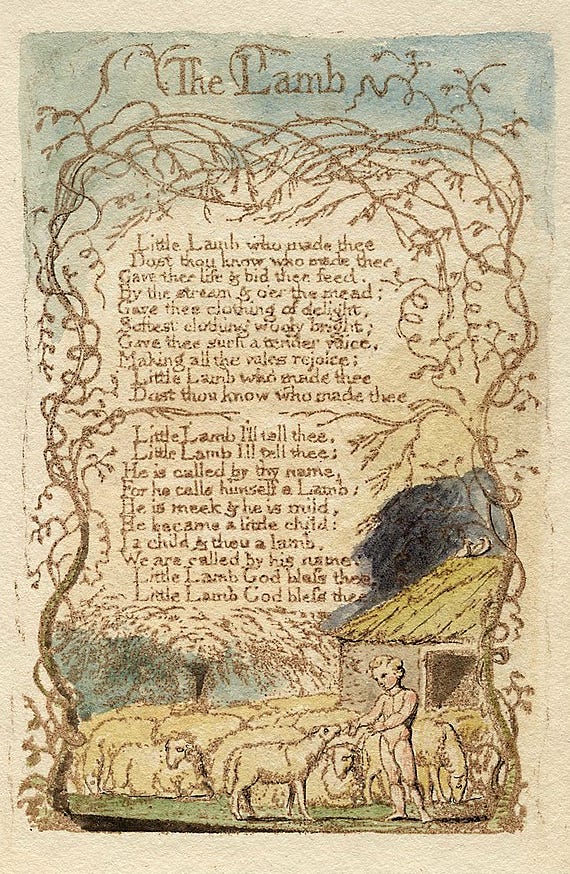
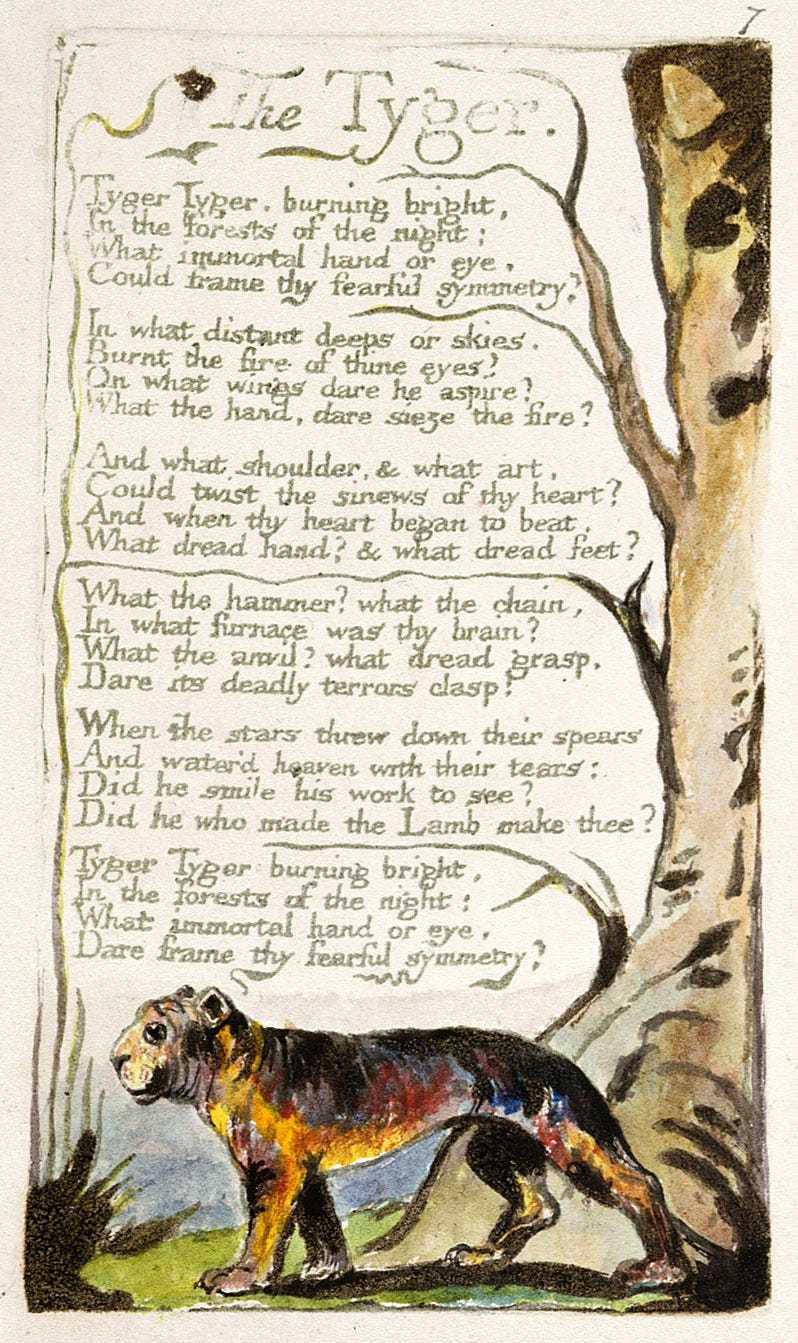


Possibly the next major step toward the graphic novel was taken by the visionary British artist-philosopher, William Blake. He claimed that it was his deceased brother, Robert, who visited him in a dream and told him of a new process of combining words seamlessly within an illustration… The result was a series of stunning illuminated poetic works of which Songs of Innocence and of Experience, published in 1794 as one complete volume, is the finest example. It remains one of my all-time favourite works of art, which I have previously discussed in Signifier.
The earliest cartoons a modern eye would instantly recognise as ‘a comic’ also began appearing around the end of the eighteenth-century, predominantly in England, France, and America. They were intended as satirical commentary on political personages and events, mainly associated with the Revolutionary period. These established the speech balloon conventions that persist today and were widely distributed, appearing in popular pamphlets. They are the immediate precursors of ‘The Funnies’ — short humorous comic strips that began to appear in American newspapers and magazines as early as 1895.
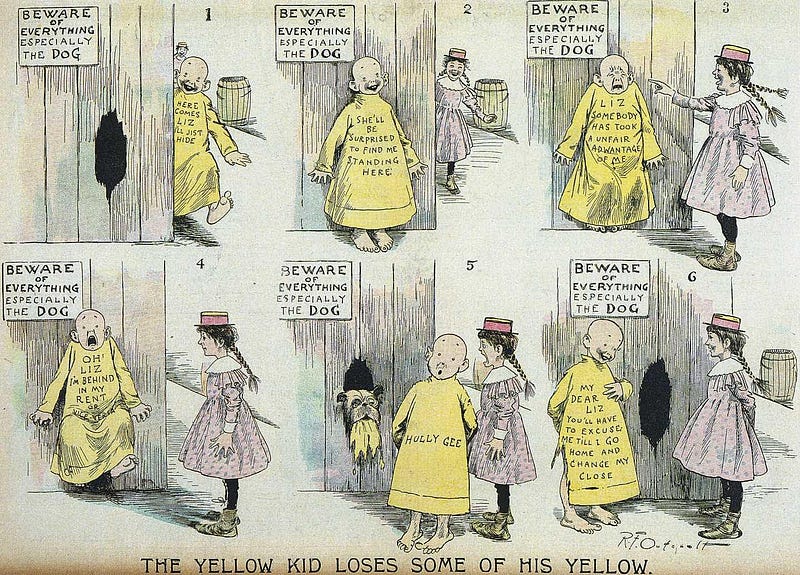
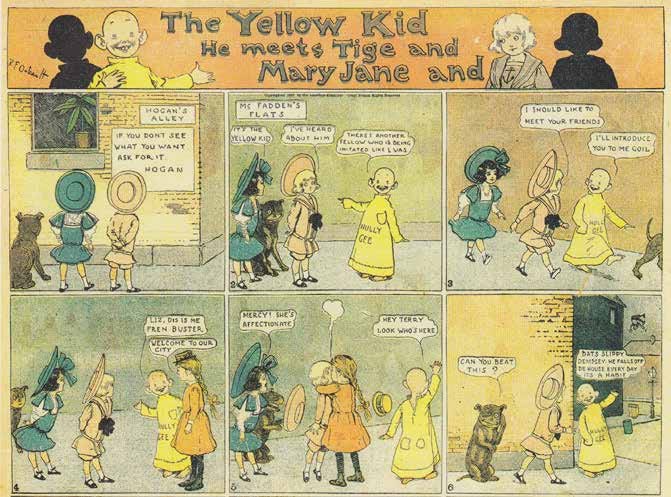
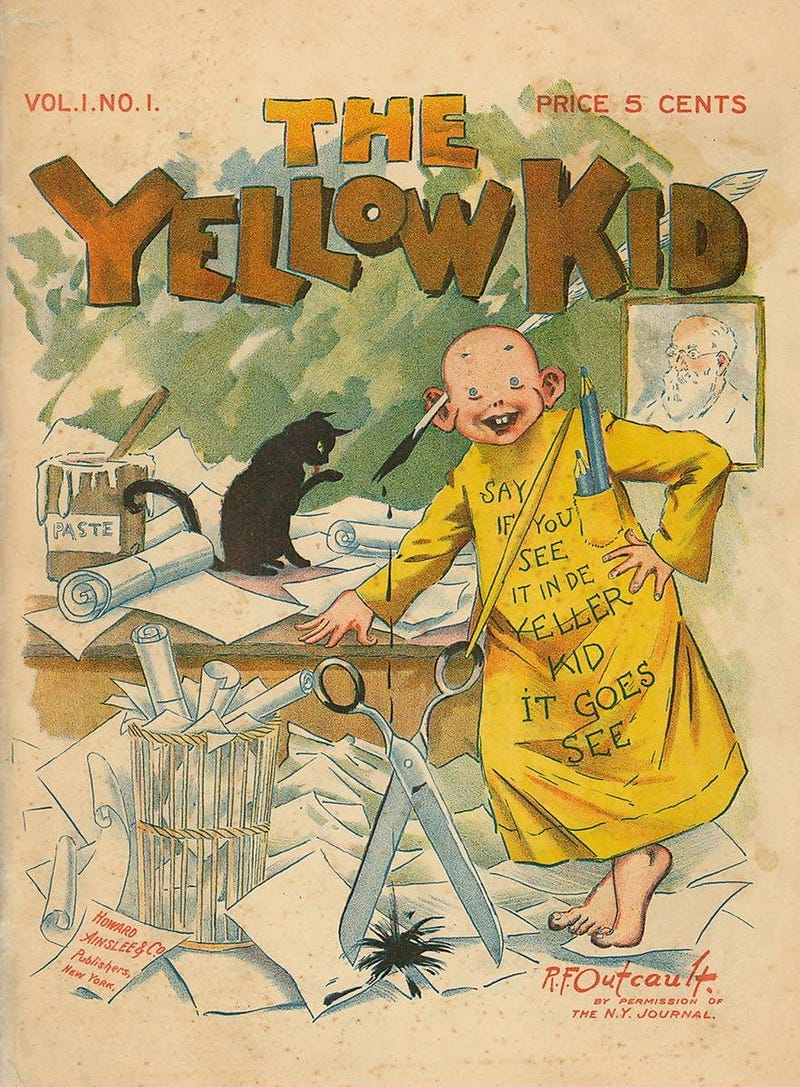
Some of those earliest strips featured a character that would become known as ‘The Yellow Kid’ a cheeky young chap who lived in the tenements of a rough part of town and got into all sorts of ‘humorous’ scrapes. First appearing in serious journals such as New York World and the New York Journal, they were aimed at grown-up readers and intended to be satirical, though much of the content may simply seem distasteful to modern eyes! Initially, the kid was his own speech balloon, with what he was saying appearing written on his yellow tunic. Conventional speech balloons were introduced in later issues. A compendium of the Yellow Kid’s misadventures was the first publication to self-identify as a ‘comic book’.
The comic book style of narrative image-making developed in parallel with the Silent Age of cinema. Although the pictures moved, they were still contained within rigid boundaries — the dimensions of the screen in place of the page format.
In the early days of motion picture, the size of the cameras along with the technicalities of continual cranking, and cumbersome set-ups, tended to keep the point of view locked down for each scene. So, each change of camera set-up represented a change in ‘story panel’. Instead of speech balloons and thought bubbles, we are presented with intertitles — textual captions that convey what may’ve been said.
Silent movies are a medium that bridges from the conventions of the narrative illustration, or comic strip form, to the audio-visual art of cinema as we know it today. Again, the narrator is separated from the imagery which, like cave art, serves to illustrate and emphasise within a larger narrative. Of course, now both the storyteller and the pictures are bonded together by the method of recording and are mutually dependant, collaborating to tell the ‘whole story’. It’s quite fitting then, that the biggest cinematic genre right now is comic book adaptations and superhero reboots.
.jpg)

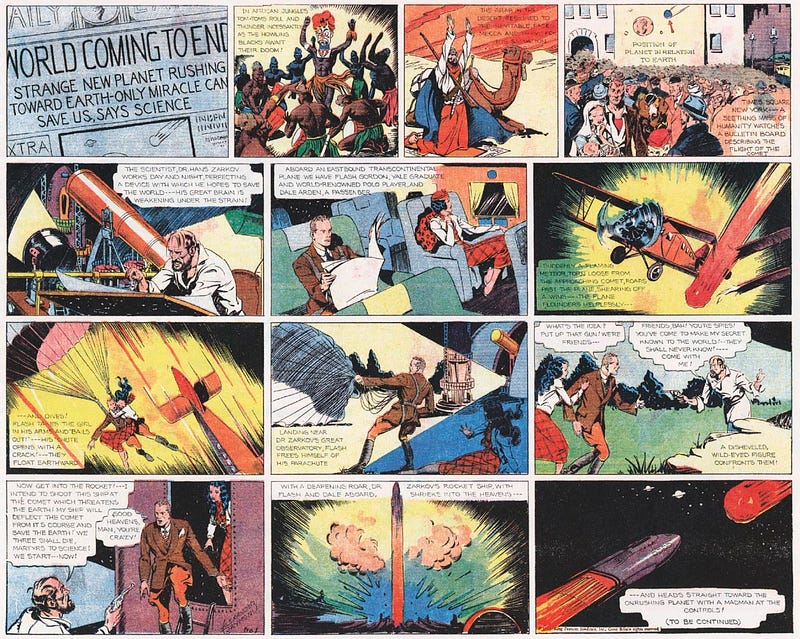
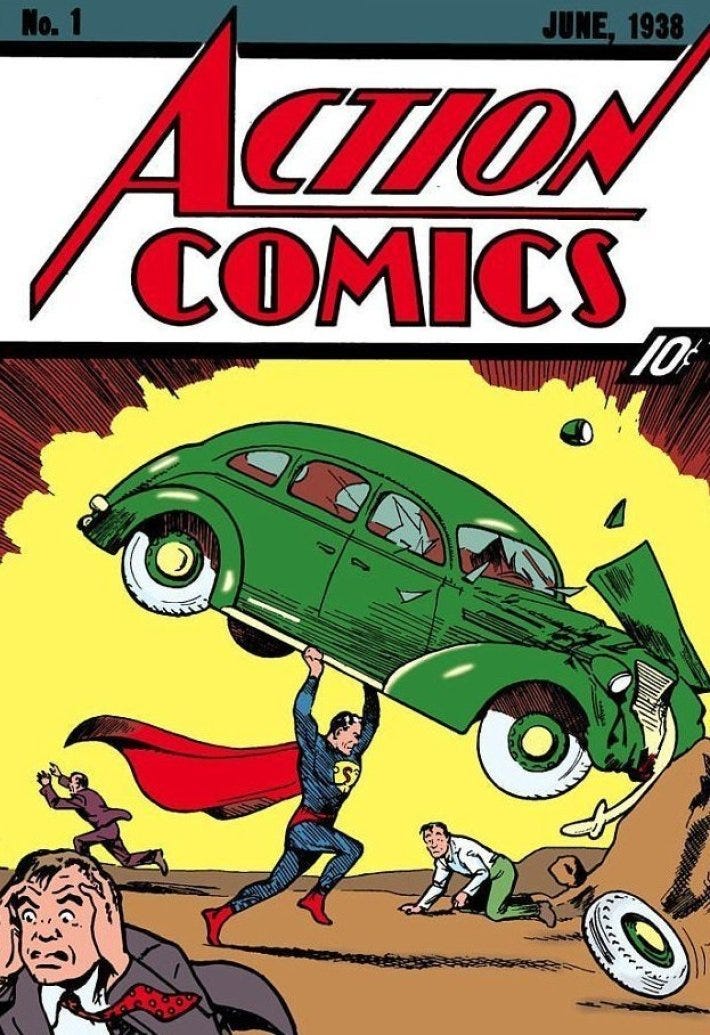
It became commonplace for comics to accompany newspapers as pull-out supplements in the 1920s. By the 1930s, they were recognised as a medium in their own right, published as stand-alone magazines. Probably, the earliest comic that sits comfortably with our contemporary notion of what a comic is would’ve been is Buck Rogers in the 25th Century A.D. first published in 1929, the same year that saw the first Tarzan comic-book adaptations. Flash Gordon, would follow in 1934, specifically conceived as an ongoing story for the comic format to capitalise on the new appetite for space adventure and, in 1938, DC Comics would launch the first issue of Action Comics, which would usher in the Golden Age of ‘the superhero’ with both Superman and Batman debuting in its pages.
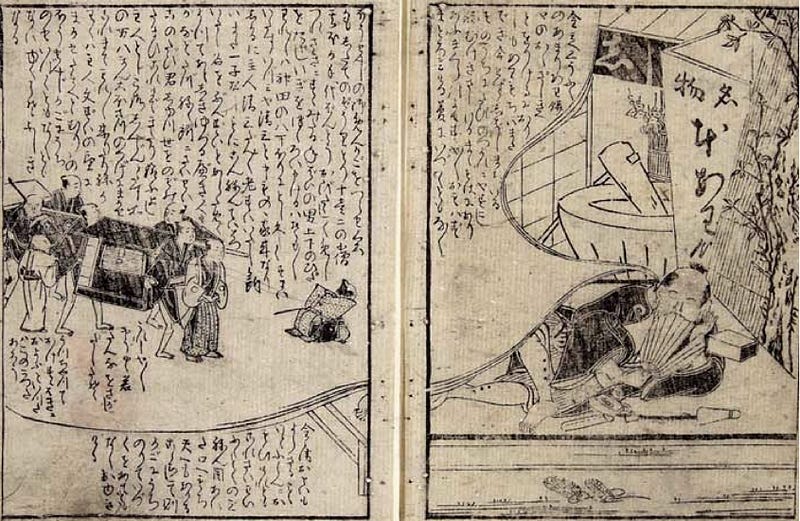
Here, we have tracked the evolution of storytelling with narrative images from a western viewpoint, so it’s worth noting the parallel development of comics in the far east. Before Manga and Anime occupied such a central position in popular culture, there were the Kibyōshi. These were short narrative picture books with content that concentrated on contemporary issues, from serious political protest to frivolous fashion trends. The story was told mainly through the sequential images and speech, often gossipy and using slang of the day, was incorporated into the white space. They attracted adult readers and became hugely popular in the late eighteenth-century. The first Kibyōshi of note was Kinkin Sensei Eiga no Yume, by the artist Koikawa Harumachi, published in 1775. It was grandly retitled in translation as Master Flashgold’s Splendiferous Dream!
* All images are used with permission or presented here for educational purposes under fair usage policy.