avatarRemy Dean

Free AI web copilot to create summaries, insights and extended knowledge, download it at here

3674

Abstract

is studies for such ambitious, and beautiful, constructions led to an understanding of architectural space that he was fond of exploiting in his paintings. He never employed strict ‘geometrical’ perspective, experimenting instead with the combination of vanishing point and parallel perspectives that he had observed in some ancient Roman murals.</p><p id="d852">Though this was not entirely convincing to the eye, it demonstrated a new interest in the ideals of Classical art and was to influence many other artists that followed. The buildings in the chapel frescoes are given rectilinear structure so that they look rather like stage sets, constructed using forced perspective. There is no attempt to render them to scale and sections are cut-away, opened-up like dollhouses to reveal the ‘players’ within.</p><p id="f188">As well as achieving an almost Expressionistic effect, this gives the panels the dramatic presence of a tableau, as if being staged for an audience. Indeed, the chapel was built with the intention of hosting the annual mystery plays that had been traditionally performed before the neighbouring Scrovegni Palace. Fittingly, the Palace had been constructed with a curved façade, echoing the size and shape of the Roman ruins that provided part of its foundation.</p><p id="dbb8">Possibly, his most accomplished use of perspective can be seen in the two <i>trompe l’oeil </i>views of ‘secret chapels’. These <i>Coretti</i> appear to be beyond the impenetrable surface of the wall, each side of the triumphal arch that leads to the apse. Their common perspective is convincing when viewed from a particular point at the centre of the chapel, approaching the altar. This apparently three-dimensional space is an accomplished illusion that exists only in the mind of the viewer and can be interpreted as a metaphor of ‘the beyond’.</p><figure id="36f0"><img src="https://cdn-images-1.readmedium.com/v2/resize:fit:800/1*J28zyjM5rTQ44kZRpTGVKg.jpeg"><figcaption><b>the left ‘Correti’ *</b></figcaption></figure><p id="9b76">Giotto worked in the Medieval method of a Master overseeing Apprentices and Journeymen. The <i>Scrovegni </i>decoration was a monumental task and as many as forty collaborated in the production of the frescoes. They would’ve prepared the plaster panels and transferred Giotto’s cartoons. The painting then had to be executed rapidly before the plaster dried. Apprentices would’ve mixed much of the pigment and blocked-in the larger areas of colours. Some would’ve been trusted to added simpler details. Others would be constructing and moving platforms to reach the vaulted ceilings.</p><p id="1ff8">Even with this highly coordinated approach, it’s estimated that the the frescoes would’ve taken at least 625 days to paint. The amount that could be achieved each day is limited by the time it took for the plaster to dry. The term ‘<i>fresco</i>’ means ‘fresh’ as the technique relied on the plaster being freshly applied so it absorbed, and permanently bonded with, the pigments. After the surface has dried and set, any further painting would just peel away.</p><p id="91cd">Giotto’s distinctive style prefigures the Florentine High Renaissance, which would follow nearly two centuries later, and certainly represents transition from the <a href="https://readmedium.com/more-than-a-christmas-card-b5cf0a996f65">Byzantine</a>. The most noteworthy innovation that Giotto brought to late thirteenth and early fourteenth-century icon painting was the introduction of figures that appear animated and emotional.</p><p id="3818">Instead of elongated figures that resembled cut-out standees, with stylised hands and faces, Giotto introdu

Options

ced a human naturalism that approaches accurate anatomical proportioning. The fabrics of clothes suggest volume, and drape in a way that describe the form beneath. He drew from direct observation so each face seems to be a portrait rather than being simply painted according to formula.</p><p id="f857">Until this point, the Byzantine and Gothic traditions had followed an accepted ‘pattern book’. Art had fallen back into the template mode and, like <a href="https://readmedium.com/prehistoric-graffiti-1772fe141c77">cave paintings</a> and <a href="https://readmedium.com/akhenaten-the-rock-star-pharaoh-250d5ef8ba81#2153">hieroglyphics</a>, was closer to picture-writing than expressive art. Development had been arrested to maintain consistency. For centuries, human figures had generally been portrayed as static with simple, passive expressions and using a limited choice of approved poses.</p><figure id="179a"><img src="https://cdn-images-1.readmedium.com/v2/resize:fit:800/1*5ncyASoQWU5TmMdLV-Guig.jpeg"><figcaption></figcaption></figure><figure id="84f7"><img src="https://cdn-images-1.readmedium.com/v2/resize:fit:800/1*mD9tyHbvwo7l847APK8rxw.jpeg"><figcaption><b>‘Crucifixion’ and ‘Lamentation’ panels by Giotto for ‘Capella degli Scrovegni’ (c.1305) </b>[view license<a href="https://commons.wikimedia.org/wiki/File:Giotto_Cruxifixion.jpg"> 1 </a>and<a href="https://commons.wikimedia.org/wiki/File:Giotto_-_Scrovegni_-_-36-_-_Lamentation_(The_Mourning_of_Christ)_adj.jpg"> 2 </a>]</figcaption></figure><p id="3c3a">The <i>Scrovegni</i> frescoes, particularly those depicting the <i>Crucifixion </i>and the <i>Lamentation</i>, show groups of people who interact in a dramatic way. They gesture, they argue, they weep… they <i>emote</i>. From the body-language and facial expressions, one can almost tell what they are saying, maybe even how they are feeling. This effectively exploits viewer empathy as a storytelling tool.</p><p id="df66">Giotto’s influence is palpable in the work of the Limbourg Brothers, particularly for the calendar pages of <i>The Book of Hours of Duke Berry</i> aka <i>Très Riches Heures du Duc Berry, </i>completed a century later, circa 1410, and which employ a very similar forced perspective for architectural details. Much of what Giotto pioneered was fully achieved in 1432 by Jan Van Eyck in his famous <a href="https://readmedium.com/altering-perceptions-of-altars-3d853ba162cb"><i>Ghent Altarpiece</i></a>.</p><p id="6b59">The advances made by Giotto remain apparent in the work of Michelangelo. It’s said he was inspired to paint the <a href="https://readmedium.com/michelangelo-working-for-god-9c9ddda9ccfc#d414">Sistine Chapel</a> because he so admired the <i>Scrovegni</i> panels.</p><p id="7908">Giotto’s patron for this project, Enrico Scrovegni is now buried along with his wife Jacopina d’Este, in the apse of the chapel. Ironically, this area was significantly altered about two decades after Giotto completed his work. His original frescoes were destroyed and replaced by another, unknown artist. Thankfully though, because the <i>Capella degli Scrovegni</i> was a consecrated church and tomb, it survived the demolition of the Scrovegni Palace, to which it was originally annexed.</p><figure id="f48d"><img src="https://cdn-images-1.readmedium.com/v2/resize:fit:800/1*BeoRmKRDWgS28lgg12ld_A.jpeg"><figcaption><b>‘Cappella degli Scrovegni’ exterior</b> [<a href="https://commons.wikimedia.org/wiki/File:La_Cappella_degli_Scrovegni.JPG">view license</a>]</figcaption></figure><p id="4558">* <i>All images are used with license, or presented here for educational purposes under fair usage policy.</i></p></article></body>

Father of the Renaissance

With his dramatic ‘graphic novel’ frescoes, telling the story of Jesus, Giotto brought art out of the Dark Ages and sparked the Renaissance imagination.

The Capella degli Scrovegni is also known as The Arena Chapel as it was sited adjacent to the ruins of a Roman arena in the Italian town of Padua. Built at the dawn of the fourteenth century, its exterior is comparatively modest, though there’s an interesting combination of Gothic accents with predominantly Neo-classical features. Inside, it’s a different story...
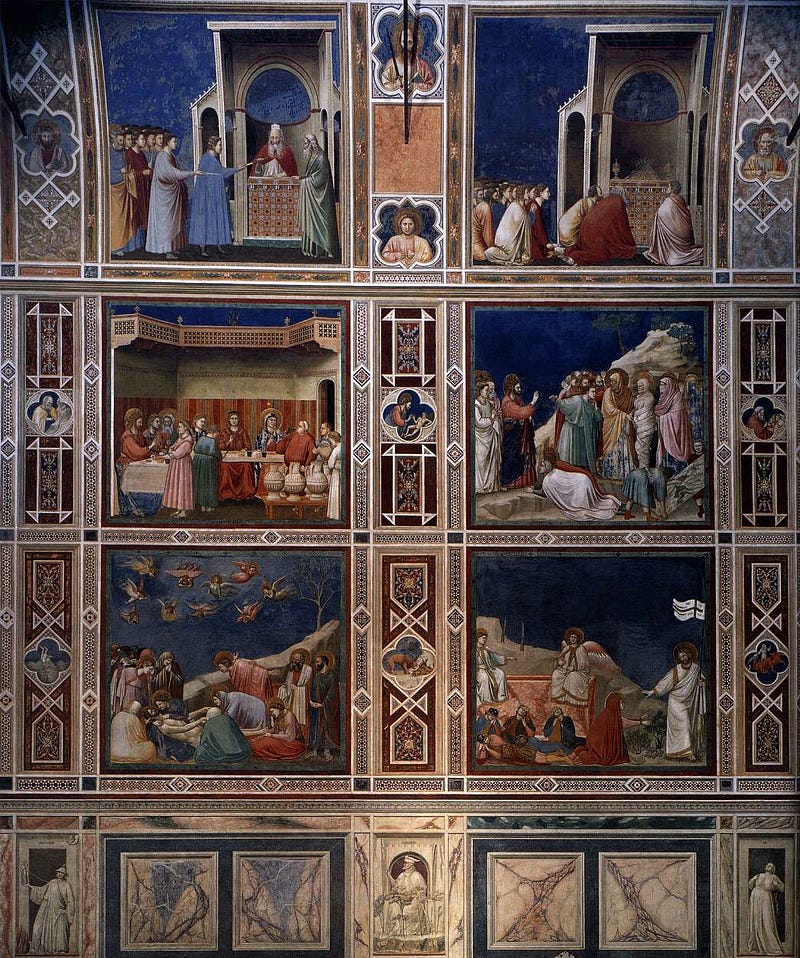
‘Capella degli Scrovegni’ fresco section showing six narrative panels and the allegorical figures of ‘Infidelity’, ‘Injustice’ and ‘Wrath’ [view license]

Between 1303 and 1305, Giotto di Bondone decorated the interior of this purpose-built chapel with more than fifty scenes showing an extended biography of Christ. It’s unusually comprehensive, starting with Mary’s father Saint Joachim, then the life of Mary, then key events in the life — and afterlife — of Jesus. There are also several allegorical figures, rendered in monochrome, depicting the opposing vices and virtues. These frescoes are considered among the most important works of the Late Gothic period and one of the earliest expressions of Renaissance ideology.

Relatively little is known, for sure, about Giotto. He was born in the late 1260s, which would make him in his mid-thirties when he began work on the Scrovegni Chapel. He was a ‘proto-renaissance man’ — painter, sculptor, architect and theorist. He brought aspects of these disciplines together, developing a more holistic approach than his predecessors. He’s been called the “Father of the Renaissance” because many important artists, particularly Michelangelo, absorbed his aesthetic approach and learned some of their technique from the study of his works.

Reputedly, his influence extended beyond visual art. According to the historian Giorgio Vasari (who’s credited with first using the term ‘Renaissance’ to define the period), Dante Alighieri visited Giotto whilst he was creating the murals for the Capella degli Scrovegni. The poet was suitably impressed, not only with the quality of the painting, but by the use of narrative structure in the epic sequence of panels, which to the modern eye begin to look like a ‘graphic novel’.
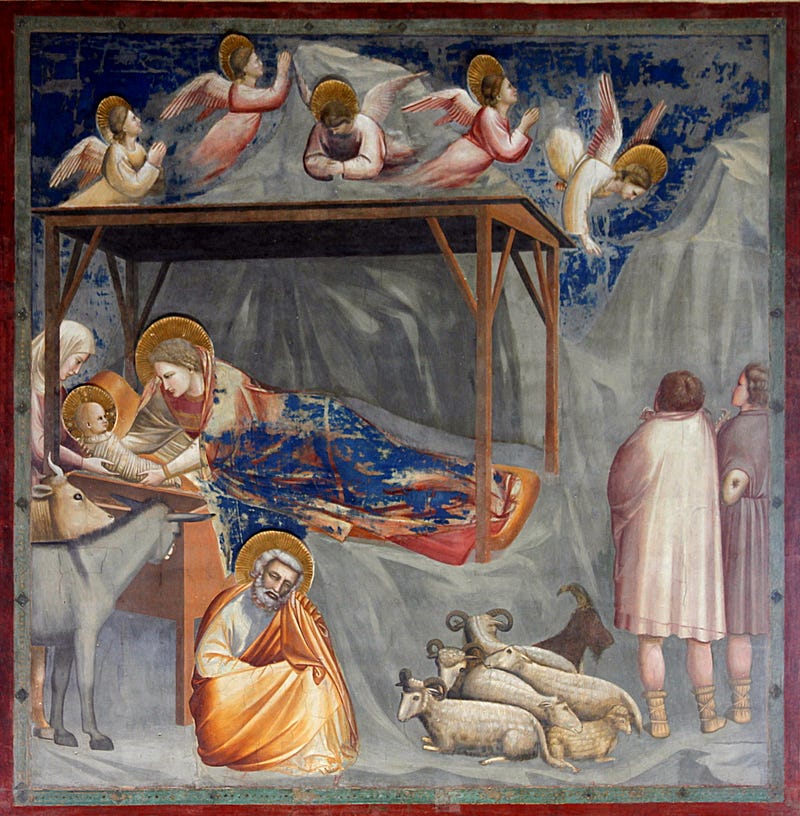
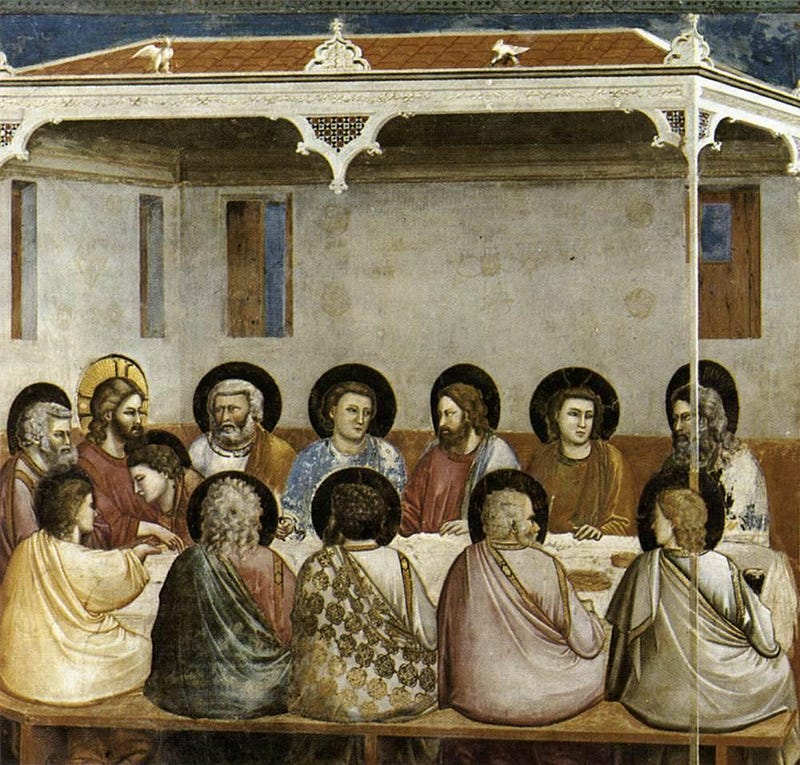
‘Nativity’ and ‘Last Supper’ panels by Giotto for ‘Capella degli Scrovegni’ (c.1305) [view license 1 and 2 ]

Among Giotto’s innovations was the beginning of formal perspective. He was also an architect, and would later oversee the building of the first Campanile tower for Florence Cathedral. His studies for such ambitious, and beautiful, constructions led to an understanding of architectural space that he was fond of exploiting in his paintings. He never employed strict ‘geometrical’ perspective, experimenting instead with the combination of vanishing point and parallel perspectives that he had observed in some ancient Roman murals.

Though this was not entirely convincing to the eye, it demonstrated a new interest in the ideals of Classical art and was to influence many other artists that followed. The buildings in the chapel frescoes are given rectilinear structure so that they look rather like stage sets, constructed using forced perspective. There is no attempt to render them to scale and sections are cut-away, opened-up like dollhouses to reveal the ‘players’ within.

As well as achieving an almost Expressionistic effect, this gives the panels the dramatic presence of a tableau, as if being staged for an audience. Indeed, the chapel was built with the intention of hosting the annual mystery plays that had been traditionally performed before the neighbouring Scrovegni Palace. Fittingly, the Palace had been constructed with a curved façade, echoing the size and shape of the Roman ruins that provided part of its foundation.

Possibly, his most accomplished use of perspective can be seen in the two trompe l’oeil views of ‘secret chapels’. These Coretti appear to be beyond the impenetrable surface of the wall, each side of the triumphal arch that leads to the apse. Their common perspective is convincing when viewed from a particular point at the centre of the chapel, approaching the altar. This apparently three-dimensional space is an accomplished illusion that exists only in the mind of the viewer and can be interpreted as a metaphor of ‘the beyond’.
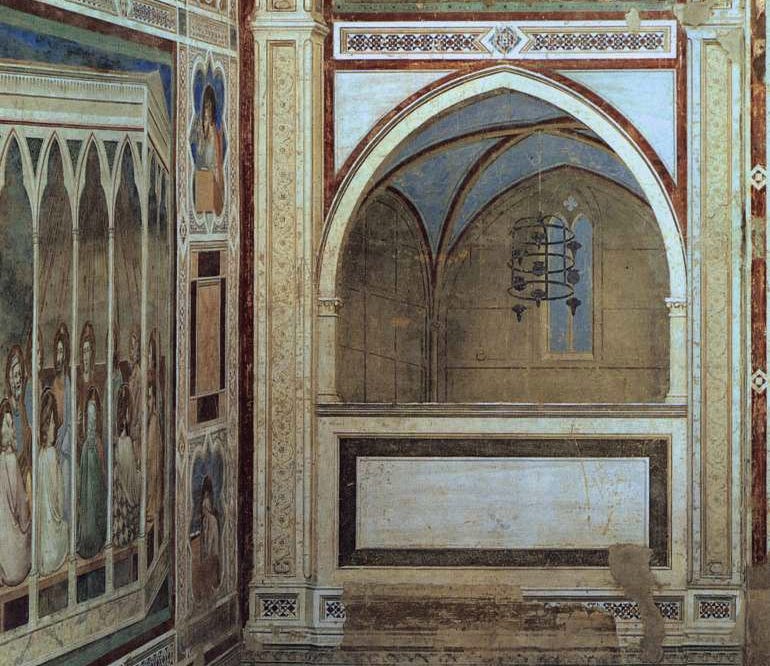
the left ‘Correti’ *

Giotto worked in the Medieval method of a Master overseeing Apprentices and Journeymen. The Scrovegni decoration was a monumental task and as many as forty collaborated in the production of the frescoes. They would’ve prepared the plaster panels and transferred Giotto’s cartoons. The painting then had to be executed rapidly before the plaster dried. Apprentices would’ve mixed much of the pigment and blocked-in the larger areas of colours. Some would’ve been trusted to added simpler details. Others would be constructing and moving platforms to reach the vaulted ceilings.

Even with this highly coordinated approach, it’s estimated that the the frescoes would’ve taken at least 625 days to paint. The amount that could be achieved each day is limited by the time it took for the plaster to dry. The term ‘fresco’ means ‘fresh’ as the technique relied on the plaster being freshly applied so it absorbed, and permanently bonded with, the pigments. After the surface has dried and set, any further painting would just peel away.

Giotto’s distinctive style prefigures the Florentine High Renaissance, which would follow nearly two centuries later, and certainly represents transition from the Byzantine. The most noteworthy innovation that Giotto brought to late thirteenth and early fourteenth-century icon painting was the introduction of figures that appear animated and emotional.

Instead of elongated figures that resembled cut-out standees, with stylised hands and faces, Giotto introduced a human naturalism that approaches accurate anatomical proportioning. The fabrics of clothes suggest volume, and drape in a way that describe the form beneath. He drew from direct observation so each face seems to be a portrait rather than being simply painted according to formula.

Until this point, the Byzantine and Gothic traditions had followed an accepted ‘pattern book’. Art had fallen back into the template mode and, like cave paintings and hieroglyphics, was closer to picture-writing than expressive art. Development had been arrested to maintain consistency. For centuries, human figures had generally been portrayed as static with simple, passive expressions and using a limited choice of approved poses.
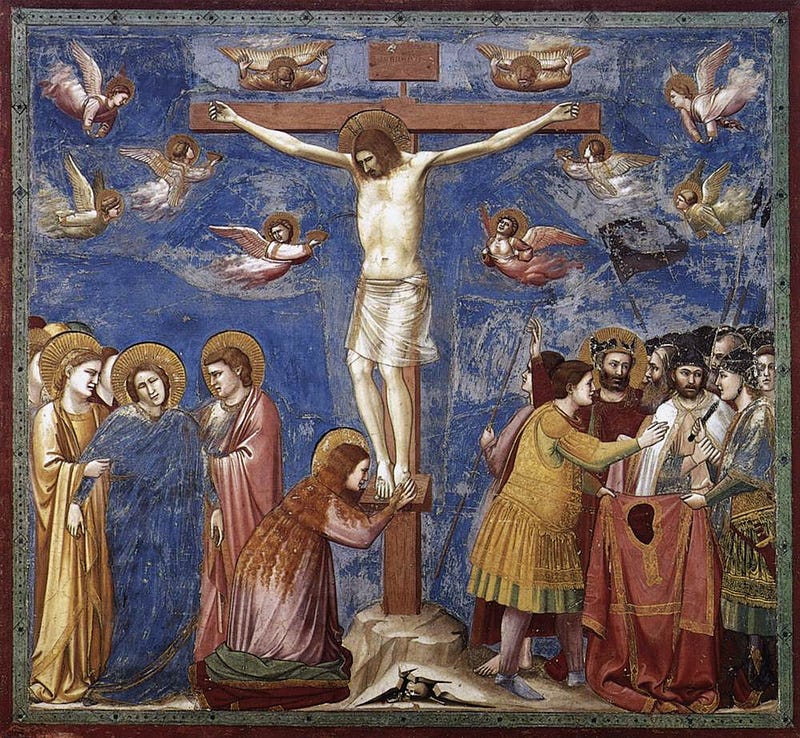
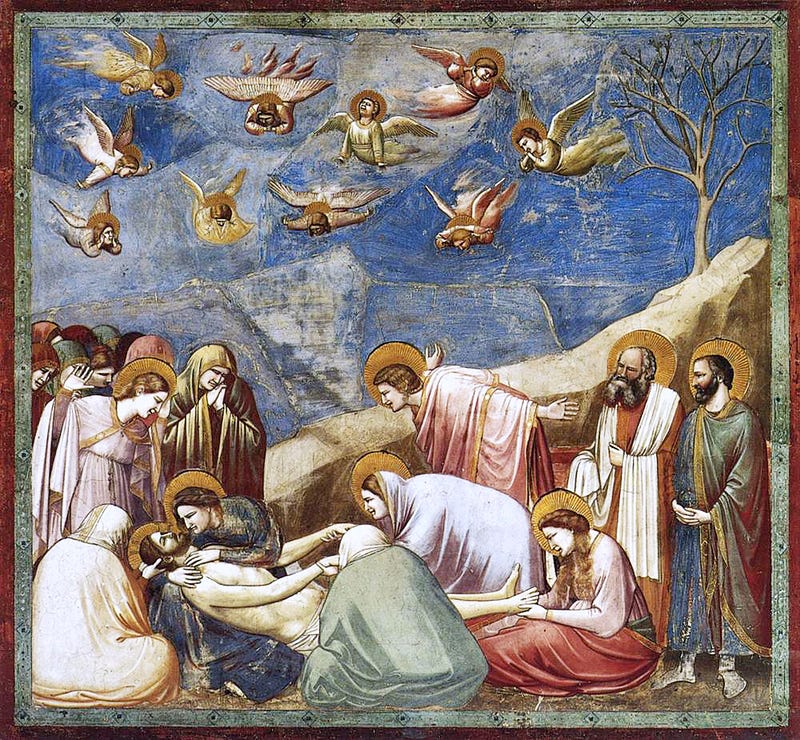
‘Crucifixion’ and ‘Lamentation’ panels by Giotto for ‘Capella degli Scrovegni’ (c.1305) [view license 1 and 2 ]

The Scrovegni frescoes, particularly those depicting the Crucifixion and the Lamentation, show groups of people who interact in a dramatic way. They gesture, they argue, they weep… they emote. From the body-language and facial expressions, one can almost tell what they are saying, maybe even how they are feeling. This effectively exploits viewer empathy as a storytelling tool.

Giotto’s influence is palpable in the work of the Limbourg Brothers, particularly for the calendar pages of The Book of Hours of Duke Berry aka Très Riches Heures du Duc Berry, completed a century later, circa 1410, and which employ a very similar forced perspective for architectural details. Much of what Giotto pioneered was fully achieved in 1432 by Jan Van Eyck in his famous Ghent Altarpiece.

The advances made by Giotto remain apparent in the work of Michelangelo. It’s said he was inspired to paint the Sistine Chapel because he so admired the Scrovegni panels.

Giotto’s patron for this project, Enrico Scrovegni is now buried along with his wife Jacopina d’Este, in the apse of the chapel. Ironically, this area was significantly altered about two decades after Giotto completed his work. His original frescoes were destroyed and replaced by another, unknown artist. Thankfully though, because the Capella degli Scrovegni was a consecrated church and tomb, it survived the demolition of the Scrovegni Palace, to which it was originally annexed.
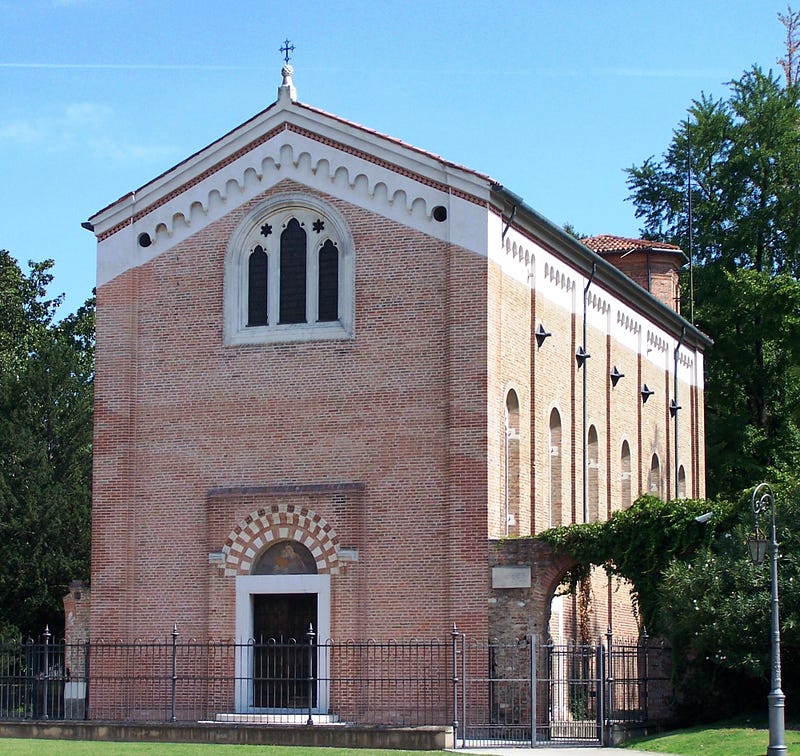
‘Cappella degli Scrovegni’ exterior [view license]

* All images are used with license, or presented here for educational purposes under fair usage policy.

Art
Art History
Painting
Gothic
Icons
Recommended from ReadMedium