
Roman Statues in the Greek Style
For half a millennium, the Roman Empire was purveyor and destroyer of classical art and western culture…
The Romans based much of their culture on that of the ancient Greeks and their art was copied directly. Roman sculptors would hone their skills by copying the bronzes of the classical Greek masters. To begin with, most Roman statues perpetuated the same conventions of style and aesthetics, though gradually things developed and Roman style diverged, albeit subtly, from the Greek. This is a good example of how the art of society, and that society's attitude toward art, signifies its core values.
The relaxed contrapposto stance of classical Greek sculpture evolved into a more distinctively Roman authoritarian stance. The facial features also became more severe again and the fleshy texture fell from fashion. The Romans wanted their statues to look like stone or metal in order to emphasise the enduring properties of the materials, and so imply that their culture would have similar longevity.
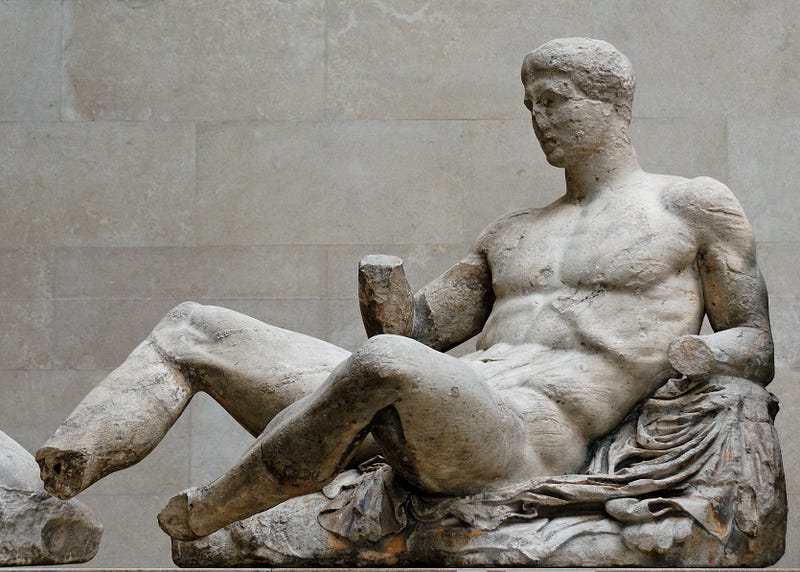
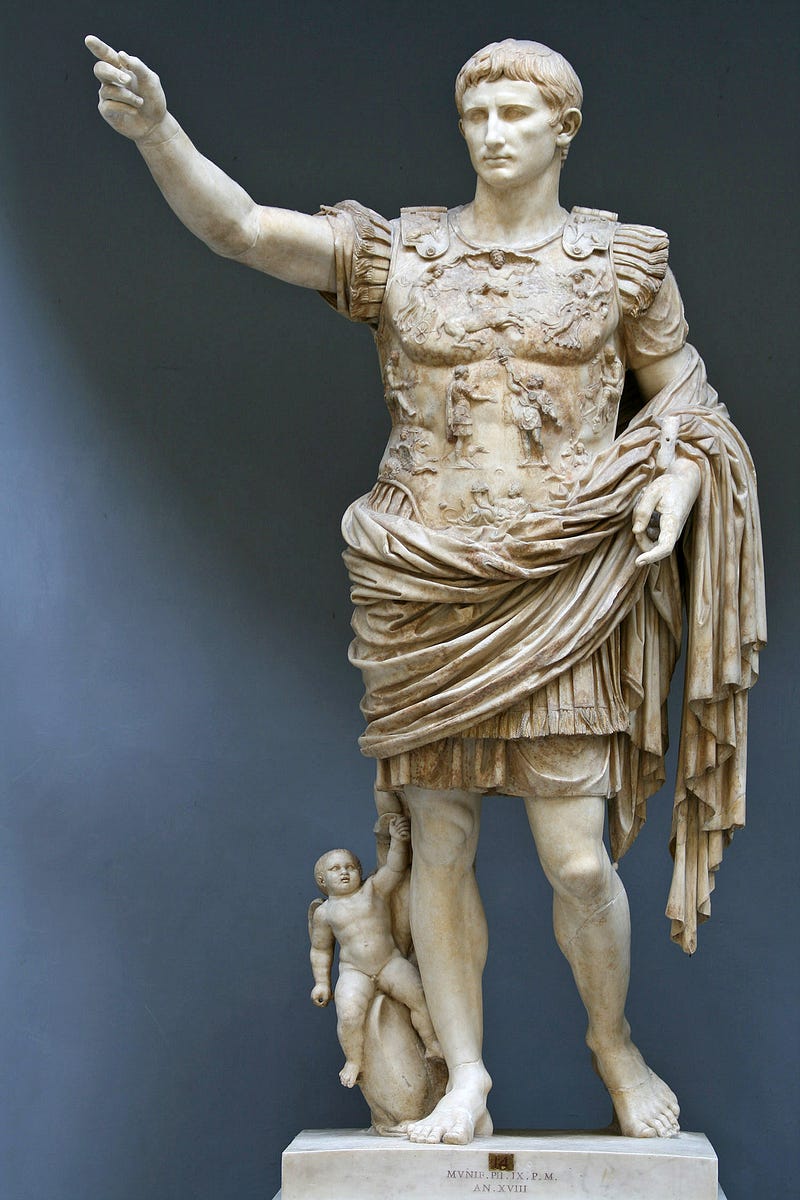


They wanted the faces of their leaders and Caesars to appear strong, hard and unyielding. They often posed holding a weapon, a symbol of office or simply indicating a direction with raised arm. There’s no denying the skill of the Roman era sculptors and there is a clear attempt to make the portrait heads as accurate as possible whilst, no doubt, remaining flatteringly idealised.
One of the first things the Roman Empire would do when it absorbed a new territory was to carve their laws in a stone slab and display it prominently in town squares, marketplaces, and outside houses of authority. Literally, the letter of the law and hence the phrase we still use to this day, “it’s written in stone”, or if a rule may be challenged, or at least ‘bent’, “it’s not written in stone.” I always prefer to hear the latter.
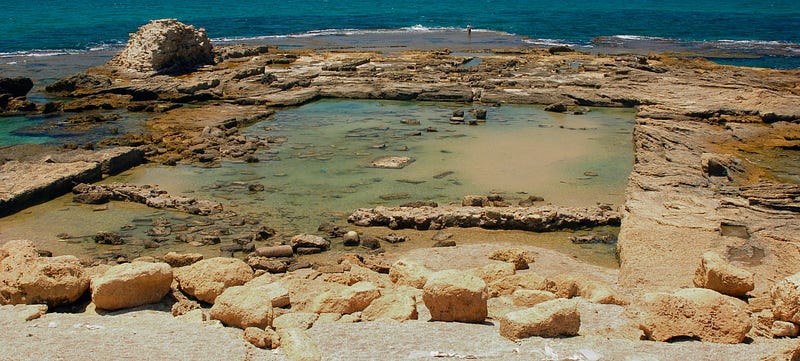

The Romans added new techniques and technology to art and architecture. They invented concrete, for example, and used it architecturally. Though they did nothing to improve on the conventions of the Greeks… The Romans were also very reactionary and did not like the ideas represented by humanism and democracy.
Although the concept behind carving their laws in stone was to ensure they applied to every citizen no matter their rank or privilege, those laws certainly did not apply to their slaves or those who were not recognised as citizens of the Roman Empire. They also re-introduced the idea of ‘the divine king’, making their emperors, or Caesars, above the law…
The Romans took the whole Greek pantheon of gods and simply re-named them, though their attitude to their gods was a major throwback. The Greeks had used their gods as metaphor. Prominent heroes in their literature and drama challenged the gods, winning-through to take control of their own destinies. In contrast, Roman culture promoted superstition, supplication and sacrifice. Gods were once again all-powerful dictators of human destiny. The Caesars went to great lengths to claim that they were descended from the gods, or were in fact gods themselves.
Of course, the Roman Empire grew to include most of Europe and with this expansion spread many of those ideals adapted from the classical Greeks. Unfortunately, their culture also became increasingly bloodthirsty and morally juvenile. They enjoyed sadistic sport such as gladiatorial combat and theatrical executions. As the Roman Empire grew, the power of their senate diminished and eventually, with the conversion to Christianity, the Roman Emperors were promoted as direct representatives of god. Their authority could not be challenged and they ruled over the vast territories as fascist dictators.
The word ‘fascist’ derives from the symbolism of the Roman Fasces which depicts a long-shanked axe surrounded by a bundle of rods to form a cylinder bound together by rope or ribbon.

Still prevalent in the national iconography of the USA to this day, it symbolises strength through unity, the masses bound to a single leader that will strike a decisive blow on their behalf. The shank of the long reaching weapon is strengthened by its supporters, and the single axe-head, or sometimes a spear, represents the single non-negotiable outcome, as dictated by the leader.
As a cultural signifier, the Fasces replaced the Labrys, which had been an important symbol since the dominance of the proto-Greek Minoans. The Labrys was also an axe, but what it represented was, at least to begin with, entirely different. The two heads mounted on a single shaft implied that there is always an alternative, the decision could fall either way and still be just as effective. It represented a balanced approach to things, duality in its many forms and, to some extent, equality.
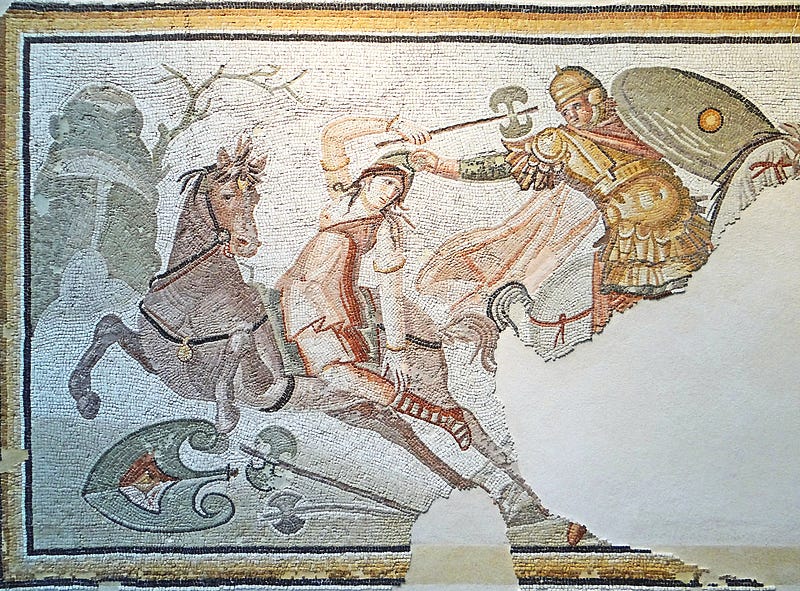

As with many ancient symbols, the fascist movements of the early twentieth century misunderstood and re-appropriated the Labrys as interchangeable with the Fasces. This association persisted until the 1970s, when it was adopted as the symbol of lesbian rights movements, mainly because of its association with the mythologised Amazons — that’s the matriarchal clan of formidable women worriers from the area north-east of the Caspian sea, nothing to do with the South American rain forests or the delivery service. The double-headed axe motif is also popular among modern pagans and fantasy role-pay gamers.
Throughout history, the rise of fascism within a society has always signified that society’s decline. This leaning is often first expressed in artistic conservatism. Authoritarian regimes tend to favour populist, traditional, and explicit approaches over the more challenging abstract, conceptual and poetic. This change in the core concepts of classical Roman culture marks the decline and eventual fall of the Roman Empire. They had spread themselves too thin and attempted to govern too many people who resisted their rule.
A combination of other factors also contributed to the downfall of the Roman Empire, such as disease, dissent, secession, lead poisoning and insane leaders whose mad commands could not be easily questioned. (Let’s be on the look-out for any of those tell-tale warning signs, shall we?)
Ironically, most of the so-called classical Greek statues were destroyed and we mainly know of them in the form of Roman copies. As symbols of a pagan past, the majority of Greek bronzes were melted down to be recycled in the making of cannons or to be recast as religious icons for the expanding Church. Many of the ancient marble statues were broken up and used as aggregate for road building or for bulking out concrete.
Of course, in many respects the Roman Empire did not fall. It split into the western and eastern empires. The latter ran on until the mid-Fifteenth Century, but the former petered out in the Fourth. Some might say it survived in the form of the Roman Catholic Church, which was to dictate nearly all western aesthetics and artistic themes (and lack thereof) for the millennium that followed. We now refer to that period as The Dark Ages.
A version of this article was first published in my book Evolution of Western Art (questing beast books, 2012)