
The Mythic Minoans
King Minos and the Minoans were a myth to the Ancient Greeks and remained the stuff of legend until their capital at Knossos was discovered thousands of years later on the island of Crete…
The Minoan civilisation was a precursor of Ancient Greek culture and was based on the Mediterranean island of Crete from before 3,000 until around 1,000 BCE… Cattle are still prominent in the art and religion here, however, it is the worship of bulls in Minoa that gave rise to the myth of the Minotaur, a mighty man with the head of a bull.
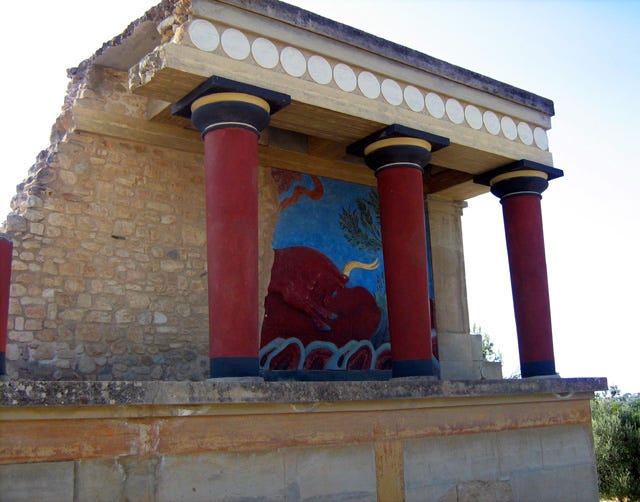
The site at Knossos, now known to be the centre of Minoan society, was excavated during the first part of the twentieth century. When a huge coloured wall relief of a giant red bull was uncovered, the local labourers became scared and refused to continue working. Sir Arthur Evans, the archaeologist in charge, had to call in a priest to convince the workers that what they had unearthed was a mural and not an actual devil!
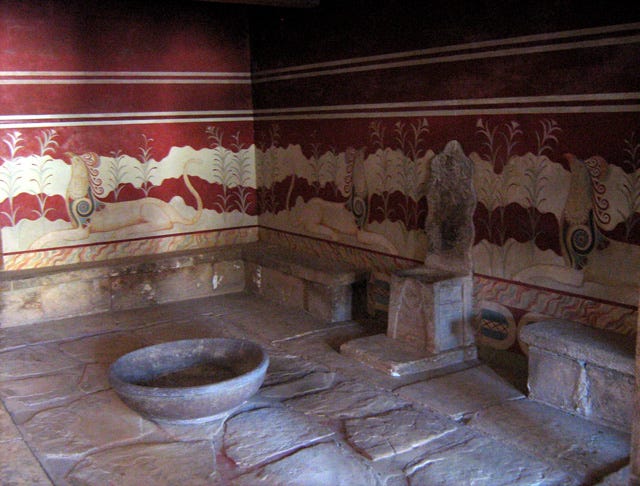
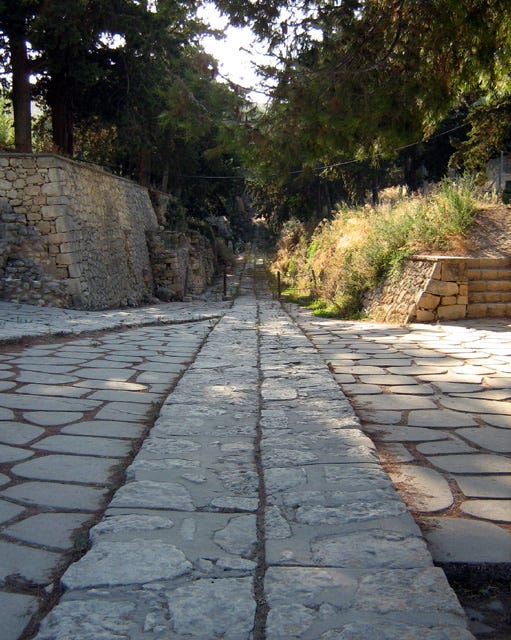
As the dig at Knossos progressed, it became apparent that what had been discovered was the remnants of a civilisation that had long been a legend, even to the ancient Greeks. They found the world’s earliest known paved road, the first running water system, some of the earliest multi-storey buildings with more than a thousand interconnected rooms. Almost certainly the inspiration for the ‘labyrinth’ of the mythical Minotaur. The throne and throne-room of the, until then, mythical King Minos was another first, as it seems he established the now familiar format of kingship.
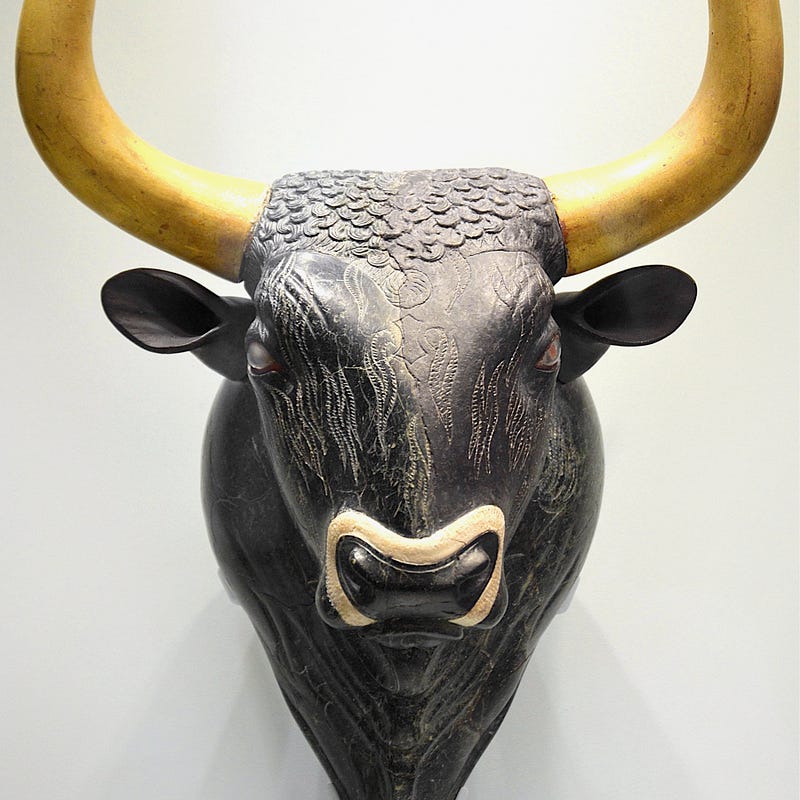
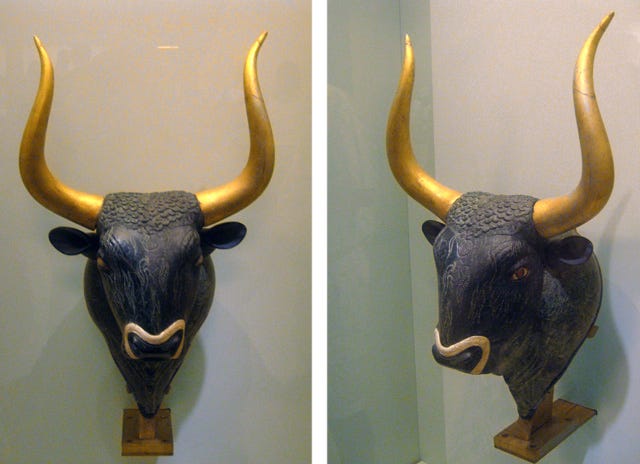
One of the finest finds excavated at the Knossos site is a Bull’s Head Libation Vessel exquisitely carved from black serpentine, detailed in light relief and inlaid with shell around the muzzle. The eyes are striking, made of quartz crystal and jasper, and seem almost alive as they catch the light. The magnificent horns are of gold. The level of technical ability represented in this piece is a major step in its own right, but it is the naturalistic accuracy of the model fused with the artistic purity of the forms that show a change in how humans now see, and respond to, the world around them.
This vessel is religious art and its making would have been a devotional act in itself. It was then used ritually to present offerings of wine and oil. This shift of reverence from cow to bull also marks the beginning of the change from matriarchal to patriarchal dominance. For the first time we have a culture that worships the masculine over the feminine. Their pantheon still comprises both gods and goddesses, but increasingly through their long cultural development, it is the male principle that finds favour.
Why would this change come about?
Before this period, cultures knew very little of each other. A much lower population density would mean it was far less likely for one clan to ‘bump’ into any others. Travel would have been slow and arduous, so although humans were migrating, it may have taken generations to travel far enough to interact with others of a significantly different culture.
With the increase in world population and improving technologies, such as wheeled carts and better boats, the overlap of one society with another became ever more likely. When one culture meets another, there is often a clash. This is one of the sad facts of human history. The competitive streak that pushed our early ancestors to survive and progress also leads to a propensity for conflict.
The Minoans established a settled civilisation on what is now the island of Crete. They grew crops on the land, domesticated animals, and made use of the abundant fishing. With no reason to continue a nomadic existence and no need to spend their time hunting and gathering food, they had more time to devote to arts, technology and cultural pursuits. This made them one of the earliest civilisations to have to deal with potential invaders who might come across their rich culture and regard it with envious eyes.
This necessitated a much more protective and pugnacious attitude. They saw those traits as being represented by the bull, rather than the cow. It was the bull who protected the herd, saw off rivals, sired the calves. Cows were still revered as mother figures and symbols of fertility and abundance, but it was the powerful bull that kept them safe and made their way of life possible…
Elaborate parietal art featured throughout the city in which fantastic beasts feature prominently, suggesting a rich culture of storytelling. There is a famous mural of a young man jumping over a charging aurochs, which is a now extinct ancestor of our domestic cattle. This acrobatic show of bravery was part of a rites-of-passage initiation ritual. An elegant mural of a bird seems to be painted as a decorative piece of ‘art for art’s sake’, bearing strong stylistic parallels with classical oriental art. This shows their gentler side and, though primarily decorative, this would be a very early example of art as we know it: no longer a type of picture writing, but an image created for its aesthetic merits and maybe signifying poetic cultural meanings. Perhaps a bird had similar connotations to the people of Knossos as it would to people today: the spirit of freedom and the joy of nature expressed in its song.
There’s evidence that the Minoans built a navy and ruled the surrounding seas. They established shipping routes to trade with other islands and the ancient civilisations bordering the Mediterranean, including Egypt and Greece. It seems that the Minoans were the precursor to what eventually blossomed into the Classical period of the Ancient Greeks, though not directly.
It’s thought the Minoan civilisation eventually declined and fell due to natural disaster, unable to survive the dramatic climate change caused by a nearby volcanic eruption that destroyed coastal settlements with tsunamis, poisoned the seas and caused crops to fail.
*all photographs © Remy Dean except where otherwise stated
Originally published at https://dean-evolution.blogspot.com.