
Bride of Duchamp
Just like Alice stepping through the looking glass, The Large Glass lets us reflect on the world around us and on the very nature of art itself…
I was in the Tate Modern bookshop during a recent visit to London and found a book dedicated to this one piece… the book was at least as thick as the London telephone directory...
The Bride Stripped Bare by Her Bachelors, Even or The Large Glass (1915–23) is one of the most conceptually advanced pieces of art there is. It brings together quite a few of Marcel Duchamp’s truly innovative approaches and tackles, amongst other things, the meaning of art and our experiences of it.
No, I do not think the viewer needs to be aware of all those theories and ideas behind the work in order to fully appreciate it. And neither did Duchamp! Although he had intended to produce an accompanying book to promote responses beyond the visual and did extend the piece across several other works.
Whenever there is a lot of thought and conceptual depth behind a piece of art — be it music, literature or in visual form — I believe that there is a resonance that enriches the experience of that piece, independently of its ‘meaning’. I enjoy the feeling that I am only getting a part of the whole and there is so much more to come. This is probably why religious art often has grandeur, even when it is from a religion that the viewer does not subscribe to, and why Beethoven, Bach and Scarlatti sound so impressive even to a listener who has not studied classical music and has no formal knowledge of scale, mathematical metre and complex compositional structures.
Works that I have a strong positive response to are often backed up by deep meanings and theories — which always interested me — though these are pursued only after the aesthetic ‘hook’ has done its job.
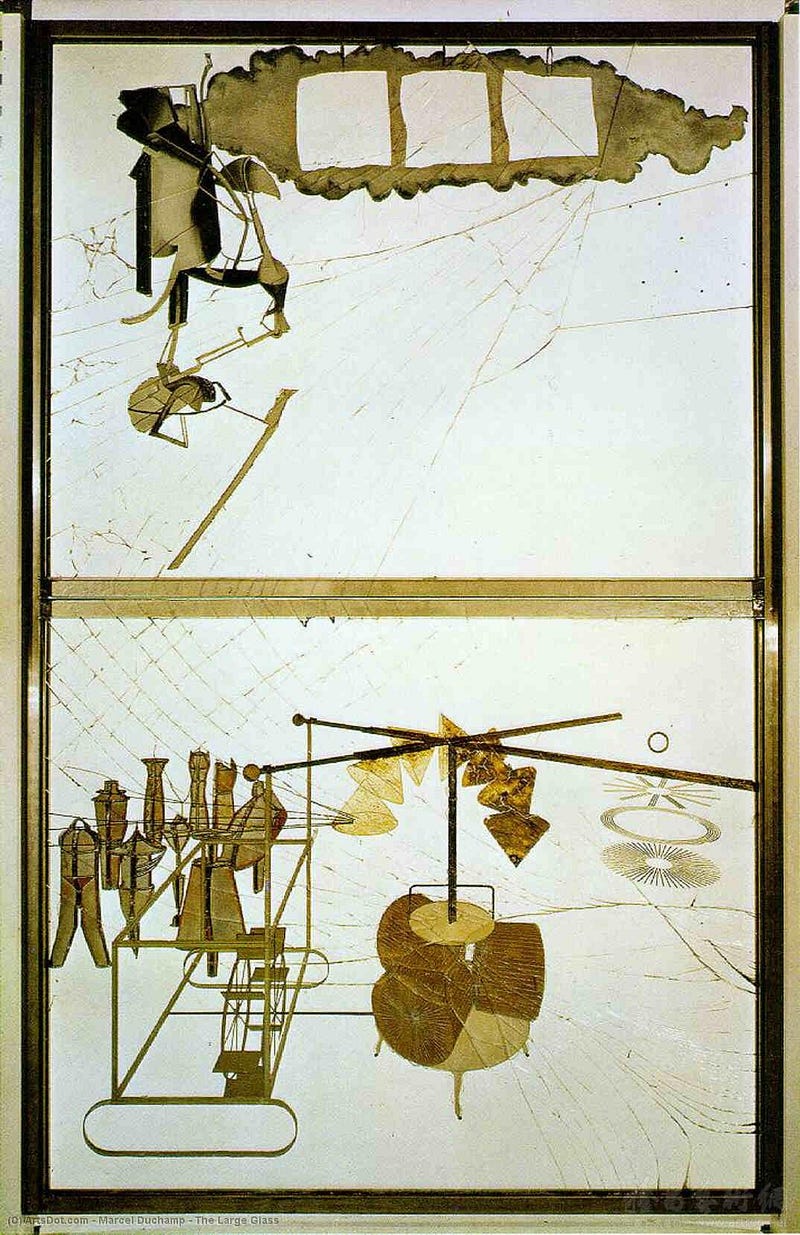
I have experienced this work through media and through its meticulous replica at Tate Modern, made by Richard Hamilton in 1966 and fully endorsed by Duchamp himself. Basically, I like it. I like being in the same room as it. In the gallery, its replica is displayed alongside many impressive and important works from Dada and early Surrealism, yet it is to this piece that most people gravitate — children, grannies, tourists, and art aficionados alike. It dominates the space. It inhabits the space. It alters the space. The space alters it.
It is a construction of oil, varnish, lead foil, lead wire (I have been told that some of this wire is actually fuse wire), dust, glass, aluminium, wood and steel, standing 2.73 metres high. Crossing the boundaries between painting, collage and sculpture, The Large Glass, can be viewed from either side.
At first glance, the piece appears to be an abstract made up from mechanically inspired shapes and a few more organic forms. The expression of dynamic movement, along with the rather evocative full title, The Bride Stripped Bare By Her Bachelors, Even or The Large Glass, stimulates us to re-assign meaning to the shapes and begin creating a narrative.
The small ‘machines’ take on a dual meaning as they also represent figures. The horizontal bisection of the composition implies a ‘before and after’ or ‘meanwhile’ sequence. The obvious resemblance of a window highlights the role of the viewer and implies that we are looking in upon a scene, or out onto a view. As in other works by Duchamp, we have the depiction of objects that have been inspired by mechanistic function, yet are now removed from that function.
The Large Glass is:
A sculpture — it is a free-standing three-dimensional piece that can be transported.
An installation — it interacts with any environment in which it is placed and is very different depending on its surroundings.
A painting — some of the forms ‘sandwiched’ between the panes of glass are painted in oils, some of the pigment in other areas is also paint dust.
A collage — it is an assemblage of forms and materials.
A window — it clearly references a window, being something that can be looked through, though not passed through.
A mirror — it reflects aspects of its surroundings, including the viewers, who appear as a ‘ghost image’ standing on the other side.
A threshold — it suggests a transition from one side to the other, from one place to another, the outside looking in or vice versa.
A play — it fringes the realm of theatre with its cast of characters and intriguing plot… Most people agree the technical diagram of the chocolate grinder is the ‘bride’, but who are the ‘bachelors’? They seem to have been reduced to clothes on some sort of hoist… Why are they not ‘suitors’? What is all the ‘apparatus’ for?
A time-lapse recording — some areas contained in The Large Glass were left to lay open and collected dust for years, sections were cleaned or ‘fixed’ during the first few years of its eight-year making process, from 1915 to 1923 — a technique of very slow ‘painting’ that Duchamp termed ‘dust farming’ or ‘dust breeding’ — so the dust that accumulated is a visual record of the paint pigments used in his studio during that time, as well as fibre from the clothes of Duchamp and some of his associates, and there must also be skin cell debris and a little bit of DNA?
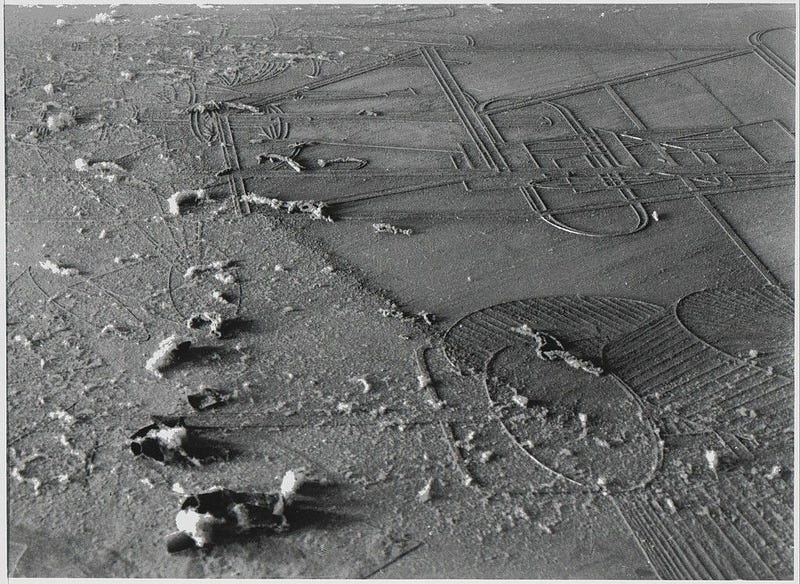
The first part of this work to be revealed to the public was a photograph, taken by Duchamp’s friend and collaborator, Man Ray in 1920 — a section of the lead work. It was a beautifully toned photograph that was taken with an exposure time of two hours! Even this ‘messes’ with our concept of what a photograph is — we usually think of a photograph being a fraction of a second, an instant frozen in time, not a couple of hours in the existence of a stationary object that is undergoing change on an extremely slow time-scale.
The image was revealed with no explanation, and some people took it to be an aerial shot of some sort of landscape, maybe an air base, as there was no obvious indicator of physical-scale.
A Symbolist metaphor — The Large Glass is at once “both surface and symbol” (to quote Oscar Wilde) but in this case, the surface is transparent and only evident from its function of holding the composition in place and by reflecting its surroundings, including the observer — the glass also allows the surroundings to be seen through the composition, thereby altering the overall composition, and integrating with, the artwork.
The glass was damaged whilst in transport between France and its final destination at the Philadelphia Museum Of Art in America. The new owners of the piece were dismayed, but Duchamp was delighted. He stated that the damage happened whilst the piece was still technically in his care and therefore was part of the artistic process. He realised that the cracks drew attention to what would have otherwise remained invisible.
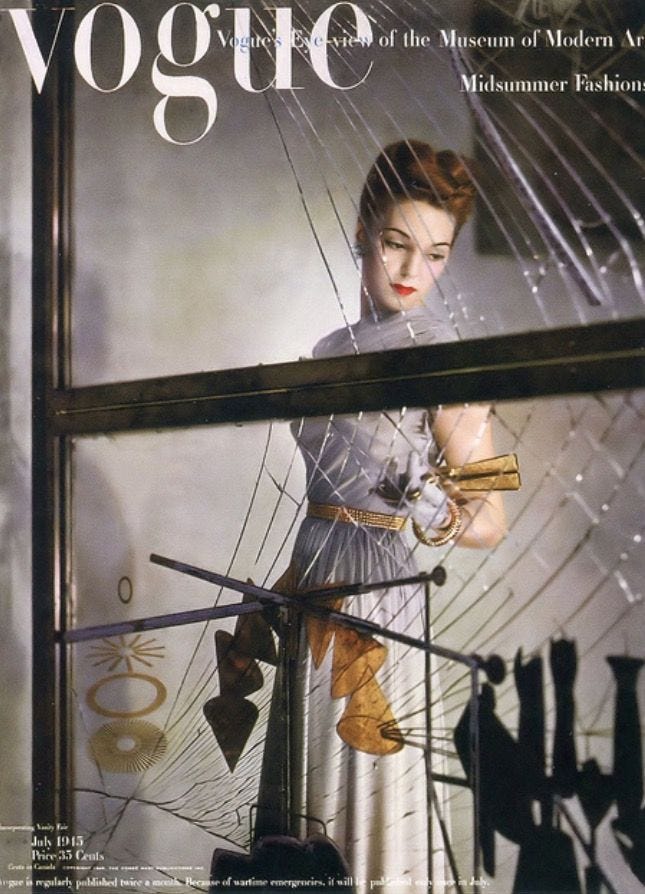
You can see these cracks quite clearly on the Vogue cover image above, shot through The Large Glass for the magazine’s July 1945 issue. The cracks in the glass draw our attention to the presence of the glass itself as a material. This reiterated the political statement that sits intrinsically within the work.
Primarily, The Large Glass is a very successful composition, but is also much more: it is a treatise about art, society and humanity — their nature and their interdependence.
It is a metaphor that works on many levels and applies to many artistic and social themes, such as the integrity of the surface… art as a window onto culture… perceived duality, class (or should that be glass?) divisions… It also hints that these divisions/differences/boundaries can be quite fragile and need the support of other structures to keep them in place.
Y’know, even if we are unable to pass through from one side to the other, we can just walk around it if we so desire…
I could go on — there’s more!
Marcel Duchamp’s hugely influential key-work, Fountain (1917 & 1964), is discussed previously in Signifier
*All images used here for educational purposes under fair usage policy.
A version of this article was first published in my book Evolution of Western Art (questing beast books, 2012)


