avatarRemy Dean

Free AI web copilot to create summaries, insights and extended knowledge, download it at here

3762

Abstract

es-1.readmedium.com/v2/resize:fit:800/1*8sS4XJ86DQlic8K9y4rFqA.jpeg"><figcaption><b>‘Le Bonheur de Vivre’ (1906) </b>by <b>Henri Matisse</b> [<a href="https://en.wikipedia.org/wiki/File:Bonheur_Matisse.jpg">view license</a>]</figcaption></figure><p id="bd77">In Matisse’s figure arrangement of 1906, <b><i>Joy of Life</i></b>, many see a stronger stylistic link with Paul Cézanne, particularly in the treatment of trees and foliage. Others have made a tenuous connection with the figure work of Paul Gauguin. Here, Matisse has gone one step beyond and also ‘liberated line’ as well as colour. Not only are his expressive, non-naturalistic colours free from the duty of form, they are contained not by black outlines, but by lines of strong colour.</p><p id="8242">Avoiding traditional solutions of scale and vanishing point, Matisse has created an effective sense of depth whilst at the same time respecting the flatness of the medium. The figures do not obey the rules of proportion. I mean, the two nudes in the middle would be giants compared to the reclining pipe player in the centre foreground! They also have a flatness that presages the later <a href="https://readmedium.com/the-parakeet-the-mermaid-and-matisse-53151fea39d7">cut-out method</a> he was to develop in the early 1950s. Similarly, the goats to the right of the composition are evoked with an elegant use of negative form.</p><p id="1c5a">Although this is still a representational image, Matisse has used lines and colours in a purely structural way that begins to approach abstraction. The use of two types of dominant line — strong, painted lines and lines created by the meeting of different colours — is an innovation that influenced <a href="https://readmedium.com/driven-to-abstraction-332fb2d1e3ff#5d49">Wassily Kandinsky</a>.</p><p id="37f1">The seeds of Modern <a href="https://readmedium.com/driven-to-abstraction-332fb2d1e3ff">abstract art</a> can be seen germinating within this work. If the viewer accepts that a painting is a composition of brush strokes that<i> in itself </i>can be pleasing, or at least <i>interesting</i>, then it follows that a painting can be valid as a painted surface, even if it no longer attempts to represent the ‘real’ world.</p><p id="9077">The brightness of non-naturalistic colours seems to celebrate a timeless joy in communing with nature and lends a classical, almost mythological feel to the scene. Matisse is also admitting his debt to the Romantics by including a nod to the influence of <a href="https://readmedium.com/the-wisdom-of-william-blake-d0727ad73fcc">William Blake</a> here, with a clear visual quote from <i>Oberon, Titania and Puck With Fairies Dancing </i>(1785). His group of dancers express an almost weightless sense of joy and freedom. This motif later becomes an icon in the work of Matisse and he repaints it several times, famously on a grand scale in a wall-sized canvas in 1910.</p><figure id="0b9a"><img src="https://cdn-images-1.readmedium.com/v2/resize:fit:800/1*C6zieU0dTfpWeAm58XUVIQ.jpeg"><figcaption></figcaption></figure><figure id="d227"><img src="https://cdn-images-1.readmedium.com/v2/resize:fit:800/1*AxZRwcUcEDXZtrrVqkcs4A.jpeg"><figcaption><b>‘Oberon, Titania and Puck with Fairies Dancing’ (c.1786) by William Blake was visually quoted by Henri Matisse in ‘The Dance’ (1910)</b> [view license<a href="https://commons.wikimedia.org/wiki/File:Oberon,_Titania_and_Puck_with_Fairies_Dancing._William_Blake._c.1786.jpg"> 1 </a>and<a href="https://en.wikipedia.org/wiki/File:Matissedance.jpg"> 2 </a>]</figcaption></figure><p id="b8c7">This approach to figures in motion seems to be an extension from what may be the most influential work from his Fauvist period. In 1907, he painted the first of what would be

Options

come a series of life studies known as <b><i>The Blue Nude</i></b><i>, </i>also regarded as one of the most important works of early Modernism. It’s a striking image that influenced the major <a href="https://readmedium.com/the-power-of-three-9016986c3cc1">Cubist painters</a> that followed, particularly Braque and Picasso.</p><figure id="94d5"><img src="https://cdn-images-1.readmedium.com/v2/resize:fit:800/1*g18IlzrVFwfrTNy2N7QyOg.jpeg"><figcaption><b>‘The Blue Nude’ (1907)</b> by<b> Henri Matisse</b> [<a href="https://en.wikipedia.org/wiki/File:Matisse_Souvenir_de_Biskra.jpg">view license</a>]</figcaption></figure><p id="6d75">The canvas presents a slightly elevated and flattened view, with no receding perspective. The figure is oddly twisted, harking back to ancient Egyptian <a href="https://readmedium.com/akhenaten-the-rock-star-pharaoh-250d5ef8ba81#2153">Frontalism</a>. Matisse has chosen to show us this figure from more than one point of view, or in a combination of poses, almost ‘cork-screwing’ from the underside of the right foot, through the side view of the lower half up to the front-on view of the upper torso. Parts of the form are ‘ghosted’, as if in a ‘double-exposure’, and some curves are echoed in the surrounding foliage.</p><p id="3a49">The body is treated as a solid sculptural form, which is at odds with this contorted pose, implying the flexibility of the human form. Again, shadow and line utilise colour, and the shadows are reversed in some areas. Positive form and negative space are rendered with the same painterly integrity. Parts of the anatomy are fairly well observed, whereas some are reduced to symbols — compare the treatment of each hand.</p><p id="a38c">This image was produced in parallel with the bronze figure titled <i>Reclining Nude I (Aurora)</i> which shows the same figure in the same position and with the same distortions. Of course, Matisse modelled the statuette in clay before it was cast in bronze and did not ‘finish’ the surface by completely smoothing out his hand and finger marks, allowing them to add texture and display the language of his technique, a ‘truth to materials’.</p><p id="2f54">In the painting we explore colour, liberated from its duty of form. In the sculpture we have form, free of colour. This parallel narrative of how the painting and sculpture developed lends insight into how Matisse was forwarding his understanding of the relationship between three-dimensional reality and its translation into two-dimensions.</p><figure id="2157"><img src="https://cdn-images-1.readmedium.com/v2/resize:fit:800/1*bTNEjmzdxyMxwUjZAZ_CsA.jpeg"><figcaption><b>‘Reclining Nude I (Aurora)’ (1906–07) a clay model by Henri Matisse cast in bronze </b>[<a href="https://en.wikipedia.org/wiki/File:Henri_Matisse,_1906-07,_Nu_couch%C3%A9,_I_(Reclining_Nude,_I),_exhibited_at_Montross_Gallery,_New_York,_1915.jpg">view license</a>]</figcaption></figure><p id="0414"><i>A short version of this article was first published in my book </i>Evolution of Western Art <i>(questing beast books, 2012)</i></p><div id="8e52" class="link-block"> <a href="https://readmedium.com/the-parakeet-the-mermaid-and-matisse-53151fea39d7"> <div> <div> <h2>The Parakeet, the Mermaid, and Matisse</h2> <div><h3>The late-career Cut-Outs of colourful shapes produced by Henri Matisse changed the form of art and design we find in…</h3></div> <div><p>medium.com</p></div> </div> <div> <div style="background-image: url(https://miro.readmedium.com/v2/resize:fit:320/1*rom5epRnRY8-xpuVrEoVLg.jpeg)"></div> </div> </div> </a> </div></article></body>

Wild Beast of Art

How Henri Matisse released colour from captivity and became the ‘Father of the Fauves’

The term ‘fauve’ is the French word for a ‘wild beast’ and referred to the instinctive, rather than trained, style of a group of painters united by their expressive, rather than realistic, use of colour. Henri Matisse was the foremost of the early Fauvist painters and often called the ‘Father of the Fauves’. His influence can be detected in the work of many many major artists including Georges Braque, Pablo Picasso and Gustav Klimt…
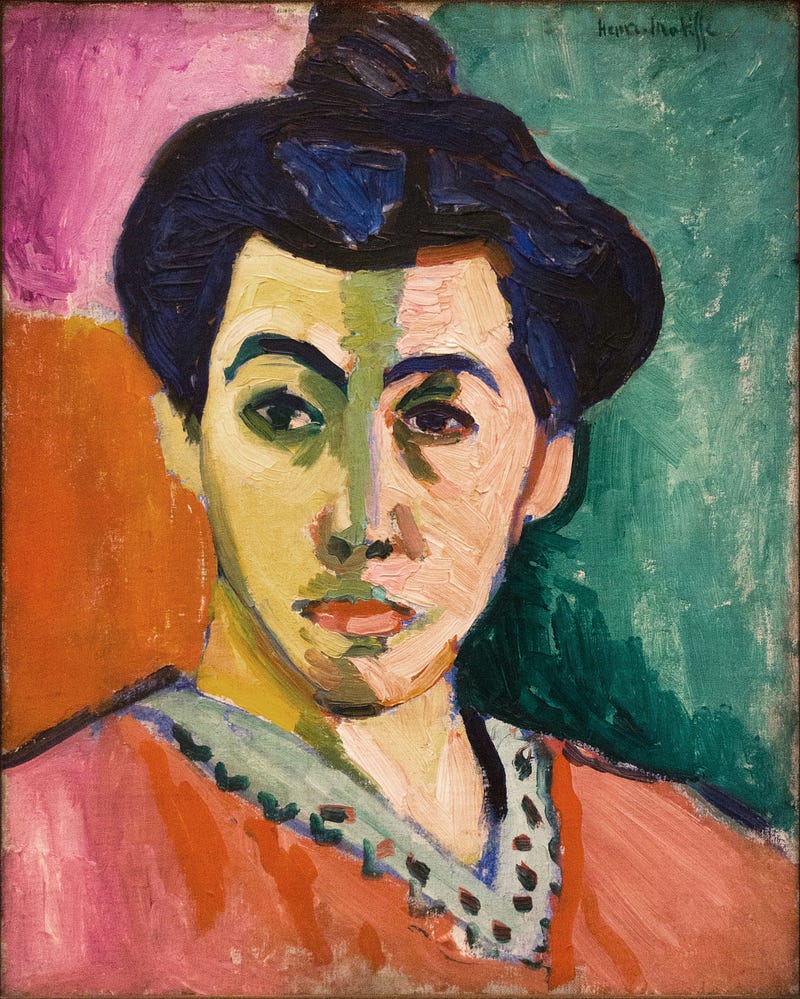
‘Green Stripe, or a Portrait of Madame Matisse’ (1905) by Henri Matisse [view license]

In 1905, Matisse painted a portrait that would become famous in art circles and cited as a key piece of groundbreaking art by many academics and art historians. With Green Stripe, or a Portrait of Madame Matisse, he has rejected traditional use of colour and most notably he even uses quite vibrant colours for the shadows as well as there being strokes of incongruous hues daubed here and there.

As a portrait, the formal structure is fairly traditional. It’s lit from one side, eyes at the vertical mid-point, very slightly to the left. Matisse, though, is obviously more interested in the structure and pattern created by the patches of bright colour than in a true representation of his wife. The title he gave the picture also tells us this.

He’s consciously rejected the accepted colour theory which dictates that warm colours advance, cool colours recede, and used combinations of cool and warm tones in both background and foreground. He also veered away from naturalistic tones. This is an early example of his ongoing endeavours to liberate colour from its descriptive duties of form so that the colour, in itself, assumes its own painterly form on the canvas.

It seems he set himself the challenge of pulling together a balanced composition using blocks of colour to create cohesion rather than any pretense of perspective or chiaroscuro. He also relinquishes any pretense of ‘realism’ — we are in no doubt that what we’re looking at is a painted pattern on a surface...
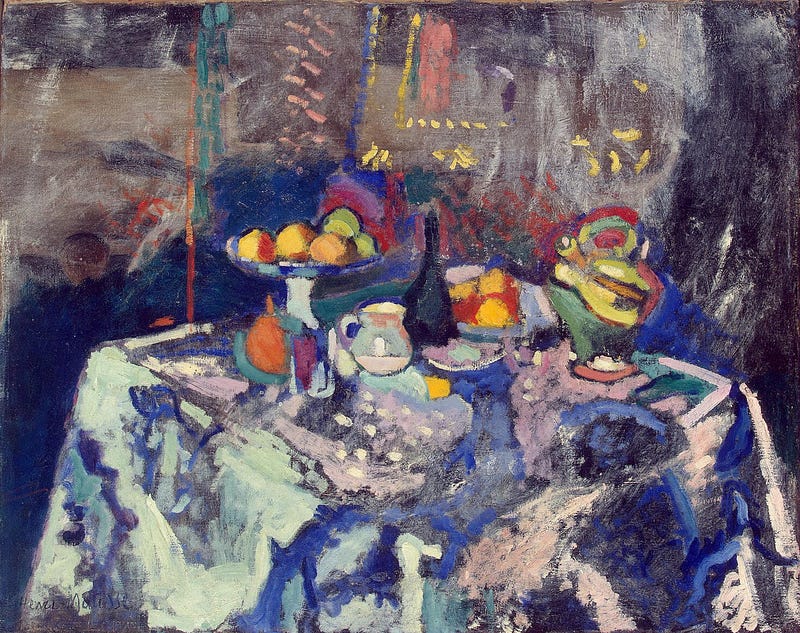
‘Vase, Bottle and Fruit’ (1906) by Henri Matisse [view license]

This still life, painted by Matisse in 1906, seems straight-forward at first glance. In one way, it is a fairly traditional subject — a table of assorted household item as described in its title, Vase, Bottle and Fruit. Nothing too remarkable about in its subject and proportions, though painted in a very free style. The strong pattern in the table cloth, the solidity of the fruit in the bowl and the glint of glaze on the little jug clearly indicate the influence of Paul Cézanne. Although painted from life, as were Cézanne’s still life subjects, the arrangement and the way that Matisse has treated both colour and line give it an impact similar to an abstract. It is the integrity of the canvas, the balance, energy and structural use of colour that interests Matisse here and despite being a still life, the brushwork is vigorous and full of energy...
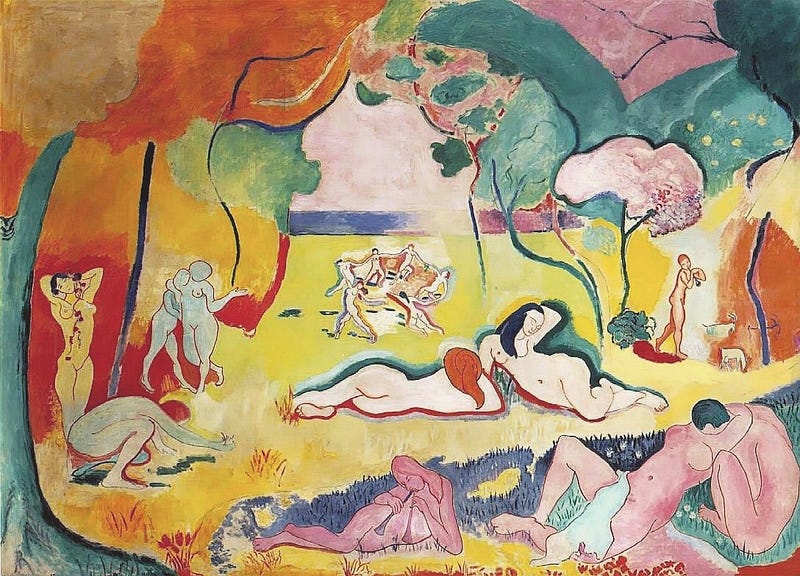
‘Le Bonheur de Vivre’ (1906) by Henri Matisse [view license]

In Matisse’s figure arrangement of 1906, Joy of Life, many see a stronger stylistic link with Paul Cézanne, particularly in the treatment of trees and foliage. Others have made a tenuous connection with the figure work of Paul Gauguin. Here, Matisse has gone one step beyond and also ‘liberated line’ as well as colour. Not only are his expressive, non-naturalistic colours free from the duty of form, they are contained not by black outlines, but by lines of strong colour.

Avoiding traditional solutions of scale and vanishing point, Matisse has created an effective sense of depth whilst at the same time respecting the flatness of the medium. The figures do not obey the rules of proportion. I mean, the two nudes in the middle would be giants compared to the reclining pipe player in the centre foreground! They also have a flatness that presages the later cut-out method he was to develop in the early 1950s. Similarly, the goats to the right of the composition are evoked with an elegant use of negative form.

Although this is still a representational image, Matisse has used lines and colours in a purely structural way that begins to approach abstraction. The use of two types of dominant line — strong, painted lines and lines created by the meeting of different colours — is an innovation that influenced Wassily Kandinsky.

The seeds of Modern abstract art can be seen germinating within this work. If the viewer accepts that a painting is a composition of brush strokes that in itself can be pleasing, or at least interesting, then it follows that a painting can be valid as a painted surface, even if it no longer attempts to represent the ‘real’ world.

The brightness of non-naturalistic colours seems to celebrate a timeless joy in communing with nature and lends a classical, almost mythological feel to the scene. Matisse is also admitting his debt to the Romantics by including a nod to the influence of William Blake here, with a clear visual quote from Oberon, Titania and Puck With Fairies Dancing (1785). His group of dancers express an almost weightless sense of joy and freedom. This motif later becomes an icon in the work of Matisse and he repaints it several times, famously on a grand scale in a wall-sized canvas in 1910.
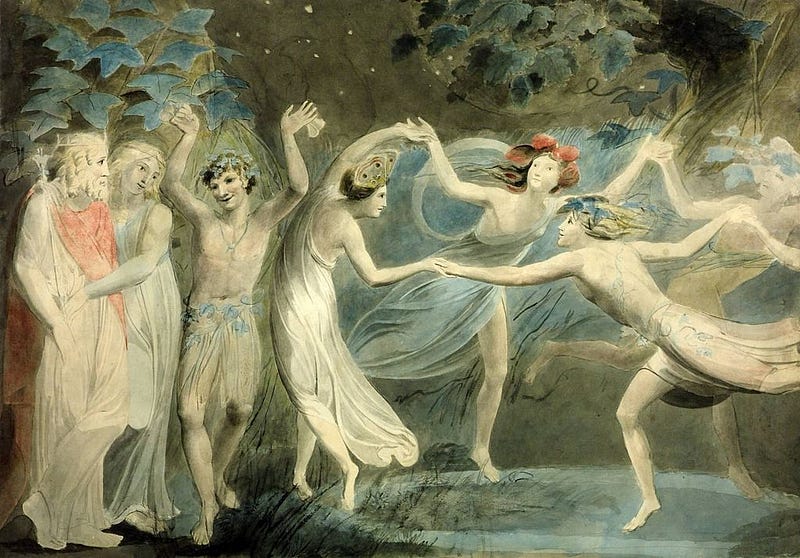
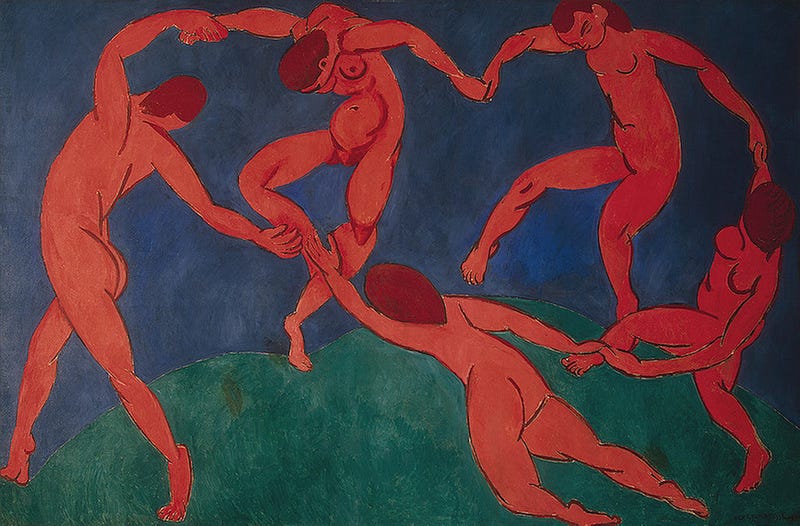
‘Oberon, Titania and Puck with Fairies Dancing’ (c.1786) by William Blake was visually quoted by Henri Matisse in ‘The Dance’ (1910) [view license 1 and 2 ]

This approach to figures in motion seems to be an extension from what may be the most influential work from his Fauvist period. In 1907, he painted the first of what would become a series of life studies known as The Blue Nude, also regarded as one of the most important works of early Modernism. It’s a striking image that influenced the major Cubist painters that followed, particularly Braque and Picasso.
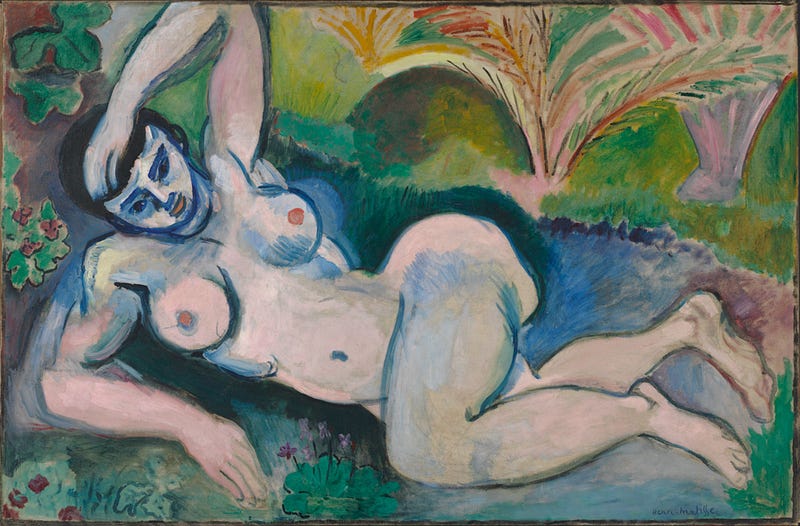
‘The Blue Nude’ (1907) by Henri Matisse [view license]

The canvas presents a slightly elevated and flattened view, with no receding perspective. The figure is oddly twisted, harking back to ancient Egyptian Frontalism. Matisse has chosen to show us this figure from more than one point of view, or in a combination of poses, almost ‘cork-screwing’ from the underside of the right foot, through the side view of the lower half up to the front-on view of the upper torso. Parts of the form are ‘ghosted’, as if in a ‘double-exposure’, and some curves are echoed in the surrounding foliage.

The body is treated as a solid sculptural form, which is at odds with this contorted pose, implying the flexibility of the human form. Again, shadow and line utilise colour, and the shadows are reversed in some areas. Positive form and negative space are rendered with the same painterly integrity. Parts of the anatomy are fairly well observed, whereas some are reduced to symbols — compare the treatment of each hand.

This image was produced in parallel with the bronze figure titled Reclining Nude I (Aurora) which shows the same figure in the same position and with the same distortions. Of course, Matisse modelled the statuette in clay before it was cast in bronze and did not ‘finish’ the surface by completely smoothing out his hand and finger marks, allowing them to add texture and display the language of his technique, a ‘truth to materials’.

In the painting we explore colour, liberated from its duty of form. In the sculpture we have form, free of colour. This parallel narrative of how the painting and sculpture developed lends insight into how Matisse was forwarding his understanding of the relationship between three-dimensional reality and its translation into two-dimensions.
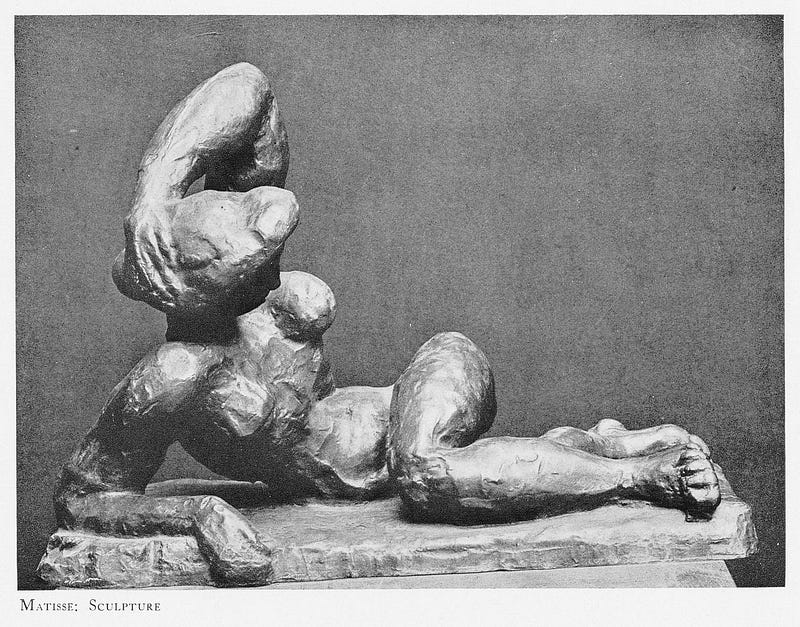
‘Reclining Nude I (Aurora)’ (1906–07) a clay model by Henri Matisse cast in bronze [view license]

A short version of this article was first published in my book Evolution of Western Art (questing beast books, 2012)

Art
Art History
Painting
Modernism
Sculpture
Recommended from ReadMedium