
The Parakeet, the Mermaid, and Matisse
The late-career Cut-Outs of colourful shapes produced by Henri Matisse changed the form of art and design we find in the modern world…
“The walls of my bedroom are covered in cut outs,” the impressionist painter Henri Matisse wrote in 1948, “I do not yet know what I shall do with these.”
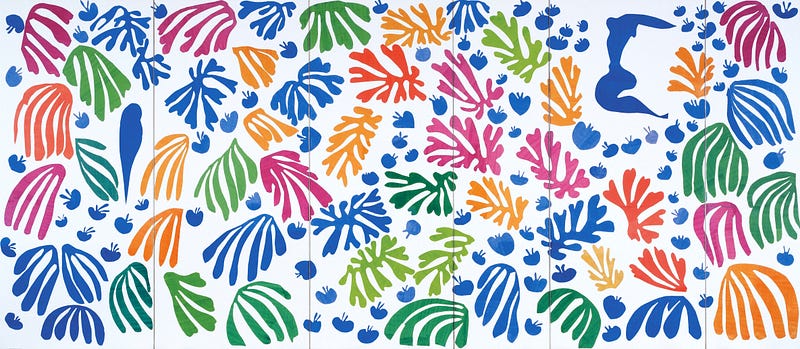
At this stage of his life, Matisse was almost bedridden following surgery for abdominal cancer. Unable to continue to paint for long hours in front of an easel, he developed a new way of working which emerged from approaches he’d explored back in 1919 when designing the costumes and sets for Sergei Diaghilev’s Les Ballets Russes production of the Igor Stravinsky opera, Le Chant du Rossignol, which debuted at the Théâtre National de l’Opéra in Paris. Then, he had explored stencil methods to develop repeating motifs for the various Chinese style tunics and most prominently in the overlapping cut-out layering for the dress worn by prima ballerina, Tamara Karsavina.
Having Matisse design for the ballet set a trend for many other experimental artists who would also design for major, mainstream theatre productions, among them were his contemporary, Pablo Picasso who’d designed costumes for Diaghilev’s Parade in 1917. Then there was Oskar Schlemmer with his sculptural Bauhaus costumes of the 1930s, followed by Isamu Noguchi, Jasper Johns, Robert Rauschenberg, Anish Kapoor, Olafur Eliasson, Anthony Gormley, and Howard Hodgkin — which brings us up to the present. Matisse would work on several other big shows including another for Les Ballets Russes, Rouge et Noir in 1938, with sets and costumes designed using the cut-out techniques.
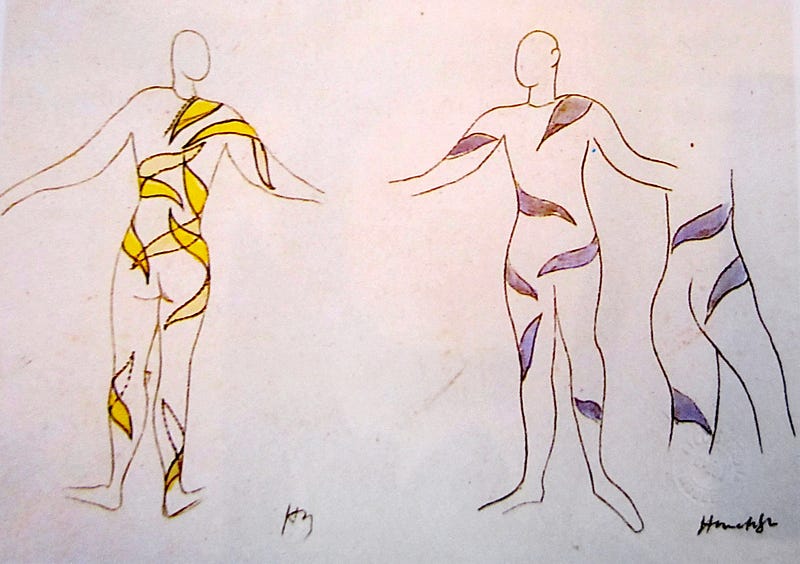
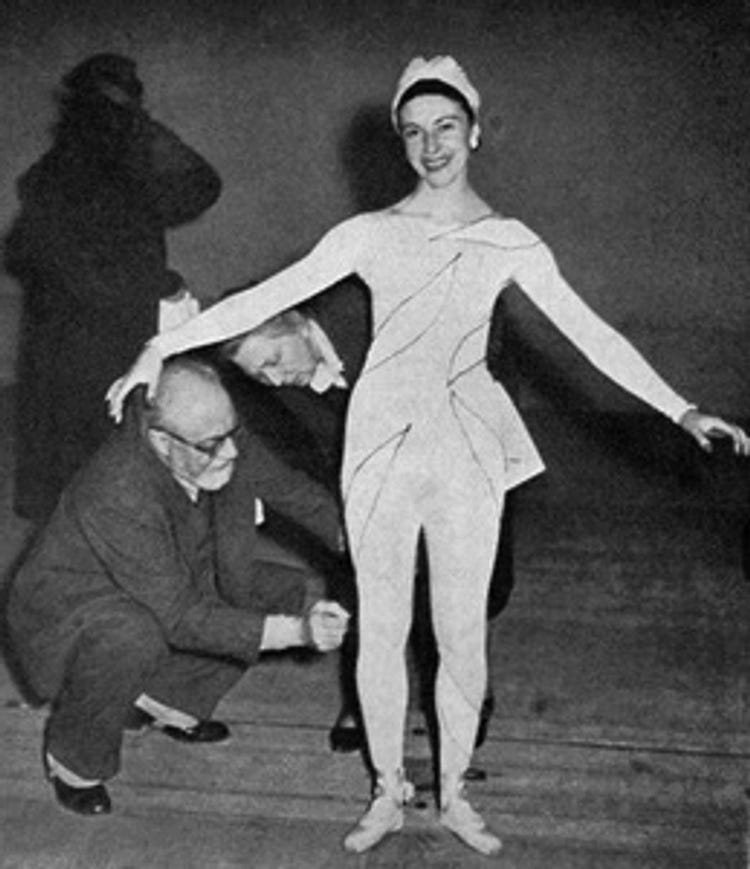
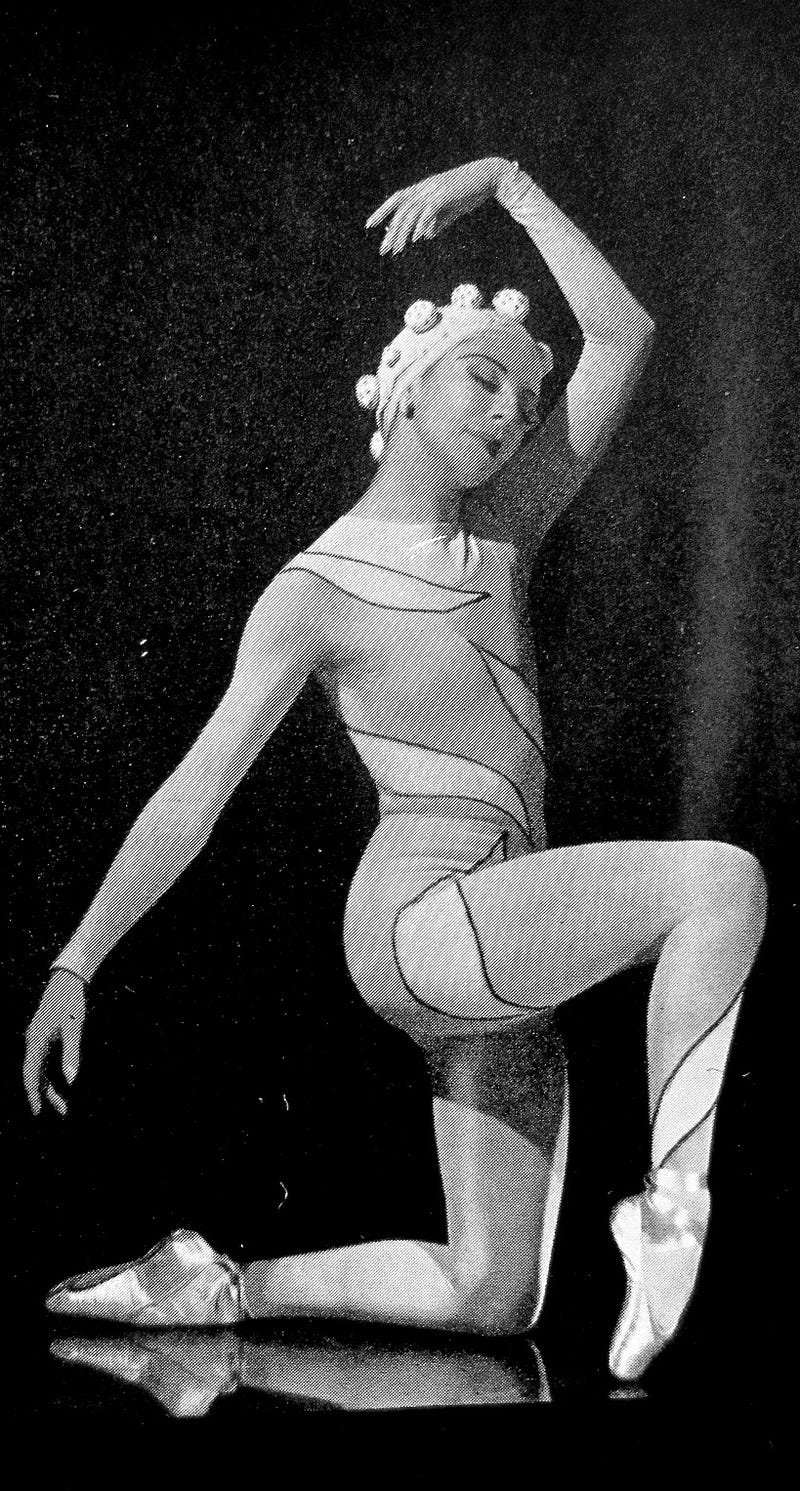
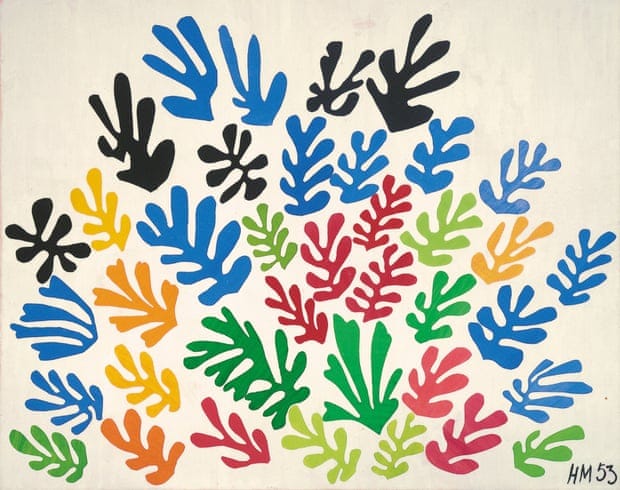
As his mobility problems worsened, Matisse needed the help of young students and assistants, particularly Lydia Delectorskaya, to realise his vision. They would paint paper with gouache in the shades that he specified, and he would then cut out his sinuous shapes, based on natural forms. His assistants, armed with panel pins and a hammer, would then position, and reposition these shapes according to Matisse’s directions. Thus, his studio walls became his canvas.
Matisse wrote that he wanted to recreate a garden to wander and dream in since he could not easily gain access to the natural world with his current ill health, and he also wanted spaces to imagine swimming in. He was creating an immersive installation that could be engaged with in the physical space and at the same time create an environment to be explored by the imagination. In many respects this overlapped with Surrealist sensibilities.
This approach led to a series of arrangements that would culminate in the work known as Parakeet and Mermaid, for which he recreated the shapes and colours that conjured the tropical Island of Tahiti that he had visited when he was younger — where he has swum among coral reefs. “The memories of my voyage to Tahiti have only now returned to me, 15 years later, in the form of obsessive images: madrepores, corals, birds, jellyfish, sponges,” Matisse had told fellow artists, Brassaï, who visited the artist’s apartment in Paris in the summer of 1946.
Visitors to his studio in the South of France reported that the colour-forms, pinned temporarily, would flutter in the breeze, and alter according to light and shade like a living garden. Or, indeed a magical underwater realm. Matisse thus created a fairy-tale world, an invitation to dip into the unconscious, and swim alongside mermaids in his paper coral reef.
Parakeet and Mermaid, completed by 1952, is a large mural that filled two walls of Matisse’s studio. He used the white plaster background to position an exuberant arrangement of cut-out natural forms, coral, and seaweed shapes in blue and green, red, and orange, along with a motif of blue pomegranates. On one wall, he positioned a minimalist teardrop shape to suggest a parakeet. Opposite, he played with a number of blue nude figures to give balance to the composition, until he finally settled upon the stylised shape of a mermaid.
There are many photographs of Matisse working in his studio while Parakeet and Mermaid developed, which show the various forms and positions of a blue nude that were tested out before settling on the mermaid. Matisse had painted his first, hugely influential, Blue Nude in 1907 and had alternated between sculpture and painting while examining the female form. In 1952, he used pencil sketches to plan positions before he cut out the blue nudes, a blend of 2D and 3D which required decisive drawing with scissors to realise his vision. Matisse would hold the paper in one hand, unencumbered by any other support, and manipulate the scissors in the other.
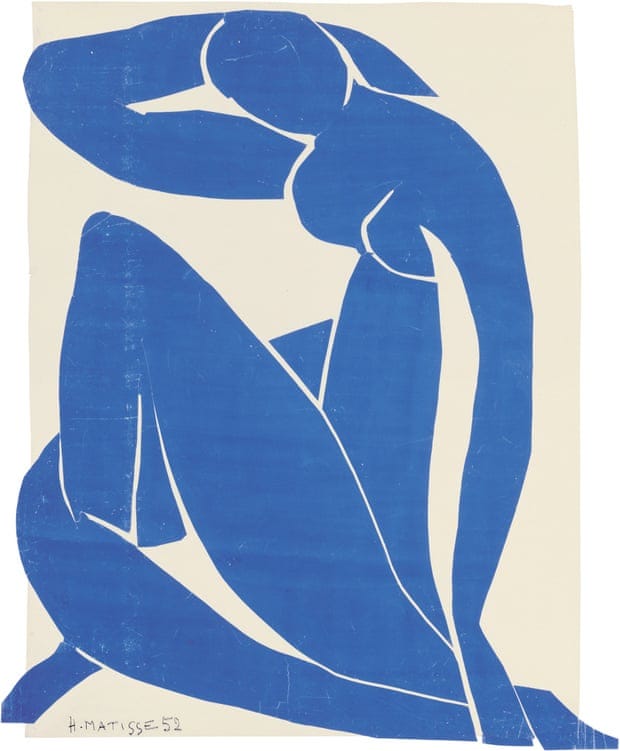
The first three nudes were thus cut “with mastery,” Lydia reported, “each on a different day, they had been cut in one line/stroke of the scissor, in 10 minutes or 15 at the maximum.” The grooves of white within the blue ‘aerated’ the figures, whereas the final mermaid shape is a solid silhouette shown in a dolphin-like, arched stretch.
I vividly recall a visit to the major Matisse exhibition, The Cut-Outs, at the Tate in 2014. It was stunning to see such colour and exuberance in room after room, although fixed and permanent by this stage. Mermaid and Parakeet was almost the last display of the exhibition, and it was amazing to walk into a room filled with vibrant seaweed and coral-like forms that rejoiced in underwater life.
All this celebration of nature was more remarkable when one realised that Matisse had just come through the Second World War — for her part in the resistance, his daughter Marguerite had been tortured until near death by Nazis and was very frail. Perhaps this kickstarted a new determination and lease of creative life, his own antidote to ‘Lockdown’ as he wrote, “An artist must never be a prisoner of himself, prisoner of a style, prisoner of a reputation, prisoner of success…”
The cut-outs were startling and new, yet a continuation of Matisse’s earlier work where he strove to simplify shapes and play with rhythm and colour — such as the famous Green Stripe, or a Portrait of Madame Matisse in 1905, and La Danse in 1910. They also showed an interchange of influences with other important contemporary artists, such as his friend and rival Pablo Picasso, and Spain’s Joan Miró — interestingly, Matisse’s youngest son, Pierre, became an art dealer who worked closely with Miró.
The impact of the cut-outs on illustration and modern art would be far reaching. The colour fields of Mark Rothko and Yves Klein could owe a debt to Matisse’s use of flat colours within defined forms. The innovative graphic style of Saul Bass, exemplified by his iconic film posters for The Man with the Golden Arm (1955) and Alfred Hitchcock’s Vertigo (1958), show clear influences of Matisse’s cut-outs which, in turn, helped shape today’s ubiquitous illustrative branding. Also, the many Matisse-inspired patterns found in home décor such as wallpapers, rugs, lampshades, ceramics, and shower curtains…
Matisse had a prescient awareness of the implications of what he was doing. “By creating these coloured, paper cut-outs, it seems to me that I am happily anticipating things to come,” he said. “I don’t think that I have ever found such balance as I have in creating these paper cut-outs. But I know that it will only be much later that people will realise to what extent the work I am doing today is in step with the future.”
* All images are used with permission or are presented here for educational purposes under fair usage policy.


