
The Melting World
Olafur Eliasson’s ‘Ice Watch’ is a recurring work of public art that connects us with the world as physical and emotional beings
Environmental art has been a thing since the mid-nineteenth century but has moved to the forefront of culture over the last few decades. Now, to coincide with COP26 (the 2021 United Nations Climate Change Conference), a plethora of environmentally aware arts and activism events are scheduled in and around the host city of Glasgow, Scotland …and beyond. After all, it’s a global issue being discussed.
This has become a tradition, for artists and collectives to add their passion and poetic responses to the statistical-wrangling, fact-selecting, platitudes, and, to quote Greta Thunberg, the blah-blah-blah, within the conference centre. Art can be a powerful mode of cultural democracy and has pushed for meaningful engagement alongside political debate on many subjects of great importance.
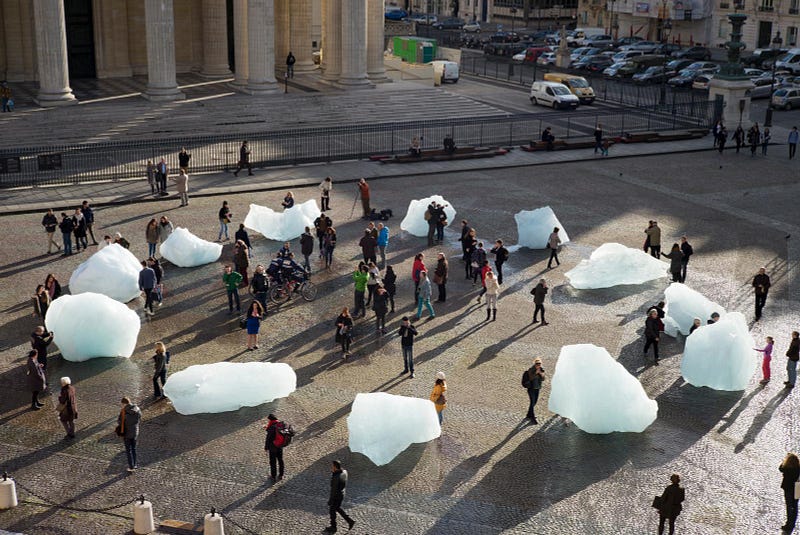
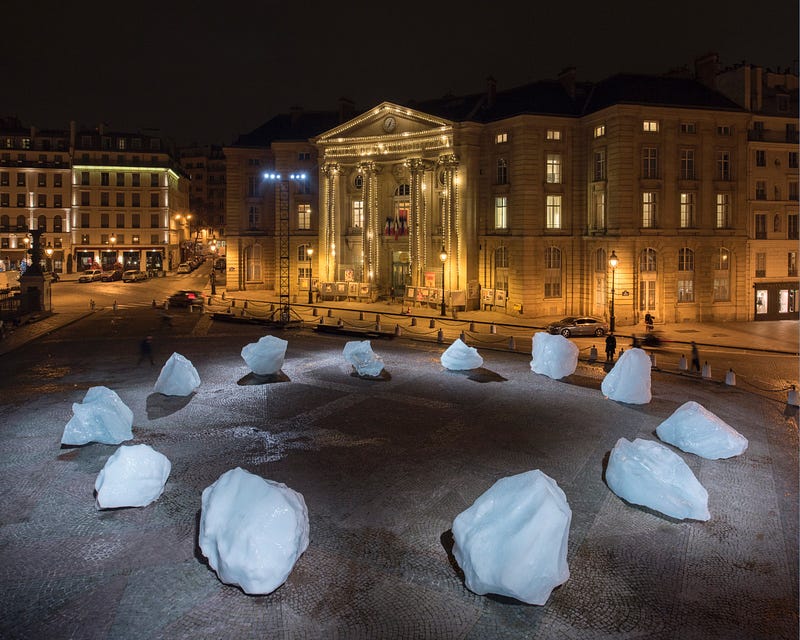
One of the most ambitious and eloquent of those past responses was by the Icelandic artist, Olafur Eliasson. For the first iteration of Ice Watch, in 2014, he organised the transport of 12 huge blocks of glacial ice, recovered from the sea off the diminishing Greenland ice sheet, and placed them on the streets of Copenhagen. This coincided with the COP20 in Lima, Peru, and encouraged a unifying dialogue between the northern and southern hemispheres.
He replicated Ice Watch in Paris, France, for COP21, again placing 12 blocks of glacial ice, each weighing between 1.5 and 5 tonnes in the publicly accessible Place du Panthéon. They were arranged in a circle, referencing a clock face and the passing of time as a visual countdown...
The arrangement also evokes a poetic link with Neolithic stone circles erected by our ancestors, many of which endure to this day. However, the blocks of ice would not last and immediately began to melt, albeit rather slowly. This allowed people to experience their initially imposing physicality, to touch them and feel the cold of another place, bear witness to their slow demise as they faded from the material world into memory alone. Eliasson hoped there would be a sense of urgency to experience the transient work and that an emotional connection would be forged through their presence and subsequent absence. Followed by a sense of loss.
Ice Watch was created in collaboration with Professor Minik Rosing, of Copenhagen's Natural History Museum and highlights the overlaps of art and science. To effect change, perhaps the stark facts are best served through media that can reach both the intellect and emotional faculties of the individual. We know that ‘Mother Earth’ is suffering at the hands of humans. We know we only have so much time left to save ourselves. But knowing hasn’t been enough to reverse, or even halt, the damage we continue to inflict. Every one of us needs to feel the need to do something about it.
“Facts alone are not enough to motivate people. At times, they even create the opposite effect. We need to communicate the fact of climate change to hearts as well as heads, to emotions as well as minds.” — Olafur Eliasson
Eliasson and Rosing have presented Ice Watch three times now — Copenhagen in 2014, Paris in 2015, and in London for 2018. Each time the configuration has changed. For London it was presented across two sites, with 24 ice blocks outside Tate Modern, and a circle of six outside the Bloomberg offices.
They hope that experiencing the sublime helps individuals to strengthen their emotional connection with the wider environment that, in turn, connects us all as a global community. The time and coordinated effort required to create the works implies a similar level of individual dedication is required to work toward averting the current climate disaster before we pass the tipping point we teeter upon. It’s already too late for the countless species and habitats that have already been lost.
Also, we are aware this considerable effort was collaborative. Sometimes, individuals need to work together toward a common goal. Every one of us can choose to make a difference. To varying degrees, we all have power to take individual actions and to push for systemic change. However, it is those in the so called ‘developed world’ and their governments that can make the big changes, to lead industry out of the downward spiral it’s been stuck in since the Industrial Revolution.
Although it has been politicised by profiteers and extremists, climate change is not a political matter. It is a real world, existential threat. Regardless of our differences, we all share our global fate and this stark fact is something the representatives at COP26 will loudly proclaim.
We hope.
7000 Oaks, a seminal, globally important, work of environmental art by Joseph Beuys, and the transient art of Andy Goldsworthy, have been discussed by Remy Dean previously in Signifier.
Work by environmental artist Tim Pugh was the May 2021 exhibition for Signifier’s Six Shot Gallery.
* All images are used with permission or presented here for educational purposes under fair usage policy.


