
Deep in the Wood — Trees as Art
Trees have always featured prominently in art but since the 1960s a handful of post-modern artist have presented trees, sometimes unaltered, as sculpture…
There’s a difference between making art out of a tree and making art with a tree. Wood has been used as a material in art since prehistoric times. It’s commonly used as a sculptural material and of course, is the basis for most paper, which is about the most common art material, very often used in conjunction with a wooden pencil, or charcoal!
A tree already fulfills many of the criteria art critics use to formally analyse sculpture. Imagine a tree in your mind’s eye or, better still, if there’s a tree in sight, take a look at it. Is the tree three-dimensional? Does it have a visual rhythm in its pattern that exploits the interplay between positive and negative form? Is there a progression or tension between symmetry and asymmetry? Does it reference landscape and/or the human form?
In most cases, an unaltered tree can tick all the boxes and an average tree placed next to an average sculpture will be aesthetically superior. Really, the only thing preventing a tree from being classed as ‘art’ is the earliest and enduring definition of art as, “a thing of beauty that was of human, as opposed to natural, origin…”
The ancient sacred groves of the Druids are perhaps the earliest surviving examples of trees planted with intent to imbue a meta-physical significance that extended beyond the practical. Of course those groves were eventually assigned more pragmatic purposes: the Oaks gave their timber for shipbuilding and the Yews their boughs for longbows.
Many other cultures around the world have adopted natural trees as shrines. The tradition of tying coloured ribbons to their branches dates back to pagan times, but persists in many religions today. The Bodhi prayer trees represent the sacred fig that the Buddha was sitting beneath when he achieved enlightenment. Some of the indigenous peoples of the Americas tie ritually prepared cloths to trees in their sacred places. Across eastern Europe there are some ancient trees concentrated to Catholic saints. The tradition of decorating a Christmas Tree has become a secular tradition that allows anyone a creative outlet every Yuletide!
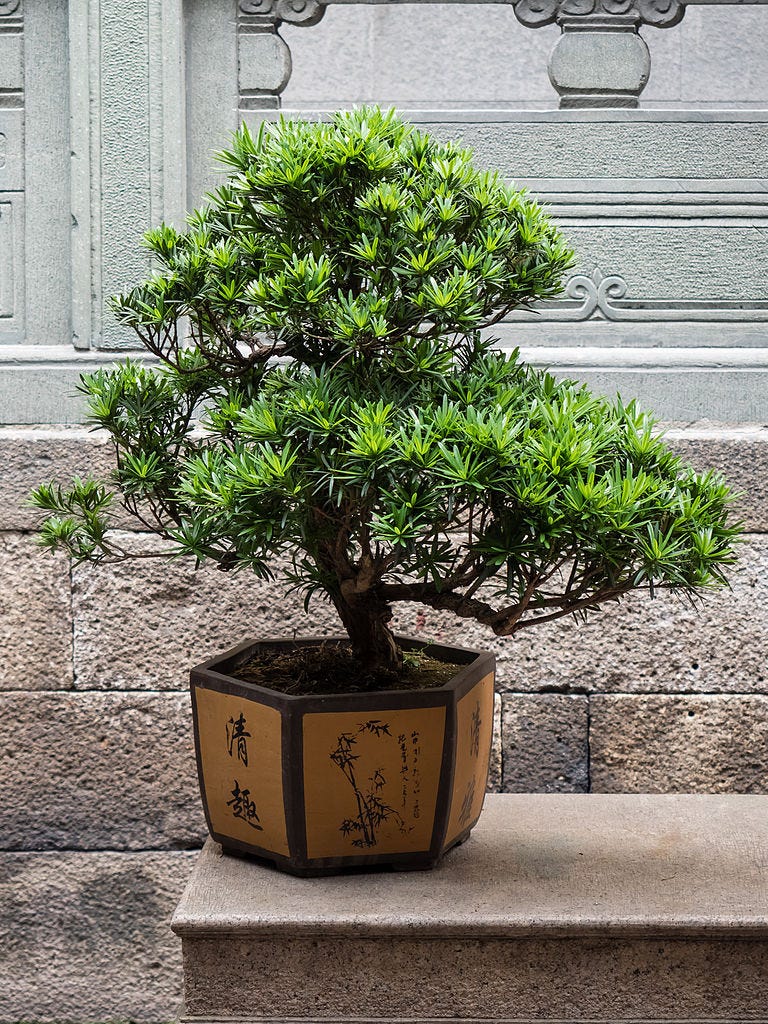
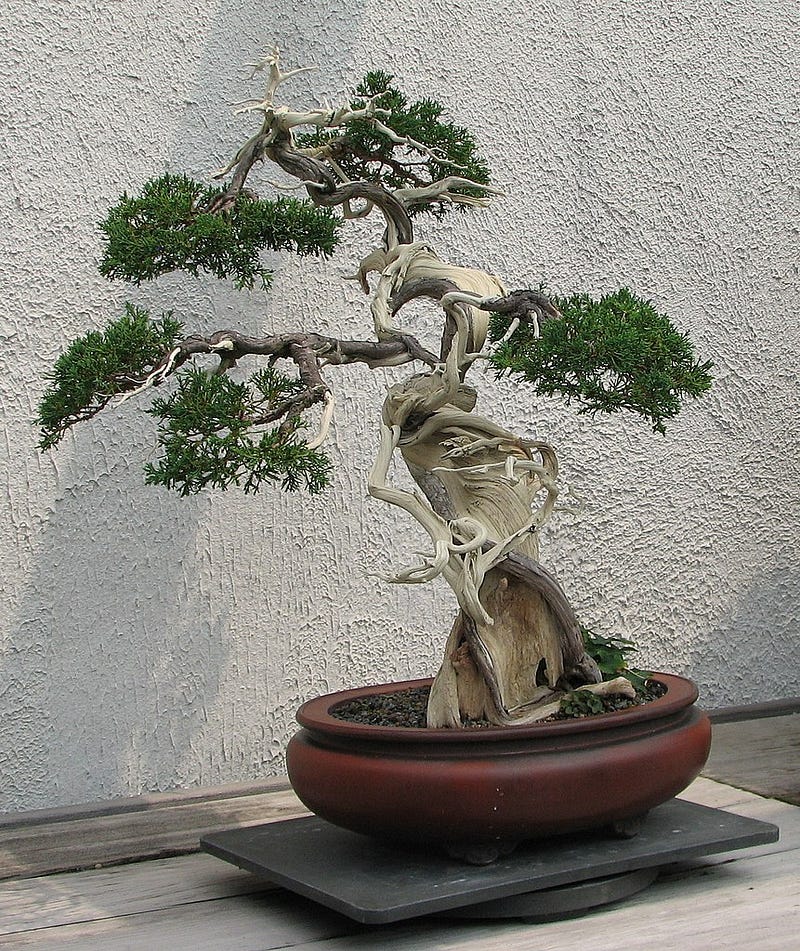
In the far east, trees have been revered for millennia. The ancient Chinese practice of penjing involved patiently growing a tree in a pot, pruning and caring for it so that it remained small yet developed the features of a fully mature specimen. This tradition was embraced by the Japanese in the form of bonsai, which introduced a meticulously formal approach to the art. Fine examples of bonsai trees, that have been nurtured and trained for generations, are assigned values that rival a Picasso or Van Gogh.
Here, I am going to briefly consider a handful of post-modern artists who, rather than simply carving dead wood to represent something else, have tried to incorporate the tree into their work with the minimum of formal intervention. Some have explored ways of working with live trees, the process of growth being integral to their artistic language. Others have brought living trees into the gallery space, transported from their original growing place and presented in another space. This touches upon Marcel Duchamp’s notion of reassigning meaning through changing context, the ‘site and non-site’ concept of Robert Smithson, and objets trouvés…
The term, Arte Povera, was coined in 1967 by Germano Celant, an Italian art curator and critic. It translates literally as ‘poor art’ and means art that uses everyday, unremarkable materials not traditionally present in fine art. Artists associated with the movement would often make things using old rags, discarded furniture and reclaimed building materials, or natural things gathered from their environment like sticks, raw clay and soil.
Giuseppe Penone was an early proponent of Arte Povera. His art is an ongoing investigation into poetic harmonies between the human and the natural world. In trees, he saw an organism that is very different to the human body, whilst also having many similarities. Both grow, digest, respire and have a circulatory system…
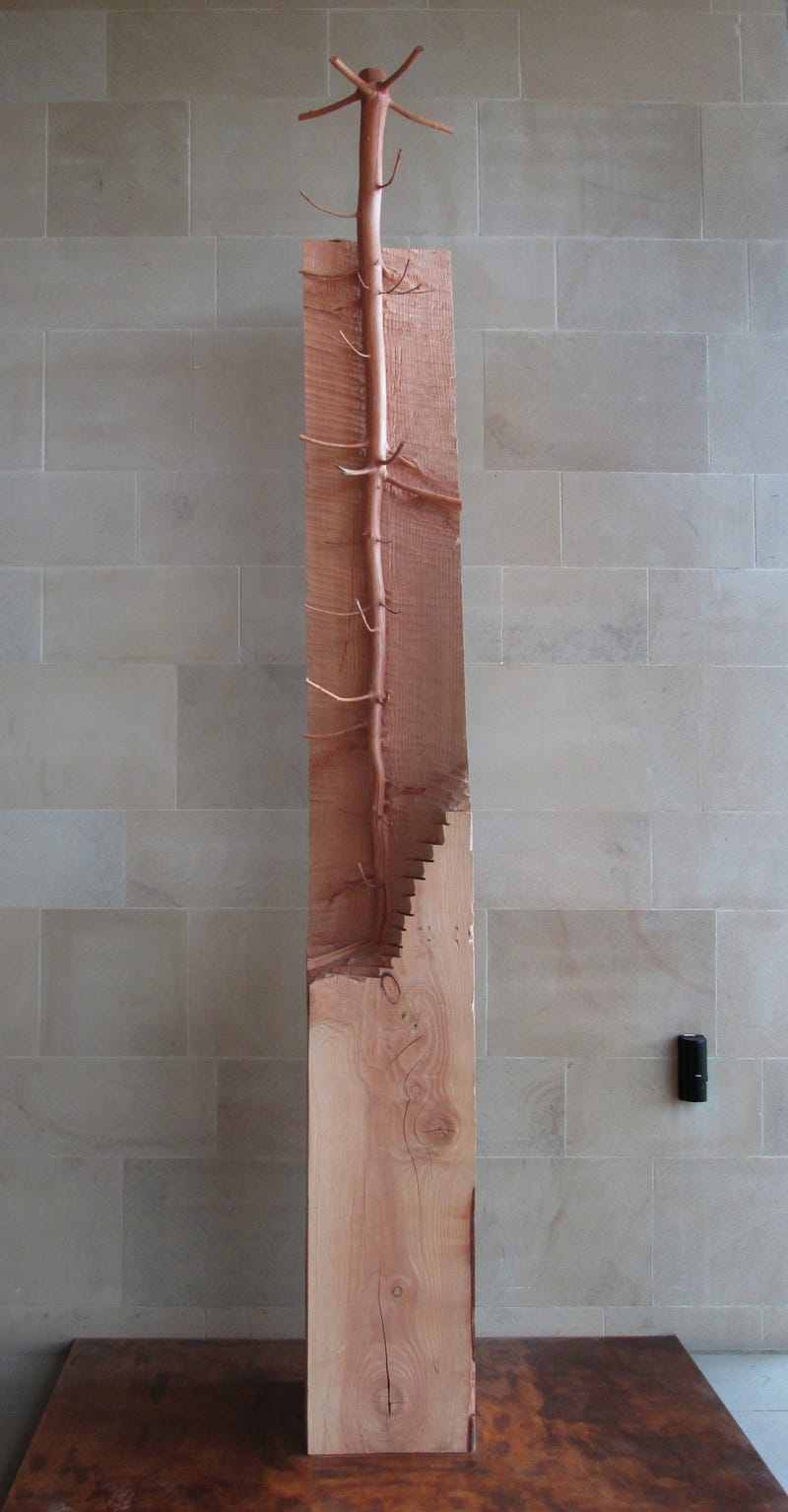
In 1969, he acquired a hefty piece of timber that was, initially, destined for the construction industry. In search of a connection, he carved-back the wood of the artificially squared beam until he revealed the structure within of the tree when it had been 22-years-old, which was also his age at the time. He titled the piece, Il Suo Essere nel Ventiduesimo Adi Età in un’Ora Fantastica / His Being in the Twenty-Second Year of His Age in a Fantastic Hour.
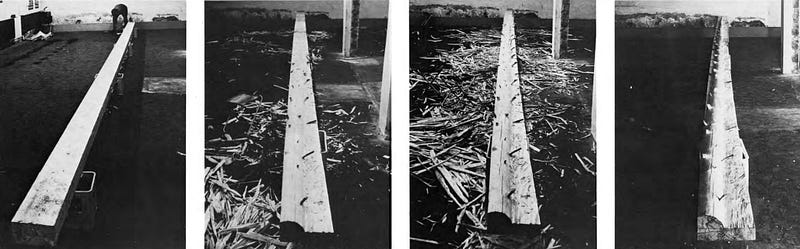
Just as Auguste Rodin sometimes left sections of his raw marble blocks in tact — from which emerge his exquisitely carved human figures — so Penone chose to preserve part of the rectilinear shape of the existent beam. This added a touch of wonder, whilst visually explaining aspects of the material and the artist’s techniques. It also acknowledged the prior industrial processes involved.
We are used to seeing knots in structural wood around us, such as floorboards, doors and tabletops. How many of us pause to consider them not only as an interesting surface pattern, but as a cross-section of a three-dimensional structure within the wood? A slice through a moment in the growth process of the tree that donated the timber.
Sculptors who carve — rather than construct or cast — are always working with the negative space in their composition. The outcome depends on the absence of materials. It’s a process of removal that reveals a form within the larger volume though, usually, that shape first exists within the artist’s imagination. In this case, what Penone has uncovered did actually exist in there! This was a new sculptural approach perhaps more akin to archaeology and the first of his Alberi series of sculptures which is ongoing to this day.
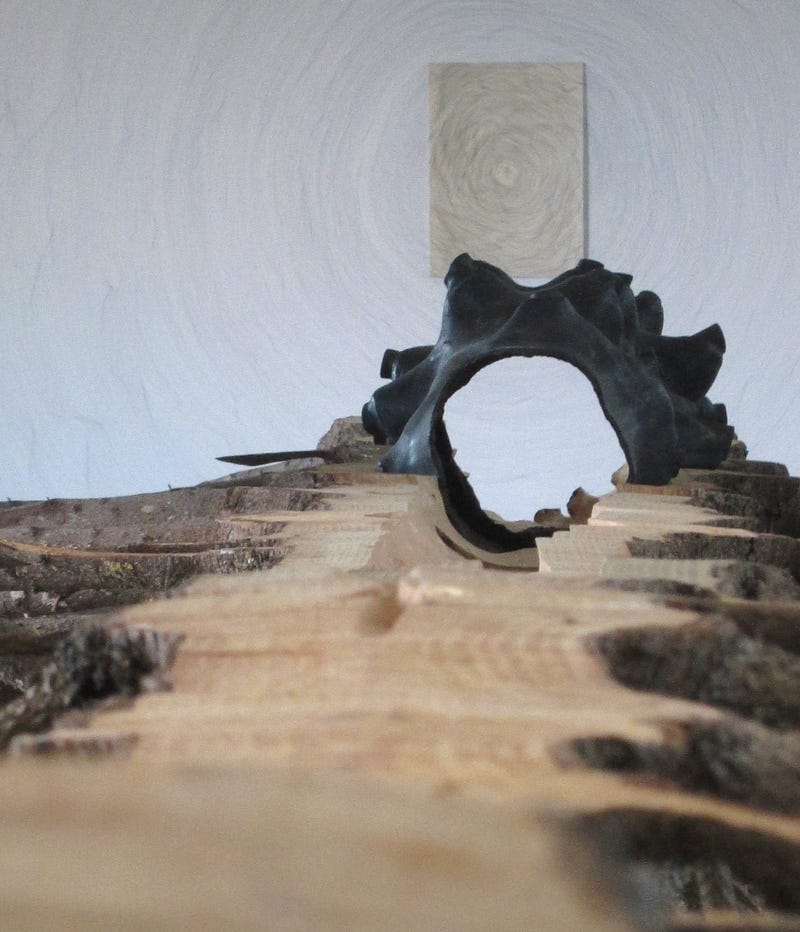
Penone became fascinated with the idea of trees as a kind of time machine, with memories of the seasons recorded in each of their growth rings. They shared and responded to our common environment as we changed it around them.
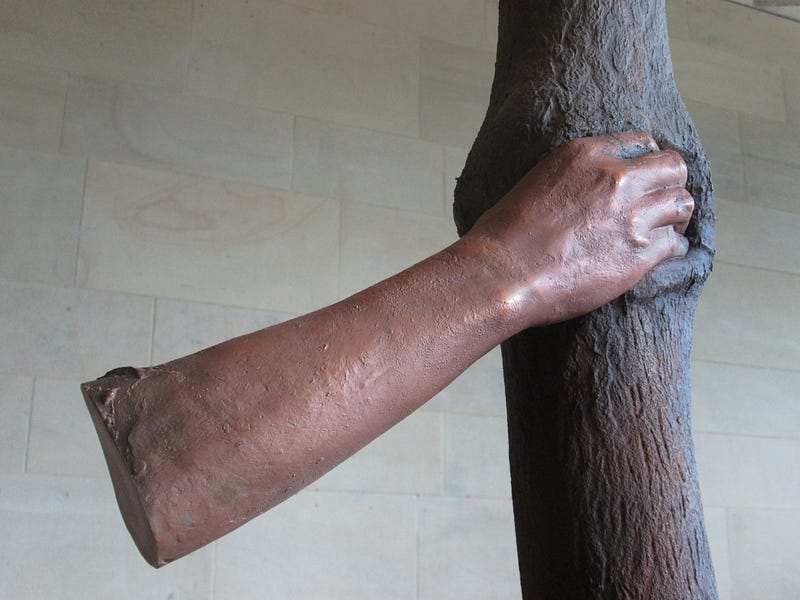
As early as 1968, he began another particularly poignant series with Mano di Ferro / Hand of Iron. He took a mould of his own hand grasping the trunk of a young tree and cast a replica of it in iron which he then attached to the tree at the place he’d held it. The moment of connection is preserved in metal whilst the living wood of the tree grows to incorporate the artist’s severed ‘poetic hand’ into the trunk. Here, the artefact presents a cross-section where the life of the artist intersects the life of the tree. In this case, though, the art is an ongoing process. For later developments of this series, he would return to these trees, years later, and cast sections of them in bronze for gallery exhibitions.
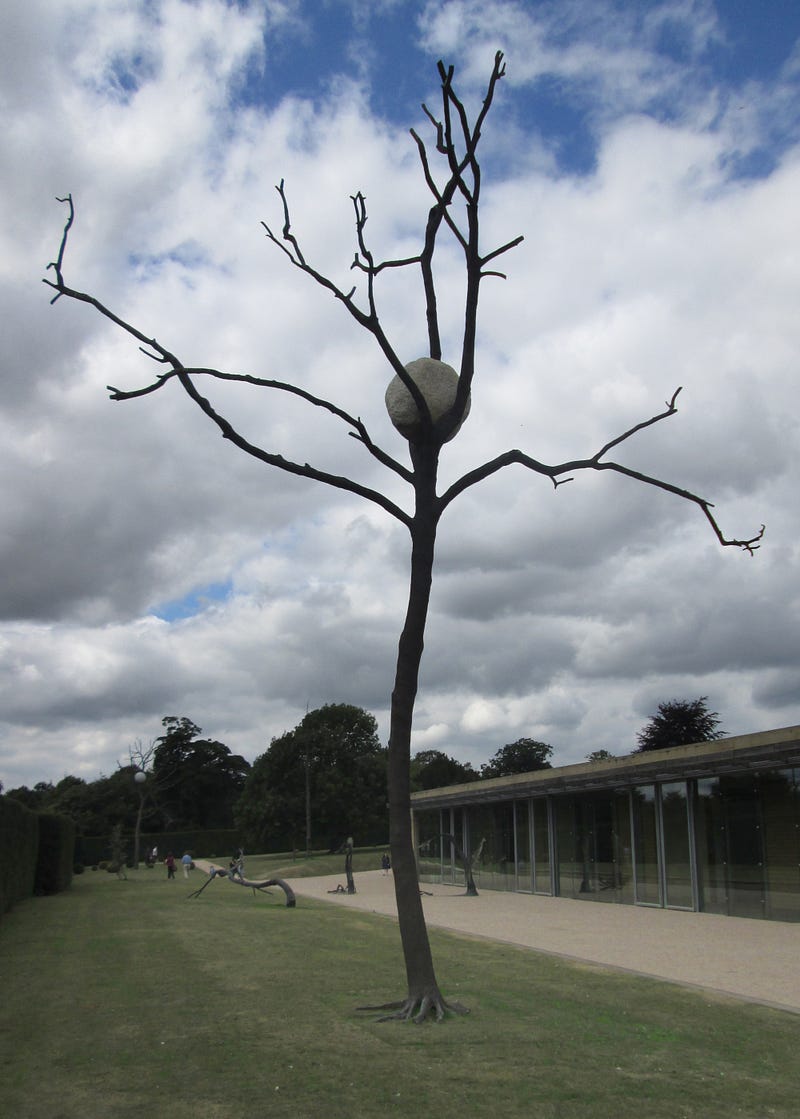
He has also worked with trees to display his bold, quite simplistic sculptures among their boughs. The trees remain unaltered but continue to grow in dialogue with the volumes Penone positions among the branches. The sculptures play with ideas of balance, his artificial objects enhancing rather than detracting from the tree’s natural structures to create a gravity-defying harmony. Again he plays with our perceptions, sometimes presenting convincing full-size bronze replicas for exhibition in place of the living ‘originals’, which remain rooted in their natural places, elsewhere…
“Rise trees of the wood, of the forest, rise trees of the orchards, of the avenues, of the gardens, of the parks, rise from the wood that you have formed, take us back to the memory of your lives, tell us about the events, the seasons, the contacts of your existence. Take us back to the woodland, the darkness, the shadow, the scent of the undergrowth, the wonder of the cathedral that is born in the wood land” - Giuseppe Penone, 1979
David Nash was another artist working with trees during the late 1960s. He began by making sculptures using trees that had been felled by storm or for land development. Selecting the dominant form he saw in the tree, he would sculpt them with a chainsaw into a simplified version that retained the characteristics of the original natural shape and also its balance. His large-scale works were displayed both outdoors and in gallery spaces.
Though Nash significantly changes the trees to make his sculptures, he thinks of these works as a collaboration between artist and tree and, if asked how long it takes to produce a piece of his artwork, he answers, “a hundred years or so,” because he’s including the time it took for the tree to grow.
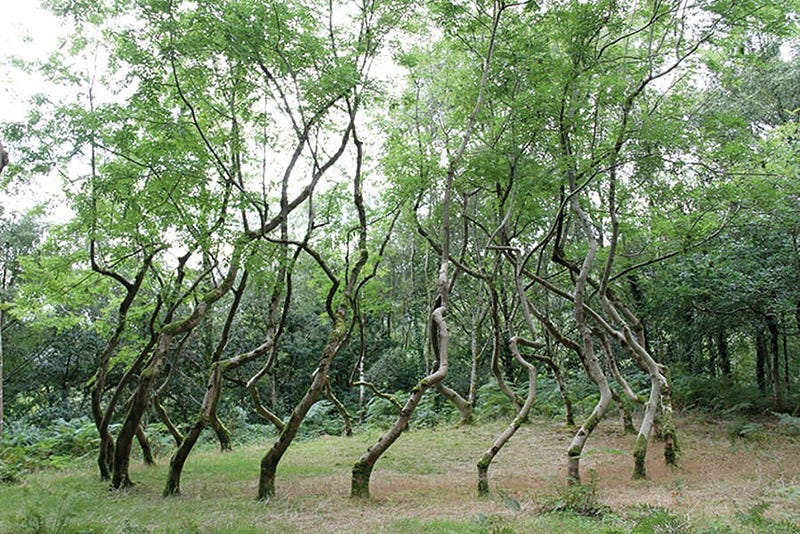
He was soon to begin working with trees in the landscape and during the 1970s produced two hugely significant works: Ash Dome — which involves a grove of living trees manipulated to create a dome, and Wooden Boulder which used the land itself and the natural water-cycle to create a ‘drawing’ through space-time, recording the rainfall run-off in the tributaries that gradually carried the hulking mass of the carved ‘boulder’ down stream, river and finally out to sea.
Ash Dome and Wooden Boulder have been discussed previously by Remy Dean in Signifier
Around the world, landscape gardening uses trees artistically in grand compositions. Gardeners have long sculpted living trees through ‘training’ their growth over arbors and arches, and so on. Topiary is the tradition of clipping shrubs and hedges into formal, geometric shapes or whimsical animal shapes. In the 1990s, David Nash tackled the impressive Yew hedges at Powis Castle, in Wales, to create living sculptures he called Twmps. Rather than the formal shapes of traditional topiary, he created vast flowing forms that look like great green, land-bound clouds.
In 1982, Joseph Beuys initiated his 7000 Oaks project, the grandest of his extended works of ‘social sculpture’. This was a socially aware work that broke out of the usual fine art confines and operates at an environmental scale to incorporate industrial processes, town planning, council administration and legality.
Basically, Beuys planned the planting of 7000 Oaks in various locations within the German city of Kassel. The trees were planted in a ceremony that also involved erecting a single basalt ‘standing stone’ next to the tree. This configuration became known as a ‘Beuys Tree’. Each one had to be approved by town planners, but also brought with it legal protection that made them very difficult to interfere with after they had been placed. This was an ambitious and, quite literally, ground-breaking work.
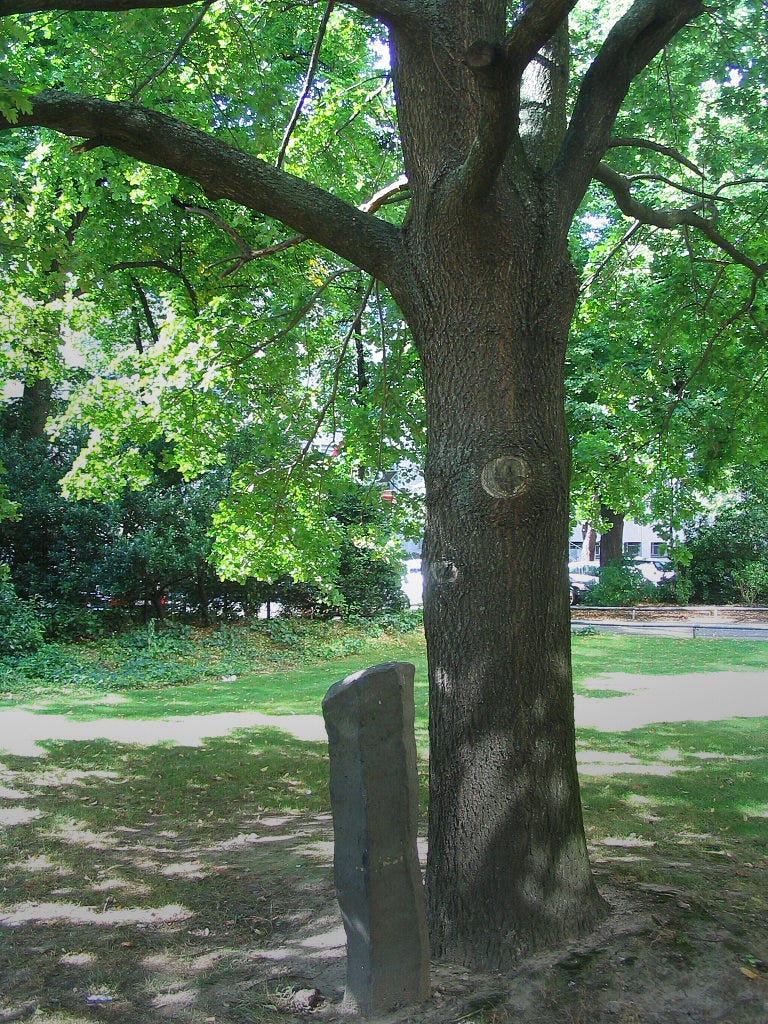
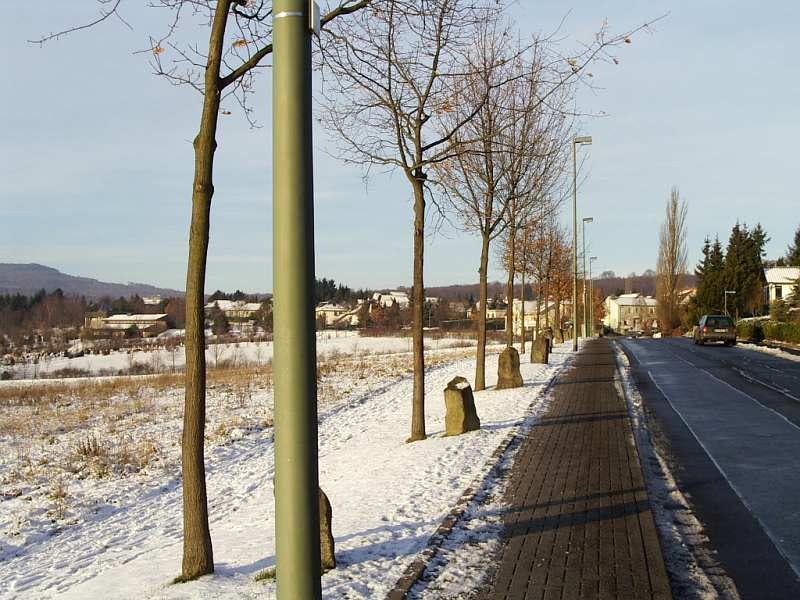
Joseph Beuys was a founder member of the German Green Party and wrote their guiding manifesto in 1978. The party was officially founded in 1980 and became the first internationally significant of the early green parties. It grew out of the anti-nuclear campaigns of the 1960s and built upon the increasing environmental awareness of the 1970s. Beuys envisioned his 7000 Oaks, not only as art but as socio-political reform, as a push-back against the urbanisation of German cities that lacked easily accessible green spaces.
Like Penone, he also wanted to highlight the interdependence of the human and natural world and saw trees as analogous with the human body. He went beyond this concept and described trees as our ‘external lungs’, proposing them as extensions of our biology and a integral part of our respiratory system. The branching pattern of trunk, to boughs, to branches does, indeed, echo the pattern seen in the structure of our lungs. They convert the carbon dioxide we exhale, back into the oxygen we need to continue breathing.
Beuys Trees were adopted by campaigners and activists as methods of protest and protection. If an area of land within the city was ‘earmarked’ for development, then the strategic placing of a tree and stone pairing not only drew attention to such plans, but could also disrupt or even defeat them.
Sadly, Joseph Beuys died in 1986 and the last of the Kassel Beuys Trees was planted, posthumously, at the opening of the Documenta 8 Arts Festival in 1987. However, not only do the trees endure, the project lives on and 7000 Oaks has become an influential international social sculpture. The following year, the Dia Art Foundation began planting Beuys Trees in New York City with the first five along West 22nd Street. The planting has continued, sporadically, using varied species in addition to oaks. The most recent stone and tree pairing was just added, in 2021...
Picking up on Beuy’s idea of trees as our external lungs, Christo wrapped numerous trees in the grounds of the Beyeler Foundation and Berower Park, in Switzerland — previously discussed in Signifier — and, when backlit the branches are made visible inside the translucent ‘sack’ and visually they resemble x-rays of lungs.
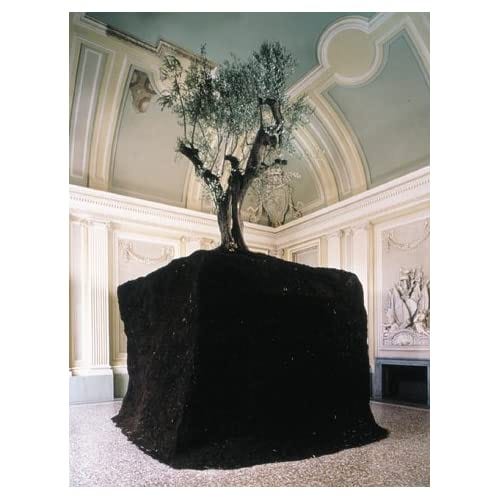
With his technically challenging installation of 1998, controversial ‘art prankster’, Maurizio Cattelan, transplanted a living olive tree, complete with roots in a huge cube of soil, into a gallery interior. The smell of damp earth reinforces the physicality of its presence within the exhibition space. The sheer, monumental, mass of the cube of earth is striking and draws attention to the roots and how much of a tree is actually underground: That which is visible — the branches, leaves and fruit — is supported by invisible structures — the roots in the soil. This is, of course, a metaphor alluding to many things, such as the public face of politicians and their hidden agendas, the visible surface of our bodies and the biological systems that animate us, our actions as seen by others and our subconscious motivations that even we may not be not fully aware of…
Here a familiar thing has been taken out of its usual context and presented in a way that changes how we see the everyday world. The installation is very memorable and after experiencing it, the viewer cannot help but feel its effect when encountering ‘normal’ trees, at ground level. This is a twist on traditional landscape art in that a part of actual landscape is transposed into the gallery situation. This stimulates the viewer to think about the negative space in the land, where the tree and its cube of earth have been removed from. This work could fall into the category of eARTh, or Land Art, and deals with the concepts of site and non-site pioneered by Robert Smithson… it could also be approached as a natural Readymade or an organic objet trouvé.
For her touring installation, Ghost Forest, artist Angela Palmer organised the transport of 10 huge tree stumps from the Rainforests of Ghana and presented them as an assemblage in London’s Trafalgar Square, in 2009. This certainly fits the bill as what Joseph Beuys termed ‘social sculpture’. The art lies in the process of international logistics in sourcing and transporting the remnants, as much as in the aesthetics of the assembled exhibition. Some of these massive pieces of tree are three centuries old and weigh as much as 19 tonnes.
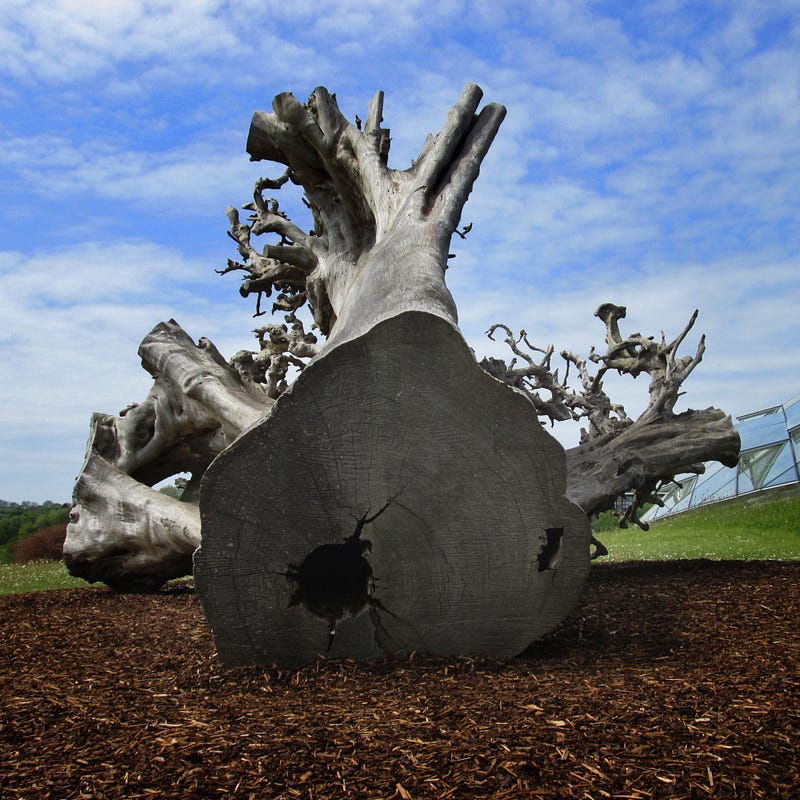
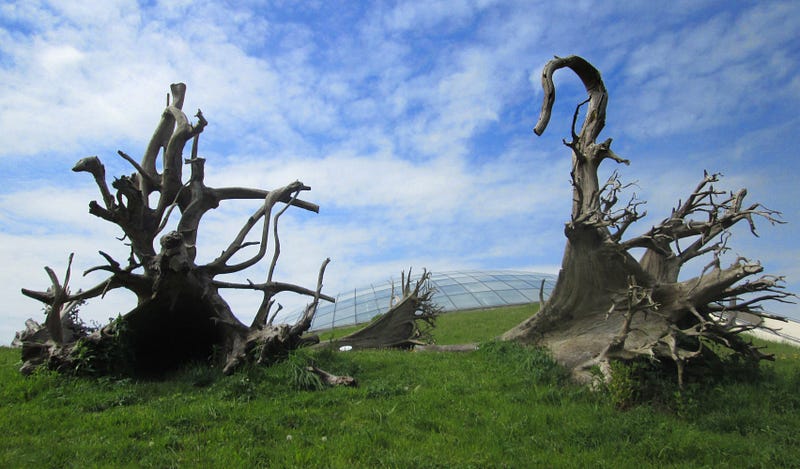
Angela Palmer was driven to produce Ghost Forest in response to the unprecedented acceleration in deforestation that was taking place globally. She had learned that an area of rainforest the size of a rugby pitch is destroyed every four seconds! She hoped that the monumental presence of these ‘ghosts’, the smell of their resins, the textures of their surfaces, would help viewers to visualise their prior, majestic state and to feel their absence.
This is another work that overtly plays with Robert Smithson’s concept of ‘site and non-site’ as we are encouraged to make a mental journey from where we see these imposing sculptural forms to the place where they once grew. There’s a poignant interplay of presence and absence… an inanimate thing that once lived — what once were trees now deadwood hulks. This begs an engagement on an existential level as we ponder our own transience in a world that depends on complex biodiversity that once linked their life to ours.
It seems that using trees as art in themselves unavoidably raises important and increasingly urgent environmental issues. As well as its stay in Trafalgar Square, Ghost Forest toured sites including Copenhagen, to coincide with the 2009 international Earth Summit, and spent 2010 in Oxford before finally reaching the National Botanic Gardens of Wales, where it remains…
* All images are used with permission or presented here for educational purposes under fair usage policy.


.jpg)
