
The Ashes of Nash
During the late 1970s, in a secret woodland location somewhere in Snowdonia, David Nash set a new paradigm for landscape art.
Secluded in an area of private woodland is ‘Cae’n y Coed’, where a circle of 22 Ash trees stand. They have been growing under the gentle guidance of artist David Nash for more than 40 years. Over the decades he has gradually manipulated their growth so they have bent in towards each other in a vortex that has now met to form a living dome.
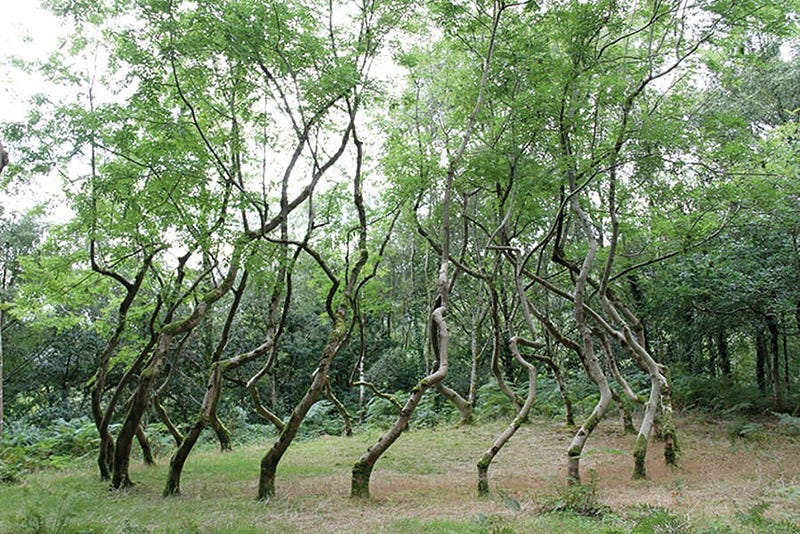
The dome creates a space that is only a little bit different from its surroundings, yet the sculptural intervention draws our attention to the natural processes and the passage of time. This is a sculpture that exists in the time scale of nature. It changes through the seasons and over the years. As each tree grows, they also document their times in each ring that marks annual periods of growth. They are, quite literally, ringing the changes.
The growth of the trees is fuelled by traces of nutrients lifted from the soil, powered by solar energy through photosynthesis and uses atmospheric carbon as its principal building material. Recorded in its very substance is information about weather and the changing climate, pollution levels, prevailing wind, the duration of each and every season that has passed since they were seeds. All trees do this.
This is art rooted in the land, in the purist sense. It cannot be exhibited in galleries or sold by a dealer. It must remain where it is made as a permanent and ever-changing site-specific installation. Nash has tended the Ash Dome year in and year out, recording its subtly developing intervention in the environment with drawings and photography.
He chose to plant 22 trees because he wanted to avoid any number with explicit symbolism. The project was initiated in 1977, a year with historic connotations. For one thing, it was the Silver Jubilee of Queen Elizabeth II, but the celebrations to mark the event were incongruous with the political and economic turmoil of the times.
Despite an ‘official’ ceasefire in 1972, IRA-inspired terrorism remained constantly in the news. There was escalating friction between government and trades unions leading to prolonged strike action. The UK was entering what is now known as ‘The Winter of Discontent’, though there was also a sense of impending change in the air and Nash intended his action of planting for the future to be a symbol of hope.
Ash Dome has weathered much socio-political flux. Quietly, inexorably growing while the world went through major change. They were there when the USSR signed up to SALT II (Strategic Arms Limitation Talks) and for a while, the Cold War looked to be fading. Their buds swelled through springs. Reverend Jim Jones killed himself and murdered 900 of his congregation in Jonestown. Margaret Thatcher become Britain’s first woman Prime Minister. Their leaves fell during autumns. Stephen Hawking theorised about the existence of cosmic bodies he called ‘black holes’. There were devastating wars and earthquakes.
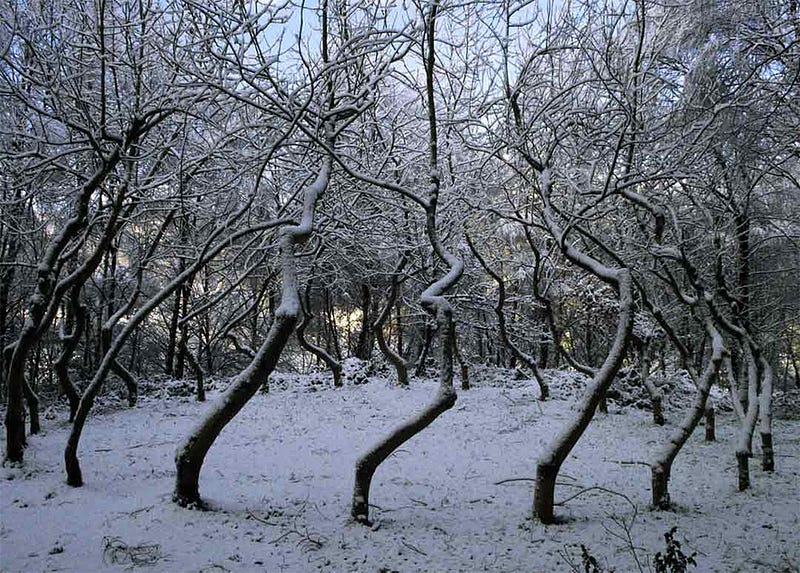
The trees stood naked in harsh winters. Computers and the internet were welcomed into our homes. Humans took up continuous off-world residency in space. The branches were leaf-laden all through spectacular summers. A sheep named Dollie met her clone. The twin towers of the World Trade Center were destroyed. We took the first photograph of a black hole. The world got warmer and warmer. Partly due to climate change, Ash Dome is currently under threat from the spread of a fungus causing Ash-dieback, a disease which it is estimated will kill 80% of Ash trees across the UK.
Ash Dome is recognised internationally as a key work for David Nash, even though it’s located in private woodland, somewhere in Snowdonia, and few have actually stood under its cathedral-like canopy. I feel lucky to count myself among the few who have.
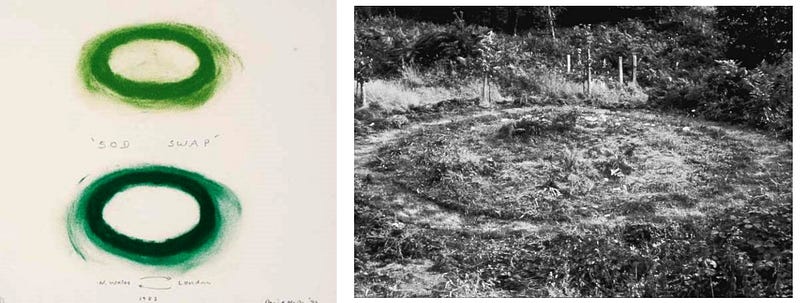
It’s situated close to some other living works by David Nash: a copse of wonky trees known as Planted Larches (1981+), a woven barrier of living hazel and a circle of sod, one of his Sod Swap works where circles of soil and their living biomass are swapped with a circles from other locations. This circle was swapped in 1983 with an area of sod from Kensington Gardens in London.
Generally, Nash works almost exclusively with wood. Usually, he carves the boughs of great trees that have fallen or that he manages to reclaim after they may have been felled to clear ground. He works with the forms already in the trees and has described his method as collaboration. When asked how long it takes to produce a piece of his artwork, he answers, “a hundred years or so,” including the time it has taken for the tree to grow.
His approach is one of truth to materials and he uses the properties of wood in the creation of his form. For example, he will carve deep parallel cuts into a column of wood and then kiln-dry the piece, causing the straight slices to curl and form waves. He uses fire to char the surface of some of his works, a process that both colours them and also preserves them.
So, in his sculptures with living trees, this truth to material is taken a step further and deals much more with the processes involved. These processes include his artistic guidance and intervention, as well as the biological processes of photosynthesis, respiration, transpiration and direct response to changes in environment and climate.
In 1978, the year after he began Ash Dome, David Nash set another radical work in motion, literally. He had started carving a very large Oak where it had fallen in the highlands of Snowdonia, above the village of Maentwrog, whihc is just over the ridge from ‘Cae’n y Coed'. The location was not easily accessible and he had to consider ways of transporting the sculptures that he produced. This problem of practicality was the inspiration for a truly original piece of landscape art…
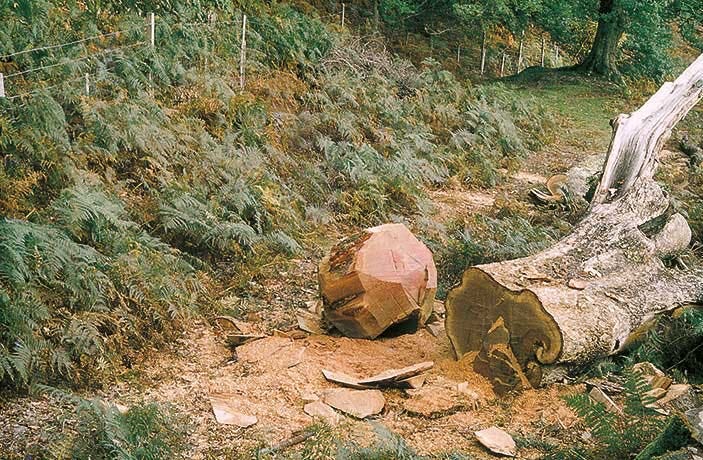
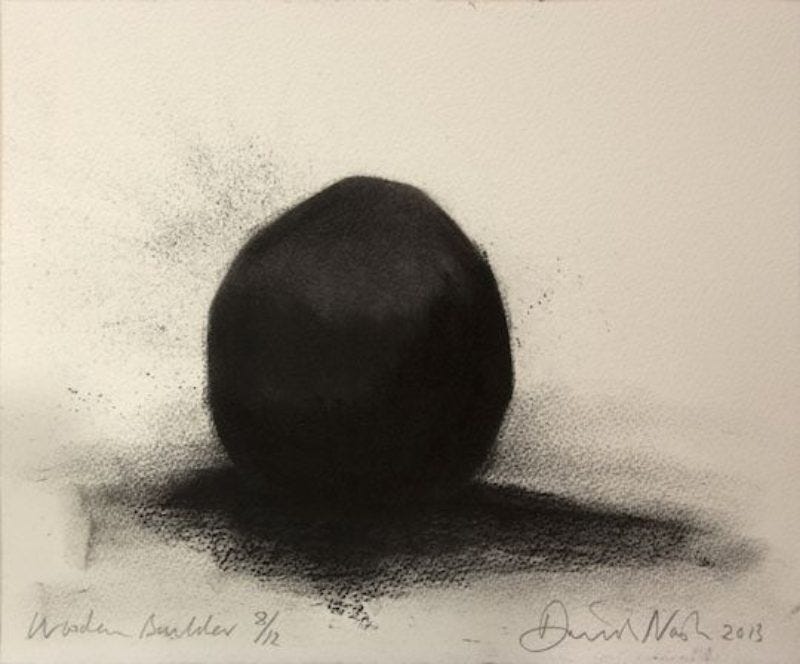
He carved a huge chunk of trunk into what resembled a large Wooden Boulder and decided to set it in a mountain stream. He knew that the boulder would move downstream as the waters carried it. He also knew that the journey of this wooden boulder would be sporadic and directly affected by the levels of rainfall. It was heavy and needed considerable water to make it buoyant. The longer it sat in water, the more waterlogged it would become and less buoyant as a result.
For the next quarter of a century the boulder would travel slowly but surely towards the sea, at the mercy of the elements. It was last sighted in March 2003 when the River Dwyryd carried it away. The journey of the boulder drew a line through the land and Nash maintained a relationship with the sculptural journey, tracking it and recording it in photographs, film and by producing his own drawings of the boulder as its situation changed.
Exploring similar concepts to Robert Smithson’s ideas of ‘sites’ and ‘non-sites’, Wooden Boulder is definitely another of Nash’s more important works. With it, he invented a new way for artists to work with the land and in the landscape. It’s a drawing on a grand scale using the terrain itself as the canvas.
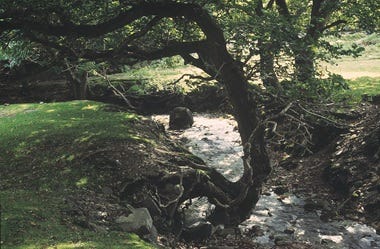
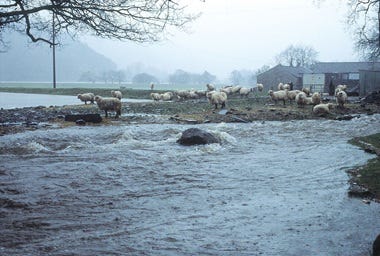
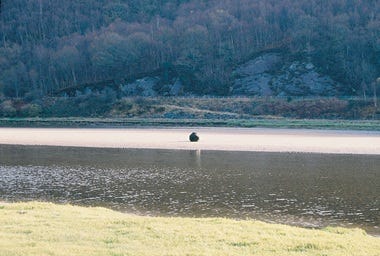
The boulder drew a line through space-time, a record of rainfall and run-off along the the tributaries it travelled, as well as a topographic response to the contours of the land itself that have been carved by glaciers and etched by millennia of erosion. The role of Nash, the artist, in this piece was as instigator and biographer. The art itself was a combination of processes and part performance. As a result of its making, it disappeared, now existing only as documentation, a concept, memories, and Nash’s continued study of the form in his subsequent sculpture and drawings.
Ash Dome may also disappear, perhaps prematurely due to climate change and Ash-dieback. Yet it still stands, a living temple of secret hopes for the future…
* All images are copyright of David Nash and courtesy of the artist, used here for educational purposes under fair usage policy.
A version of this article was first published in my book Evolution of Western Art (questing beast books, 2012)