
Inhale, Exhale: Christo through Time and Space
Reflecting on the lives and works of Christo and Jeanne-Claude, the married couple who made some of the biggest things in art…
My first experience of Christo’s art was a pastiche of their monumental work Valley Curtain (1972), mediated through the Saatchi advertising agency in the form of a cigarette commercial. This was before cigarette advertising was outlawed on UK screens. I was in my mid-teens and therefore right in the middle of the target demographic, but instead of selling me the addiction, it sold me art.
‘Christo’ was the brand name of an art production corporation formed by Christo Vladimirov Javachef with his wife, Jeanne-Claude Denat de Guillebon, who continued working together until Jeanne-Claude’s death in 2009. They are famous as pioneers of site-specific installations on a grand scale in the environment.
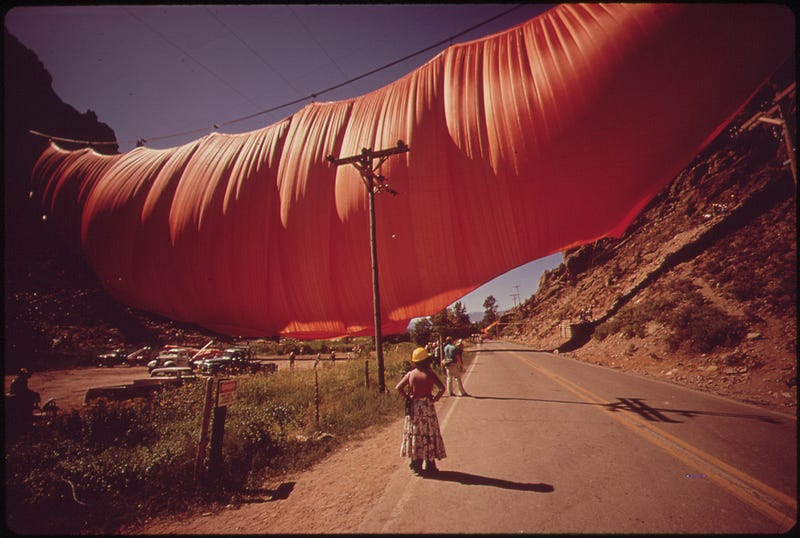
Valley Curtain was one of Christo’s earliest works of such monumental proportions. A vast sheet of orange fabric — 200,200 square feet and spanning 1,250 feet — was installed between mountains and suspended across the valley above Colorado State Highway 325. It was made using an engineering and construction crew and lasted little more than one day before the wind destroyed it.
This didn’t matter too much to Christo who had fully embraced the post-modern notion of process-art. Because their finished pieces were impermanent, and on too large a scale to be collected or preserved in museums and galleries, they understood their art to exist through three distinct stages:
- the concept — expressed through sketches, blueprints and maquettes. Often these were the items sold to galleries, dealers and collectors. Sometimes these concepts remained unrealised.
- the construction — a process involving large teams of experts, engineers, art students and communities, directed by Christo. This was an approach described as ‘Social Sculpture’ by their contemporary, Joseph Beuys, by which he meant art actions that utilised and changed social structures around them.
- the record — artefacts that documented the entire process and its end-product such as photographs, interviews and films. For example, Valley Curtain was documented by Ellen Giffard and The Maysles Brothers in a short 28-minute film, nominated for the Best Short Film Oscar in 1974.
Valley Curtain was preceded by 5,600 Cubicmeter Package for Documenta 4, Kassel, Germany, in 1968. It was an ambitious engineering project that required the tallest cranes in Europe and, at the time, was the largest inflatable free-standing structure without any ‘skeleton’ or frame. It stood 280 feet tall and the rather phallic ‘balloon’ was filled with helium to keep it erect, toying with the notion of volume and substance.
The following year, Christo wrapped the Chicago Museum of Contemporary Art and, also in 1969, made their first work in the wider environment. They wrapped two and a half kilometres of coast in Australia’s Little Bay, Sydney, in almost 1,000,000 square metres of fabric. This was understood as a work of social art as it employed more than 100 people and raised debate about access to, and protection of, natural environments. These were themes they would return to with some of their best known works including Running Fence (1973) and Surrounded Islands (1983).
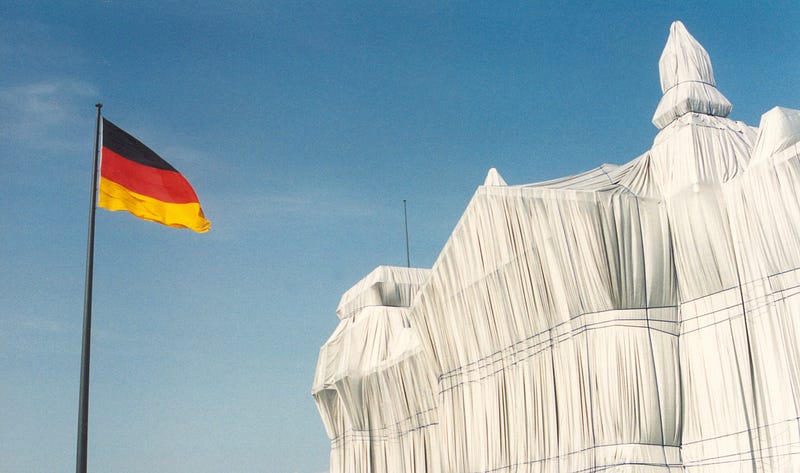
Arguably, their most famous work is Wrapped Reichstag, the concept for which was first expressed in 1971 through a series of many sketches and collages. A scale model was made in 1981 and, finally, the installation began in Berlin during April 1995 and was completed in June. The process had lasted for nearly a quarter century, but the building remained wrapped for just two weeks.
Wrapping such a historic site altered the public perception of the place. In some ways, it was a reductionist sculpture that simplified the volume and clarified its form. Unwrapping allowed the building to be seen anew, evoking a sense of closure for its questionable past and presenting it in a new light for the future.
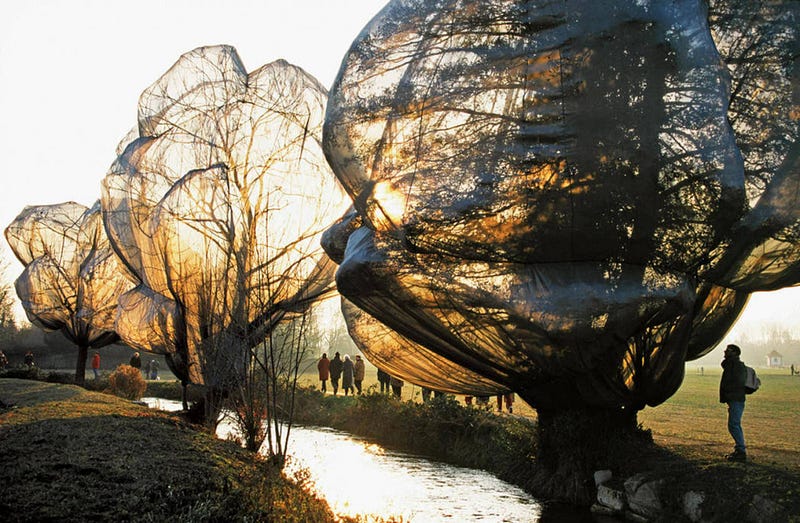
My favourite works of Christo were their Wrapped Trees series. This intervention took place in the grounds of the Beyeler Foundation and Berower Park, in Switzerland. Their team wrapped the trees in breathable polyester that was opaque in direct light, becoming diaphanous when back lit by the low sun of dawn and dusk.
The dimensions of this installation are difficult to pin down, the trees ranged in height from shrubs and new saplings to fully grown, long-established specimens, the largest being eighty-two feet high. Nearly 6,000 square feet of the material was tied around the trees with 14 miles of rope used to secure it.
Throughout their career, the couple had maintained that there was no hidden environmental agenda and their works were conceived as purely aesthetic, though they hoped that they would alter people’s perceptions of, and relationship with, their local environments that may have become familiar.
The wrapped trees are aesthetically pleasing and, as with all their wrapped projects, deal with revelation through concealment. By enclosing an underlying structure, we are made aware of the overall form — by uniting the details, we can better appreciate the whole. The added ‘twist’ with the wrapped trees is that the hidden structure is periodically revealed again by changing conditions of light.
I am reminded of that cigarette commercial and am forever glad that it left me with a craving for art not nicotine! For, when back-lit, the branches are made visible inside the translucent ‘sack’ and visually they resemble x-rays of lungs. This fractal branching structure that recurs throughout nature fascinated Leonardo Da Vinci and the correlation between human lungs and trees was also highlighted by Joseph Beuys during his huge social sculpture, 7,000 Oaks (since 1982), when he referred to them as our “external lungs”.
We could not breathe air without either.
Jeanne-Claude Denat de Guillebon died in 2009, she was survived by her husband, Christo Vladimirov Javacheff, who passed away last week. Their son, Cyril Christo is a writer, photographer, filmmaker and animal rights activist.
Silk Cut 1985 ‘Valley Curtain’ UK Advert by Saatchi & Saatchi Garland Compton [sourced via History of Advertising Trust] *
* All images used here with license or for educational purposes under fair usage policy.
Originally published at https://dean-evolution.blogspot.com.


