
Of Human Transience
Can environmental art help to restore our environment? Considering the disappearing art of Andy Goldsworthy.
Andy Goldsworthy is known for his ‘transient’ art, often working with fragile materials in nature such as flower petals, leaves, and ice to produce sculptures and collages in the environment that are destined to be destroyed by natural forces such as wind, rain, warmth, and so on.
Many of his early career works were only experienced directly by the artist who then documented them for the audience to experience ‘at a distance’ via photographs. Though more often thought of as a sculptor, Goldsworthy could be considered, primarily, to be a photographer. His work often explores ideas of dialogue between different places and times — between the places where the art existed and the idea of the art in another place, as perceived by the viewer who sees the record of the work. The primary experience of Goldsworthy creates an impression in the collective memory of his audience. This process explores the concept of site and nonsite, originally expounded by the founders of Land Art, Robert Smithson and Nancy Holt.
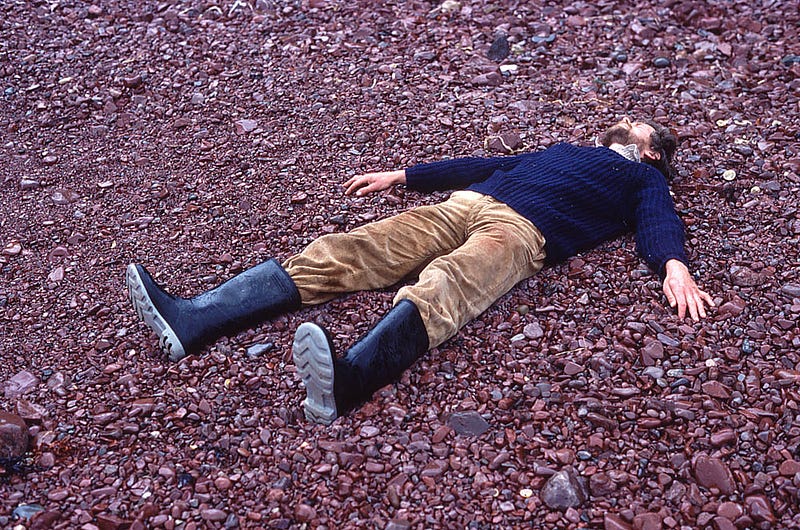
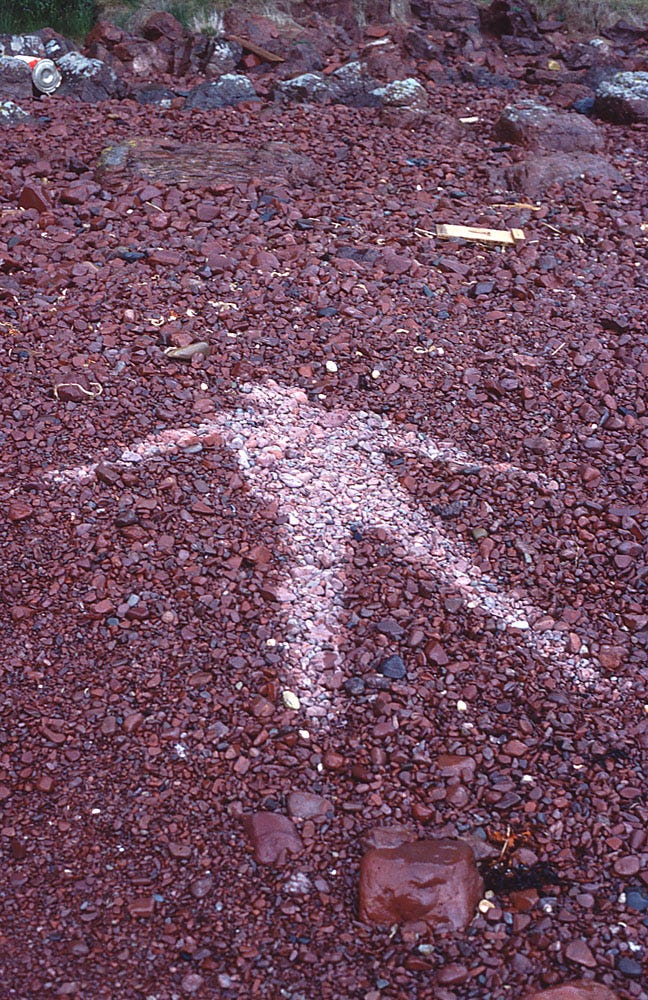
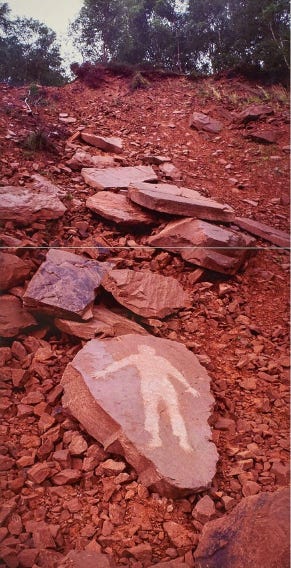
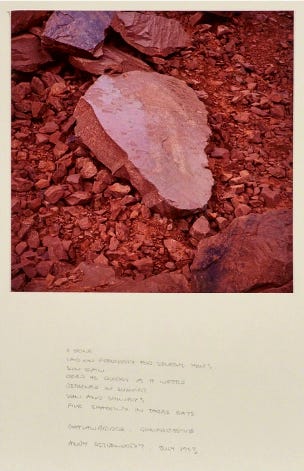
Beginning in the 1980s, he has produced an ongoing series of Rain Shadows that are the epitome of transient art. Whilst out walking on cloudy days he would note suitable flat surfaces in his surroundings such as a slab of rock or stretch of road. When he felt the first few spots of rain began to fall, his response to the change in weather was to lay down. He would remain there, prostrate on the surface until the ground all around was wetted.
Goldsworthy doesn’t flee from the moment. He embraces the elements instead of trying to avoid or avert them. He becomes at one with his environment and welcomes the experience it has to offer him, sensing the essence of place, savouring the pause in swiftly passing human time. Their are thoughts and lessons to hold onto, or simply enjoy and allow to drift on. A mediation on one being’s place in relation to others and self, here and elsewhere… a thing amongst all things.
After the shower had passed he would stand and take a photograph of the surface, onto which his dry outline had been printed by the rain. The dry area was, in effect, a shadow cast by his body, a drawing with rain that recorded his unique presence. This transient artefact would not last long. The outline would disappear, erased by continuing rainfall or through the action of air-drying. Either way, the mark left by a human presence would be wiped away by the natural action of the elements.
To a lesser or greater extent, all the marks we leave on this world are indeed transient. I am reminded of the oft-quoted and now iconic final lines spoken by Rutger Hauer as Roy Batty, the replicant, in Blade Runner (1982):
I’ve seen things you people wouldn’t believe… Attack ships on fire off the shores of Orion. I watched C-beams glitter in the dark near the Tannhäuser Gate. All those moments will be lost in time, like tears in rain...
Perhaps Goldsworthy's best known art, certainly the most widely distributed documentation of his many sculptures in the environment, are the works using ice that featured on the Royal Mail stamps designed by Dick Davis for Christmas 2003. The memorable images were selected from a series of works created in several far-flung locations around the globe including Scotland, Japan, and the receding arctic icefields of Ellesmere Island.
The choice of various locations rendered similar by their snowy conditions highlighted the interconnectivity of our global weather systems. In populated areas, snowfall tends to be seasonal and brings with it a transformative, magical sense of wonder. In recent years, though, the incidences of deep snow have become much less common and this observable change, due to global warming, links with the more troubling retreat of what should be permanent polar ice.
Goldsworthy used naturally occurring snow and ice in all these works and created them with minimal intervention in their environs. For example, he would take natural icicles and partially melt their ends using his own body warmth and breath. These parts could then be held against each other and the moisture would naturally refreeze to fix them into place.
For more ambitious bonds, he would utilise snow, or water from streams that flowed nearby, and support the structures with found sticks which were later removed by breathing on their point of contact. Thus, the works were made of the environment, in the environment, using only natural processes of thawing and freezing manipulated by the minimally invasive presence of the artist and his biological processes — respiration and homeostasis, the very indicators of life.
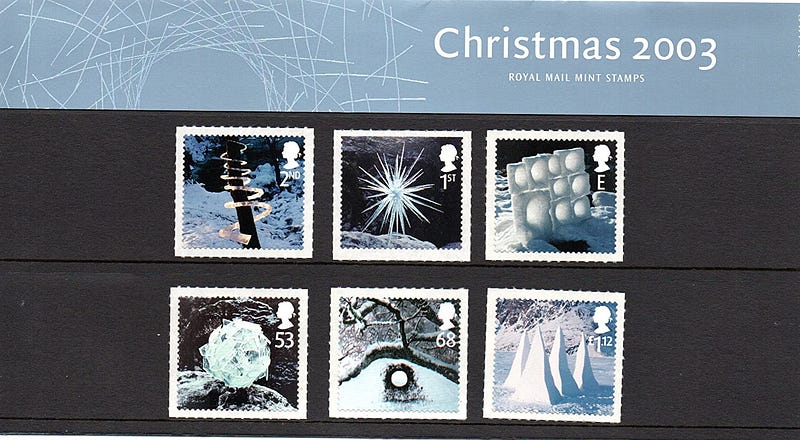
The stamps looked suitably ‘seasonal’, but also spoke of the delicate balances in nature and brought to mind the increasingly urgent existential threat of global warming. Goldsworthy courted controversy by accepting commissions generated by the sponsorship of BP, the British multinational oil and gas company that, by definition, was a major contributor to the global carbon emissions driving detrimental climate change. The fossil fuel merchants saw it as a green spin on their image, but Goldsworthy incorporated this contentious connection into the environmental narrative of his work. The use of money earned through environmental damage to fund art to highlight that damage remains a controversial stance.
Can environmental art help combat the climate emergency? Surely raising awareness and highlighting areas for action can only be a good thing. That’s something artists can do — providing emotional, human connections across the wider community. This week in the UK, thoughts are being focussed for the ‘Big Green and Climate Fringe Week’, a major festival intended to highlight climate issues and increase environmental awareness. These issues are already at the fore of public consciousness as the COP26 conference approaches, to be held in Glasgow at the end of October. As with previous UN Climate Change Conferences, the event is inspiring swathes of socially aware art and cultural happenings.
Work by environmental artist Tim Pugh was the May exhibition for Signifier’s Six Shot Gallery.
* All images used here for educational purposes under fair usage policy.


