
Drawing Down the Sun
In the mid-1970s, artist Nancy Holt gave us a set of ‘Sun Tunnels’ to help find and navigate humanity’s place in the universe…
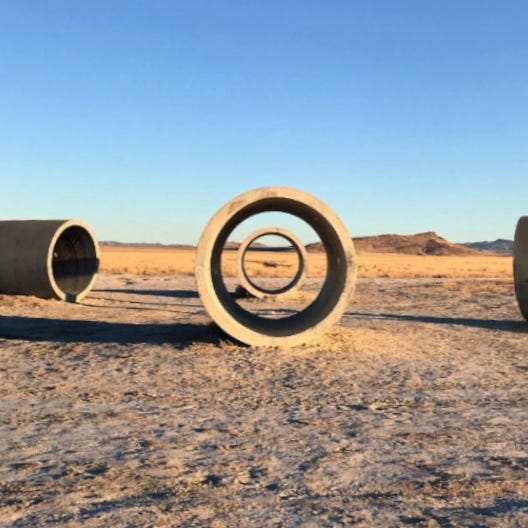
In the remote Utah desert lie four huge concrete tubes, large enough to walk through. They are arranged in a cross and each is 18-feet long, 9-feet in cross-section and weigh 22 tons, yet they are dwarfed by the expanse that surrounds them.
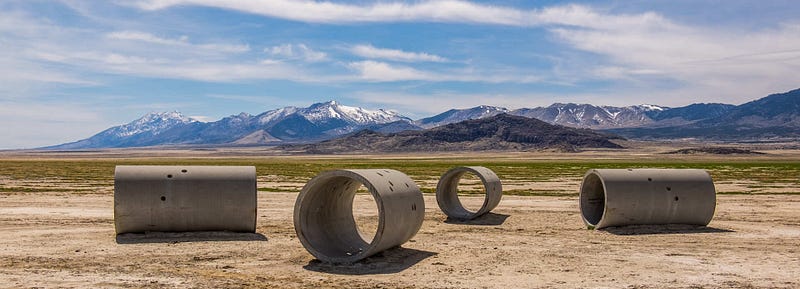
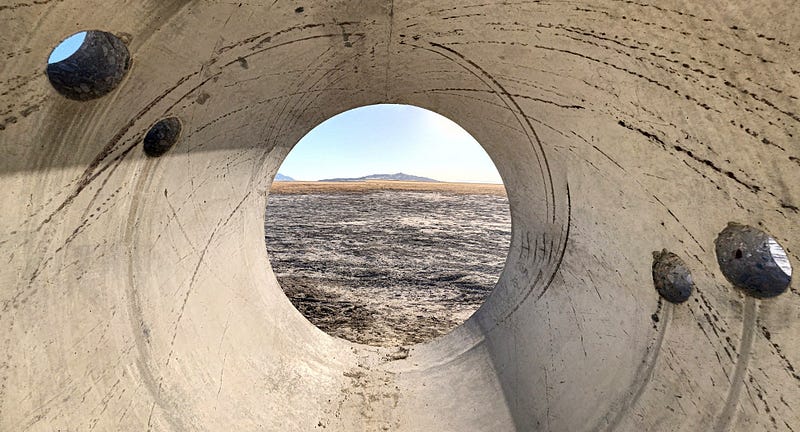
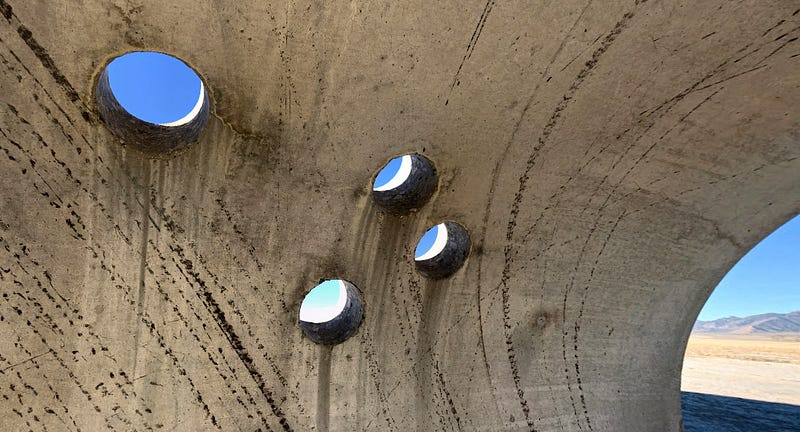
If you enter these, you are offered protection from the baking sun and can enjoy vistas of distant mountain ranges which seek to centre you at a human scale within the landscape. Holes bored into the roof of each tunnel shine bright discs of light on their curved interiors, offering stark contrasts. At night, the meaning of these seemingly random holes alters — they allow moonlight to enter, and frame the clear and endless night sky. The movement of light and shadow through the sun holes thus tracks the earth’s rotation, while the tunnels themselves align with sunrise and sunset at the Summer and Winter solstices.
Nancy Holt began working on her Sun Tunnels installation in 1973 and it was completed in 1976. It reflects her love of the great Western landscape that provided so much space. Her unique approach to framing its timeless, mythical qualities on a human scale resonates with ancient Neolithic monuments, such as Stonehenge.
Sun Tunnels took as its focal point Polaris, the North Star. It is the only constant in the night sky, although even this has an elliptical wobble and the alignment is changing, ever-so-slowly, over millennia. Thus the construction of the work is pinpointed in cosmological time making it a time specific, as well as site specific, sculptural installation in the landscape.
Nancy Holt was a scientist before she was known as an artist. Whilst she studied biology at University she also attended art lectures at MIT and was struck by how science and art overlapped. She noticed that abstract art often reflected biological forms, such as the interior of living cells. She met the pioneering land artist Robert Smithson, who also shared her fascination with science and, in 1963, they were married.
Nancy went out West with Robert for the first time in 1968, where she also fell in love with the spacious landscape. In 1969 they visited Britain to research and experience its Neolithic monuments including the large Pentre Ifan dolmen in Pembrokeshire and Stonehenge in Wiltshire. Together, they established ‘eARTh’, a major art movement that uses the land itself as its main medium.
“The idea for Sun Tunnels became clearer to me while I was in the desert watching the sun rising and setting, keeping the time of the earth. Sun Tunnels can exist only in that particular place — the work evolved out of its site.” - Nancy Holt
It was the first land art to embrace astronomy in this way since the great ancient monuments. Although it’s boldly modern in its appropriation of architectural language and scale, it seems to sit comfortably in its site specific setting. The grey of the concrete forms are harmonious with the sandy surroundings because concrete is, of course, sand bonded with cement. So, in this respect they are also of the land, cast from the same substances.
The precise positioning of Sun Tunnels speaks of time and space. In the vast expanse of the desert, it is possible to observe the curvature of the Earth. The sun’s journey is made clear as its rising and setting positions slide along the horizon and back again from solstice to solstice. At night the starscape wheels through its cycles as we are made keenly aware of our place upon this Spaceship Earth. As the realisation takes hold, we glimpse what the Romantics called ‘the sublime’.
It was also one of the first large installations undertaken by a woman — funding was difficult in an era where women were not trusted with large undertakings involving diggers and construction teams on a monumental scale!
“By the time Sun Tunnels was finished, I had spent one year in Utah and had worked with two engineers, one astrophysicist, one astronomer, one surveyor and his assistant, one road grader, two dump truck operators, one carpenter, three ditch diggers, one concrete mixing truck operator, one concrete foreman, ten concrete pipe company workers, two core-drillers, four truck drivers, one crane operator, one rigger, two cameramen, two soundmen, one helicopter pilot, and four photography lab workers.” - Nancy Holt
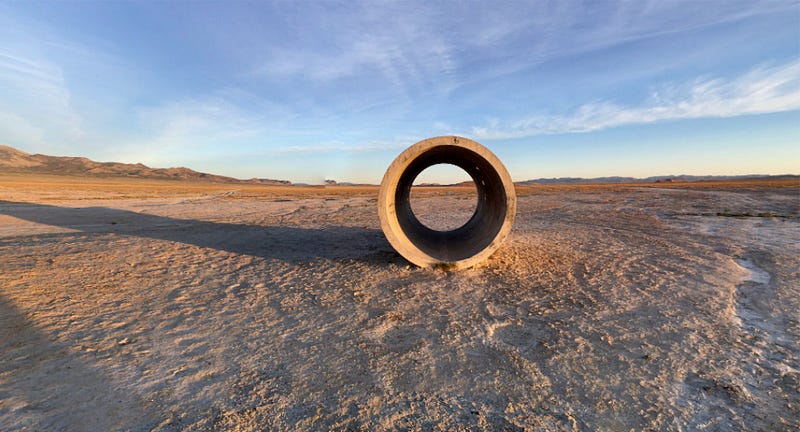
Holt encouraged people to visit the site, to camp out and spend time there, experiencing their altering perceptions of the environs and their place in relation to it. Although only intrepid travellers and art aficionados make the journey to visit Sun Tunnels, it is well documented — through beautiful photographs and the prose of the artist:
“In the glare of the desert sunlight, I want to turn away from the sun, rather than contemplate it. When the sunlight is all around me like that, I only become conscious of it when it is edged by shadow. The sunlight pours in wherever there are holes in the tunnels. Because of the seven- and-a-quarter-inch thickness of the holes, the shape of the light that reaches the bottom of the tunnels is usually a pointed ellipse, but there are times when the sun is directly over a hole and a perfect circle is cast. Day is turned into night, and an inversion of the sky takes place: stars are cast down to Earth, spots of warmth in cool tunnels.
“In choosing the constellations used for the sunholes… I wanted only those with stars of several different magnitudes, so that I could have holes of different diameters… Each constellation had also to have enough stars, and to encompass the top half of a tunnel …With those criteria there were only a few constellations that I could use, and from them I chose Draco, Perseus, Columba, and Capricorn. Together, they encompass the globe.”
The use of circular tunnels to frame the mountains in the distance echoes the globe on a more tangible scale. The horizon that rings all around and the orbits of celestial bodies beyond is suggested. The blazing sun shines its light through the drilled holes, projecting the patterns of constellations, reminding us that they are configurations of similar stars, stellar furnaces just as fierce, yet diffused by vast distances. They are patterns unique to our point of view and would seem quite different from any other place in space as they endlessly turn in their galactic orbits. Those incomprehensible cosmic distances are poetically packaged at a relatable scale, though the wonder and awe remains.
Nancy Holt also documented Robert Smithson’s most famous land art, Spiral Jetty (1970), and curated this, among his other work, following his tragic death in 1973. Holt herself died in 2014 but subsequent retrospectives of her work have raised her profile as an important land artist. Sun Tunnels, Holt’s way to ‘drag the sky down to earth’ are preserved by the Día Art Foundation and a place of pilgrimage to this day.
* All images are used with permission or presented here for educational purposes under fair usage policy.