
Making Room for Rothko
The ominously dark canvasses of American Abstract Expressionist, Mark Rothko, attempt to elevate art beyond physicality and so reveal the infinite.
Rothko’s early works, signed as Marcus Rothkowitz, were figurative and took their subject matter from Ancient Greek and Christian mythologies whilst drawing on his uneasy relationship with religion in general, and his Jewish heritage in particular. He was later to veer away from these fairly derivative techniques and explore expansive colour-fields and their emotional effects.
Typically, his major works featured large, soft edged rectangles of colour stacked one above the other, horizontally dividing the canvas. During his mid-career, these large paintings were usually bright in tone, sometimes utilising complementary colours. The intended effect of the larger size was to allow the viewer to approach close enough so that the edges were no longer in the field of view, hence losing any sense of scale and creating an illusion of absorbing, infinite depth.
In the latter years of his career, Rothko’s palette became somber and consisted mainly of blacks, purples and dark reds. He experimented with his preferred medium of oil paint and tried adding various substances to the pigments as well as, or instead of, the oil content. He experimented with egg, which had been commonly used in tempera paintings before oil paints found favour in the Renaissance.
He also added paint thinners in varying concentrations which altered the properties of the paints. At a certain point, the amount of thinners prevents the oils from bonding and the result is a softer, granular appearance, more like oil pastels than oil paints.
As with chalks and pastels, the result is powdery and would require the application of a fixative to prevent this powder from gradually falling away. Rothko did not fix his later works as this treatment affected the texture of the colour. Unless they are very carefully conserved in controlled conditions, these works will eventually fade away, back to the canvas. These paintings, even now, are ever-so-slowly decaying and fading away before their viewers’ eyes…
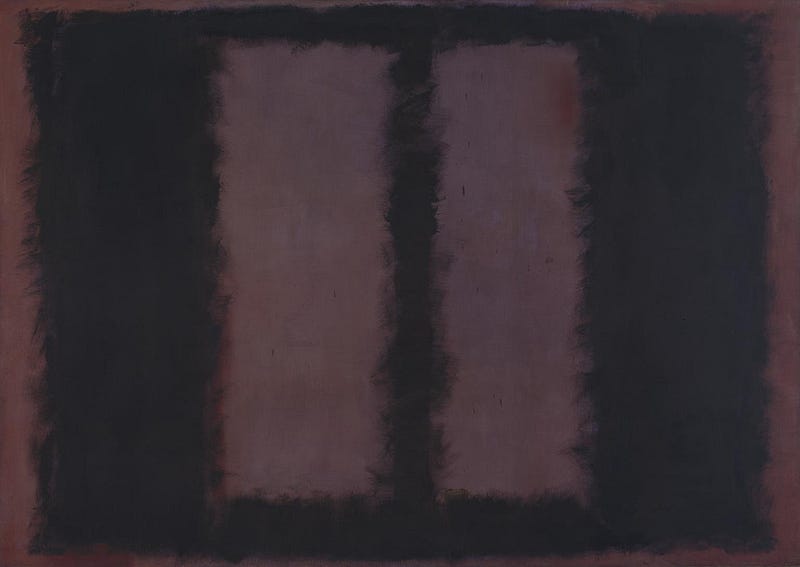
This dark and almost transient style reached its conclusion with the Seagram Murals, which Rothko painted over a period of two years, 1958–1959. This set of large paintings, which consist of dark, soft rectangles within rectangles, predominantly in black, reds and maroon, started out as a commission for the Four Seasons restaurant in New York’s Seagram building, hence their name.
This was a very prestigious job for any Abstract Expressionist to be given and the financial motivation would have been considerable. Rothko began work in good faith and had a space constructed within his studio to match the dimensions of the room where the paintings were intended to hang. However, as he worked on them, their character developed into something much more contemplative and almost spiritual.
Rothko had found inspiration in a vestibule of the 16th Century Laurentian library of Florence. The vestibule was designed to house an overly grand staircase and to be the hallway from the library to the attached church, the Medicean Basilica di San Lorenzo di Firenze.
The vestibule was built according to plans laid-out by Michelangelo. It’s an oppressive work with architectural detailing that imply windows, but are ‘blind’ bricked-up recesses. Rothko had visited this space in 1950 and the experience stayed with him and deeply affected him. He revisited Florence to see Michelangelo’s vestibule again as he was completing the Seagram Murals in 1959.
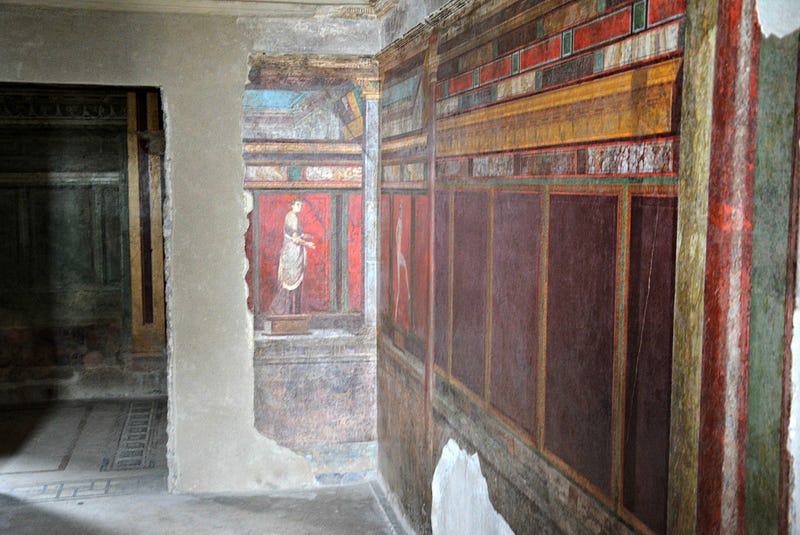
During that visit he also looked around the site of ancient Pompeii where he was impressed by the bold decoration of the interiors in black and red. In his mind, there were strong correlations with the claustrophobic architecture of Michelangelo’s vestibule, its blank windows, the unearthed city of the long-dead Pompeians, and the large paintings he was working on for Seagram. Shortly after his return to New York, he withdrew from the Four Seasons commission and returned all funds.
As he’d worked on this series of paintings, they’d changed and so too had his motivations. He wanted the paintings to be contemplated in a quiet and enclosed space with low lighting. He seemed to have produced a set of works that demanded serious engagement and profound responses, no longer suitable for a posh Park Avenue restaurant. He continued to experiment with these pieces for the next decade, absorbed in his quest to develop a coherent set of works that were unified by a unique feeling of infinite depth and eternity.
With the Seagram Murals as a new starting point, he embarked on a series of ambiguous, large-scale abstractions which he described with religious terminology. It’s said that the resulting sequence eventually extended to around 30 works…
Under the patronage of oil millionaires John and Dominique de Menil he commissioned a special gallery to be built, to his exacting specifications, to house a selection from this work in Houston, Texas. He called it a chapel, though, not an art gallery or museum. He hoped for the work to become transcendent, something that represented the invisible. He wanted the huge canvases to be difficult to discern, so the viewer looked beyond them...
So, what became of those career-defining Seagram Murals?
He kept them until 1970, when after negotiations with London’s Tate Gallery, he donated the nine paintings he’d completed back in 1959. They came with the proviso that they’d be displayed in a particular way. They were to be shown in a specified sequence, in subdued light and have a room of their own for which he dictated the dimensions.
After making these arrangements, Rothko ended his own life. His suicide coincided with the arrival of the Seagram Murals at the Tate. In this context, the chapel-like atmosphere of the works is enhanced and they are imbued with even more gravitas. Their velvety darkness evokes the void, an eternity, the last glowing embers among the ashes…
The Seagram Murals are generally held to be a masterpiece and are one of the few great works of American Abstract Expressionism that can be seen in a gallery outside the USA. The Rothko Room, in Tate Modern, is a truly affecting space. It’s meditative and absorbing. I feel a similar effect from these huge works as I get from the simple Suprematism of Malevich.
Their simplicity, geometric structure, and Rothko’s belief in ‘art transcendent’ aligns them with the approach of the Suprematists, and Rothko’s referencing of Renaissance sensibilities and mythic inspiration also places them in the broader camp of Romanticism.
Without knowledge of the artist’s suicide, the Tate’s Rothko Room would be calm and contemplative. It would speak of the great void from which all creativity is born… but when placed in context with an act of such decisive destruction, the church-like atmosphere and sense of doom become invasive.
The Rothko Chapel in Houston opened the following year, after the posthumous installation of the artist’s final works.
One of the main conceptual influences on Rothko’s pursuit of the abstraction on the grand scale that he’s famous for were the writings of German philosopher Friedrich Nietzsche, combined with the harrowing reportage of the Holocaust.
Nietzsche had commented that the primal violence and murderous themes found in Greek mythology, alongside heroic triumphs, were accurate indicators of the potential for human damnation and redemption — as much today as they were when first told. Of course, Nietzsche was a huge influence upon the Nazi intelligentsia and the ‘Final Solution’ that included their plans for mass genocide, resulting in the Holocaust.
There is a quote from Nietzsche that I feel captures the essence of the Seagram Murals and Rothko’s final works:
“Battle not with monsters, lest you become a monster, and if you gaze into the abyss, the abyss gazes also into you.”
A version of this article was first published in my book, Evolution of Western Art (questing beast books, 2012)


_WLM_025.JPG)