
Constructing the Supreme Language of Art
How abstract geometric forms came to represent profound emotions and concepts we deal with every day.
Kazimir Malevich is one of the most important painters in progressing Modern visual arts. He was the founder of Suprematism and the instigator of a new language of form that emphasised emotions and big human concepts, rather than merely attempting to represent the ‘real’ world by employing illusions of perspective, figurative symbolism and trompe l’oeil. Along with Constructivist artists, such as El Lissitzky, Malevich innovated the use of simple geometric forms to create a new visual language for feelings and concepts.
The next time you use your MP3 player, or online streaming, you will find Malevich’s legacy: Why do you think the triangle means ‘play’, the square means ‘stop’, and a red circle represents ‘record’? Then go and take another look at the Suprematists and Constructivists…
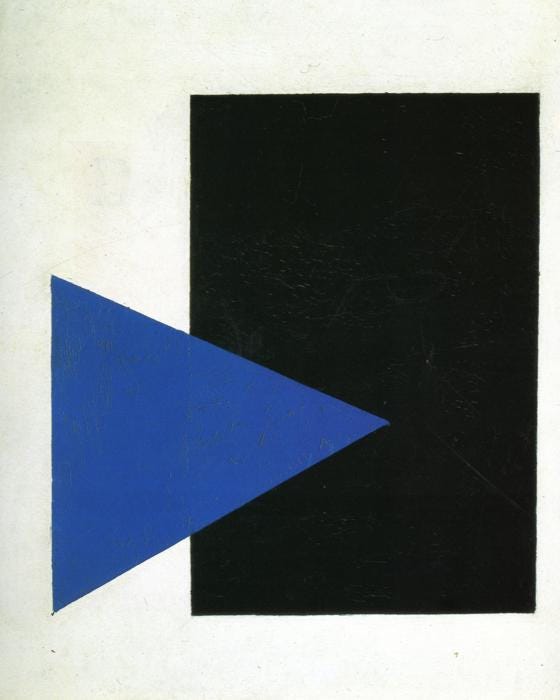
In one of his pieces, Black Rectangle, Blue Triangle (circa 1915, above) the introduction of the dynamic triangle changes the solid and ‘static’ rectangle into a new seven-sided form. The triangle represents a smaller, though more dynamic force that appears to have moved into the composition, its presence changing the status quo that had existed prior to its intervention.
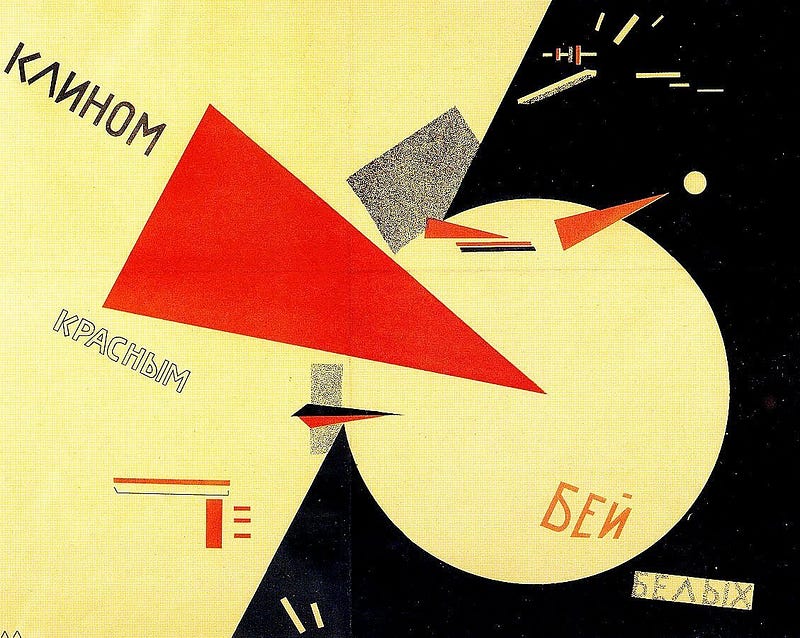
El Lissitzky took this idea and ‘ran with it’ in his famous (Beat The Whites With) The Red Wedge poster of 1919, in which the Red Wedge represents the dynamic force for change that was Communism and the Revolution… In case you’re wondering, it’s really difficult to tell the difference between the art of the Suprematists and Constructivists just by looking at it. Because the difference lies in their ideologies rather than aesthetics. Basically, Constructivists argued that art should serve politics and was little more than a tool for propaganda. Suprematists believed that art was supreme and that politics, in fact all aspects of society, should be guided by it.
This development of a completely new language of form began with experimental Suprematist paintings by Malevich such as Black Square, Black Circle. They were executed in the same year, 1913. I really like seeing them together, as intended — they have serenity, gravitas and are almost ‘Zen’ in their poetic simplicity.
“…in the year 1913, trying desperately to free art from the dead weight of the real world, I took refuge in the form of the square.” — Kazimir Malevich
Here, he is trying to avoid any traditional visual language. He deliberately casts off the established iconography that could be associated with the heritage of Imperial Russia — its history of massive class divide and the exploitation of the peasant population.
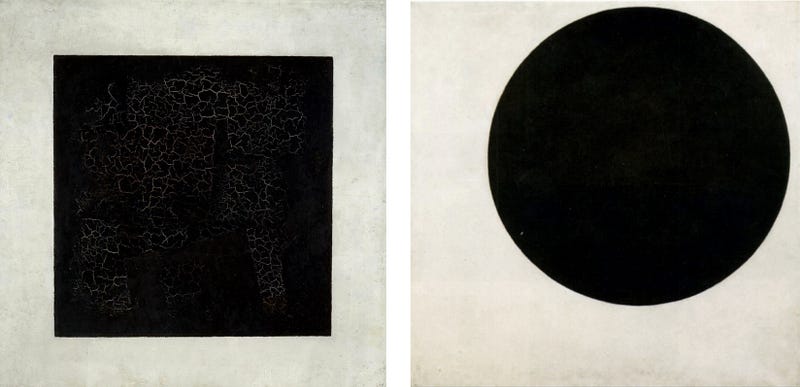
One of the first things about these paintings that becomes apparent is that the circle has a sense of movement creating a gentle tension, whereas the square sits solidly on its canvas implying strength and stability… it’s unclear whether we’re seeing a black square on a white background or a white frame around a black void. Which is positive form and which is the negative space?
One is only clearly defined by the presence of its opposite. Often this is the case with ideologies and political agendas — in these paintings there are no grey areas, only clearly defined black and white, yet that balance of two opposites creates a harmony. The two geometric forms are opposed in some respects, smooth and round versus angled and squared, the lifting circle and the static square — they have obvious differences whilst working harmoniously side-by-side. This could be read as a metaphor for many things…
So, whilst avoiding colour and representation, Malevich is working towards balance and tension in creating pleasing compositions and at the same time beginning to hint at deep ideological concepts. He also had a belief that art could be transcendental and could deal with pure emotion and speak directly to the spiritual aspects of being human. This belief that art could transcend both politics and religion was shared by his fellow pioneers of abstraction in Der Blaue Reiter, such as Wassily Kandinsky, a Soviet compatriot, and Franz Marc.
Art is the badge of a culture and therefore the new order needed its own new art. In his Suprematist paintings, Malevich endeavoured to find a new way of elevating painting into a state of being that is independent of representation and any associated dogma. He does this by stripping the whole idea of composition down to the basics — two tones, black and white, and the simplest of geometric forms. Yet he also strives to make successful paintings in terms of composition and meaning. This belief that art can be revolutionary and also speak directly to the emotion places Suprematism in the Romantic tradition.
I like these paintings on an aesthetic level, I enjoy just looking at them — but I also associate them with the exciting and inspiring period of art history when art becomes truly revolutionary. I had included them as slides in my lectures for a few years before I saw them for real at a Royal Academy exhibition. I still recall the journey through that exhibition of Russian art and the moment I entered the room with the avant-garde and saw these two on the far wall. They are not large paintings, but their assured simplicity and power dominated the entire room. I was enthralled…
a version of this article first appeared in my book, Evolution of Western Art (questing beast books, 2012)


