
Out of the Blue
Toward an understanding of International Klein Blue — Yves Klein was not only interested in the seeing of colour, but in the being of colour…
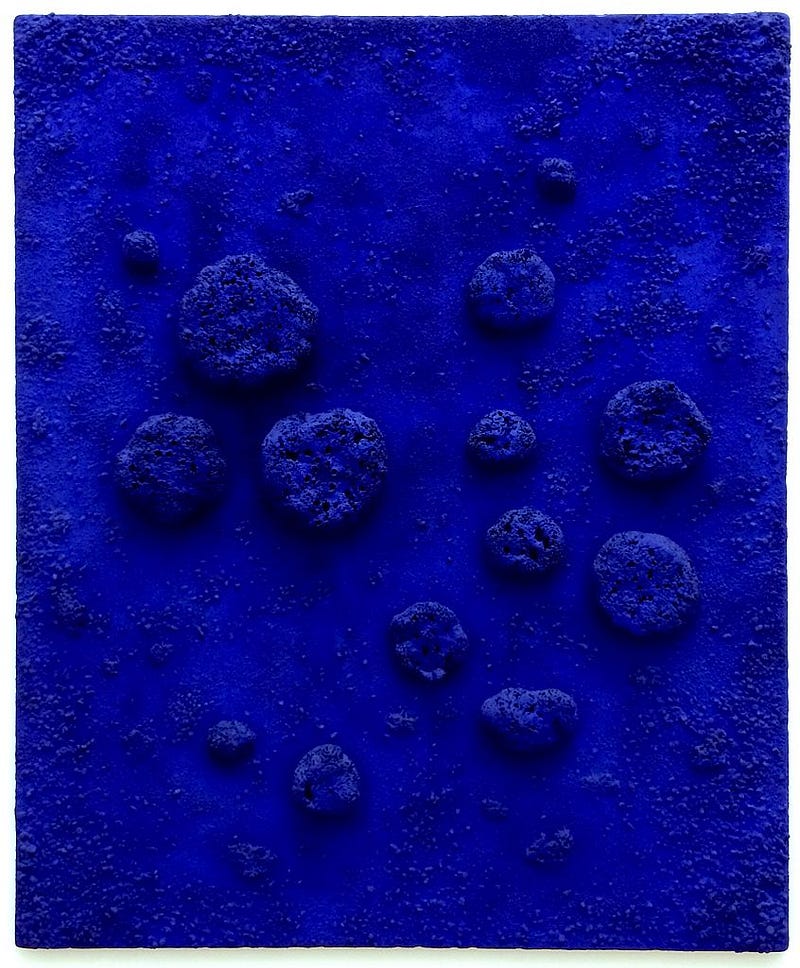
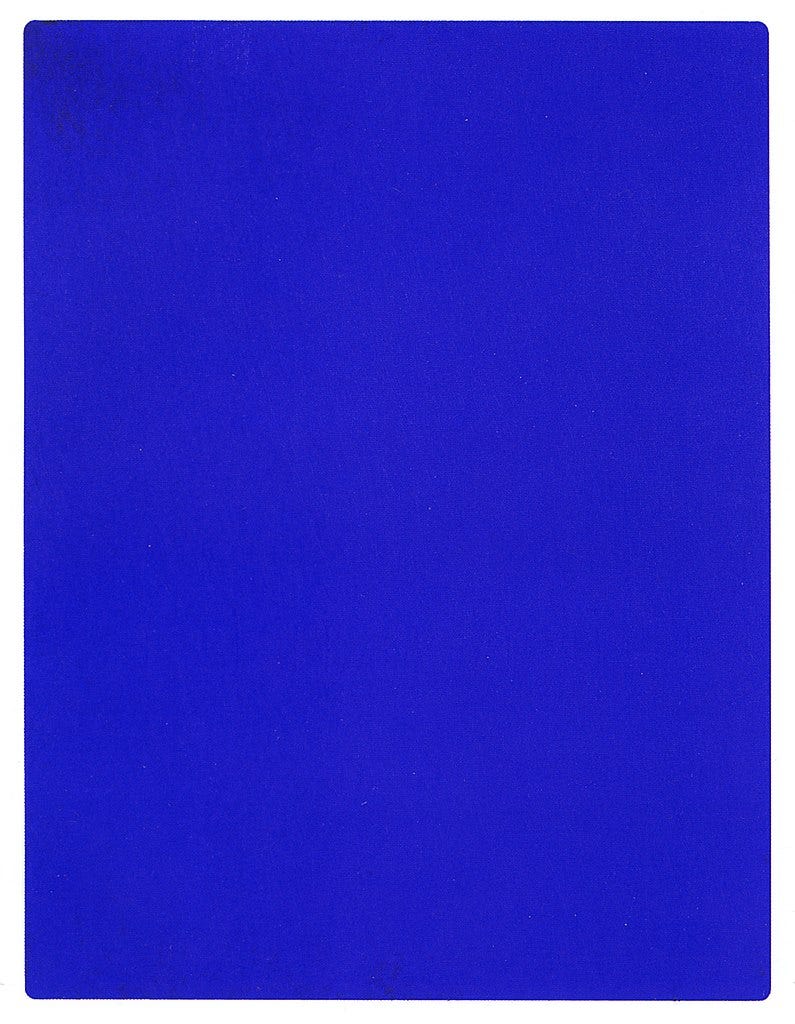
Yves Klein had been working with canvases of a single colour since the early 1950s and in 1957, as part of a solo exhibition he titled, Proposte Monocrome, Epoca Blu / Monochrome Proposition, Blue Epoch, he presented eleven canvases painted a uniform vivid blue. They were hung unframed and suspended on wires away from the gallery wall so they appeared to hover in the air. He stated an intention to produce “invisible paintings”, where the canvas disappears behind the colour.
,_1960.jpg)

Working with a paint manufacturer, he had developed a new medium for the mixing of pigment that retained the pure brilliance of its colour. Instead of traditional mediums, such as vegetable oils which dulled the intensity, he mixed pure pigment in polyvinyl acetate (PVA), a synthetic substance. Acrylic paints had recently been developed and were being used by interior decorators and a few artists. These new paints could be diluted with water, yet dried waterproof and were easier to use and cheaper than oil paints.
The use of PVA as a medium produced a similar effect. The technique that Klein introduced could use any pure pigment. In his famous blue paintings he used a synthetic ultramarine and named the new hue International Klein Blue (IKB). In May 1960, he registered the colour and process as an invention using the French Enveloppe Soleau method. This often preceded an application for patent, which he never pursued.
With his monochrome paintings, Klein was interested in making not the colour, but the process of being a colour, the subject of the work. Famously, he favoured his signature deep, vibrant blue. However, the colour blue that we perceive is subjective (just ask anyone with blue-green colour blindness, for example), stimulated by the process of reflected light extending the effect of a pigment off the canvas and onto the retina of our eyes, where a photo-chemical reaction translates that stimulus into neurological information. The colour exists between the surface and the viewer but not really on, or in, either. The paintings suggest a virtual ‘corridor’ of light connecting the canvas to the viewer.
The first monochrome painting he presented hadn’t been in blue, but a colour field of lead-orange. He titled the work Expression de l’Univers de la Coleur Mine Orange / Expression of the Universe of the Colour Lead Orange and submitted it for consideration by the Salon des Réalités Nouvelles in 1955. The selection committee rejected it because of its simplicity, suggesting that they would reconsider if he added an additional formal element in a second colour — at least a single line or point.
Klein did not alter the work, believing that the pure colour, in itself, had artistic value. Besides, he had already considered the interplay of other formal elements in its dimensional ratio and surface texture. He did add his signature, though.
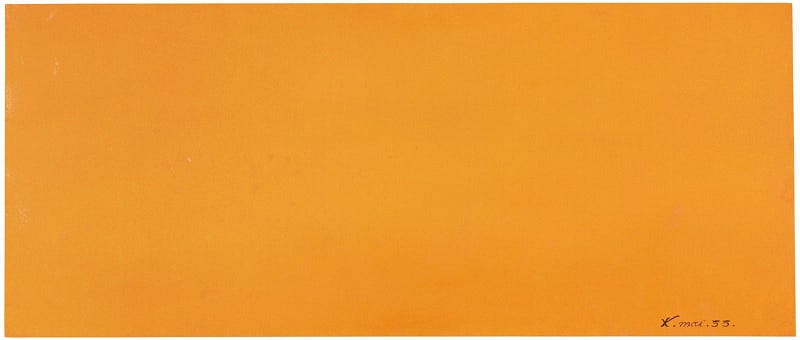
It could be argued that setting his colours free from delineation, or any such formal restriction beyond the limitation of the canvas edge, was an extension of what Henri Matisse had started when he ‘liberated colour from the duty of form’ as a founder of the Fauves. In a 1954 journal entry, Klein had written that, “in the future, people will start painting pictures in one single colour, and nothing else but colour…”
In his follow-up ‘Blue Epoch’ exhibition, Void (1958), at the Galerie Iris Clert in Paris, he left the space apparently empty except for an empty glass presentation cabinet. The gallery had been freshly painted white. A blue curtain hung across its entrance and the window had been painted with IKB. On the opening day, as a result of an effective publicity campaign which in today’s terminology would qualify as a work of ‘Hype Art’, 3,000 visitors queued and entered the gallery. They were welcomed and presented with blue cocktails. They crowded the space and looked for the art, finished their blue drinks and inadvertently took the colour away with them. Some visitors later reported having blue urine.
Apparently at age nineteen, Klein was spending time with two fellow art students on a beach in southern France when he signed the sky. He gestured his signature against the blue and claimed he had just made his first work of art. Though anecdotal, this sums up his ambitions and the broad concepts that would shape his career. He would strive to capture that feeling of pure colour and boundless depth, a colour so intense it existed without surface, a corridor of light emanating from the canvas.
He became occupied with art that attempted to escape materialism. Until his sadly premature death, aged just 34, he continued to extend this concept into performance, music and ‘social sculptures’. What further wonders would he have left us if he hadn’t escaped his own materialism in the June of 1962, due to sudden heart attack?
I expect he would’ve loved the concept of the computer hexadecimal code that produces a colour that doesn’t exist upon a surface, but radiates as light from any screen capable of displaying it — blending into a single, saturated colour within the visual cortex of the viewer. This takes his concept beyond retinal art and into the experiential realm he sought.

Yves Klein was not limited by the idea of monochromatic works. One could say that, for him, the sky was the limit! There are superficial similarities with some Suprematist predecessors and he shared their Romantic belief that art can transcend physical limitations to to stir the spirit. He also experimented with novel materials and techniques, performative art, photography, collage, music, dance, kinetic sculpture.
In his iconic photograph of 1960, Saut dans le Vide / Leap into the Void, the artist seems to fling himself toward certain death as he leaps from the second storey of a building into the air above a hard road. It is a striking image that once seen is very hard to forget. It managed to poetically encapsulate many themes of its day: the acceleration of scientific advancement, the dawn of the space age, the social shake-up that the Modern represented, the common dream of unaided flight, the profundity of the decisive action, the leap of faith . All those things along with Klein’s love-hate attitude to birds — he envied their ability to soar into that insubstantial blue brilliance, whilst at the same time resenting how their black silhouettes pocked its pure beauty…
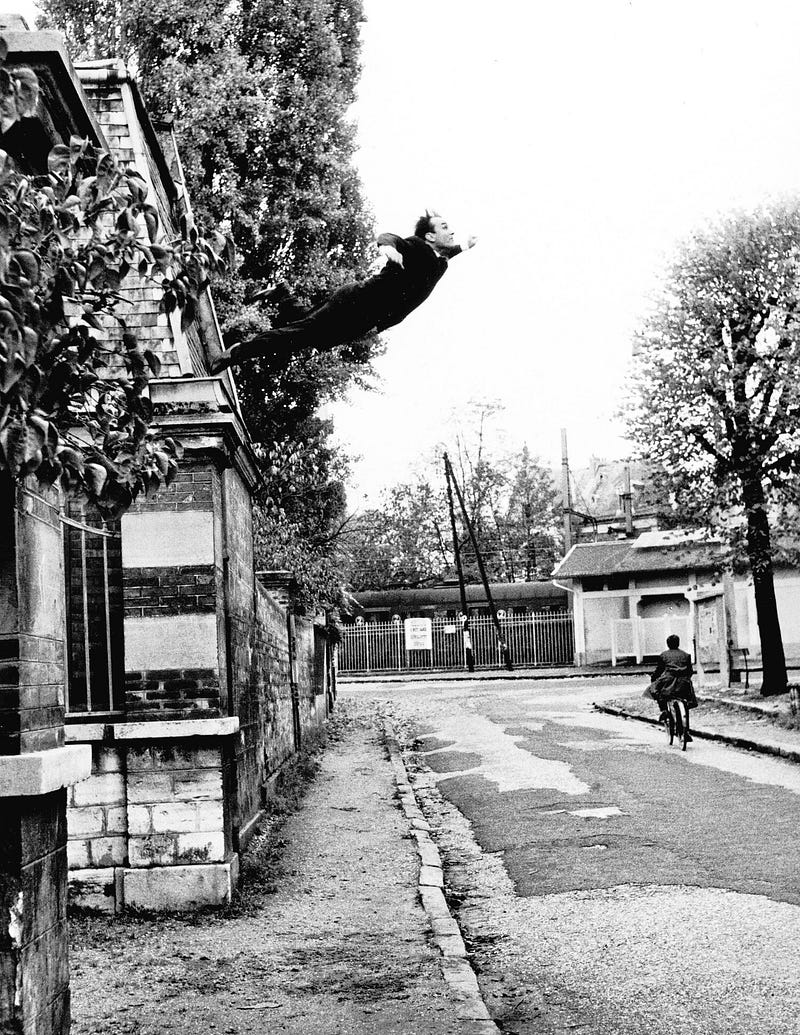

Of course, Klein survived this seemingly suicidal leap through the use of ‘trick photography’. The image is actually two separate photographs merged together in the darkroom. In one photo the artist leaps out, arms wide in a gesture that embraces the void… above a large padded tarpaulin that will break his fall. The second image is of the same street without the tarpaulin in place. Even this knowledge does little to detract from the potency of the image.
Klein published the photo on the front page of a parody of a national Sunday newspaper, which he then distributed to Parisian newsagents. The leader story in this one-off edition had the headline Theatre Du Vide (‘Theatre of the Void’), in which he discussed his previous ritualistic performances. The photograph was captioned, ‘Man in Space! The Painter of Space Throws Himself into the Void’. This is another groundbreaking use of Hype Art — art that circumvents the gallery system and instead manifests its concept across mass media, utilising social networks such as word-of-mouth, reportage, reviews and critique. Nowadays, we might call it, “going viral.”
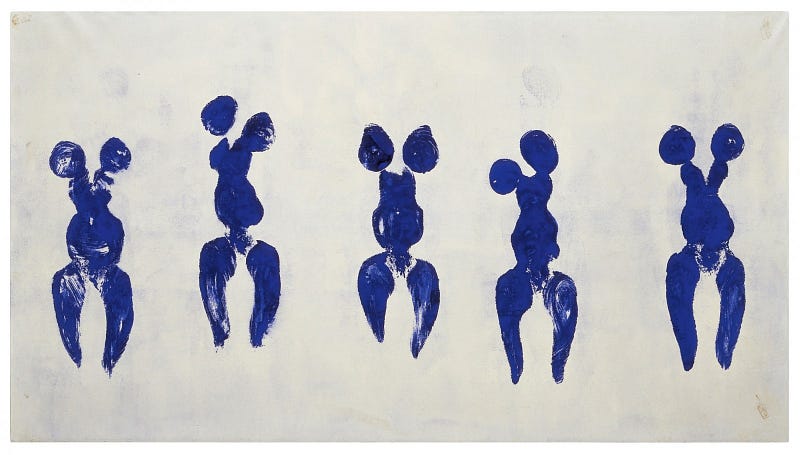
In 1961, he employed the bodies of his models as the transfer medium to produce blue prints directly from their forms. These large prints were created as performance with a musical score played live in front of an invited audience. The resulting works commented on the artistic heritage of the female nude, cleverly referencing the so-called ‘Venus figures’ found in prehistoric art whilst visually quoting the Modern ‘Blue Nudes’ of Henri Matisse.
The same year, he spent a day at the Gaz de France (French Gas Company) testing centre at Plaine-Saint-Denis where he produced around 30 of his large ‘Fire Paintings’ using a combination of fire hose, to dampen sturdy card, and an industrial blow-torch to scorch shadowy calligraphic abstracts. He saw the physically demanding process as the art itself, whereas the works were merely a record of where the surface intersected with the actions to retain a visual memory of those actions. As he once said, “my paintings are only the ashes of my art.”
His son, Yves Amu Klein, is a contemporary artist developing kinetic sculptures that incorporate artificial intelligence and biological systems that can grow and that display mood-dependent behaviours. Some of these ‘sculptures’ have artificial eyes that can recognise and respond to aspects of their environment. Again, light is a subjective conduit, but now it’s a two-way process: you see the art and the art sees you.
* All images are used with license or presented here for educational purposes under fair usage policy.