
When Brit was It
Suddenly, in the first few years of the final decade of the Twentieth Century, art in Britain became vitally important again, both at home and abroad…
During the 1990s, a group of young artists swiftly rose to prominence in the UK. Championed by the Saatchi Gallery and monopolising the Turner Prize scene, they briefly achieved a cultural standing on par with soap actors and pop stars. The newspapers loved to lampoon their often challenging art, but it seems the Great British public embraced their wild weirdness and for a time, art was foremost in the public consciousness...
A few high-profile pieces became emblematic of the movement and have endured, often by changing form and format. Likewise, a few of those artists are even more important now than they were thirty years ago. Here, we present an overview of the key works that helped to set the tone and define an era when being Brit, was really ‘it’ for the art world…
Field
In a series of installations, Antony Gormley has presented crowds of small humanoid clay figures. In each installation, these figures, often numbering hundreds of thousands and ranging in height from eight to twenty-eight centimetres, entirely fill the floor of the space.
They are roughly made figures in unglazed clay and have been formed by communities from around the world. Each group included families and people of all ages from six upward, the clay was sourced locally to each community and then the results are exhibited in galleries, and non-gallery community spaces, around the world.
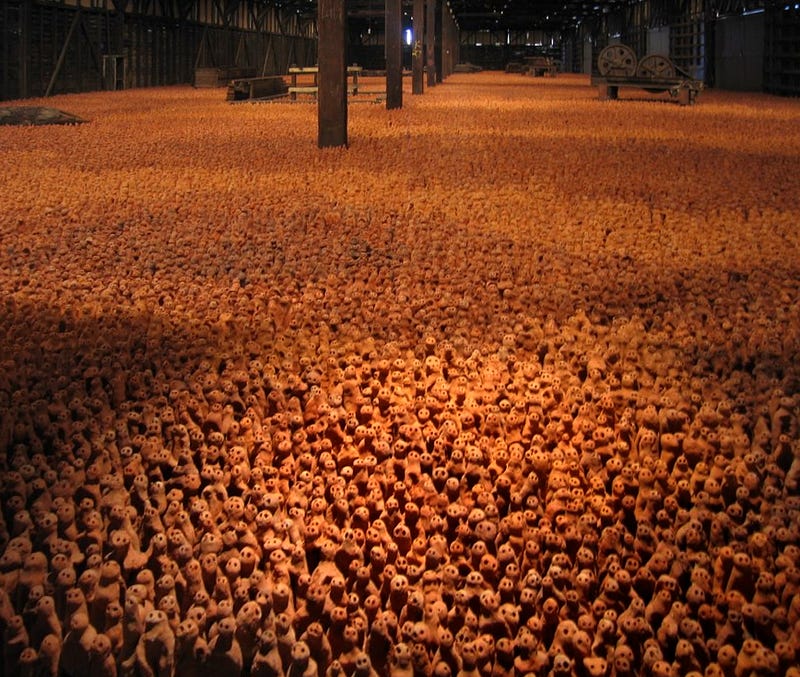
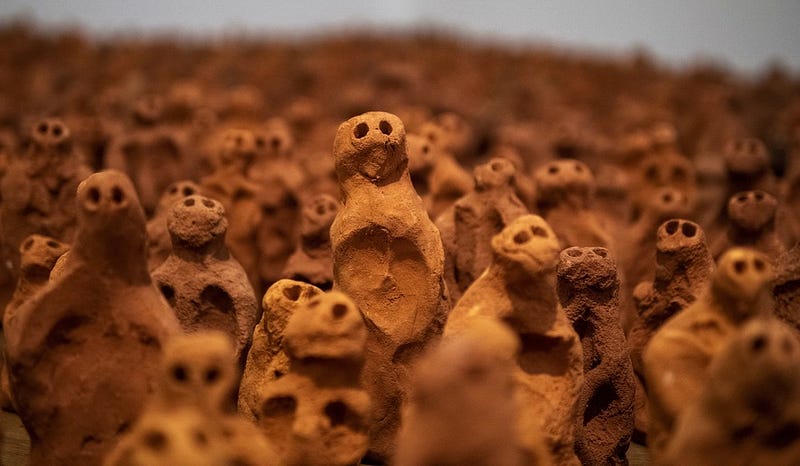
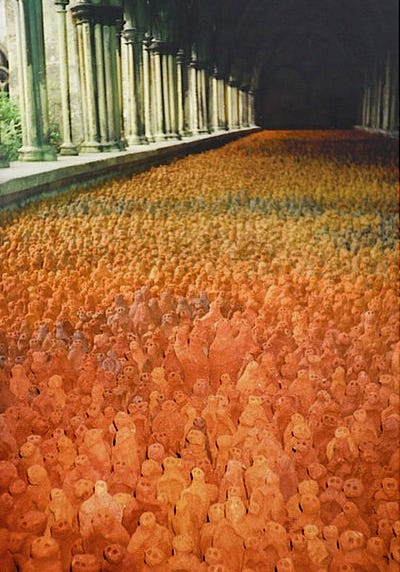
People look at these little models of people, made by people, and the models all look back at the viewers. The viewer is the subject as much as the figures, and the people who made them, are. The crowd of little figures fill the space and imply that there are even more unseen figures, which there are. Their presence excludes the viewer from entering the space as there is no floor left uncovered and, so, the only way to enter is with the imagination.
The first Field was made during 1989 by a family, their friends and relations, in Cholula in Mexico. This family was the centre of the brick making industry for the area where bricks are hand made in a similar method of production as that used to make the pottery figures. Later, in 1993, another Field was produced by the workers, and their families, of Ibstock, a brick manufacturer in St Helens, UK.
These early versions established a clear connection that crossed international and social boundaries whilst making comments on many aspects of modern life. It spoke of the workers’ dependence on corporate industry; our individual smallness as well as power in numbers; our similarity and individuality; about landscape and our connection with the earth itself or, perhaps, our loss of that connection?
Most of Antony Gormley’s work involves the human figure and he is widely known for his Angel of the North (1998) monument at Gateshead. Like Field, this employed local workers including workers of the steel industry which was in desperate decline after the closure of many ship building yards. These community sculptures, or “social sculptures” as Joseph Beuys would have termed them, imply the actual people who made them more than the artist who oversaw the projects.
The response of the viewer depends upon how that viewer feels about other people. Some feel intimidated by the fixed stares from Field, critics have described the installations as an “infection” or an “invasion”. Others are moved by the empathy they feel with all those people who have left the marks of their hands on the figures… people living their lives in far off places, lives that must be similar to our in many respects as well as vastly different in others. We find ourselves considering important issues such as population, class divides, displacement, refugees, environment, the shared earth…
Ghost
In her breakthrough sculpture, Rachel Whiteread cast the interior of a room in plaster. What we see is a very familiar environment from a point of view we have never experienced. A negative space, or void, has been transformed into a positive form, monumental and completely new yet strangely familiar. The room, in a Victorian town house, was cast in sections based on Golden Ratio proportions and then these sections were reassembled in the gallery space.
This builds upon Modernist concepts of the everyday object being re-presented as art. The viewer now sees a very accurate representation of a space, but is denied access to it. The empty space that we live in has been solidified into a barrier. It literally makes us see things from a new perspective, including representational art.
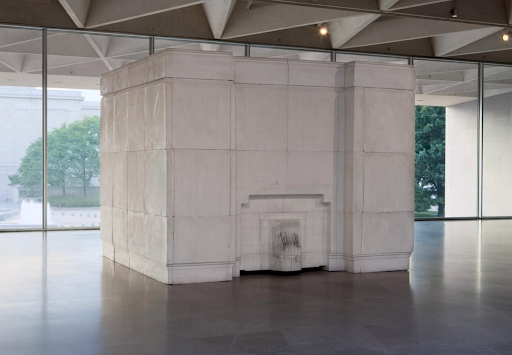
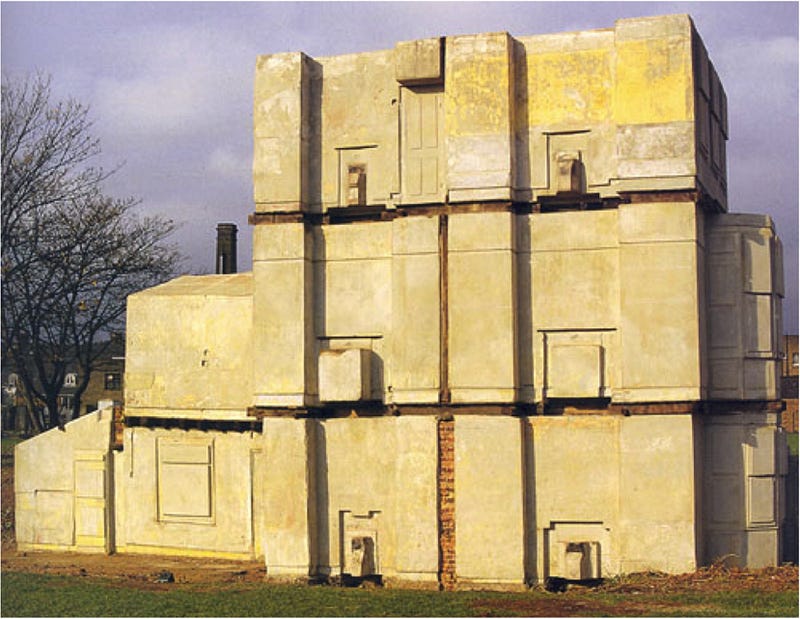
In 1993, Whiteread extended these concepts in an untitled monumental work known as, Ghost House, when she used concrete to cast the entire interior of a mid-terraced townhouse in London’s Mile End. The row of houses was then demolished, leaving the monument standing. This work is profound in both its formal and poetic content.
Things that are ordinary, a fireplace, a window, plaster coving, electrical fittings, become strange and surreal. Rooms where families have grown up and lived and passed on since the Victorian era are both publicly displayed and made inaccessible. We can no more enter those rooms than we can enter those lives. The house, like the people who lived there are gone. The sculpture itself is now gone. It survived for nearly one year until it too was subsequently demolished.
The work now only exists through documentary evidence, such as photographs and written articles, and in the memories of those who walked past it. The people who inhabited those spaces, so similar to the spaces we inhabit, only exist in memory or as concepts. Yet how strange the interior appears when stripped of its shell and viewed from the outside — this is a broad and poetic metaphor alluding to the human condition. Whiteread has taken the age-old problem of representing something through surface alone, and literally turned the notion inside out.
Shark
The assemblage, The Physical Impossibility of Death in the Mind of Someone Living became the emblem of the ‘Young British Artists’ scene of the 1990s. In 1990, Damien Hirst had famously suspended the carcass of a tiger shark in a large glass display tank filled with formaldehyde. The tank itself was divided into three cuboid sections, the cross panes intersecting the shark (they actually suspend the shark) and dividing its body into unequal thirds, hinting at a sequence — perhaps beginning, middle and end… or birth, life and death?
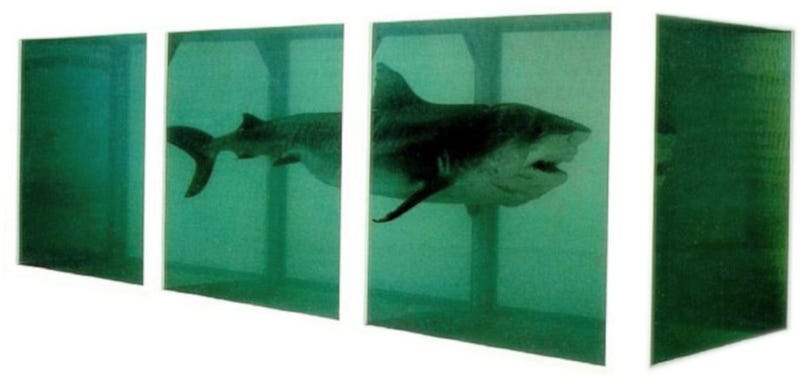
The title gives us a pretty big clue to the theme and concept of the piece and refers to the existential observation that death is meaningless as it cannot actually be experienced. An observer can witness the death of another individual, but may not experience their own, only the moments immediately prior. Experience equals life, so therefore the only life you can experience is your own unique one. This means that all things are subjective…
The installation piece is a type of Readymade, or objet trouvé, in that Hirst did not make any of the components: he purchased the shark and commissioned the display tank. This work got a lot of publicity and was received with mixed responses by critics and public. It stimulated debate similar to that surrounding Marcel Duchamp’s Readymades, made 74 years earlier — a period that was roughly the average human lifespan for Europeans back then… if they managed to survive the First World War, that is.
The broad concept is extended further by the process of decay that immediately began to affect the shark specimen. Submerging a dead thing in formaldehyde does not preserve it indefinitely without further maintenance. The shark deteriorated and later had to be removed and taxidermed, its skin being stretched over an artificial structure. The piece, in itself had a limited lifespan, though this factor was not part of the original intention. Hirst has made several ‘replicas’ since and the preservation of dead things has become central to his ongoing practice.
Images of the piece appeared throughout the media and became closely associated with the identity of a group of artists showcased in a series of exhibitions at the Saatchi gallery. The exhibitions were titled Young British Artists and also included works by the Chapman Brothers, Tracey Emin, Sarah Lucas, Ron Mueck, Michael Landy, Jenny Saville, Antony Gormley, Marc Quinn, and Rachel Whiteread.
Self
In 1991, Marc Quinn exhibited the first in his series of self-portraits made in a medium that was once part of his own physical being. In Self, he casts his own head with his own blood. The blood was drawn over a period of months and then nine pints of it were used to fill the mould.
The resulting sculpture has to be displayed and maintained in a specially designed freezer. The work needs constant maintenance, as if it was alive, and though it’s made from biological material, its continued existence relies on the artificial suspension of decay. Identity, memory and mortality are all at the fore in this piece.
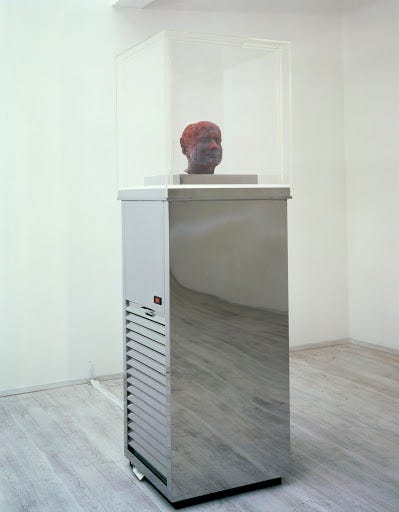
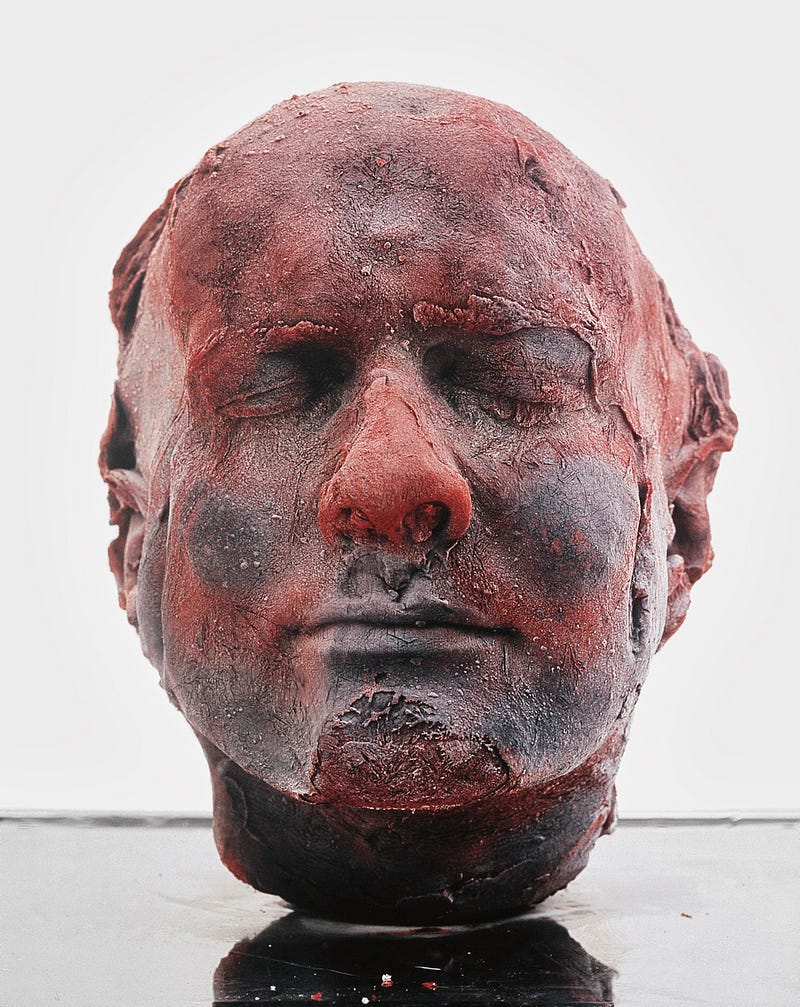
Self deals with similar concepts to many works by Surrealists who were fascinated by the difference between a perfect replica of a person and the person: They may look exactly the same, but one is marked aside by being alive — a feature that is only outwardly expressed by actions and processes. Here, Mark Quinn presents us with a replica that involves a balance of processes. The freezing maintains the facsimile, but does this by arresting a biological process.
He has repeated this work as a series, making a new cast every five years, recording his changing features as he ages. These works actually were part of him, but now merely represent a physical aspect of himself. He continues to use himself as a model for many of his figurative works about the human form.
There is an element of the ‘site and non-site’ concept of Robert Smithson. The material we see in the gallery refers to its origin within a person who is elsewhere. The positive form of the sculpture is produced by a correlating negative form within the artist. That form has, of course, been replaced as blood renews itself, whereas the non-sites of Smithson remain empty, though they too will eventually change with precipitation and erosion. The time scale is different, one biological, one geological.
The relationship between the site and non-site is a dialogue of person and place. Here and there. The dialogue between self and non-self is a dialogue of identity and human experiences. Ours and his. Now and then…
Things change. We change things. We are things that change.
* All images used here with license or for educational purposes under fair usage policy.
A version of this article was first published in my book Evolution of Western Art (questing beast books, 2012)


