
Illumined Thinking
The first product to be marketed by the Bauhaus expressed key design philosophies and processes of the famous design school’s formative years.
With his startlingly innovative lamp design, Wilhelm Wagenfeld made manifest the lessons he had learnt from the first two masters of the Bauhaus metal workshop before later taking on the role himself. Now considered a classic of design, and still in production, his table lamp was the first Bauhaus product to be publicly promoted and was used as a motif in their marketing materials after being unveiled at the 1924 Leipzig Trade Fair.
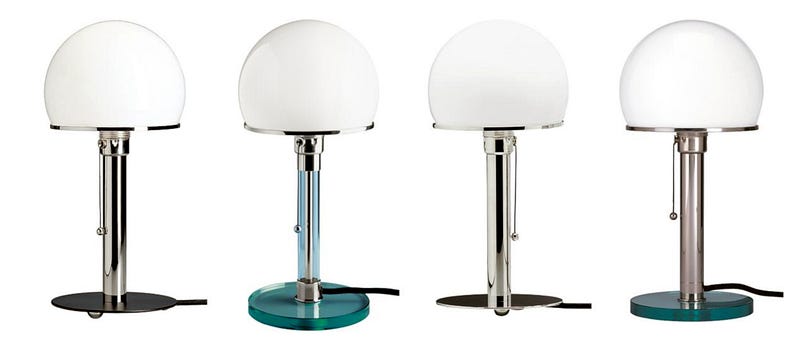
The ‘milky’ glass lamp cover of the initial design was based on one already mass-produced for use in factories and public areas such as train stations. The column was adapted piping, and the base was a disc cut from pressed steel. All very practical, industrial materials unified by a strikingly simple aesthetic and overall formal harmony.
The spherical dome of the shade balances with the circular base. The ball of its pull-switch, suspended mid-way between the two, is a design ‘comment’ on the visual transition from one to the other. This is the first commercial use of a pull-switch for a lamp. In the early version, workshopped during 1923, the white brightness of the top was contrasted in a black painted base and these were connected by the polished pipe that merged their forms in its reflective curves. The base was raised and stabilised by three additional spherical feet allowing room for the power cable to pass beneath and neatly enter the central conduit through a drilled aperture.
The result is an elegant, holistic design fulfilling core Bauhaus ideologies of truth to materials and form follows function. The language of design here is eloquent with an added poetic element that doesn’t detract from its minimalism. The orb implies those two other orbs most readily associated with illumination — the sun and moon. Perhaps the disc references our perceived place on earth, circled by the horizon, or the umbra of eclipse when these three celestial bodies align. So, it’s abundantly clear what the object does and how it’s to be used.
The materials are functional, selected for their innate properties, implying the design was intended for mass manufacture. However, the assembly of the product was labour-intensive, requiring hand-finishing. The filing and polishing of the metal components meant that this item was not as mass-producible as intended and therefore more costly than desired.
Typically, the Bauhaus process of design was collaborative and Wilhelm Wagenfeld had worked with Carl Jacob Jucker on the design, who introduced the glass-stemmed variant. This version required a little less hand-finishing during assembly, but the thick glass base and column didn’t allow for the cable to pass unseen into the central conduit from beneath. This disrupted the visual purity and interrupted the dialogue between shade and stand.
“The Bauhaus strives to bring together all creative effort into one whole, to reunify all the disciplines of practical art — sculpture, painting, handicrafts, and the crafts — as inseparable components of a new architecture. - Walter Gropius, Bauhaus Manifesto
The Bauhaus was founded in the hope of rebuilding a new Germany, lifting it from the debilitating grip of an economic crisis that had brought rampant hyperinflation and mass unemployment in the aftermath of the First World War. Part of their mission was to efficiently produce affordable, hard-wearing yet aesthetically pleasing household goods that would help establish a new and positive cultural identity.
Although the Wagenfeld lamps may not be entirely aligned with all those tenets, as a first product, they made a bold statement of intent and synthesised the design teachings of Johannes Itten and László Moholy-Nagy, two of the most important ‘Masters of Form’ to teach at the Weimar campus.
Johannes Itten was a co-founder of the Bauhaus and introduced an ideology of exploration and experimentation without the constraints of any pre-planned outcomes. He was known for a philosophical approach that sought to connect the human spirit of each individual with an all pervading mode of being that permeated all aspects of the microcosm and macrocosm, an extension of his Mazdaznan beliefs — a modern interpretation of ancient Zoroastrianism.
For their first lesson, his students may expect to go outside and lie on the ground with their eyes closed, instructed to listen to the grass growing. It may’ve seemed like a weird introduction to an industrial design school, but it provided what we would now call a ‘mindful moment’.
Itten may then quiz them as to what they noticed about their environment — birdsong, buzzing bees, the sounds of the city, of their own breathing. How connected did they feel to their surroundings, to themselves and each other? Were they more or less comfortable than when standing or sitting? Which posture gave them the greatest sense of ‘mechanical’ stability. In effect, they had just received an experiential lesson in ergonomics and the fundamental principles of engineering.
For Itten’s workshops, the participants studied form through life drawing. These included the human body, of course, and other natural structures. Thistles were a favourite because he enjoyed the interplay of plane and parabola in the leaves along with the varied textures from the softness of downy seed heads to the sharpness of piercing spines. Notably, he recruited Paul Klee to teach theories of colour and line alongside his own.
The students of Itten were given free rein to ‘play’ with combinations of different materials and explore their unique characteristics and expressive potential. Often, the materials would include random bits and pieces with no apparent value such as broken machine components, offcuts, rags, wire, discarded packaging, and so on. Elements foraged from nature would also be introduced, such as leaves, branches, conifer cones, stones, soil, and clay…
Through combining materials and processes associated with different disciplines, new ideas and aesthetics would emerge. In many ways this prefigures the Arte Povera movement of the late 1960s, and is now known as ‘material thinking’ — or ‘thinking with one’s hands’ — and generally encouraged in art and design colleges to this day.
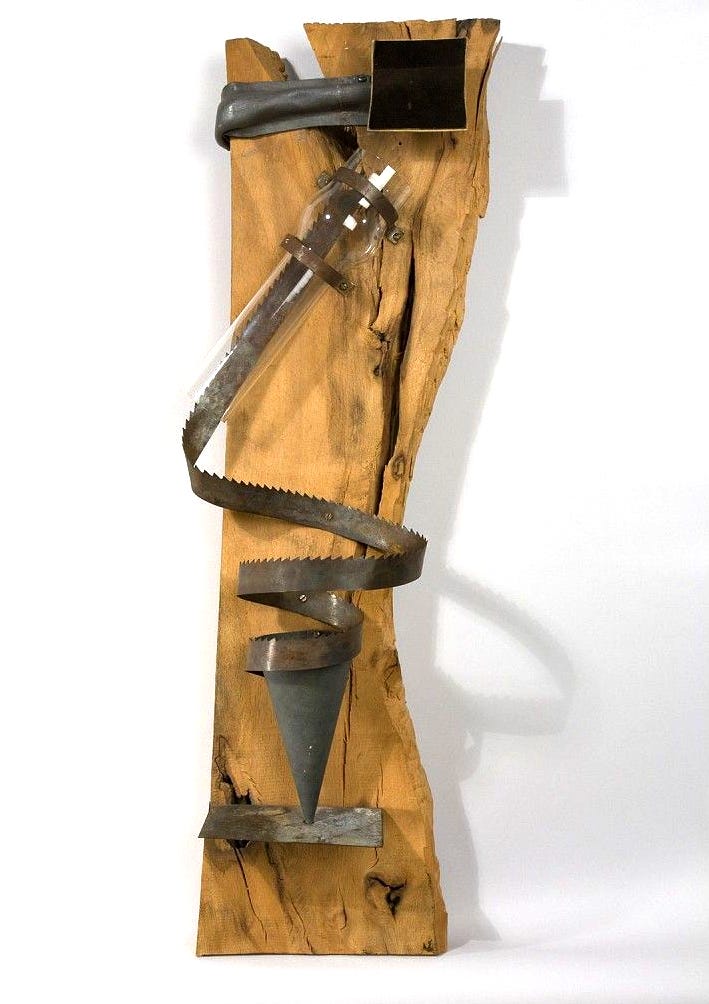
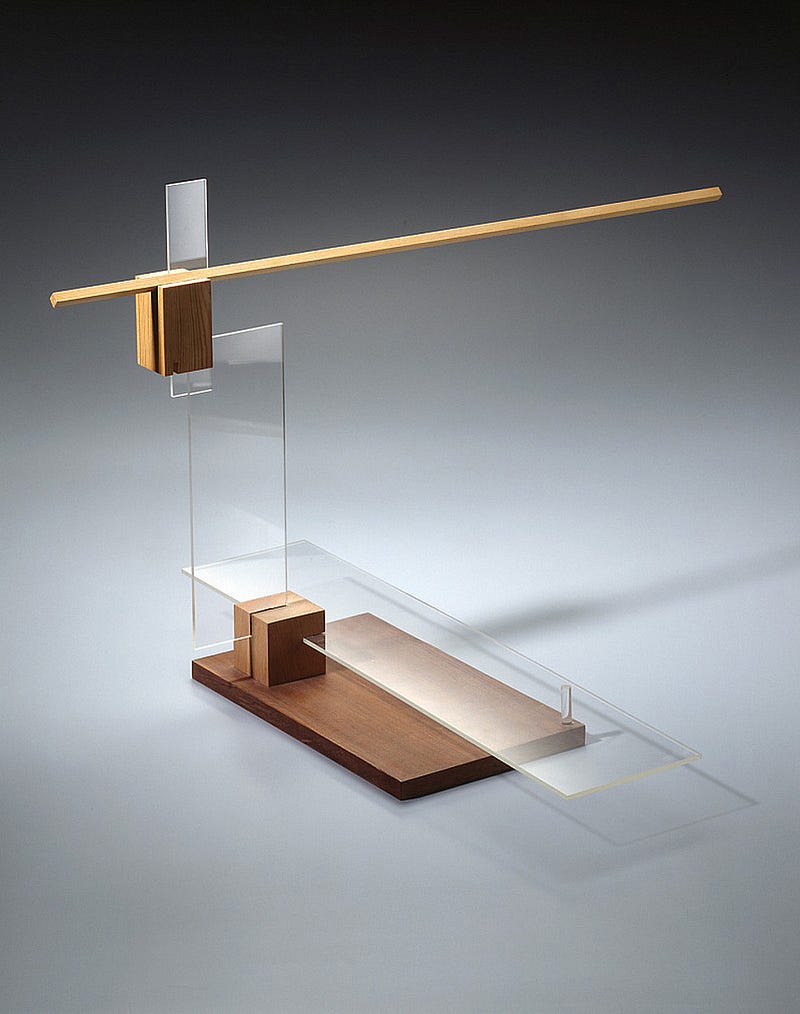
Wilhelm Wagenfeld, who was already a professional metalsmith when he enrolled at the Bauhaus in 1923, benefitted from attending Itten’s formal classes where his experiments in the sculptural juxtaposition of glass and metal led to the combinations seen in his table lamps. However, 1923 was a transitional year for the Bauhaus and Itten found himself at odds with the increasing emphasis placed on productivity and manufacture by Walter Gropius.
Itten disagreed with this new direction and resigned. Directorship of the preliminary workshops was transferred to László Moholy-Nagy whose influence is even more apparent in the formal elements of Wagenfeld’s work.
László Moholy-Nagy placed greater emphasis on the interplay of basic forms derived from the circle and square, spheroid and cuboid, cylindrical and pyramidal, with particular attention to the intersections and spatial relationships of such geometric volumes. This approach to functional design, which was to dominate the Bauhaus ethos, was similar to the theories of form expounded by the painter Paul Cézanne some three decades earlier.
When the Bauhaus relocated to its purpose-built, Gropius-designed campus at Dessau in 1925, Moholy-Nagy went with it, but Wagenfeld didn’t. He stayed in Weimar and by 1928 was head of the metal workshop at the campus there which became the State Academy of Crafts and Architecture until its closure in 1930 due to pressure from the Nazis.
Wagenfeld declined membership of the German Nazi Party but continued working as a freelance designer. He was responsible for several more iconic designs, mainly in metal and glassware, and throughout his career, he upheld the design principles of the Bauhaus, believing that all practical household goods should be simple, beautifully functional, and affordable for all, yet of high enough quality to satisfy the wealthiest.
Also, those early lessons of Itten seem to have left their mark:
“The spirit that inspires us has a decisive importance for us: we rely on it to create, and not on the materials. These are always mere means that allow us to reach our goal.” - Wilhelm Wagenfeld
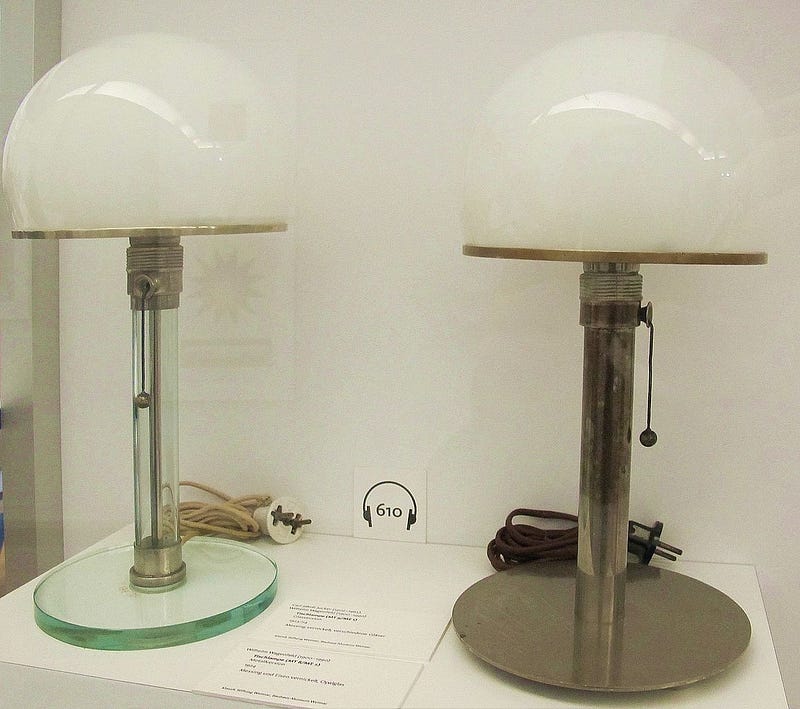
* All images are used with permission or presented here for educational purposes under fair usage policy.


_e_di_Wilhelm_Wagenfeld_(right,_1924).JPG)