
The Simultaneous Colours of Sonia Delaunay
A brief overview of the artist who ‘invented’ Artist’s Books, styled Hollywood stars and automobiles, and developed her own take on Orphism: Simultanéisme
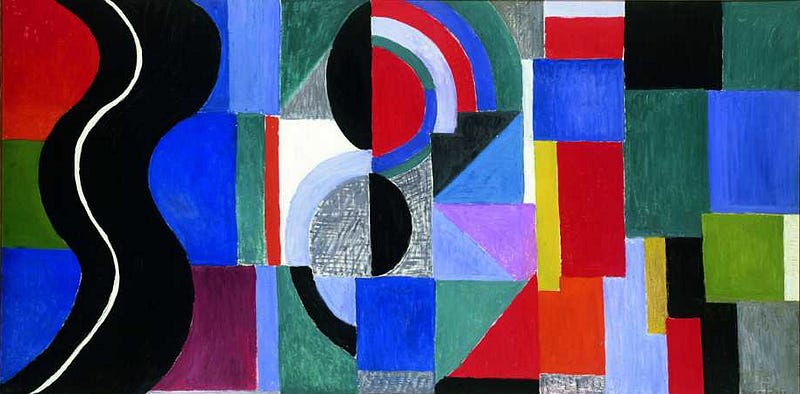
Sonia Delaunay was a colourful force of life moving between art and fashion throughout her long career influencing many artists and designers to this day.
Born Sara Stern in 1885 to poor Jewish parents in Ukraine, she was sent at the age of five to her mother’s affluent brother in St Petersburg to have a better life. Adopted by her Uncle and Aunt, she took their surname of Terk and became known as Sonia. Her Uncle collected art, and the family summered in Finland and often travelled within Europe so she visited galleries and was well-educated. Sonia’s talent for drawing was encouraged and she studied art in Germany before moving to Paris where she was influenced by Henri Matisse and the Fauvists, as well as other innovators such as Vincent Van Gogh and Henri Rousseau.
She briefly married Gallery owner Wilhelm Uhde, a marriage of convenience so that she could remain in Paris. It was through Uhde’s gallery that she met artist Robert Delaunay and fell in love. Uhde amicably divorced Sonia so that she could marry Robert in 1910 and the couple had a son, Charles, in 1911.
Robert Delaunay had exhibited with the groundbreaking group of artists known as Der Blue Reiter / Blue Rider and developed a form of Cubism which contained additional curves and swirls dubbed Orphism by the poet and art critic Guillaume Apollinaire. Working together, the Delaunay’s explored their own colour theories. Robert’s approach to was almost scientific and he intended to develop a way of painting that would be entirely dependent on colour and contrast alone… He assigned ‘values’ to each colour and hue, believing that a system similar to the periodic table for elements could be developed for colours, thereby enabling colour composition purely by mathematical formulae.
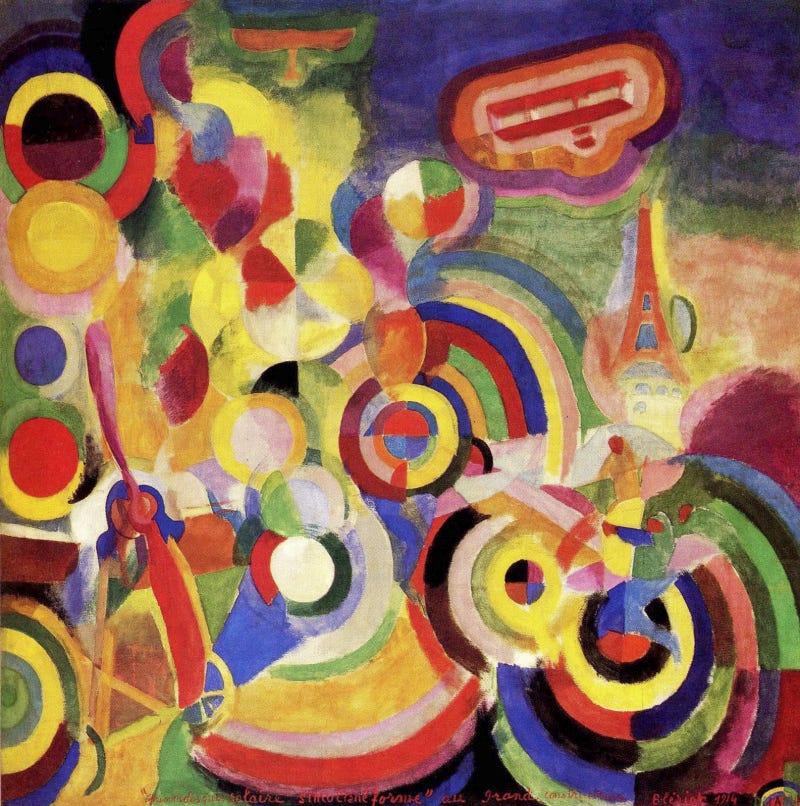
His famous painting of 1914, Homage to Blériot, operates primarily as an abstract and only contains a few representational ‘clues’ to its meaning. It’s a tribute to the aviator Louis Bleriot who performed ‘the first flight over a large body of water in a heavier-than-air craft’ when he flew across the English Channel in 1909. The repeated concentric circular motifs, divided into quarters, evoke the rhythmic noise of an aircraft motor and the bright ‘loud’ colour combinations suggest the excitement of witnessing this historic event. The fragmented image implies a time lapse of the plane passing by — colour and pattern suggesting the Doppler, evoking the noise and excitement of the event.
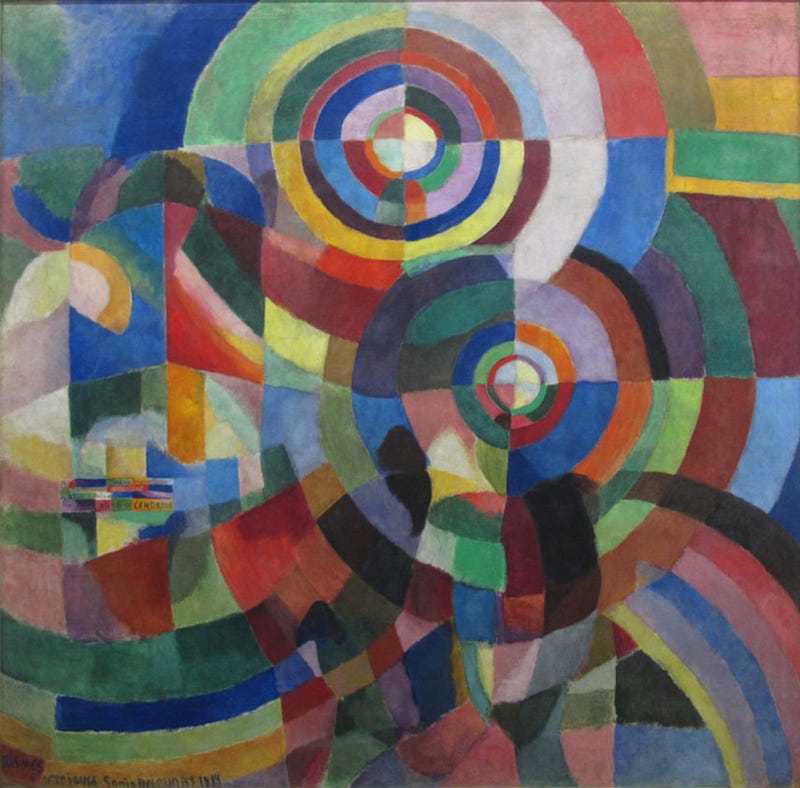
Sonia was producing similar work with dominant circular motifs typified by her Prismes Electronique / Electric Prisms, a series painted around the same time from 1913 to 1914. Her use of colour remained intuitive, rather than scientific. The painting shown above was completed shortly before the outbreak of the First World War and was inspired by a street scene at night in Paris, one of the first major cities to use electric lighting extensively.
During the War, and after the 1917 Russian Revolution, Sonia lost financial support from the Terks and decided to raise family income from her applied arts while Robert continued in Fine Art. She had already designed and made a blanket for her son in 1911, drawing upon Ukrainian folk traditions and her colour theory, which developed into Simultanéisme, an approach associated with Orphic Cubism and Futurism, in which elements from different points of view, subjects, or abstract blocks of colour are presented together, intended to be registered simultaneously.
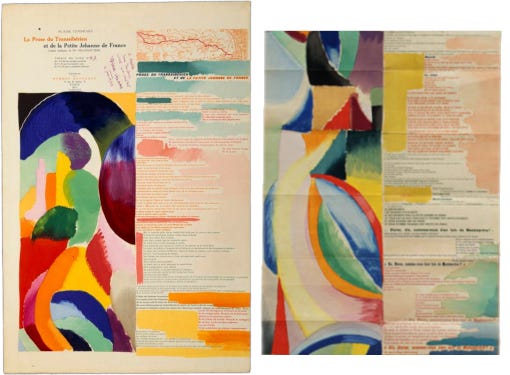
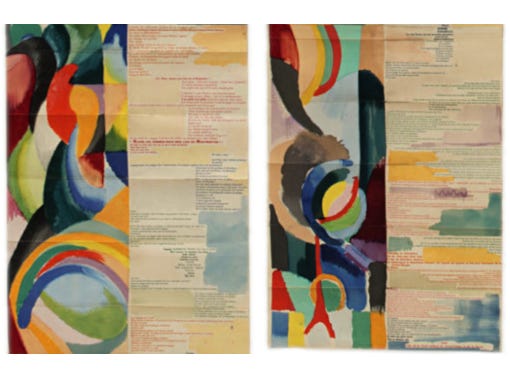
In 1913 she produced the first ‘simultaneous book’, using the poem by Blaise Cendrars titled La Prose du Transsibérien et de la Petite Jehanne de France. The layout of the book was designed in two continuous columns, the left side being a flowing illustration and the right using coloured text in different fonts sizes and styles with blocks of colour. The unpunctuated, 446-verse poem describes an imagined train journey from Siberia to Paris via Siberia, China, and the North Pole.
The folio sheets were printed in four colours with the illustration and colour blocks overpainted in gouache by Sonia Delaunay using precisely registered pochoirs stencilling. The pages were glued together to form a two-metre scroll which was then folded along its length and concertina-folded to fit within a hand-painted parchment wallet binding.
If unfolded and placed end-to-end, the planned edition of 150 would match the height of the Eifel Tower, which appears as a motif in the final panel. It seems that around 80 books were finally produced and signed, making this one of the earliest examples of the genre now known as the Artist’s Book. The work impressed Paul Klee, who also had a keen interest in abstract illustration for books, and inspired others to explore the format.
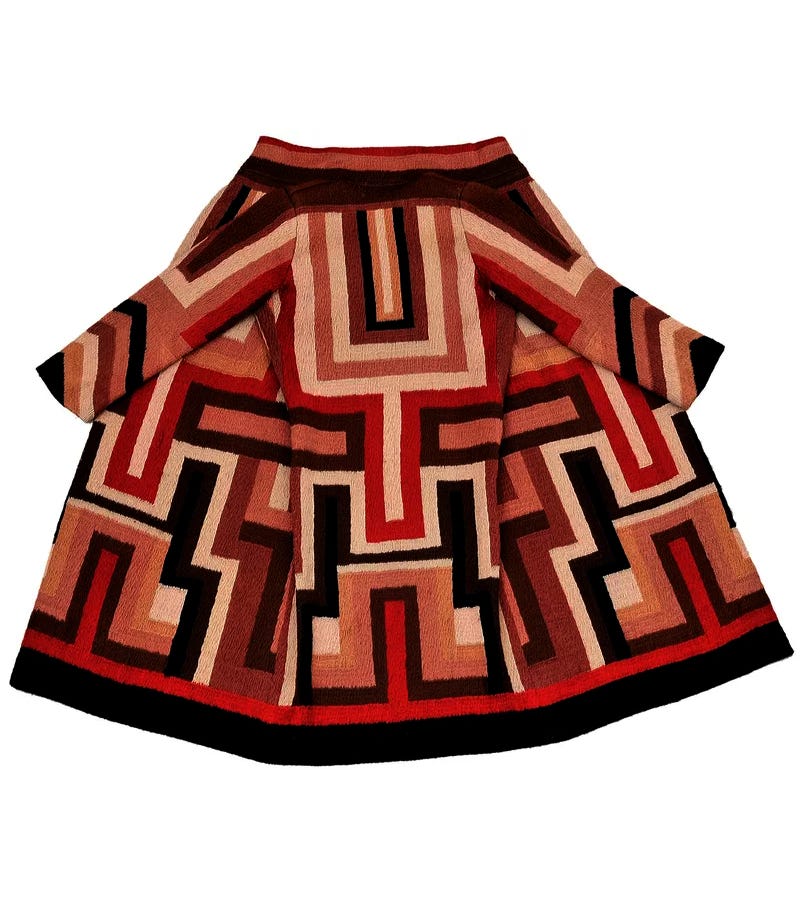
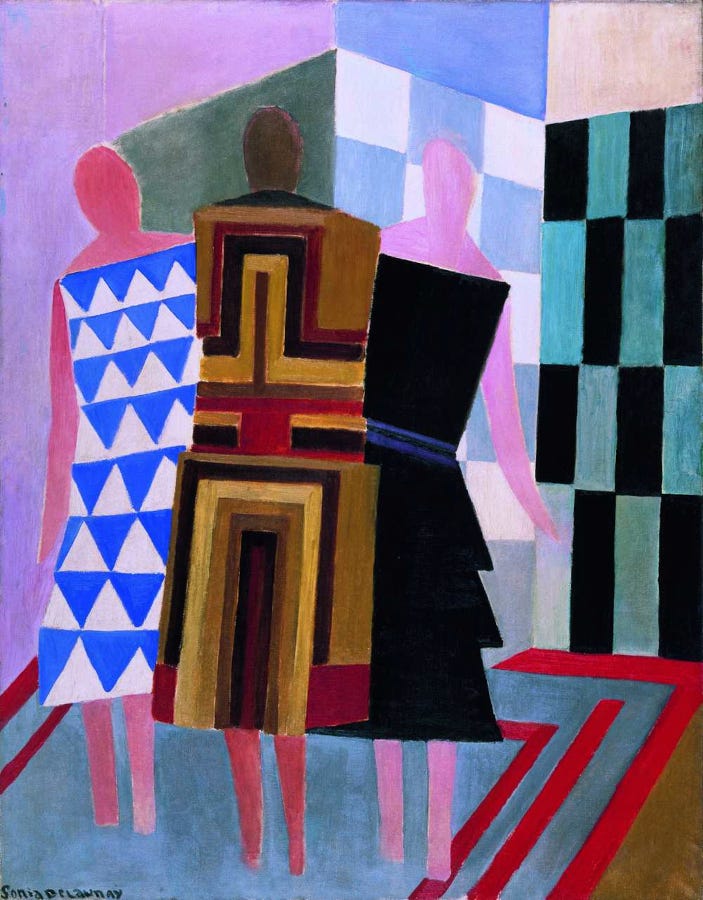
This was followed by ‘simultaneous’ designs for dresses, suits, hats, and shoes that appealed to the metropolitan Avant-Garde. Her creations were purchased and worn by the likes of glamorous Hollywood actress Gloria Swanson and British writer, heiress, and political activist, Nancy Cunard.
The interwar Depression meant she had to close her own ‘Casa Sonia’ fashion house but after exhibiting at the 1925 International Exposition of Modern Industrial and Decorative Arts in Paris, she’d been commissioned by Metz and Co, a prestigious Department store in Amsterdam, to provide exclusive designs for fabrics and rugs. Her sense for textiles preserved the fun fluidity of her designs in the final manufacture and she continued to work for them and the British firm Liberty and Co over the next few decades as well as for private clients, in all manner of fashion and interior design. She is cited as the first to create bespoke ‘art-cars’ and her automotive clients included Citroën, Matra, and Unic.
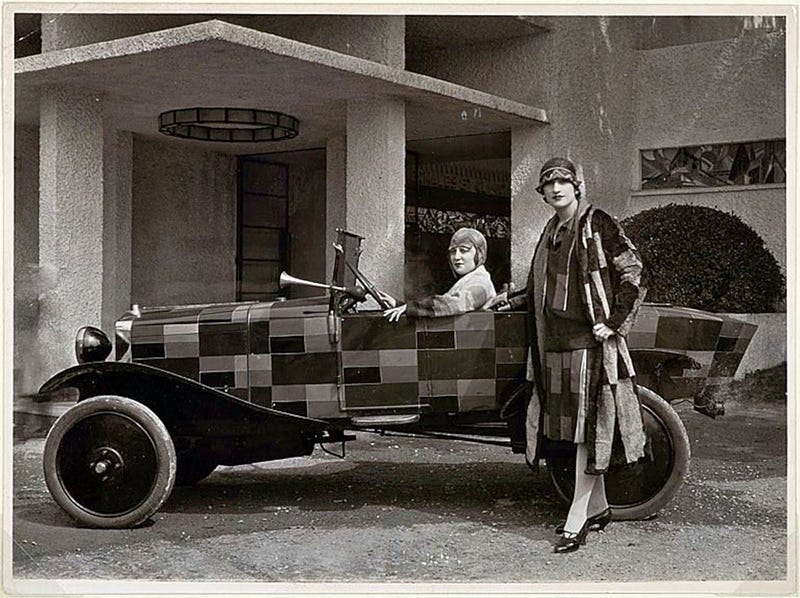
Throughout, she continued to work with Robert and meet with other fine artists such as Piet Mondrian, which further informed her work. She wanted to challenge and educate the taste of her clients and continued to be daring in her use of colour contrasts. In this way, her work seems reminiscent of Russian artist Lyubov Popova in aesthetic and application.
During the Second World War, the Delaunays had to leave Paris and Robert died in 1941. Sonia continued to champion his work in the post-war years. She returned to Paris, and to abstract painting. In 1964 she became the first living woman artist to have a retrospective exhibition at the Louvre. In 1975 she was named an officer of the French Legion of Honour.
Sonia received such recognition late in life, as applied arts were taken less seriously than fine art, but she did not seem to regret this. She once said ‘I have had three lives: one for Robert, one for my son and grandsons, and a shorter one for myself. I have no regrets for not having been more concerned with myself. I really didn’t have the time.’
Titles from her Rhythm series, such as Coloured Rhythm and Syncopated Rhythm suggest a close connection to music — her son, Charles was a gifted jazz musician and owner of the Hot Club in Paris. Many of her later works are a bold development of Orphic Colour Simultanéisme with contrasts that dynamically draw the viewer’s gaze across the canvas, some executed in a large format. These ambitious compositions continue to engage and inspire, influencing painters and fashion designers.
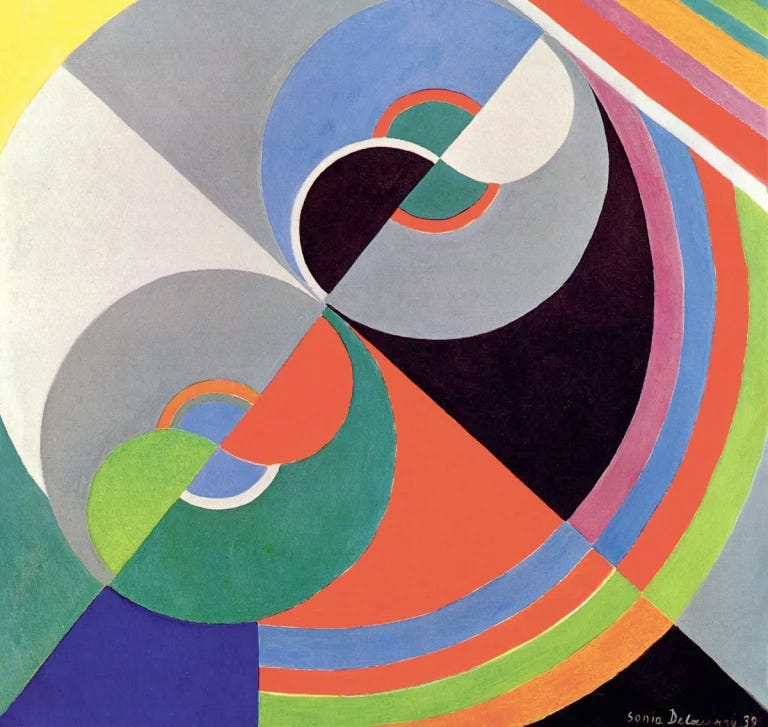
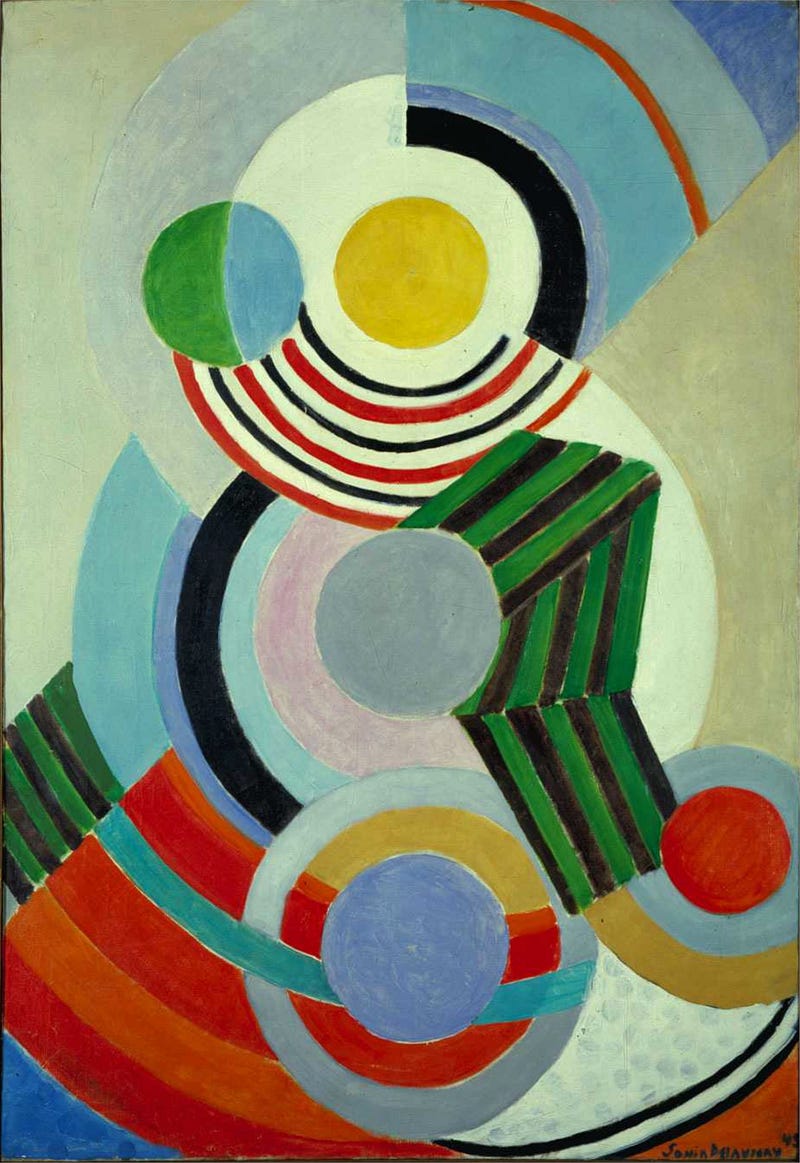
Sonia worked until her death aged 94 in 1979 and, in 1984, Parry Ellis honoured her legacy by designing his Fall collection using Sonia’s colours and patterns. Nearly four decades later, her influence is felt in Armani’s 2022 Fall collection.
In the indexes of older art history books, ‘Dealaunay, Robert,’ is commonplace but ‘Delaunay, Sonia,’ much less so. This was redressed by a major retrospective of Sonia’s work at London’s Tate Modern in 2015 named We Shall Go Up to the Sun, after her autobiography. Paying tribute to her at this time, fashion designer Duro Olowu said, “Delaunay’s sense of freedom and experimentation and her deep instinctive knowledge of colour warms my heart and lifts my spirit. She was a true renaissance woman who transformed colour into the stuff of dreams.”
Thank you, Sonia. Now we can all dream in colour.
* All images are used with license, or presented here for educational purposes under fair usage policy.


