
Paul Klee: Abstraction of Place
How Paul Klee’s colourful transition from observation to abstraction distilled the sense of place…
One could tell, from his sense of visual rhythm, that Paul Klee trained as a musician before enrolling at Munich’s Academy of Fine Art. This fusion of musical sensibilities and visual expression encouraged him to explore colour and line as compositional elements in much the same way as a musician uses notes, tempo, tone, and volume in compositions. This would later provide conceptual common ground with his fellow Blue Riders…
In 1901, shortly after his graduation from the Academy and whilst recovering from traumatic experiences in his personal life, he visited Italy. There, he sought out the work of the Renaissance masters and was equally impressed by the colours of the Amalfi coast as by the monumental architecture and classical ruins he saw in Florence, Naples, and Rome. He was left with a strong impression of structure and colour informing his approach to landscape.
For the next decade or so he painted, played violin professionally, and worked as an illustrator. He became friends with Alfred Kubin, August Macke, Franz Marc, Gabriele Münter, and Wassily Kandinsky, who began exhibiting together as Der Blaue Reiter (The Blue Rider) — a loose affiliation of artists who shared a belief in the transformative and transcendent powers of colour. However, his travels with August Macke and Louis Moilliet to North Africa, in 1914, is cited as the artistic awakening that sparked the distinctive style he is remembered for.
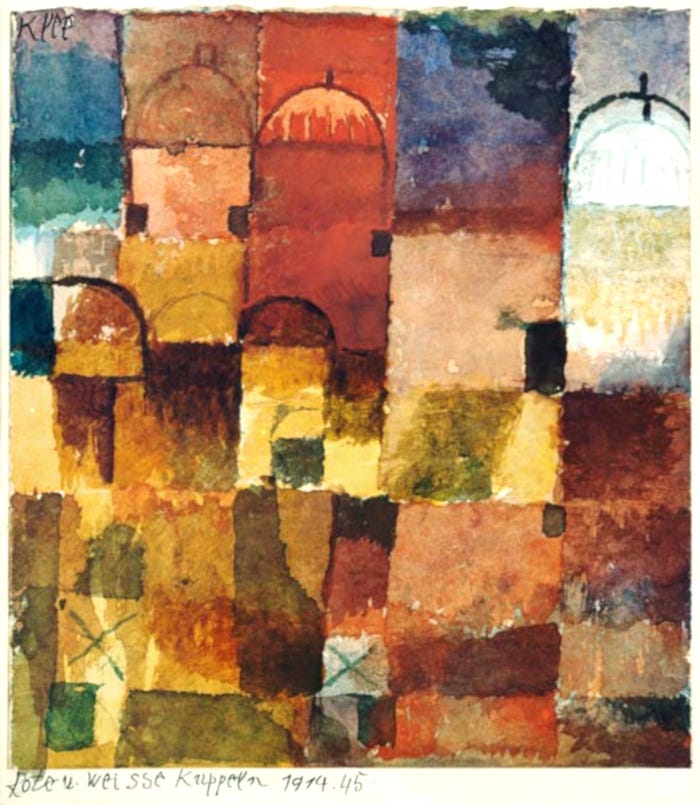
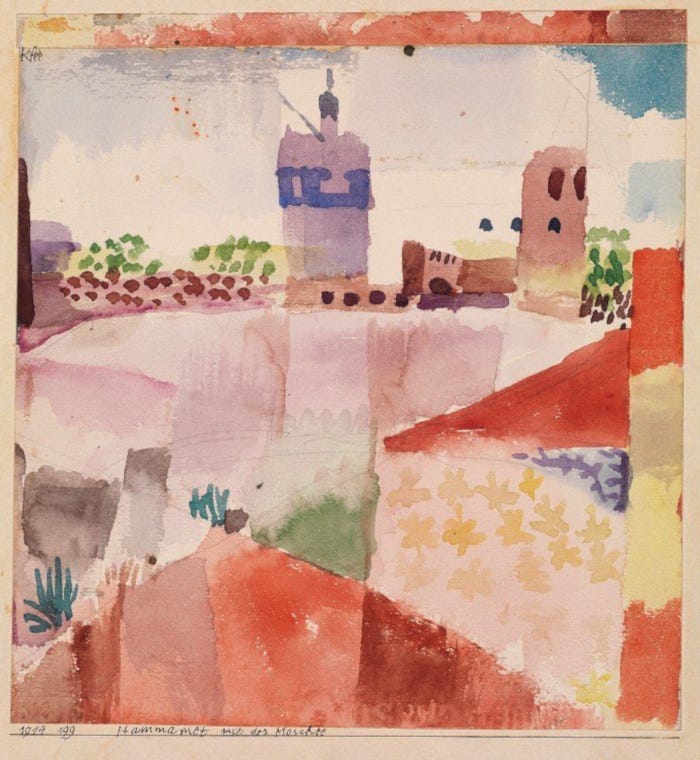
Though the plentiful sketches, studies, and paintings he produced in Tunisia were experimental, they were not abstract. At least not to begin with. In paintings like Red and White Domes or Hammamet with Mosque, the architectural details remain recognisable. There’s even a sense of distance and scale. His style became very confident yet loose, a patchwork of flattened colours evoking the rammed-earth walls, domes, shading canopies, and the patterns of naturally dyed hanging fabrics. A rhythm interrupted by simple gestural mark-making to denote details such as foliage.
The transition to abstract is already evident here and the lower halves resemble many of his later pieces as he introduced intuitive symbolism rather than observed objects. Indeed, many of the studies Klee painted of Tunisia were visual records of colour and volume that also reference the sounds and movement of bustling markets and city streets. These are effectively abstracts. As were his studies isolating and lifting visual motifs from their original context. He would continue to look back on these paintings and notes as source material well into the 1930s.
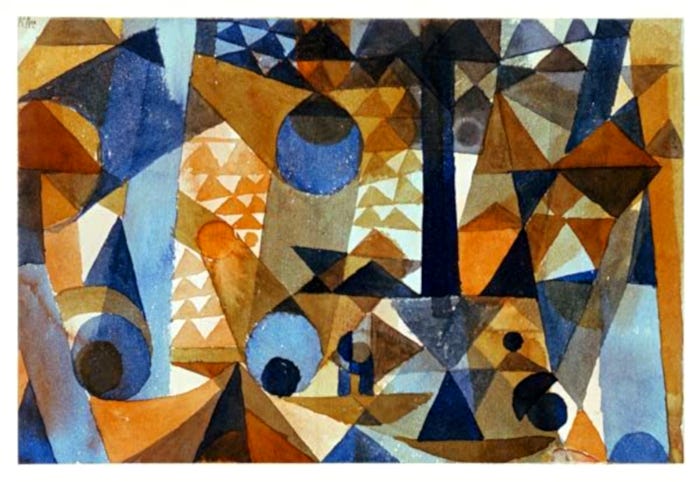
Within a year of his experiences in Tunisia, Klee was producing genuinely abstract work. The suggestion of cylinders and cones in some of his compositions lend movement to imply a 3D space or depth that recedes into the picture — this dynamic structure is very similar to what will later be known as Vorticism, also echoing much Futurist art as well as Orphism. The ‘earth-tone’ palette and ‘reductionist’ approach of this abstract is reminiscent of Paul Cézanne’s landscapes.
Klee survived the First World War and was hugely influential during the interwar period. Paul Klee at the Bauhaus and his 1920 painting, They’re Biting, have been discussed by Remy Dean previously in Signifier.
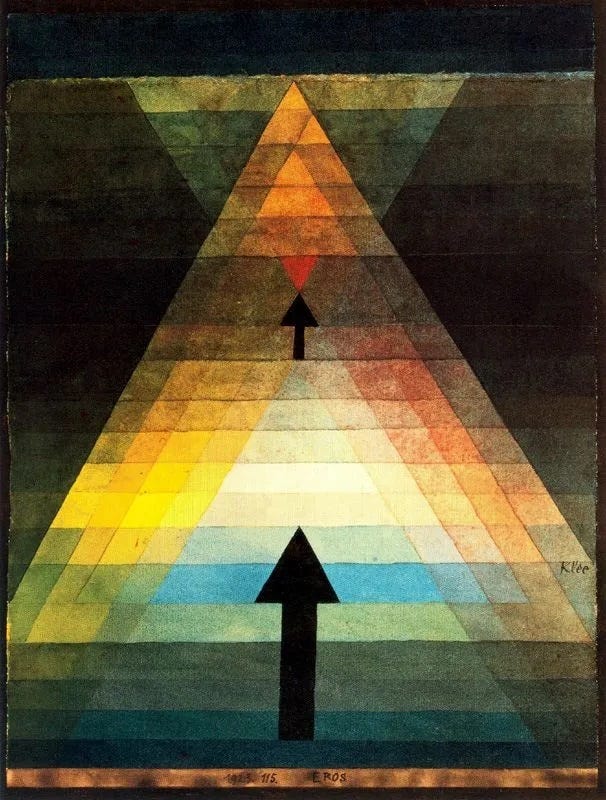
I am particularly fond of Eros, Klee’s watercolour of 1923. It’s an exercise in balance and how a single point can disperse the energy of a composition if placed in the right position. The energy is generated by repetitive rhythms of form and an incremental ‘colour ladder’, the point is where these energies meet and achieve harmony.
It is more of a visual essay than a purely aesthetic piece, yet it makes its point beautifully. Klee developed his approach to abstract art alongside his colleague Wassily Kandinsky who shared a belief that colour could not only express emotions but also directly affect them. They both taught at the Bauhaus as well as exhibiting their work together with Der Blaue Reiter and contributing to its journals.
The upthrusting triangle enters his work as a recurring motif at a time his fascination with ancient Egypt was growing and the monumental geometry of the pyramids impressed him. Eros prefigures much of the visual vocabulary that he would embrace after his visit the land of the Pharaohs a few years later, in 1929. There, he noted regimented rows of crops that striped the landscape, following the linear pattern of irrigation trenches. This was an aesthetic outcome of practical actions — something that paralleled the focus of his teachings at the Bauhaus where functional design strove to create pleasing forms.
Although he continued to lift colour from landscape and to adopt formal elements from direct observation, Klee approached abstraction as more of a visual exercise than a means to an end, exploring underlying theories of colour and form. He was also fascinated with symbols and the intuitive visual language that came naturally to children when drawing. Whilst embracing and innovating abstraction, he tended to see it as an exploratory process. He was making sense of reality by reducing some aspects to geometric and biomorphic forms, rather than replacing representation with total abstraction.
In this, he is a hub in the wheel of abstraction made up of geometric minimalism, compositional abstraction, Cubism, dynamism, automatist and dream Surrealism…
Klee is a key to understanding the development of all these varied approaches.
* All images are used with license, or presented here for educational purposes under fair usage policy.


