avatarRemy Dean

Free AI web copilot to create summaries, insights and extended knowledge, download it at here

1983

Abstract

83">the sublime</a>’.</p><p id="50bf">To some extent, there is an alignment with the German Romantic literary movement of <i>Sturm und Drang </i>— a philosophy that profound truths were accessible through a more poetic and sensual engagement with the world around us and not solely via intellectual reasoning or rational deduction. The term translates as ‘Storm and Stress’ and embraced the Nietzschean adage that what does not kill us makes us stronger. There will always be suffering as part of human existence, so hardship should not necessarily be avoided, but used as a tool for improvement — of one’s self <i>and</i> in the cumulative progress of humanity.</p><p id="9f37">Many of Kubin’s works are predominantly black and recall the <a href="https://readmedium.com/caravaggio-bad-boy-of-baroque-b37390b2744a#80e1">Baroque</a> where light gives form to a subject amidst a drama of light and shadow. His early work was inspired by <a href="https://readmedium.com/mad-as-munch-2c4bc4fff234">Edvard Munch</a> and James Ensor, but he was influenced in producing his distinctively dark images by the so-called ‘Black Paintings’ of Francisco Goya and the work of sculptor and print-maker, Max Klinger.</p><p id="510c">Some of his dark, dreamlike beasts have been linked to the development of the abstract style of <i>Der Blaue Reiter. </i>He became friends with <a href="https://readmedium.com/driven-to-abstraction-332fb2d1e3ff#ae25">Wassily Kandinksy</a>, Gabriele Munter, August Macke, and <a href="https://readmedium.com/walking-the-line-off-the-page-and-into-the-world-545226f11956">Paul Klee</a>, showing work alongside theirs at ‘Blue Rider’ exhibitions. He also wrote a novel in 1908, <i>The Other Side</i>, and illustrated around seventy more books, including the works of Edgar Allan Poe.</p><p id="615b">Although Kubin was primarily an illustrator, his innovative paintings are often just as concerned with compositional balance and integrity as in portraying their subject

Options

and in this way he pioneered abstract approaches. He saw a link between literature and ‘visual’ poetry in much the same way as Kandinsky saw a strong connection between visual art and music.</p><figure id="45ae"><img src="https://cdn-images-1.readmedium.com/v2/resize:fit:800/1*SvlyUXrPH03hc3AtIuypQw.jpeg"><figcaption><b>‘Gewitter’ / ‘Thunderstorm’ (1907) another of Alfred Kubin’s ‘Paintings From the Deep’</b> [<a href="https://dean-evolution.blogspot.com/2012/04/alfred-kubin-rauchende-negerinnen.html">view license</a>] </figcaption></figure><p id="af7a">Kubin was interested in how a painting can be ‘read’ and will reveal more elements as the viewer considers it and how this process equates with the narrative structure of poetry. He structured many of his images as ‘layers’ that were not meant to be clear at first glance, but instead would release their meanings to the viewer in a narrative sequence. Not unlike the sequential verses of a poem, or the turning of pages in a book.</p><p id="e139">In his 1907 painting, <i>Thunderstorm</i>, we have a picture that can be read on a number of levels: it is a fantasy painting, a landscape, a natural history illustration, a view of the cosmos! Look carefully. It is an incredible journey through the <i>micro</i> and <i>macro</i>cosm. A strongly surrealistic image, dealing with layers of meaning and multiple perceptions.</p><p id="50fa">We can see in it: a seahorse that becomes a flying dragon made from moonlit storm clouds against a backdrop of planets, galaxies, and comets, over a tumultuous ocean crashing onto the shoreline, just after sunset, or at the first glimmer of dawn…</p><p id="69e4"><i> All images are used with permission or presented here for educational purposes under fair usage policy.</i></p><p id="bf63"><i>A version of this article was first published in my book</i> Evolution of Western Art <i>(questing beast books, 2012) and has been revised and updated for Signifier.</i></p></article></body>

Kubin’s Poetic Paintings

Alfred Kubin used art to delve into the human condition and found sparks to light the darkness, to bring meaning into the void

Alfred Kubin was a troubled artist who expressed his dark imaginings to help him deal with them in an ongoing quest to rekindle his awe for the world. He recognised that there were sparks of light in the darkness. Like stars in the night sky. Like moments of sparkling joy that break through dark despair. He wrestled with depression and dark compulsions all his life. To him, the darkness was an all-consuming, daunting void. Yet a little light could lend it meaning, and sometimes a fierce beauty.

What, at first glance, appears to be a dark abstract, or a Turner-esque stormy nocturne, may reveal itself to be a painting of some imagined deep-sea creature dredged up from the ocean depths. A notion brought to light from the deep subconscious.
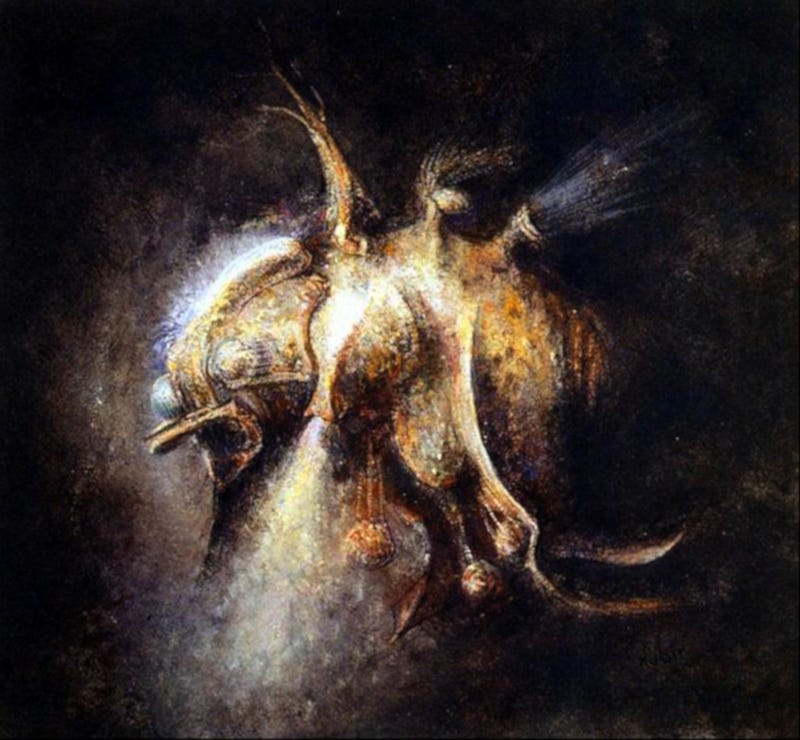
‘Aus der Tiefe’ (c.1906) one of a series of ‘Paintings From the Deep’ by Alfred Kubin [view license] *

Kubin was a much-underrated Austrian illustrator who has since been credited as being a major early influence upon Expressionism, Symbolism and Surrealism. He was famed for dark, disturbing drawings that explored existential aspects of the depression that beleaguered him, and also a few fantastical paintings of animals and landscapes that attempted to capture the strange beauty and power of nature — what the Romantics had termed ‘the sublime’.

To some extent, there is an alignment with the German Romantic literary movement of Sturm und Drang — a philosophy that profound truths were accessible through a more poetic and sensual engagement with the world around us and not solely via intellectual reasoning or rational deduction. The term translates as ‘Storm and Stress’ and embraced the Nietzschean adage that what does not kill us makes us stronger. There will always be suffering as part of human existence, so hardship should not necessarily be avoided, but used as a tool for improvement — of one’s self and in the cumulative progress of humanity.

Many of Kubin’s works are predominantly black and recall the Baroque where light gives form to a subject amidst a drama of light and shadow. His early work was inspired by Edvard Munch and James Ensor, but he was influenced in producing his distinctively dark images by the so-called ‘Black Paintings’ of Francisco Goya and the work of sculptor and print-maker, Max Klinger.

Some of his dark, dreamlike beasts have been linked to the development of the abstract style of Der Blaue Reiter. He became friends with Wassily Kandinksy, Gabriele Munter, August Macke, and Paul Klee, showing work alongside theirs at ‘Blue Rider’ exhibitions. He also wrote a novel in 1908, The Other Side, and illustrated around seventy more books, including the works of Edgar Allan Poe.

Although Kubin was primarily an illustrator, his innovative paintings are often just as concerned with compositional balance and integrity as in portraying their subject and in this way he pioneered abstract approaches. He saw a link between literature and ‘visual’ poetry in much the same way as Kandinsky saw a strong connection between visual art and music.
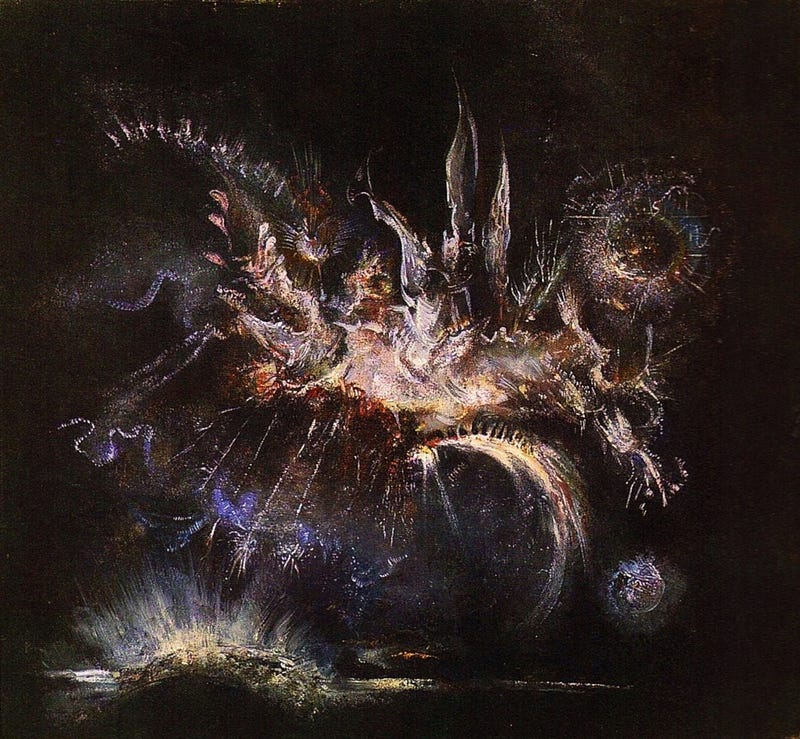
‘Gewitter’ / ‘Thunderstorm’ (1907) another of Alfred Kubin’s ‘Paintings From the Deep’ [view license] *

Kubin was interested in how a painting can be ‘read’ and will reveal more elements as the viewer considers it and how this process equates with the narrative structure of poetry. He structured many of his images as ‘layers’ that were not meant to be clear at first glance, but instead would release their meanings to the viewer in a narrative sequence. Not unlike the sequential verses of a poem, or the turning of pages in a book.

In his 1907 painting, Thunderstorm, we have a picture that can be read on a number of levels: it is a fantasy painting, a landscape, a natural history illustration, a view of the cosmos! Look carefully. It is an incredible journey through the micro and macrocosm. A strongly surrealistic image, dealing with layers of meaning and multiple perceptions.

We can see in it: a seahorse that becomes a flying dragon made from moonlit storm clouds against a backdrop of planets, galaxies, and comets, over a tumultuous ocean crashing onto the shoreline, just after sunset, or at the first glimmer of dawn…

* All images are used with permission or presented here for educational purposes under fair usage policy.

A version of this article was first published in my book Evolution of Western Art (questing beast books, 2012) and has been revised and updated for Signifier.

Art
Art History
Painting
Mental Health
Philosophy
Recommended from ReadMedium