
Franz Marc: Seeing Through it All
The famous painter of colourful animals hoped to find the essence of all things beyond the wonderful illusion of our world.
Franz Marc predominantly painted animals. Or to be precise, he animalised his paintings. His art was driven by a philosophical exploration of nature and by interrogating the nature of reality itself.
As I understand it, Marc was beginning to build upon the concept of animism — that all things have within them an animating spirit. However, he was pushing past this notion toward a belief that these spirits were actually facets of one ‘unifying spirit’, of which we were once also a part.
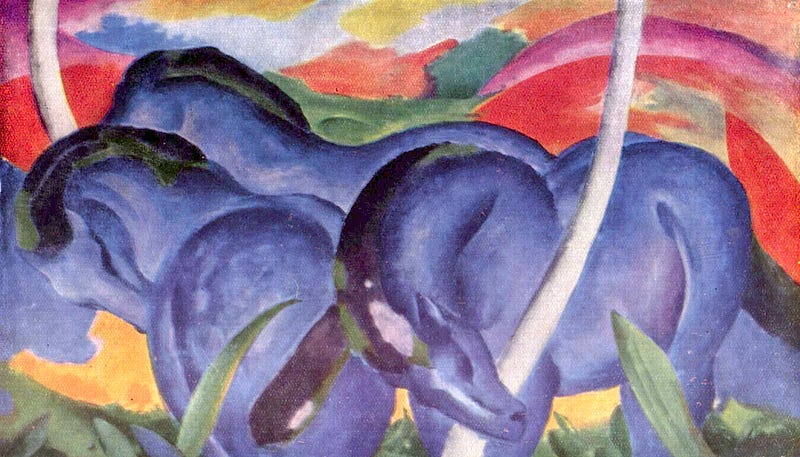
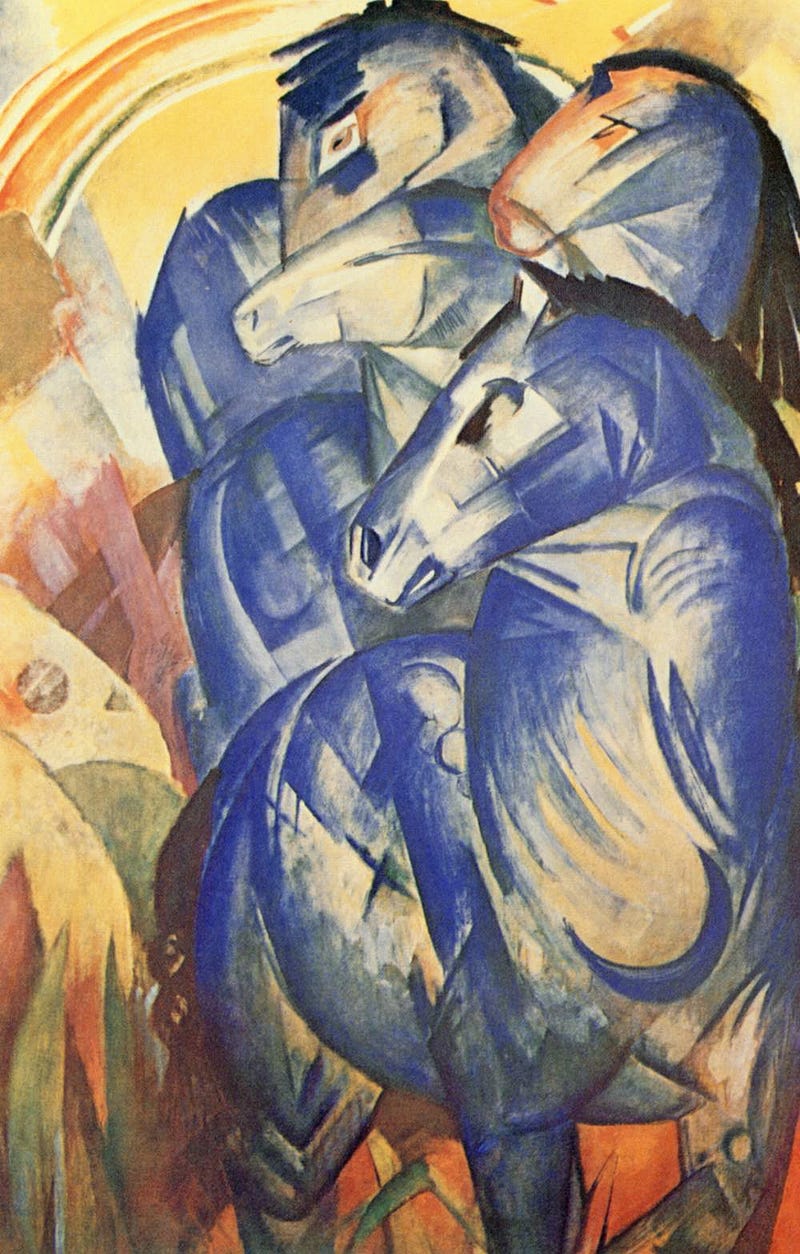
Franz Marc felt that animals were closer to this unifying spirit than humans, who had drifted further away from the primordial essence. He also found that painting animals made him much happier than painting fellow humans. He wondered why this should be so.
When he painted an animal, he was not painting any particular individual. After initial studies to understand the underlying forms, he would paint his animals without using a model. He saw his designs as totemic and thought of his animals in terms of iconography rather than representation — perhaps more like the animals in prehistoric cave paintings.
It seems he was thinking like a shaman and saw each animal as an expression of a great spirit that inhabits the whole species. Several shamanic cultures have a belief that their tribe has a special animal that they repeatedly hunt. When they are successful, they ritually release the beast’s spirit which returns to the great encompassing spirit for ‘recycling’ so it may return and give itself to them again, at the next hunt.
Marc’s spiritual journey was ongoing, so to summarise his findings using any of the numerous Aphorisms he wrote could be misleading as his understanding continually grew and changed throughout his life. Besides, he believed that art was the best expression of the illusory world in which we exist. So, simply looking at his paintings, and then at world around us, may be the best way to understand and appreciate both…
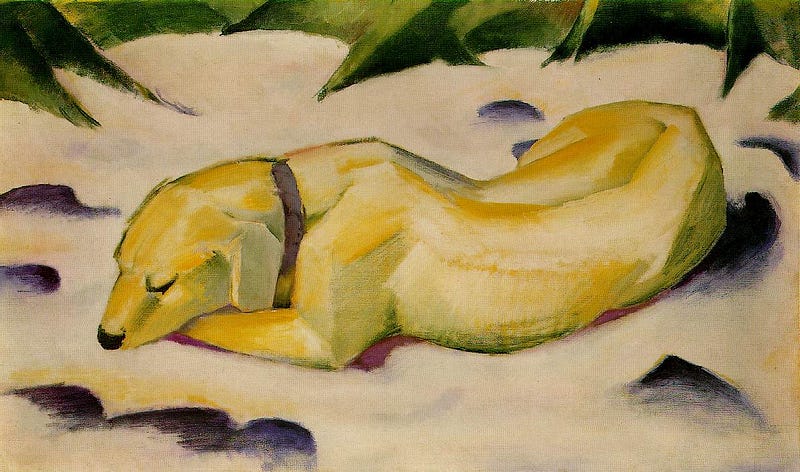
Strong influences of Fauvism, and Cubist reductionism, are mixed with some excellent observation in his very pleasing painting of a golden dog snoozing on the snow. This composition, of 1911, has a definite resonance with The Blue Nudes series that Henri Matisse was painting around this time, as well as the rendering of shadow in warm hues we saw in Le Bonheur de Vivre, painted by Matisse five years earlier.
Although it’s a simplified ‘symbol of a dog’ (I fondly recall one student observing the resemblance to a peeled potato) it’s also well-observed by an artist who clearly spent much time looking at dogs. I love the way the relaxed jowl sags slightly over the supporting paw and how the luxuriant thickness of fur is implied by the curve of the collar.
Along with his friend, Wassily Kandisnky, Franz Marc was a founder member of the hugely important group of artists collectively known as Der Blaue Reiter (The Blue Rider) — a fairly loose association of several pioneering international artists who were united by the emphasis they placed upon colour and a belief that visual art could transcend cultural and political boundaries.
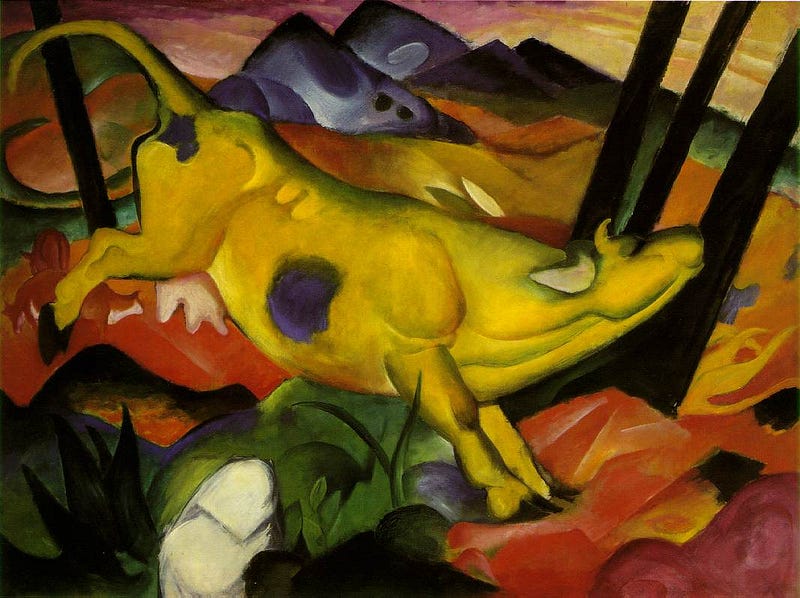
Also painted in 1911, around the time of his marriage to his second wife, Maria Franck, The Yellow Cow has been interpreted as a purely joyous painting. The cow even appears to be smiling!
Cows have been revered as a symbol of the feminine principal since prehistoric times. They proliferate in cave art, are central to the creation myths of several ancient cultures including Egyptian and Norse, and were worshipped by the people who built the earliest ‘cities’.
In many ways, Marc is dealing with the mythic in his art. The animal here is recognisably a cow. The title of the work also tells us this. Yet it’s more than merely a realistic re-presentation of a cow. It’s also the ‘symbol of a cow’ and in keeping with his notion of one illusion behind another, it may well symbolise things beyond that. The use of non-naturalistic colours and the dynamism of the bold composition implies there is more to be read within the image.
When Marc’s coded colour theory is applied here, we see a celebration of vivacious yellow denoting female energies, with the blue essence of masculinity contained inside it. This implies a sort of yin-yang balance, or perhaps a more explicit narrative of consummation. Or simply, the joy of life!
Interestingly, horses were one of his favourite subjects and he almost always assigned them the male principal by rendering them in blue. He also uses them to represent the ‘unbridled’ nature of mankind. The horse with a rider represents the animal instincts — our emotions — under the control of the rational intellect. It also speaks of humanity’s drive to dominate nature. The riderless horse is closer to the animal’s ‘wild’ state and often represents a more intuitive interaction with the wider world, literally being ‘true to our nature’.
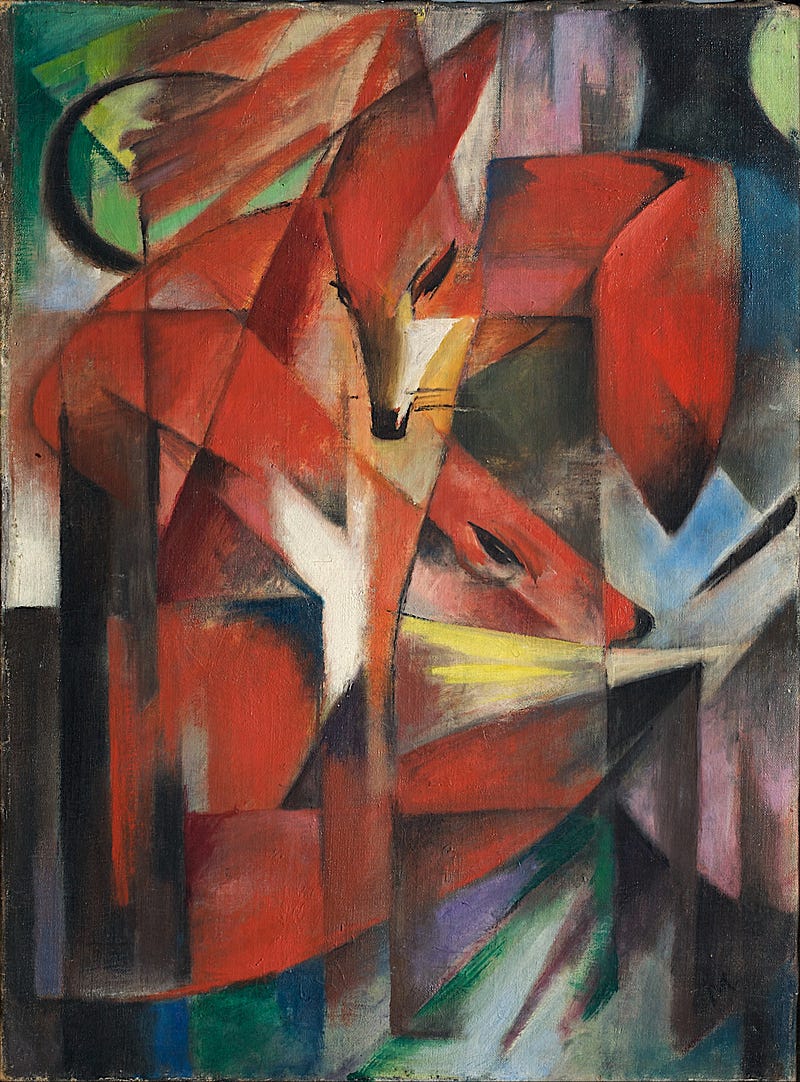
This 1913 painting of two foxes shows many characteristics that would later identify the style of the German Expressionist movement: strong dark shading mixed with rich colour and a dynamic, almost jewel-like faceting of the image. The structure of this particular composition is echoed in the works of Juan Gris, the Cubist who loved colour…
Foxes were a subject that Marc returned to several times and are one of the few non-domesticated animals he chose to focus on. The merging of the two foxes with their background makes them part of their environment and vice versa. This is a clear interpretation of his concept of seeing through the illusion of the world to a deeper essence that flows through and unifies all living things — think of Obi Wan explaining ‘The Force’ to Luke.
Or perhaps how Edgar Allan Poe put it in his famous poem, from 1849:
“All that we see or seem Is but a dream within a dream.”
Franz Marc thought that the world we see is an illusion created by our perceptions. We now know that indeed, our brains render a version of the world based on the information brought to it by our senses. What we see is our individual interpretation of what’s out there. So, he was right on that point.
Marc went further and proposed that the essence behind the illusion, was another illusion. And beyond that we’d find yet another… He was aware of how science explained and labelled many aspects of nature that had previously seemed magical and wonderous. Though he welcomed scientific investigation into his ‘toolbox of understanding’, he believed that scientific explanations were also illusions to be cut through.
In this, he aligns himself with the Romantic movement, particularly its precursor, the British artist and visionary William Blake who pointed out that the scientific facts of one generation are generally disproved by the following generation. However, in tandem with imagination, science is essential to the quest for deeper understanding.
Marc was also fond of the writings of Friedrich Nietzsche, another great Romantic philosopher who was becoming prominent in the early twentieth-century psyche of Europe. Nietzsche wrote of a return to nature as a metaphor of the return to selfhood. He also believed the pursuit of illusions may be infinite. Therefore, it was essential to ponder the wider world whilst also looking within to understand how we perceive and interpret our own version of ‘reality’. It all sounds rather like our contemporary quantum theories!
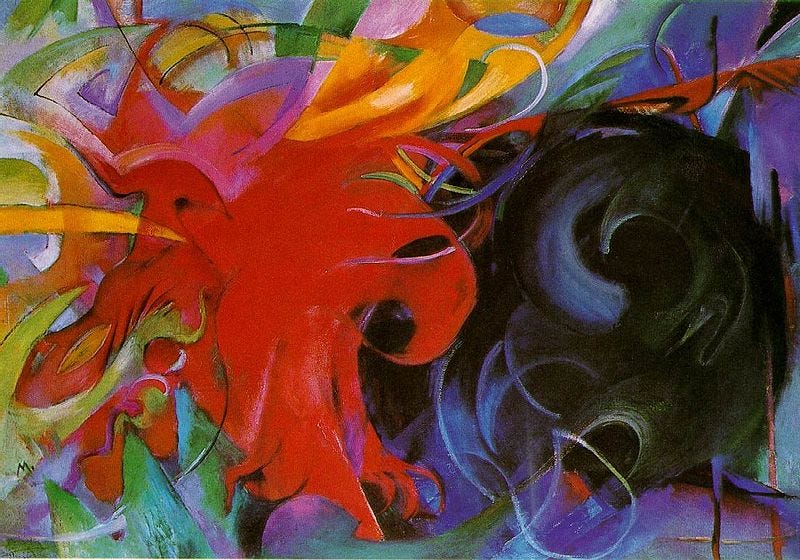
Marc was very impressed with Kandinsky’s innovation of abstract art and joined his friend and colleague in developing some of the first true abstracts... In his 1914 painting, Fighting Forms, biomorphic shapes are still very much in evidence, taken from his observation of nature, though they now serve the metaphorical narrative of the composition, dealing with socio-political themes.
As with the other pioneering abstracts coming out of The Blue Rider around this time, this is an image that would influence both interwar Modernism and the Abstract Expressionism of the mid-twentieth-century. Strong links to current trends in graffiti art can also be seen here, both in the strong use of colour and the vigorous gestural approach.
In many respects, this is not a harmonious composition and reflects the turmoil around Marc during the onset of World War I. Marc was drafted, though later his name was on a list of notable artists to be withdrawn from combat… Tragically, before the orders were carried out, he was killed by a grenade explosion while riding a horse on patrol in the Battle of Verdun, 1916.
With the onset of war, The Blue Rider group dissolved and, though some of its surviving members went on to be among the few truly important and influential artists of the period between the wars, it never reformed.
Tiger, Franz Marc’s key-work of 1912, has been discussed by Remy Dean previously in Signifier.


