Princess of Polka Dots, Yayoi Kusama
Exploring the relationship between the individual and the infinite through the work of one of Japan's globally renowned artists…
Many already know the work of Yayoi Kusama without knowing about the artist… Her influential Pop Art in the sixties has spilt over into fashion, installation, and performance. Now in her 90s, Yayoi Kusama is one of Japan’s most famous artists. Yet she needed to work with unerring dedication and ambition to achieve the world fame she now enjoys.
As a child, she showed great talent as an artist, but her middle-class parents made clear this was an unsuitable career for a girl. Her family ran a flower nursery in rural Japan and, while drawing in a field of flowers, she experienced an intense visual sensation. It was as though the flowers turned into a myriad of coloured dots that overwhelmed her senses yet liberated her consciousness. These sensations and her unique perspective, combined in an experience she offers us in many of her, now famous, Infinity Room installations. The first ‘peep show’ infinity rooms were developed in the sixties, while she was establishing her reputation as an international artist in New York.
When studying and working in Japan, learning traditional Japanese painting techniques, she had written to the American artist Georgia O’Keefe, enclosing some of her watercolours. O’Keefe wrote back with an encouraging response. This inspired Yayoi Kusama, then aged 27, to take action, packing her suitcase with over 2,000 paintings and travelling to the USA. There, she met O’Keefe and other famous artists such as Andy Warhol and plunged into the vibrant avant-garde New York art scene of the late 1950s. She became known for covering large canvases with repetitive mark-making, networks of lace-like loops to begin with until becoming known as the ‘Princess of the Polka Dots,’ as this emerged as her obsessive motif that covered not only canvasses, but the curved surfaces of sculptures, and then people as she diversified from painter to performance artist.
But it was a difficult, precarious time as well as an exhilarating one for Kusama. As a woman, and a Japanese woman, in post-war America, she found it hard to progress in her career. In the seventies, Kusama returned to Japan, where she was relatively unknown, exhausted with the effort of maintaining her reputation in the then male-dominated art world. She needed to find a safe place to regroup and care for herself and her mental health.
After a period of rest and recuperation, she returned to making art in the eighties and attracted international recognition during the nineties. She created colourful canvases that examined microcosms and produced more elaborate installations. Unafraid to embrace media from lowly marker pens to human scale environments, her repertoire of materials and processes expanded to take in fabric, fibre-reinforced polymers, stainless steel and, of course, the intangible interactions of light and spacial volumes.
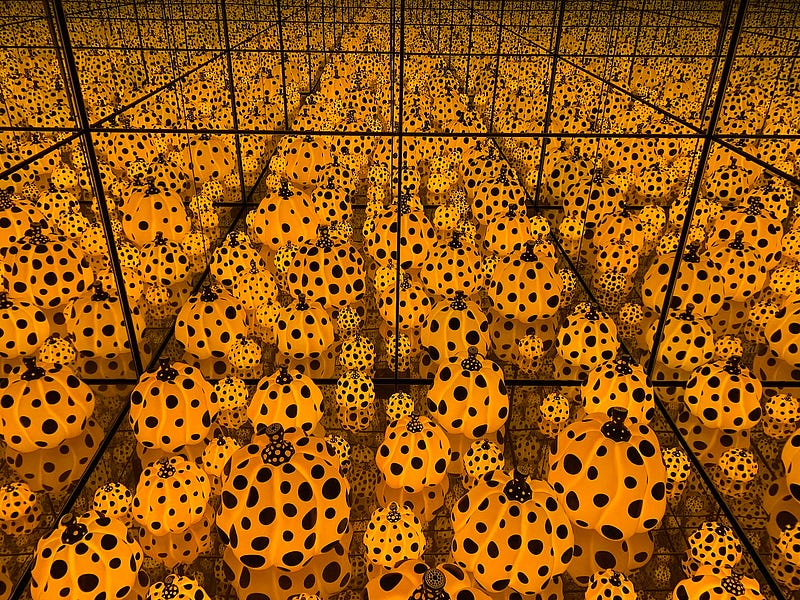

Kusama was obsessed with how tiny marks can accumulate to create epic works of art where each dot is as important as another yet together they become more. A metaphor for the innumerable stars that make the universe, the individuals creating a culture, the particles that comprise everything.
She became known for creating oversize ceramic pumpkins decorated with polka dots that became open-air installations as well as ‘pumpkin rooms,’ where mirrors provided endless reflections. These infinite spaces encouraged us to consider the meanings that may grow from repeated experience, or prolonged contemplation of a singular event. In 2015, she explained that she loved pumpkins, “because of their humorous form, warm feeling, and human-like quality and form. My desire to create works of pumpkins still continues. I have enthusiasm as if I were still a child.”
Throughout her career she has collaborated with others, branching into other media such as fashion, to spread her ideas and work beyond the art world. For example, in 2012 Louis Vuitton produced a fashion collection based on Kusama’s polka dots. Thus, images of her work have appeared in magazines such as Vogue, and she was more recently photographed with her works by influential Japanese stylist Kumiko Iijima who also works with Kyary Pamyu Pamyu. Such links with the world of fashion along with her signature use of bright colours have led to an association with Kawaii culture but, although she shares the positivity of that scene, Kusama is keen for those links to remain tenuous.
Yayoi Kusama is a success on her own terms. Her work now sells for millions and is in private and public collections around the world. She’s immensely popular because she makes accessible art collaborative and fun. For example, one installation was a totally white room — colourless furniture and all — where visitors were given one coloured dot to place where they wished. As the exhibition progressed, the random colour polka dots created a unique colourful space that continually changed and recorded the short presence of visitors who all left their individual marks. Her installation rooms invite us to see ourselves reflected in her artwork, and there are so many Instagram images out there as a result.
In the 1990s, she appeared at the Venice Biennale to represent Japan and randomly handed out miniature pumpkins to visitors. There is generosity and exuberance in her work, and she herself says she wants to make the world a better and more peaceful place through art.
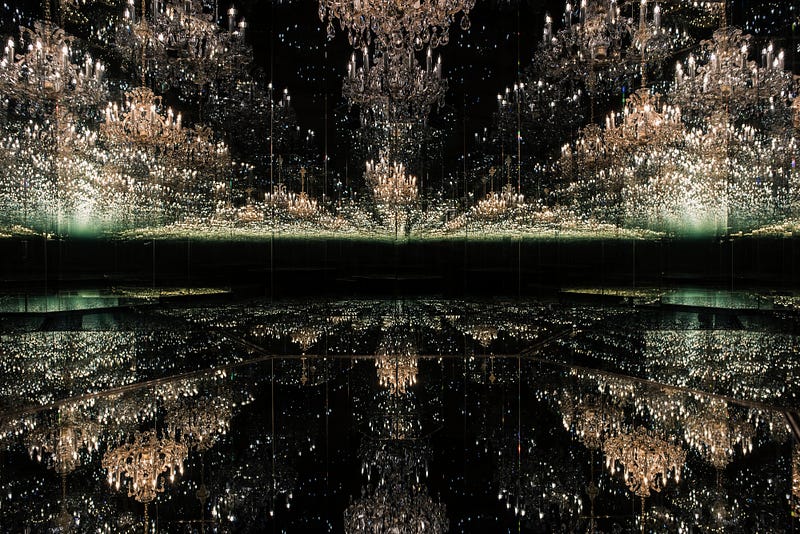
She recently set up the Yayoi Kusama Foundation, which she intends to spread her work and message further afield and continue doing so, even when she can no longer be physically present. As part of this initiative she founded the Kusama Museum, located in Tokyo’s Shinjuku City, which houses a permanent collection of her works, including a major Infinity Room installation across one of its five floors.
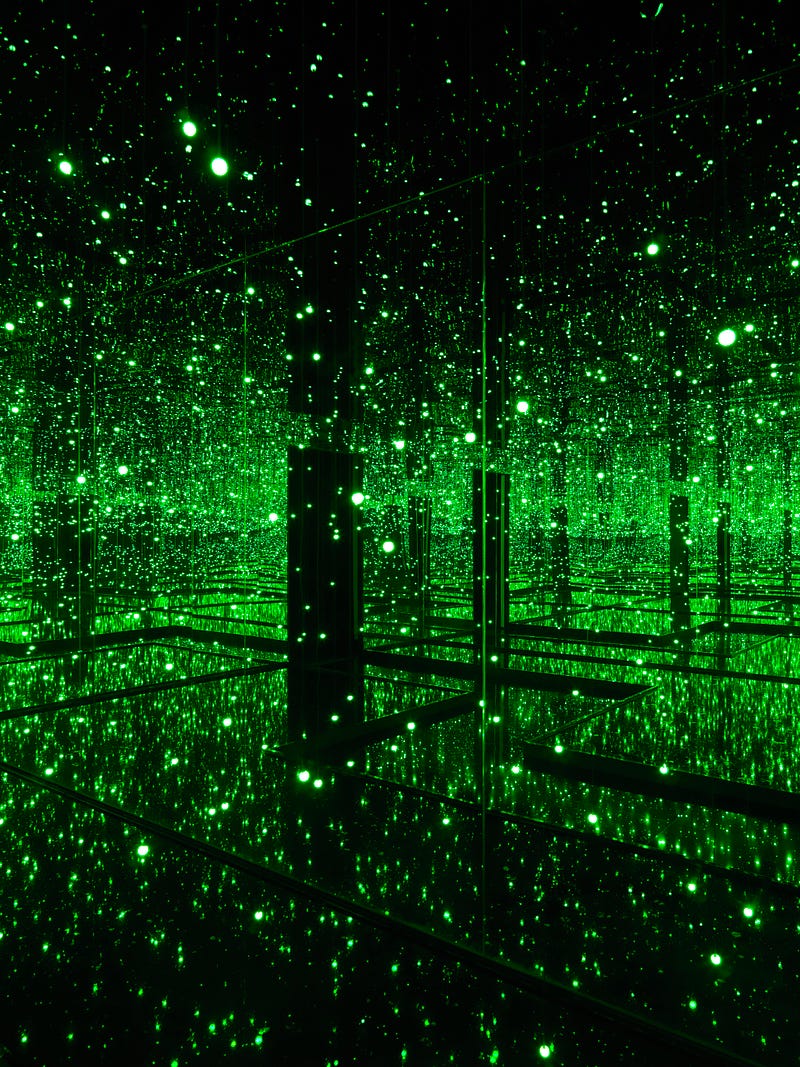
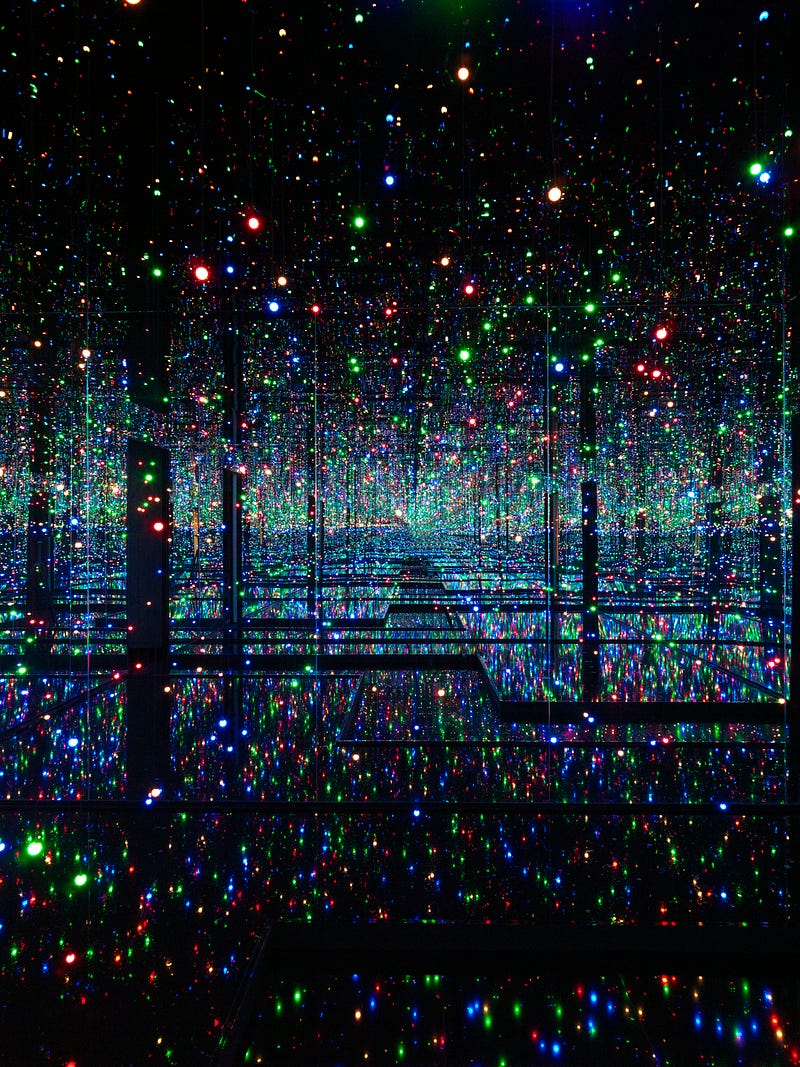
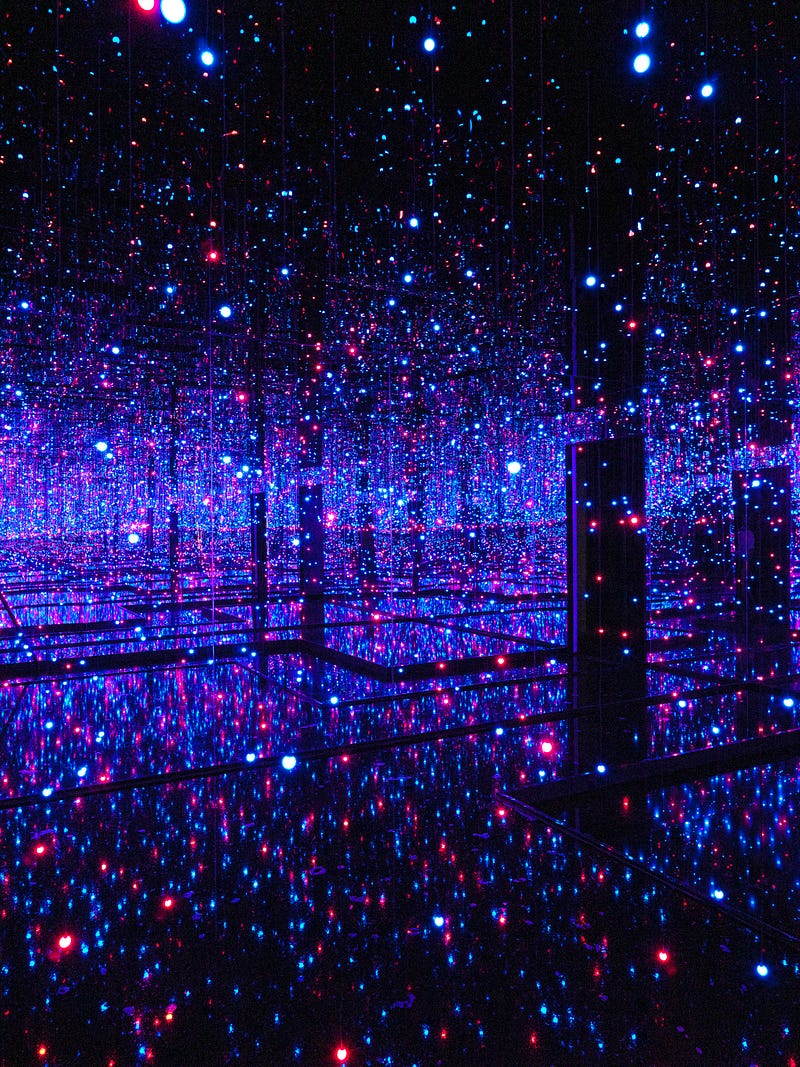
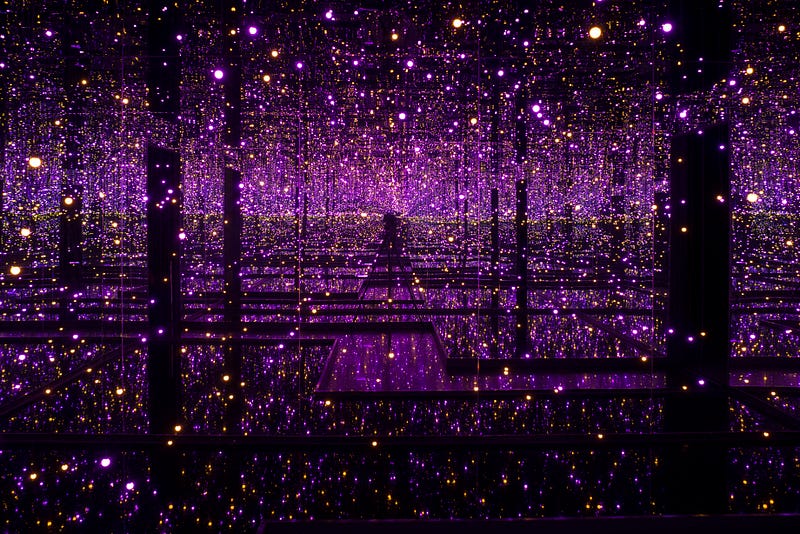
Currently, London’s Tate Modern hosts some of her latest Infinity Rooms as part of an major retrospective and this exhibition is extended into 2023 due to popular demand. One of these infinity rooms, entitled Filled with the Brilliance of Life, uses coloured LED lights in an infinitely changing sequence that glows in the darkened space. Perimeters disappear and the visitor is engulfed by these dots of light, reflected in shallow water alongside the path they walk.
Losing oneself in these endless dots of glowing colours is an out-of-body experience, which can immerse yet elevate one into the universal, recreating Kusama’s own flower field revelation. A unique neurodiverse view that enchants and challenges. It links across centuries to the Starry Night painted by Vincent Van Gogh in 1889, another magical and exuberant rendition of the sublime...
As Kusama said back in 1968, “Our Earth is only one polka dot among a million stars in the cosmos,” and her infinity rooms help us feel that for ourselves.