
Mother of the American Modern
Painting flowers was nothing new, but no one painted them quite like Georgia O’Keeffe…
Georgia O’Keeffe once admitted, “I’ve been absolutely terrified every moment of my life — and I’ve never let it keep me from doing a single thing I wanted to do.” It’s a quote often repeated and it seems she applied the credo to all aspects of her long creative life, not least her art. This bravery led her to a new approach to colour and form which started with her famous flower paintings. These vivid, close-up portraits of blooms such as poppies and cannas are among the most well-known of O’Keeffe’s paintings. Many are still reproduced as popular prints or greetings cards, many are also sequestered in private collections.
O’Keeffe was born in Wisconsin, on a farm near Sun Prairie, where she developed a deep connection with the land. When she showed artistic talent, her mother encouraged her to study, ultimately at the Chicago Art Institute. Ill-health, and money worries meant she worked alongside further study, as a commercial illustrator and later as an art teacher. She took a class with the painter Arthur Wesley Dow, who was much influenced by Japanese Art, and she was impressed by this style.
Around this time she also veered away from her realist approach to still life, which she’d mastered, and began experimenting with abstraction. The work of European painters like George Braque and Wassily Kandinsky interested her and she, too, experimented with visualising the sound and emotion of music, attempting to capture this on canvas.
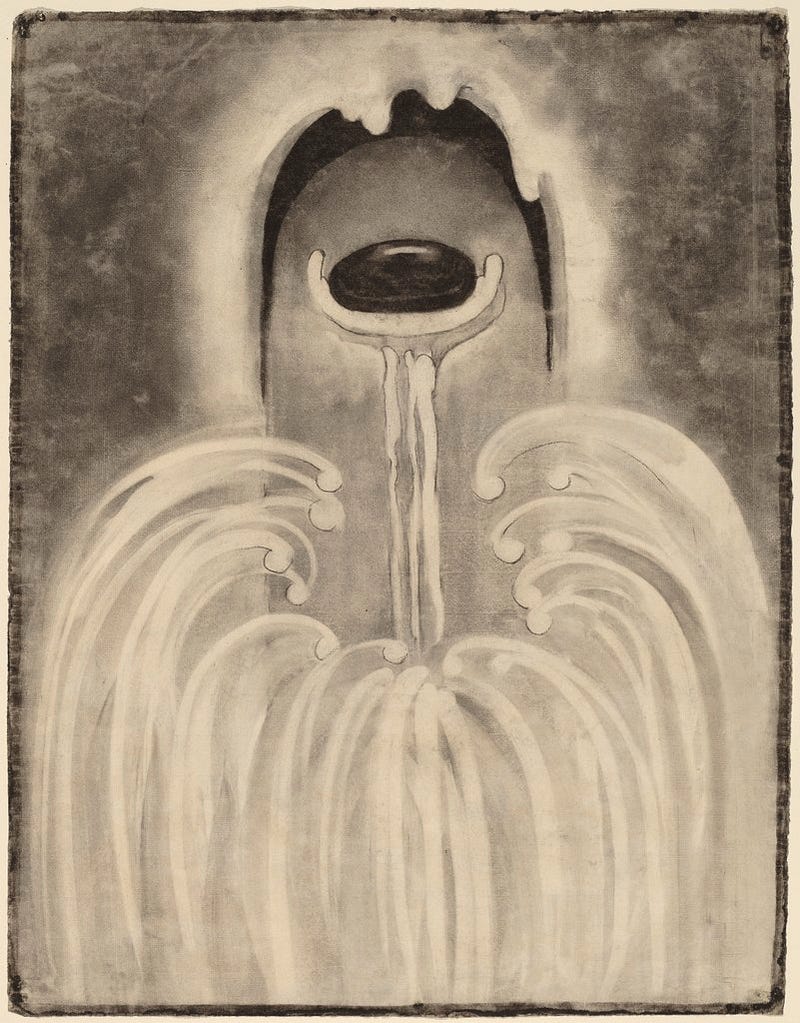
In 1916 an old school friend, Anita Pollitzer — artist, photographer, and suffragist, showed some of Georgia’s charcoal drawings to a fellow photographer, Alfred Stieglitz —the gallerist and art dealer. He thought they were the,“purest, finest, sincerest things,” he’d seen in a long while and included them in a mixed show at his influential 291 gallery in New York.
In the April of 1917, he also presented her first solo show there. The same year, Stieglitz famously photographed Marcel Duchamp’s seminal work Fountain, which became the only document of this key work long after the ‘original’ was lost. O’Keeffe and Stieglitz fell in love and later married in 1924 — possibly the most influential couple in the mid-century Modern Art scene of the USA.
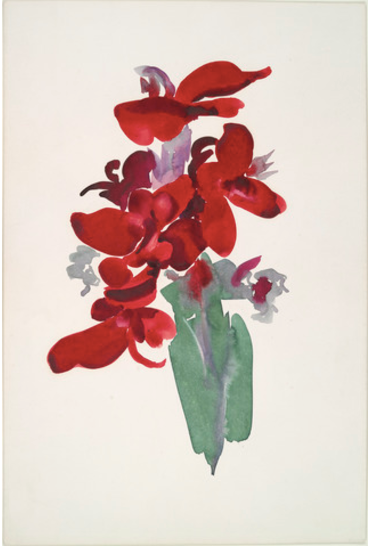
They often stayed at his parents’ summer residence in Lake George, New York where Georgia became fascinated by the form and colour of cannas. Perhaps influenced by the close-up approach of photography, these series of oil paintings evolved into extreme close-ups that celebrated colour and form, which would dominate her visual explorations throughout her career.
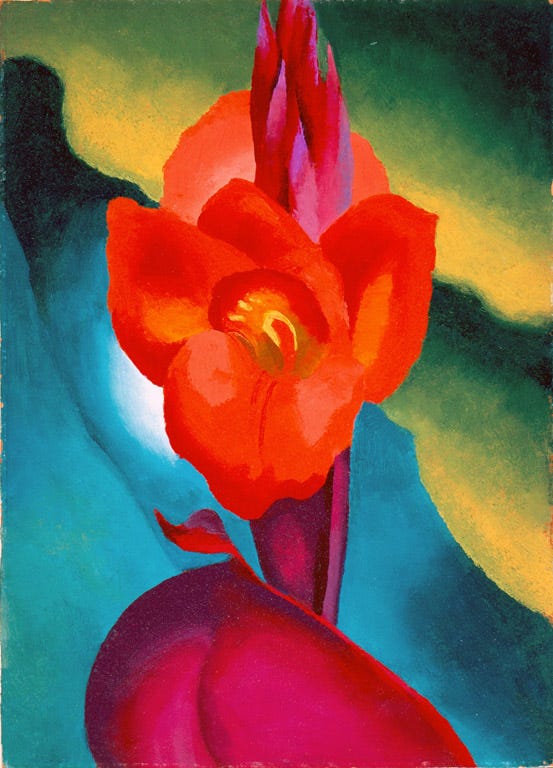
Her oil painting Red Canna, produced in 1919, contrasts the bright red flower with stylised background, curved blocks in cooler shades of blue and sepia. It shows the influence of the Fauvist approach of Henri Matisse yet injects Japanese and art nouveau sensibilities. The careful blending of dramatic colours, the generous curves, show O’Keeffe’s own emergent style.
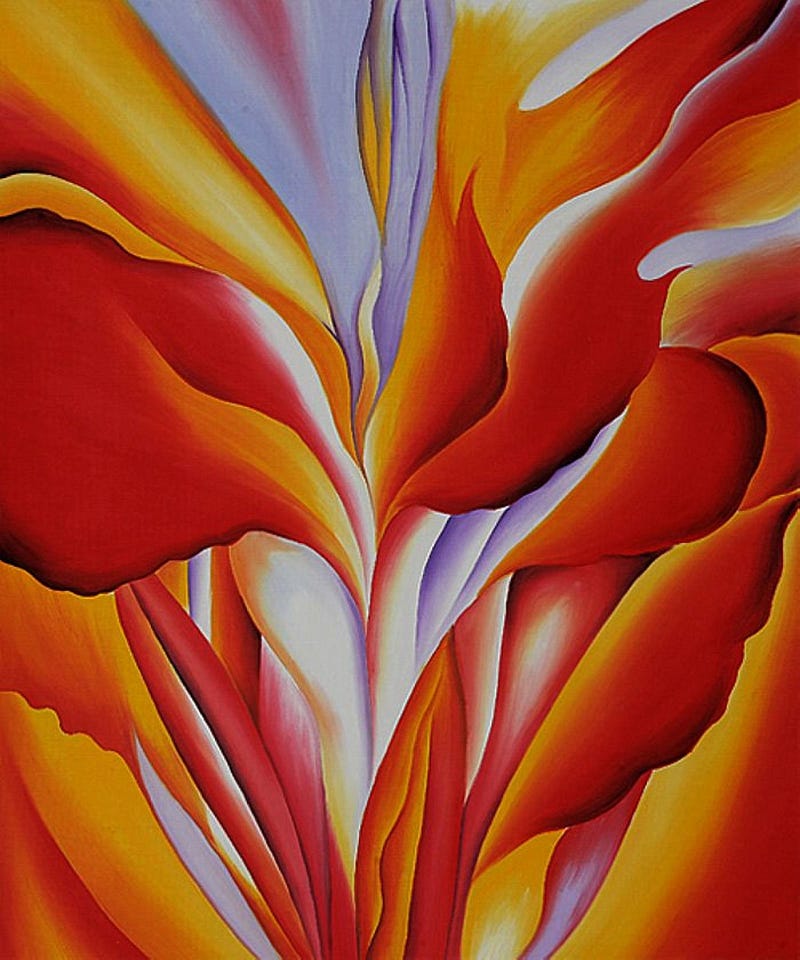
That same year, O’Keefe painted an extreme close up entitled Inside Red Canna which focussed on the warm palette of reds and oranges within the flower itself. This progressed to her well-known 1924 oil painting The Red Canna which immerses the viewer totally in the flower — it attempts to share what the artist sees when she examines the bloom — and was a totally new approach to still life in the process, one that merged realist elements with abstraction.
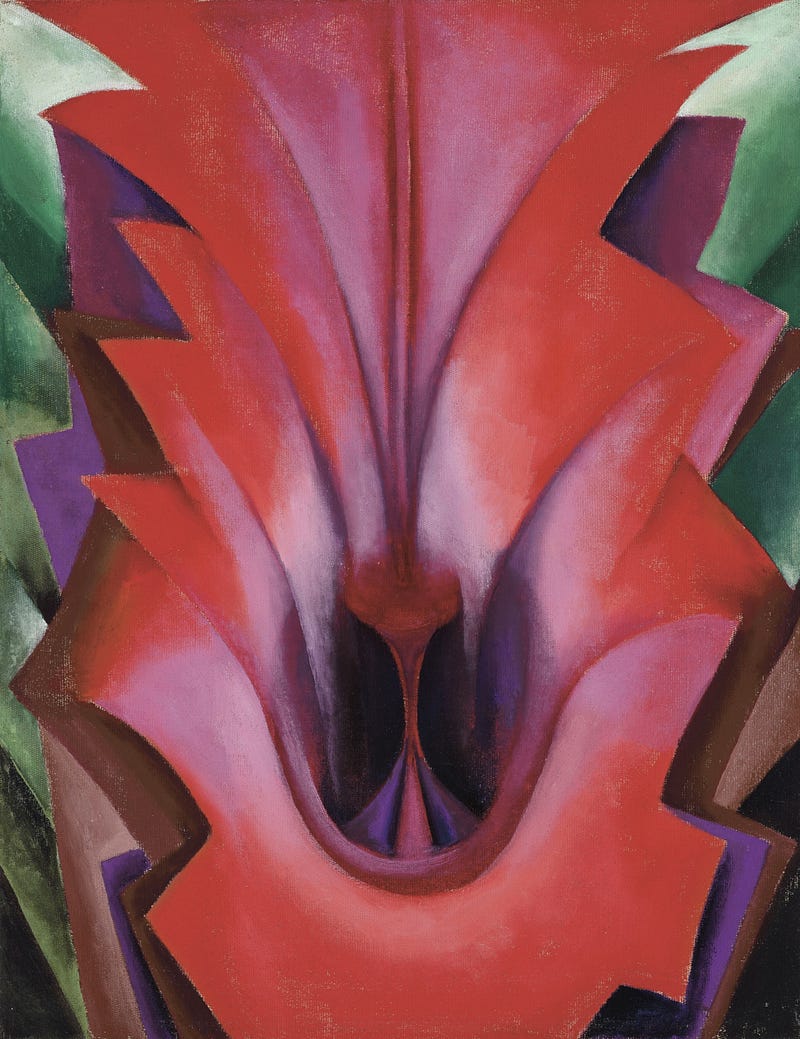
The curves and bold outlines of petals are simplified, visually distilled to emphasise their symmetry whilst also drawing attention to a subtle, naturalistic interruption of that rhythm. Echoes of Cubism can be detected here. Their vivid shades of red and orange leap towards you as if lifting from the picture plane, inviting you into the heart of the flower itself, which seems to recede beyond the surface of the canvas. Streaks of cooler blue, violet and grey at the very centre pull you even further in, until you are cocooned in the riotous colour of this soft, voluptuous flower.
“In a way, nobody sees a flower, really, it is so small, we haven’t time, and to see takes time, like to have a friend takes time. If I could paint the flower exactly as I see it, no one would see what I see because I would paint it small like the flower is small. So I said to myself, I’ll paint what I see, what the flower is to me but I’ll paint it big and they will be surprised into taking time to look at it. I will make even busy New-Yorkers take time to see what I see of flowers.” — Georgia O’Keeffe
The sensual beauty and eroticism of the images led to comparisons with the female body, which was always denied by O’Keeffe herself although she has been lauded by feminists for depicting female sensuality in a totally feminine way. O’Keeffe herself said that she was trying, “to do painting that is all of a woman,” but also protested, “I am not a woman painter!” She later explained, “I believe in women making their own living. It will be nice when women have equal opportunities and status with men so that it is taken as a matter of course.”
She was immensely successful and enjoyed a long and varied career. She influenced many modern artists and has been called ‘the mother of American modernism’. She inspired many artists to follow, such Tamara de Lempicka, and later Eva Hesse and Louise Bourgeois. She even passed the baton back to photography — Robert Mapplethorpe famously photographed blooms with voluptuous precision, including Canna Lily (1988) his take on the same flower which so often inspired O’Keeffe. Her influence, particularly the fascination for ‘zooming-in’ to a single bloom, remains palpable in the work of many artists to this day and I am reminded very much of Marc Quinn’s ‘Desire’ series of large-scale sculptures.
By no means did Georgia O’Keeffe specialise in painting only flowers! Her distillations of landscape are fascinating, the Modernist simplicity of her architectural paintings is always striking but, along with her Surreal paintings of beautiful bones floating over desert sands, it’s her celebrations of the flower that remain foremost in the public imagination. In 2014, her oil painting of the humble Jimson Weed, White Flower No.1, from 1932, was sold at auction for $44.4 million dollars, a new record price for a female artist. That O’Keeffe did not let her inner terror stop her immense talent from blossoming is a lasting inspiration.


_by_Georgia_O%27Keeffe.jpg)
