
Preserving Paradise
Marc Quinn’s ‘The Garden’ and our eternal desire to capture and keep the essence of beauty.
In the year 2000, just at the birth of a new Millennium, Marc Quinn created his large-scale installation, The Garden, for exhibition at the Fondazione Prada in Milan. He was part of the pack of ‘Young British Artists’ of the 1990s but already showed greater signs of longevity than some.
His most famous work to date was the portrait, Self (1991), a cast of his own head in frozen blood drained from his own body over a period of several months. This had been purchased by the Saatchi Collection and initially displayed in their West London Gallery. Quinn would proceed to make fresh versions of these frozen self portraits in blood every few years. The special refrigeration involved in preserving this fragile work was further developed for The Garden…
This was a real garden of botanical blooms gathered from across the world, plunged in freezing silicone oil and preserved in a refrigerated state — a perfect yet unnatural ‘Paradise Garden’, perhaps recalling the lost ancient wonder of the Hanging Gardens of Babylon. The colour and spectacle are a feast for the eyes — yet the scents and the tactile joys of the garden are lost. The “breath of summer, breath of gold,” as John Foxx describes in his evocative 1981 song, The Garden, is replaced by the hum of refrigeration, smooth glass that one must not touch, and our own frigid breath.
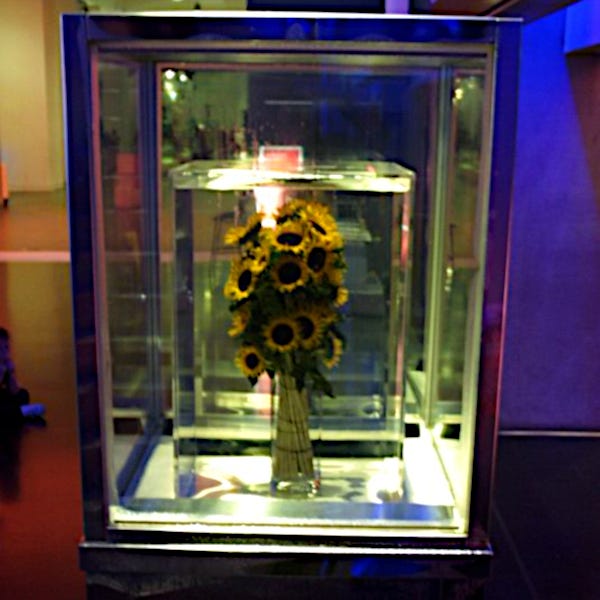
Many, smaller frozen flower arrangements were also constructed by Quinn for exhibition — some look like aquarium tanks, some resemble the glass bell terrariums that the Victorians were fond of. I remember enjoying one of these displayed on a pedestal at the Science Museum in London. One could not surround oneself with the beauty of the blooms in the same way, but these smaller-scale works are also exquisite yet unnerving.
The blooms are preserved at the moment of perfection and this act of preservation instantly killed them. The smaller displays also permit the viewer’s own face to be suspended among the blooms. We become ghostly self-portraits of ourselves, voyeurs that flit across the bouquets then disappear while the ‘still life’ remains pristine, forever intact. We move on, our beautiful biological processes continue, whilst these blossoms are inert—just as long as the power doesn’t fail so they start to melt and rot as nature continues, taking its true course…
Quinn studied History of Art and here seems to follow the western Still Life tradition which reached its zenith in sixteenth and seventeenth century Dutch art. The sensual realism of this tradition set a bar and reflects the quest for botanical realism seen in the work of, for example, the Pre-Raphaelites in the nineteenth century.
Christopher Dresser, the designer and founder of Art Botany as a discipline, looked to the east, embracing the influence of Japanese art and culture in his work. Here, Quinn is also invoking something of the Japanese tradition of ikebana, which literally means ‘making flowers alive’, and are minimal, exquisite displays celebrating the ephemeral, seasonal nature of such beauty.
There’s also a subversion of this human desire to capture and preserve the fleeting beauty of nature’s blooms. The florist may know tricks such as sugar in the water but, in many ways, we are simply extending the ‘life’ of a corpse. Use technology to suspend and arrange blooms which in their natural state would not grow together shows how we can manipulate the environment to suit our aesthetics. But at what cost?
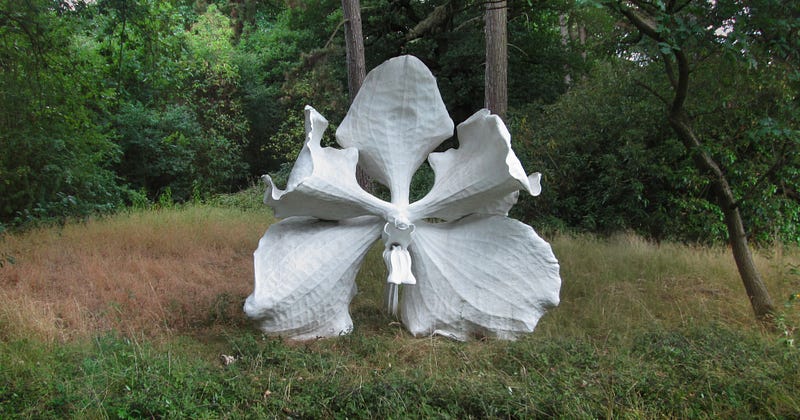
These works led onto colourful 2D still life depictions of frozen flowers, and many large-scale bronze sculptures of orchids, a plant which intrigued Charles Darwin because of its beauty and its symbiotic relationship with mycelium.
These massive, yet delicate, metal flowers were produced using state-of-the-art 3D scanning technology and given names like The Archaeology of Desire. One on display at the Yorkshire Sculpture Park (above) is called Wilder Shores of Desire. The large orchid sculptures are often displayed outside, exposed to the elements in the open air, in parks or in the midst of flowerbeds in public gardens. They play with relationships of scale, they lure us closer just as real flowers attract pollinators. We see them from a similar point of view as the bees.
In these works, Quinn seems to show that the beauty we desire and treasure is almost accidental — it was evolved by plants as a lure to pollinators to ensure their propagation and continuation, after all. Yet perhaps humans will become the most important propagators for all plant life.
In our passion to collect plants, to garden, to yield food for future generations, we are the plants’ best bet for survival in the Anthropocene world. As Quinn observed, “You breed flowers because you like the look of them. You could argue that by doing this, we’re working for the genes of the flower. So, in a funny way, the plant is making us do its work.”
We even collect and freeze seeds in vast deposits held by Kew botanical gardens and other organisations, in the hope of extending the diversification and adaptability of our essential food crops as well as preserving the delicate environmental biomes which we are losing across the globe — a hopeful and worthy cause, which continues our symbiotic relationship with plants.
When interviewed in 2014 Quinn said that art for him, “is a philosophical exploration of the world in concrete form...” The Garden, and later works which arose from it, are tangible evocations of issues such as global warming and climate change. They reflect our love of the world and desire for its beauty alongside a need to care for it in order to survive as a species. All of these works, although they draw on tradition, are executed in a very beautiful, technical and modern way.


