
To See the World in a Great Piece of Turf…
Celebrating the small, tangible things in our everyday world with Dürer and considering why we still connect with his vision, half a millennium later.
Have you ever sat in the grass of a summer meadow, perhaps as a child, to make a daisy chain, or to examine a cricket singing? Only to be mesmerised by the many plants and flowers flourishing together at your feet? I remember marvelling at a large golden bee which visited each tiny pink Herb Robert flower to collect its drop of nectar, almost bending the little flower stems double when it landed upon them.
This sense of wonder is sparked when looking at Albrecht Dürer’s The Great Piece of Turf / Das große Rasenstück, completed in 1503. Dürer was one of the first artists to paint ‘en plein air’ (in the open air), although he may well have completed this painting in his Nuremberg studio workshop.
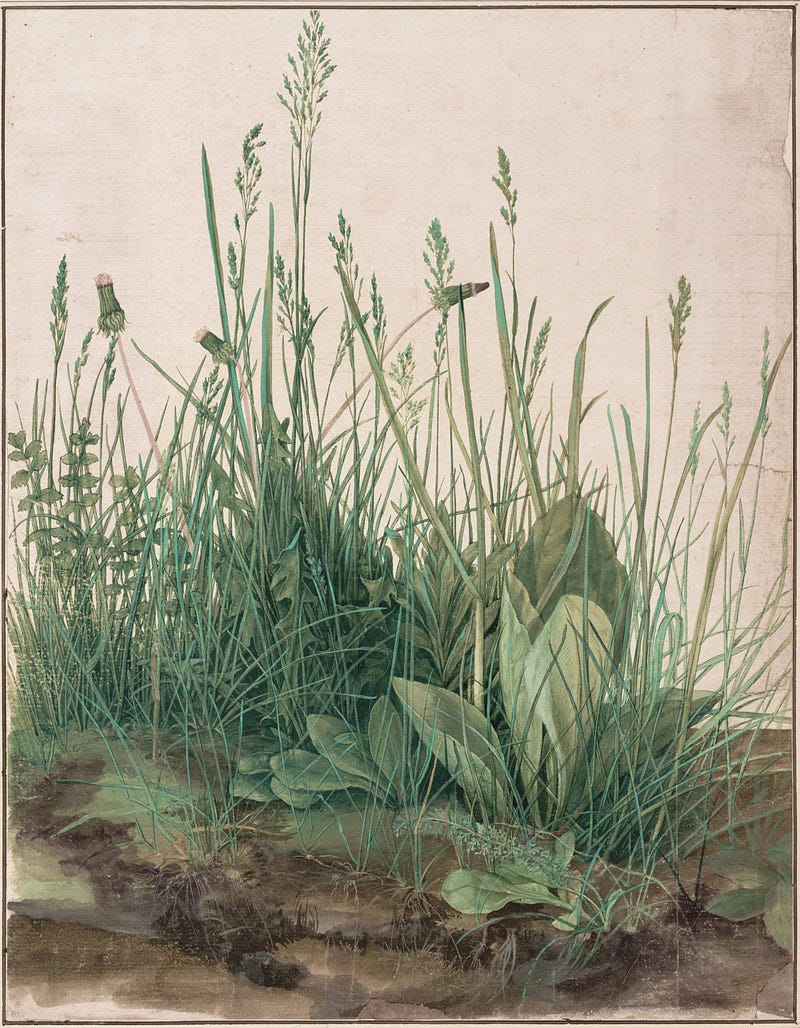
We are drawn into this intimate view, almost as though we are lying down on the grass to examine a random spot of meadow that grew 500 years ago. He represents every natural plant — dandelion, plantain, germander, speedwell, yarrow, and grasses — in exquisite, scientific detail. His approach here established our expectations of what natural history illustration should look like.
The painting was made in watercolour and gouache on paper using the most delicate of brushstrokes, with some details later added in pen and ink. So many greens, such fine brushwork, invite us to lavish enough time on looking at these plants to appreciate their quiet, complex beauty. The artist has seduced us into admiring his genius but also the wonder of the natural world itself.
Why did Dürer spend so much time upon this study? Perhaps to prove his talent for prospective clients, but he was already famous when he painted this. To extend his craft? Dürer later wrote instructional advice for fellow artists, and maybe he developed some of his innovative techniques through this study. However, it seems as though it was undertaken simply to explore and further his understanding of the natural world.
Dürer was the first in Western Art to celebrate the tangible and everyday world in such loving detail. It’s significant that Dürer considered the minutiae of nature worthy of this much joyous scrutiny, even when the dominant ideology of the Church emphasised the intangible heavenly realm, yet to come for Good Christians.
Applying human faculties to observe and understand the world around us is an aspect of Humanism, a central concept of the Renaissance. Such thinking re-emerged when the classical texts of ancient Greek civilisation arrived in Venice through trade with the Islamic world.
Dürer crossed the Alps to visit Venice in 1494 and so had direct access to these influences. Many of his watercolour studies of the natural world — landscapes and animals — including what is perhaps his most famous, Study of a Young Hare, painted in 1502 — are so vibrant and lifelike that they resonate with our modern sensibilities.
We now understand that humble meadow plants are a vital basis of ecosystems that support us and the natural world. The Great Piece of Turf seems to celebrate this: all life is precious; all life is fleeting.
Yet Dürer, with his human genius and technical skill, captured this piece of meadow in the summer of 1503, and gave it a kind of immortality: a gift for us to enjoy here and now. May it continue to delight and inspire for at least another 500 years.
As the poet William Blake wrote in his poem of 1803, Auguries of Innocence:
To see a World in a Grain of Sand And a Heaven in a Wild Flower Hold Infinity in the palm of your hand And Eternity in an hour


