
The Self, the Hare, and the Hands
Three examples of how Albrecht Dürer used observation, without preconception, as a tool for scientific and philosophical discovery
Albrecht Dürer was a precocious talent and whilst still in his teens produced drawings that masters would try to outbid each other for, so they could learn by copying his mark-making techniques. He went on to become one of the first celebrities of art and made his name into a recognisable ‘brand’, prominently signing his work with his ‘AD’ logo.
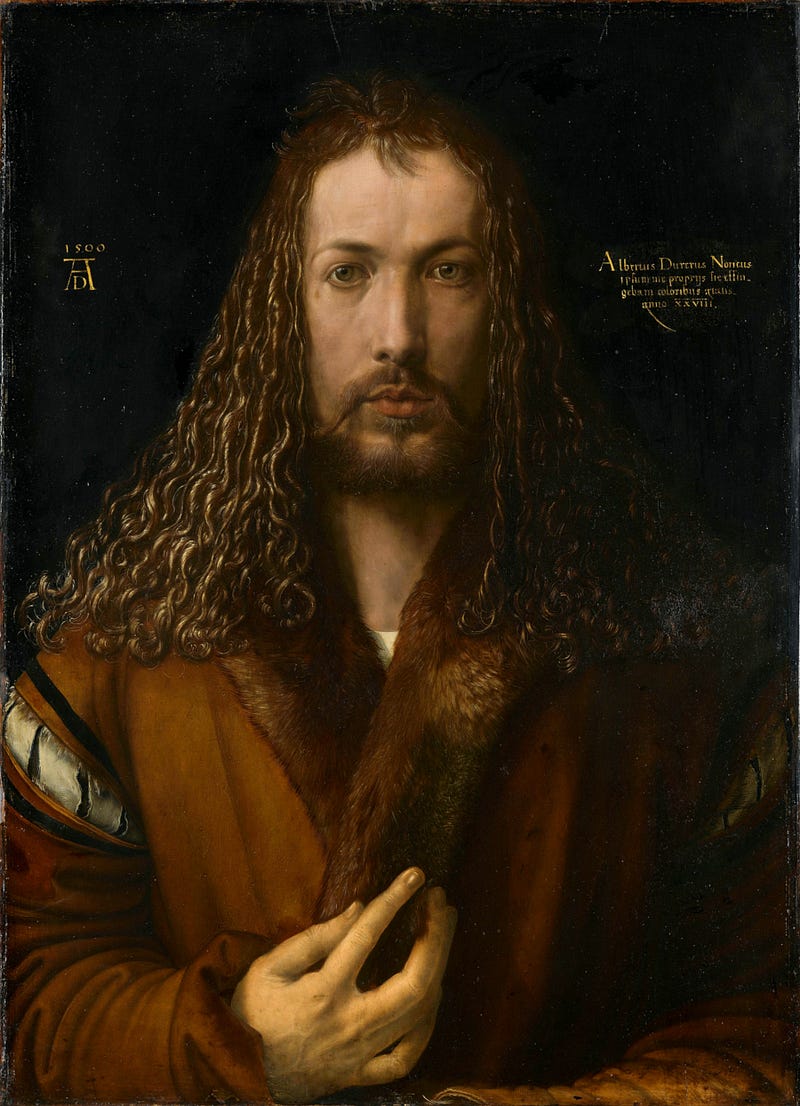
Part of his self-promotion was a series of self-portraits produced through his twenties. Dürer is given credit for introducing this discipline to art. Other artists had used themselves as visual reference and included their own likeness in historical scenes, but none had used themselves as the sole subject of a proper, professionally finished, painting. I mean, what patron would want such a thing?
Dürer produced several self-portraits, of which the last, painted in 1500 when he was aged 28, is considered to be the finest and most enduring in its appeal. It is a ‘slick’ work in graphic terms, in which he shows himself against a flat black background with text to either side of his head at eye level. His right hand enters the frame from the bottom to sensually stroke the fur of his jacket collar, drawing attention to how well the texture has been rendered. His face is calm, serious and the eyes sparkle with life.
The lighting seems to come from a single source to the upper left, a style of lighting usually reserved for paintings of religious personages as it represented ‘The Light of God’. It echoes many depictions of Christ and Albrecht Dürer’s initials could’ve easily been misconstrued as the abbreviation for Anno Domini at first glance.
A viewer of the day would probably assume this to be the portrait of a saint, not a self portrait of a ‘lowly artist’, though the inscription and monogram do make his identity clear. In many ways this served as an elaborate business card. It proclaimed something to the effect of, “This is me and this is what I can do.”
Not only did Albrecht Dürer turn his keen observation upon himself in a process of self-discovery, he also looked at the details of the world around him. This equally-weighted exploration of ourselves and the wider world, the microcosm of humanity and the macrocosm of the universe, was a driving factor of the Northern Renaissance and Dürer was at the vanguard.
So, in addition to introducing the self portrait, he also came up with the radical idea that an artist should visually record the world around them and should make first-hand studies of what fascinated them and what they intended to include in their paintings.
For example, instead of buying a dead hare from the butcher or game merchant, arranging it in the semblance of life and drawing that, maybe one should go out and wait patiently and very, very still in order to observe an actual living hare.
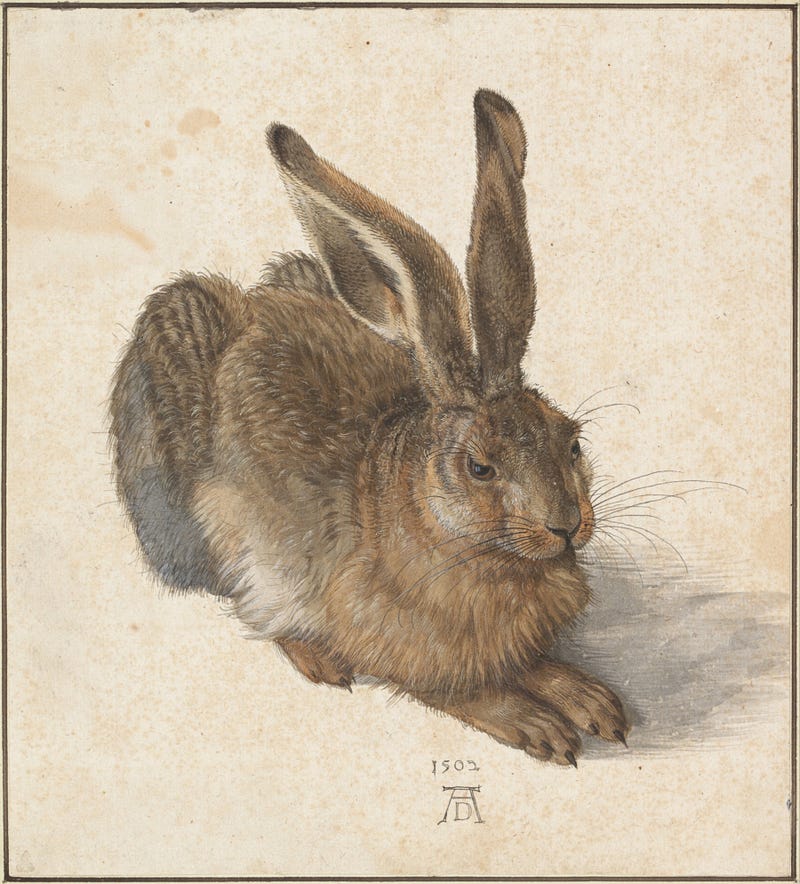
This exquisite study of a leveret is a rarity as not many watercolours survive from this period as they would fade away over the centuries. Only works by important artists, collected by other artists to learn from, were respected and kept properly. Watercolour was not widely used as a medium by artists who generally preferred to sketch in chalks and then paint ‘in oils’.
Dürer favoured watercolours because they were easily portable and could be taken out of the studio and into the field. The notion of drawing from direct observation in nature was a ground-breaking innovation on par with the ancient pharaoh, Akhenaton, directing his official artists to “show things how they are”.
Before this break from tradition, artists would study the work of other artists and learn how to draw a horse, a hand, a house, or a hare, from their predecessors. This way, any errors were perpetuated. Ironically, Dürer’s many studies of flora and fauna became the templates for other artists for centuries after, particularly his horses which can be seen copied in many works of those who followed.
He was one of the first artists to study nature in detail as a worthy pursuit in itself and not necessarily as studies to be used in bigger paintings. Observation, without preconception, was a form of discovery and led to new scientific and philosophical thought.
Possibly Dürer’s most famous image and certainly the most widely reproduced is a study for a work he never completed. It’s a simple yet well-observed drawing of a pair of hands in the ‘palms-together’ gesture of prayer. This is a perfect expression of Renaissance sensibilities — the piety of prayer is balanced against the frailty of being human, both the spiritual and corporeal expressed in harmony.
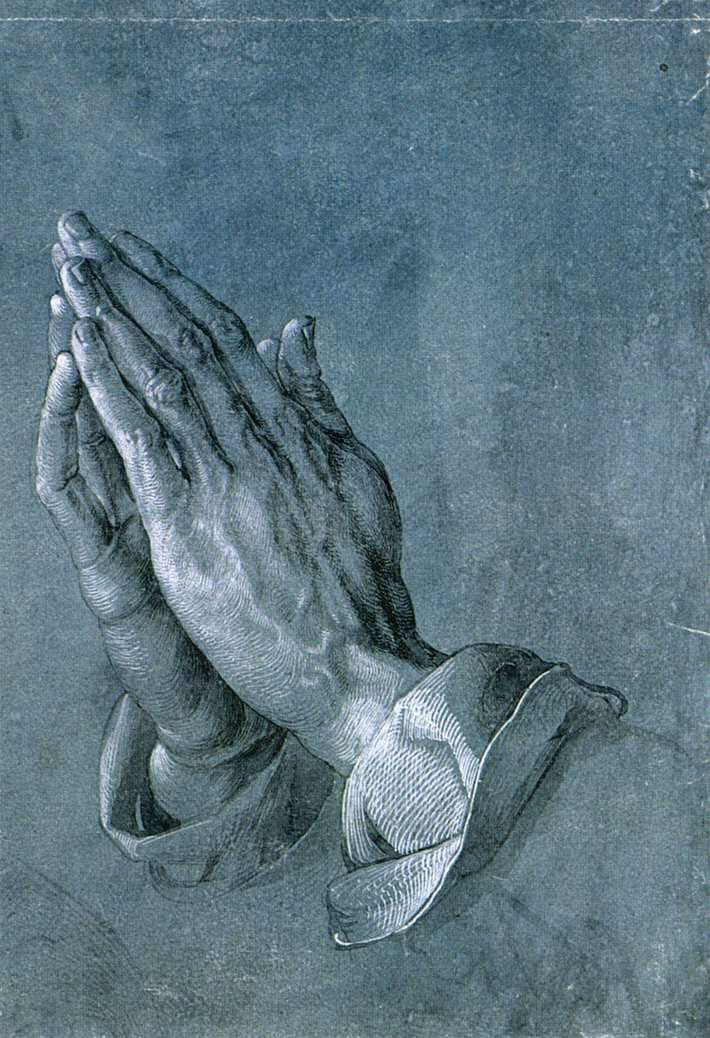
The hands are gentle, slender fingered, yet aged and imperfect. The image sparked a much recounted, though apocryphal, morality tale about how Dürer’s brother ruined his hands through manual labour in order to earn money to support Dürer through art school and by way of a tribute Dürer immortalised those hands with this study.
In reality, the hands were almost certainly modelled after the traditional pose, but observed from a real life model, who was elderly and seemingly suffering from the beginnings of an inflammatory disease, but who hadn’t done much manual labour. The attention to detail is so meticulous that a modern day physician is able to discern this information, simply by observation.
Dürer is seen as a major figure in the Northern Renaissance and is considered by many to be on par with the great figures of the High Renaissance, such as Leonardo De Vinci and Michelangelo. “The Renaissance” can be a misleading term as there was not a single renaissance, there were lots of parallel renaissances throughout Europe. The process of renaissance started in locations near to centres of trade, most notably Flanders in the north and Venice to the south.
Dürer’s Rhinoceros woodcut of 1515 has been discusses by Kim Vertue previously in Signifier


.jpg)

