
A Rhinoceros-shaped Idea
Why Albrecht Dürer’s fabulous woodcut still stirs the imagination
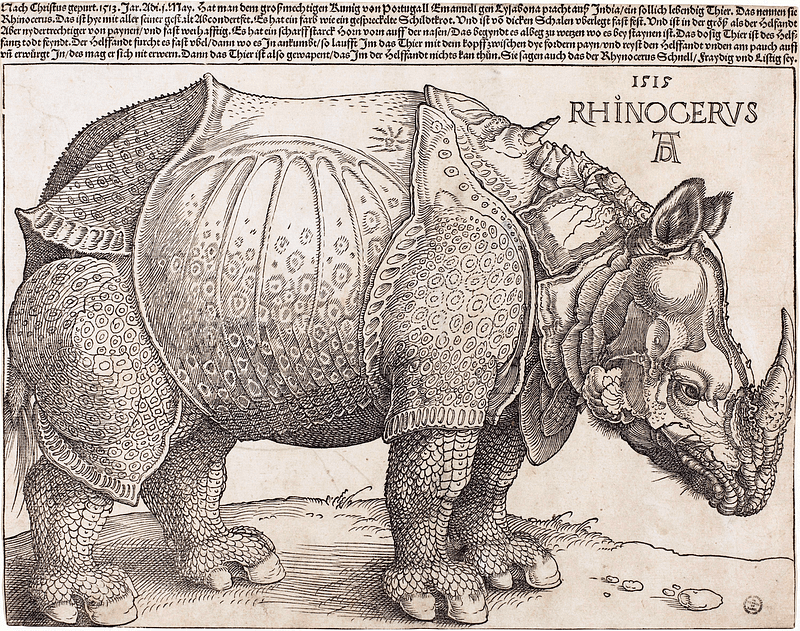
In 1515 a one-horned Indian rhino, gifted by the Sultan of Gujarat in Northern India, arrived in Lisbon to be presented to King Emmanuel of Portugal. It had voyaged for 120 days in a sailing ship, evidence of the skill of the Portuguese sailor explorers who forged new trade routes to the East. It is fitting that Albrecht Dürer also used a new technology, the printing press, to produce about 4,500 copies of his famous woodblock print of the beast. An image that would capture the imagination and evoke the idea of what a rhinoceros was for centuries.
_enhanced.png)
Dürer was always fascinated by the natural world and became renowned for the accuracy in which he depicted it. His Portrait of a Young Hare, the Stag Beetle, and his Great Piece of Turf are just a few examples of his astute observation. However, one of his best known images is considered inaccurate, yet evocative. You see, he didn’t get to see a real rhinoceros at first hand...
King Emmanuel had sent the rhinoceros on to the Pope but, sadly, it died at sea during its second ill-fated voyage from Portugal to Italy. Dürer, therefore, relied on a rough first-hand sketch and the descriptions of others to create his rhinoceros — that and a thousand year old description in Pliny the Elder’s The Natural History, which described the rhinoceros as the mortal enemy of the elephant, about the length of an elephant but with shorter legs, and skin the colour of box-wood. Some of this description is included in vernacular German above Dürer’s image of the rhinoceros.
Why was this event so significant and newsworthy? In Durer’s time, ancient Greek and Roman texts were being rediscovered and re-examined. Their knowledge contributed to the Renaissance, a renewal of arts and science throughout the fifteenth and sixteenth centuries which really gathered momentum in northern Europe, ahead of the High Renaissance in Florence.
A rhino had not been seen by Europeans for a thousand years — not since the Roman era, when some were brought over for the sake of spectacle and slaughter in the gladiatorial arenas. Such creatures had become almost mythic, like that other horned creature, the unicorn. So, a real rhinoceros was living proof that the texts of the ancients contained facts and knowledge still relevant and worthy of continued exploration. Dürer’s rhinoceros celebrated this rebirth of knowledge and discovery.
His drawing of the rhinoceros is full of life and fills the page to emphasise its size. Dürer used his knowledge of more familiar creatures like horses and dogs, as well as his knowledge of armour from depicting Knights, to embellish the vague reports he had of the real creature. Yet many details seem astonishingly accurate, the shape of the head and presence of rib-ridges, for example.
The smaller horn on its neck is often dismissed as pure invention but in some rare cases a process know as hyperkeratosis can result in a localised thickening of the hide that may grow to resemble a small horn, in exactly the position shown. Generally, the armour plates do closely resemble the fold pattern of the real life version’s thick hide, as do the warty bumps that stud them.
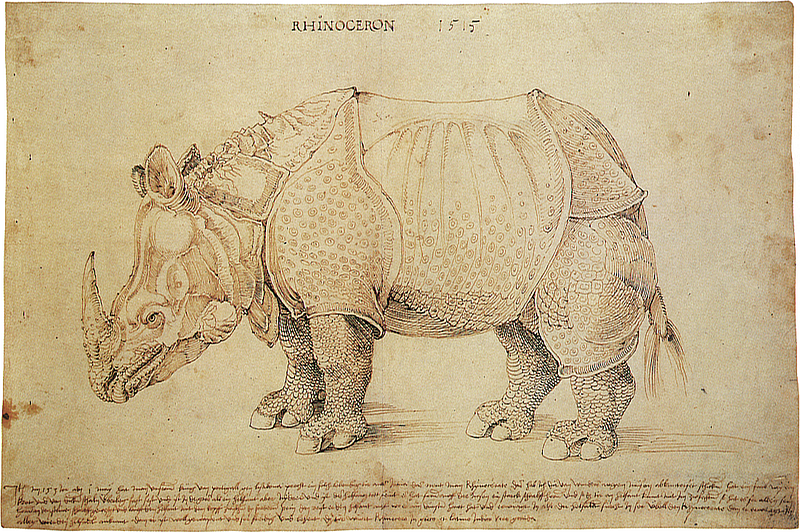



His drawing was reversed, in the process of carving into a fruit wood block for printing. This process was quicker, cheaper and more easily distributed than paintings, and so capitalised on the sensation the real rhinoceros had caused. Prints were widely distributed and proved very popular.
Dürer’s inspired rendering has lived in the western imagination ever since and was the definitive image of a rhinoceros to Europeans until the eighteenth century when another real rhinoceros arrived and toured Europe, depicted by other artists. Yet, even when ‘reality’ came along, the poetic version created by Dürer remained a popular illustration that fired the Romantic imagination.
The image has earned historic significance as an artefact in its own right. It’s still the best known drawing of a rhino. It is ‘Dürer’s Rhinoceros’ and seems to have a life all its own. Still popular as a decorative print and pattern design, centuries later...
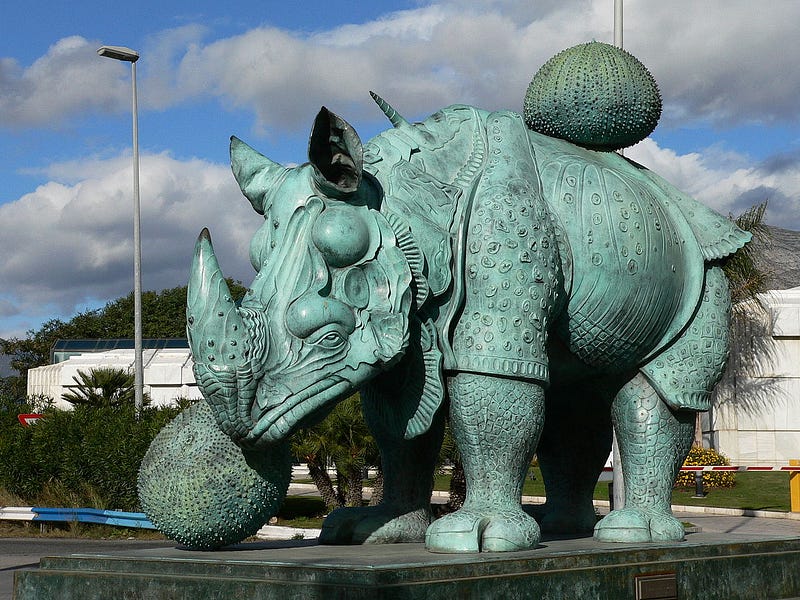
A copy hung on the wall of the house where Surrealist artist, Salvador Dali grew up. As a result, he was always fascinated with rhinos. He saw Dürer’s as an iconic work that celebrates the imagination as a tool that leads to further understanding. An example of art that helps us decipher the real world. In this way, he appropriated it as a work of Surrealism.
Dali thought a rhino’s horn was one of the most pleasing forms in nature and admired the mathematical purity he could see in its curve. He painted this motif many times, sometimes attached to the animal often isolated as abstract forms. He also carved and cast a series of bronzes that vary in scale from tabletop to monumental, in which a copy of ‘Dürer’s Rhinoceros’ is juxtaposed with the rounded shapes of sea urchins.

The total population of Indian Rhinoceros dropped to below 200 during the twentieth century. Currently, due to concerted conservation efforts, the World Wildlife Fund estimate that about 3,700 Indian rhinos now exist in the wild. The rhinoceros is a herbivore and Assam farmers are experimenting with planting the herb mint as a cash crop, which is unpalatable to the rhinoceros, to serve as a buffer so that its territories could extend beyond the border of the National Park where it is protected. Let’s hope such measures succeed.
If we’re lucky, we can see rhinos in Zoos, or wildlife preservation areas, and marvel at what Dürer could only realise with witness reports and artistic licence. Even though they are much rarer today, with some species becoming extinct, we have more chance of seeing a living specimen than any European of the sixteenth century. But that may not always be the case…
Wouldn’t it be good to ensure the rhinoceros survives to enthrall future generations, so they won’t need to rely solely on pictures and second-hand accounts of this ‘fantastic beast’?