
Take a Bow: The Power of Kyary Pamyu Pamyu
Reviewing the kawaii career of an artist who continues to deliver the most eclectic and positive expressions of Pop Art
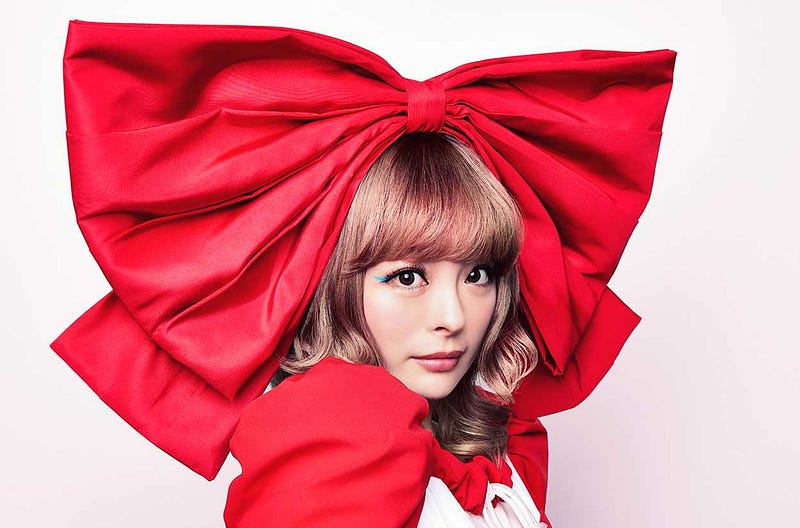
Local Power Japan is a fine example of what an artist with creative stamina and a strong sense of social responsibility can achieve and may well be the most sophisticated and accomplished iteration of Pop Art.
The ambitious initiative couldn’t have been helmed by just any artist as it’s made possible by a rich visual grammar tenaciously established over more than a decade by Kyary Pamyu Pamyu (きゃりーぱみゅぱみゅ) whose multi-media manifestation has transcended initial cult status to become a cultural icon. Her practice encompasses audio-visual, costumed performance, music, dance, fashion, hype-art, painting, sculpture, graphic work, gaming, broadcast, commerce, and the J-Pop arena. Her motivations? Seemingly to fuel dreams, increase happiness, and bring people together, regardless of gender, age, class, or persuasions.
Needing no introduction in her homeland where she’s a top tarento and bona fide ‘household name’, Kyary Pamyu Pamyu is now gaining global traction beyond her standing as Japan’s Kawaii Harajuku Ambassador (that’s an actual honorary title awarded her by the Mayor of Shibuya) and undisputed Queen of the J-Pop scene — a culture she’s repeatedly deconstructed, redefined, and revitalised.
Probably because of Kyary’s relentlessly positive focus on self-expression, she also manages to embody cultural democracy and is the hub for a hive of creatives that are, for modern Japan, what Andy Warhol’s Factory could’ve been for twentieth-century USA. As the figurehead of this prodigiously creative collective, she instigated several strands of Tokyo subculture before infiltrating the mainstream and making mass media her canvas. (Think of a multicoloured hybrid of David Bowie, Kate Bush, Vivienne Westwood, Bradley Walsh, and Grayson Perry!)
Local Power Japan goes far beyond celebrity endorsement and draws upon art to drive post-pandemic recovery in collaboration with an array of small businesses. Promotional materials and packaging design, along with a broad variety of products themselves, comprise ‘the works’ with high street retailers, cafés, and shopping malls as the extensive decentralised gallery. The ambitious exhibition is fun, accessible, anti-elitist, and a rare example of art having a quantifiable function whilst ticking all the boxes as Pop Art.
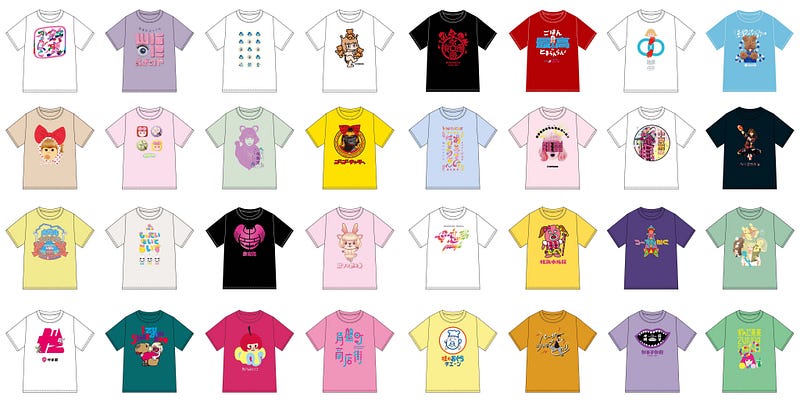
Checking the project’s online store reveals over 50 different collaborations ranging from numerous hybrid logos on T-shirts and other apparel to packaging for curries, teas, sake, cakes, condiments, and comestibles… Each collaboration was sold commercially in limited editions, launched to coincide with tour dates in more than 30 locations during her 10th anniversary tour of Japan. She supported the KPP products with special events, short video documentaries and, where feasible, got involved in production so that a few special versions were created with the artist’s hand. A portion of the royalties went to community regeneration projects.
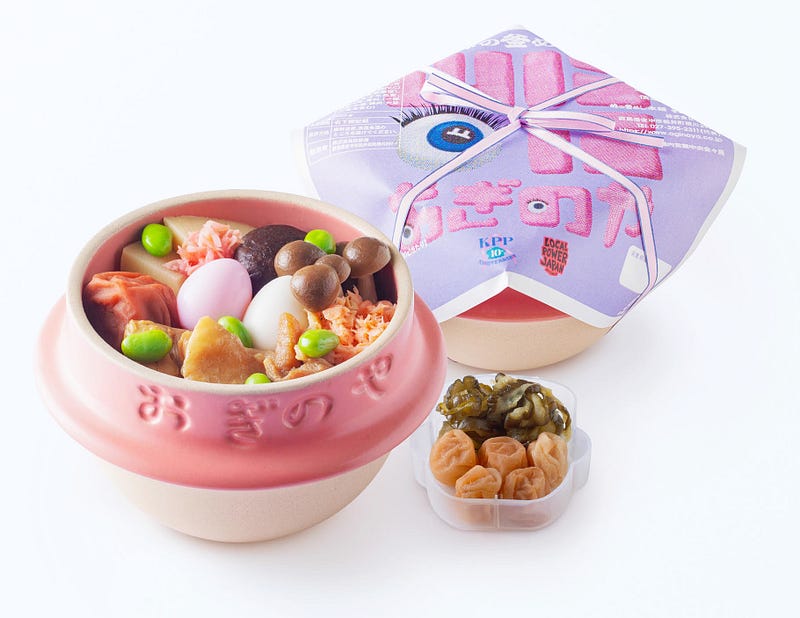
One of the most interesting collaborations was a bento produced for Oginoya — Japan’s oldest ekiben shop, founded 136 years ago in Yokokawa. With this example, Kyary added the media of foods to her repertoire, creating the Kyary Pamyu Pamyu Toge no Kamameshi served in a specially commissioned pink clay pot. The paper cover was printed with a radically redesigned logo.
The ingredients were also tweaked to become another portion of Kyary’s continuing self-portraiture by showcasing her favourite flavour combinations. There’s the expected chicken, mushrooms, edamame, bamboo sprouts, pickled ginger, and quail egg, with more surprising additions including sour umeboshi plums and extra quail eggs pickled pale pink to complement the pot. The special meal was sold at the concert venue ahead of the show, linking the experiential nature of performance with transient edible art accompanied by lasting souvenirs in the form of the pot and print that may act as anchors for the memory of the experiences.
Kyary also continued to bring her love of locomotives into her art. Perhaps the KPP Train than ran on the Seibu Ikebukuro Line during the summer of 2016 had seeded the idea for Local Power Japan. The pink painted train had hosted themed events, with Kyary as its ‘conductor’ for the inauguration and maiden journey that took it through Nishitōkyō municipality, the birthplace of the artist. The styling of different carriages reflected the imagery from particular videos and the corresponding songs were piped over the onboard PA system.
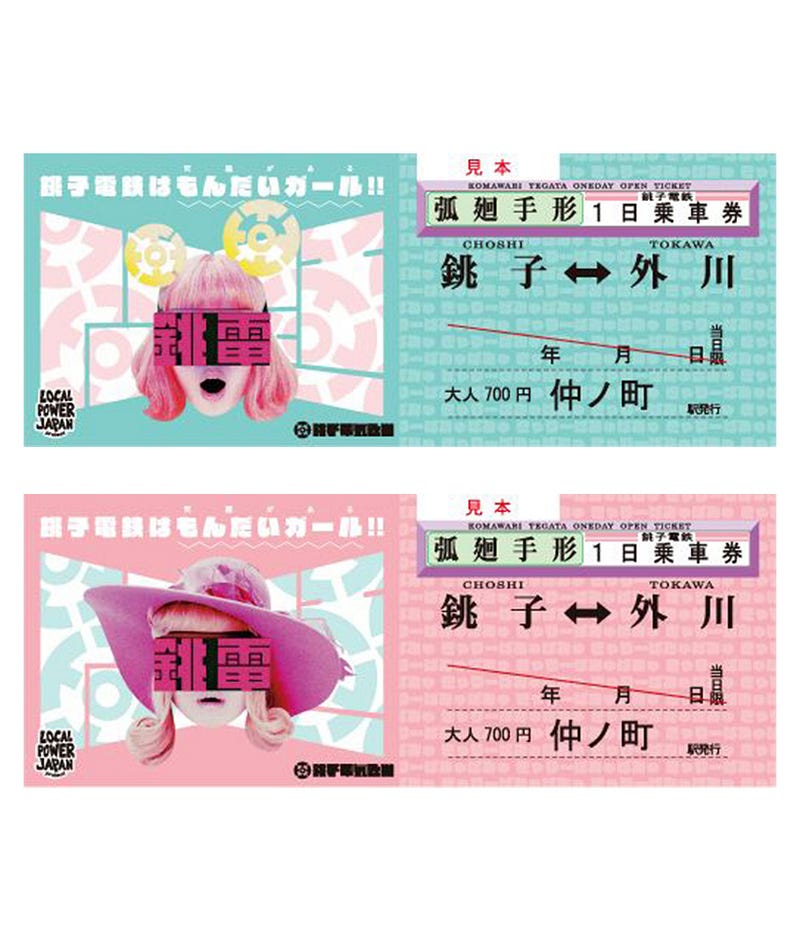
For Local Power Japan, Kyary once again collaborated in the design and rebranding of a special train, this time for Chiba’s Chōshi Electric Railway. The train, which was primarily painted and upholstered in pink, also had special KPP carriages with the interiors inspired by her 2015 single and video, Mondai Girl, and boarded using commemorative tickets. Following suspension of services during the pandemic, the relaunch was marked by a special event hosted by the Mayor of Chōshi with Kyary opening the redesigned Kannon Station, involving interactive ‘photobooths’ and Kyary-themed merchandise.
The Local Power Japan project was coordinated to allow personal appearances at the locations visited during the extensive tour celebrating 10 years since her major label debut and the fresh founding of her own indie label, KRK Lab. Also, showcasing material from her latest album, Candy Racer, which debuted during lockdown via a television special filmed without audience at the Kyoto Railway Museum. There was a brief hiatus in the tour to allow for three additional dates in the USA as travel restrictions were eased…
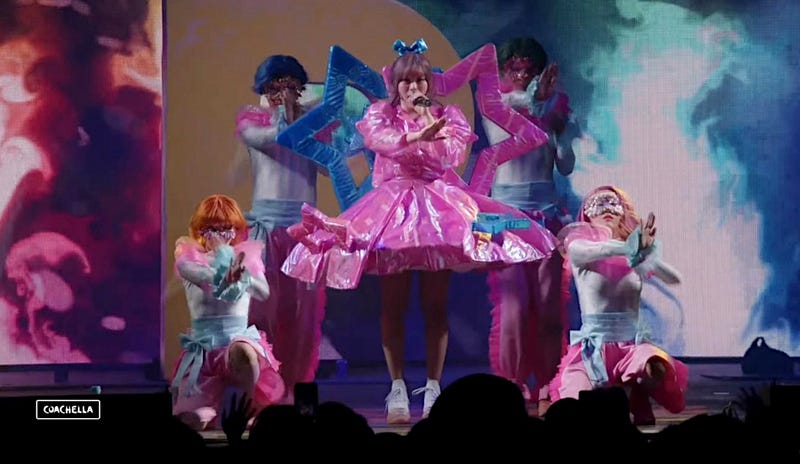
Kyary Pamyu Pamyu’s festival audience at California’s Coachella 2022 was wholly engaged — an ocean of arms waving in unison to the upbeat set. Clearly, a good number were there to see their favourite artist in action, though some may’ve turned up out of curiosity to be quickly won over by the sheer exuberance of the experience. Several sources reported that Kyary’s crowd was the cheeriest and best behaved of all — evidence that the positivity of ‘the KPP effect’ was just what America needed. Many of those present were masked but their eyes were smiling and, for a time, the fun of the viral overwhelmed the fear of the virus.
It was just over a decade earlier when a teenage fashion blogger from Tokyo took on a lively little music project using her modelling moniker of Kyary Pamyu Pamyu, firstly for a charity event in aid of those affected by the 2011 Tōhoku earthquake and tsunami, and then to support her application for fashion college. Along with four collaborators, she made a music video that would showcase their respective skills. The creative collective included: Yasutaka Nakata (中田ヤスタカ), already an established DJ and songwriter; Jun Tamukai (田向潤), a video graphics designer; Kumiko Iijima (飯嶋久美子), a costume designer and stylist; and Sebastian Masuda (増田セバスチャン), the artist-owner of influential Harajuku kawaii emporium, 6%DokiDoki. It turned out that, in addition to her unique fashion sense, she was a natural performer and gifted singer.
Unsigned, and relatively unknown beyond Tokyo’s Harajuku scene, she co-created and independently released PONPONPON in 2011, a song and super-garish piece of video art that propelled Kyary and her take on Harajuku style into the global spotlight. Back then, it was bafflingly bizarre and unlike anything else. Released directly onto YouTube, it immediately went viral and its audio-visual influences still resound through mainstream Japanese culture, TV ads, graphics, and beyond.
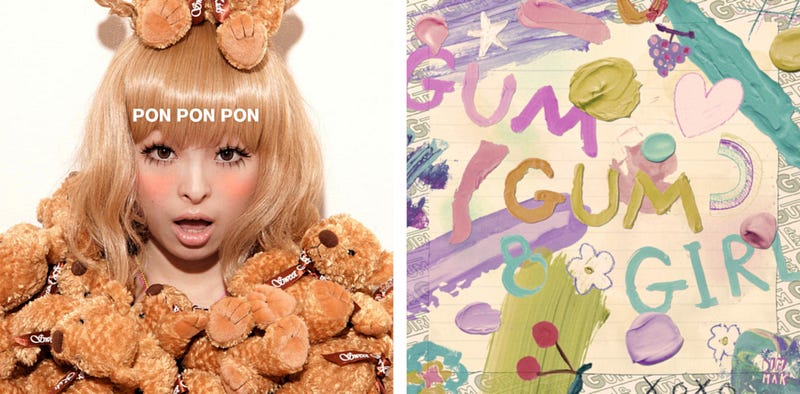
The hyper-catchy pop perfection was provided by maverick producer Yasutaka Nakata who certainly has a handle on the J-Pop zeitgeist. Which isn’t surprising, as he’s played a notable part in creating it over the past 25 years, first as half of the duo, Capsule, then writing and producing for Perfume and Kyary Pamyu Pamyu, among others.
PONPONPON has the energy of children’s skipping rhymes and is irresistibly fun with an underlying psychedelic surrealism that hints at encroaching other-realities… A candy-coated Lynchian fugue or hi-fructose Halloween party hallucination? Sure, she regurgitates a murmuration of dark birds and eyeballs are tumbling from her tongue… there are even some sing-along skulls, but they’re more dayglow-day-of-the-dead than sinister-Freudian-nightmare.
There’s also rotating teddy bears, levitating toast, disembodied brains, cheese-themed head gear, a unicycle, an amorphous blob… The set is an environment serving as portrait, and it seems art director Sebastian Masuda threw everything in to suggest the subconscious of a girl in transition from adolescent to young adult — restless, confused, beautiful, and sparking with creative energy.
This introduces aesthetics and themes that run through much of KPP’s work revolving around the inner life of the child — a kind of D.O.S installed during our early years upon which we construct our adult personalities. These themes are universal because being a child is something we must all have in common. It’s also worth noting that being ‘childlike’ is not the same as being childish or immature.
True, individuals choose to embrace their sense of childlike wonder and imagination to varying degrees. Among other factors, I guess that’s dependant on the quality of their childhood, the liveliness of their intrinsic self, and the perceived worth of the adult ‘programming’ that ‘over-writes’ it as they increasingly compromise with consensus culture. Although her work has been described as a rainbow explosion, Kyary also recognises the darker aspects of childhood: the fears and uncertainty that, to a greater or lesser extent, haunt our adulthood despite learnt ‘coping’ mechanisms; the unsettling nightmares as well as fairy tale dreams and aspirations.
She was one of the earliest artists to exploit the pop potential of direct-to-internet releasing with PONPONPON going viral a full year ahead of comedian and K-Pop dabbler, Psy, using the same route for Gangnam Style. However, PONPONPON wasn’t a one-hit wonder and KPP was snapped-up by major label Warner Japan. Her success was meteoric, and a succession of hit singles and industry awards followed… along with five chart albums so far and a string of endlessly inventive music videos that track the many and varied reimaginings of KPP, providing a cohesive framework for an array of other, wide-ranging creative ventures.
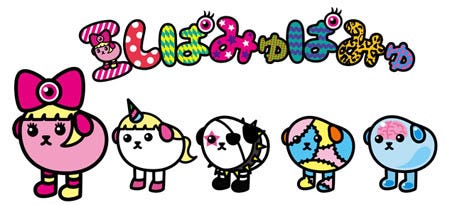
A notable early collaboration produced a set of five Mameshiba (豆しば) characters that featured across media formats as emojis, accessories, plushies, and in a series of animated interstitials. The Mameshiba concept was created by Kim Sukwon in 2008 and are a combination of bean and dog that habitually impart incongruous trivia. With the 2012 intervention of Kyary Pamyu Pamyu, some evolved legs and took on the attributes of Kyary’s persona, a unicorn, ‘punk’ pug, patchwork ‘monster’, and a candy-pink brain suspended in a droplet of clear fluid...
By 2013 she’d already amassed enough costumes, props, accessories, and graphic works to warrant her first major gallery exhibition, Kyary Pamyu Pamuseum, at the Umu space in Tokyo’s Roppongi Hills Centre. Most of the artefacts on show had appeared in her first stadium tours — staged with lavish production and sets created in collaboration with Sebastian Masuda. Or had featured in a series of thematically linked promo videos conveying a subtle psychological narrative amidst their unwaveringly weird, wonderful, and sometimes disconcerting imagery. At the time she defined kawaii and was subverting its sugary sweetness with elements that the fashion journals would categorise as Gothic Lolita and Dark Aristocrat.
Which brings us to the oft-misunderstood, sometimes problematic, term of kawaii. There’s always going to be a cultural disjoint when foreigners attempt to engage with what is a fundamentally Japanese concept. Simply translated into English as ‘cute’ it carries a similar complexity of meanings and associations. In her role as Kawaii Ambassador, Kyary has helpfully explained that it’s not a thing one can be, but a response one feels. A puppy or a dolphin or a baby or an old granny, can equally elicit the emotional response that causes kawaii and, as with all concepts of beauty, it’s culturally dependent.
Kawaii, therefore, aligns nicely with traditional Japanese aesthetics of the intangible and difficult to define — prominent in haiku and zen brushwork — and it’s been a common defining feature for a set of Tokyo subcultures that have grown into the international scene it is today. (It even reached the art college in rural Wales where I was an arts lecturer — the phrase ‘Kawaii till I Die’ appeared on several sketchbooks and pencil cases and its influence was obvious in the work of fashion students.)
Typical Harajuku fashion stems from Japan’s version of the 1980s New Romantic movement that centred on dressing up and creating one’s own distinctive look rather than buying designer gear off-the-peg. I’ve heard the term Aomoji-kei used to sum-up the aesthetic exemplified by Kyary Pamyu Pamyu. This ‘street-snap’ subset of kawaii embraces the broader ‘sweet-girly style’ but makes it much more about fun, freedom, and self-expression.
The mix’n’match styles are typically colourful and ostentatious though also embrace darker manga influences. Teenage girls and young women dominate the style, wearing whatever they find interesting and feminine without pandering to the male gaze. I suppose it touches upon the western label of ‘girl-power’ with a large dose of ‘riot-grrrl’ and, similarly, has been approached academically in the context of post-third-wave feminism.
In 2015, Kyary’s international standing as an artist was consolidated when she became the face of The World Goes Pop exhibition at London’s Tate Modern and produced a Pop Art video for the gallery’s website to coincide with the show. The following year, along with the Kyary Pamyu Pamyu XR Ride (Japan’s first VR rollercoaster at the Universal Theme Park), an extensive exhibition at Tokyo’s Laforet Harajuku celebrated the first five years of Kyary Pamyu Pamyu’s career. On display was a comprehensive collection of all the visual art and graphics produced in collaboration with creative director Steve Nakamura (スティーブ・ナカムラ) for CD and DVD releases, along with costumes, wigs, props, and accessories designed with stylist Kumiko Iijima, featured in performances, photoshoots, and promotional material.
The Kyary Pamyu Pamyu Artwork Exhibition 2011–2016 being staged just a month before the huge David Bowie Is touring exhibition arrived in Japan led to comparisons with the giant of Glam and suggestions that Kyary Pamyu Pamyu is a constructed fiction akin to Ziggy Stardust or Aladdin Sane. This may be a ‘way in’ for westerners but doesn’t quite ring true...
It seems that KPP certainly is an alter ego but, rather than a fiction, is a facet of herself that she shares generously, and unreservedly, with her public. Such lack of guile and pretense is rare in celebrity circles, and may be one of her most appealing traits, allowing millions of fans to feel a level of human connection. Yet, for sanity’s sake, she keeps safe a personal strand of her life, separate and secluded from scrutiny, allowing instalments of her own personality to be explored through song, lyrics, actions, presentation, and metaphor.
Perhaps her original background in fashion primed her for this approach as it too serves as an interface between the personal and the political, the private and the public — a mediator establishing protocol through the use and modification of tribalised motifs.
This theme seems to be expounded by the lyrics to the unexpectedly poignant Harajuku Iyahoi, released in 2018 along with its innovative video placing multiples of four Kyary variants among a parade of animated and brightly coloured CGI ‘sculptures’ (which were also realised as performative costumes for the supporting live tour). It’s a love song to the Harajuku culture that, along the way, advises the listener that life is not the runway and fashion can be a friend to the shy person… but only if it’s a ‘safety cushion’ limiting the trauma of social interaction instead of a barrier preventing the real self from emerging. Wise words, born of personal experience perhaps?
Elaborate clothes, accessories, hair, and make-up have long been at the core of traditional Japanese society. So, the radical fashion tribes of Harajuku embraced their nation’s heritage whilst re-appropriating and subverting it. Formal gestures and strict social signifiers were largely freed of negative connotations and reenergised for contemporary youth culture. Thus, making them part of an optimistic future by challenging stereotypes, shedding historical baggage, and reclaiming only positive elements from the past.
In a way, this has always been the case with kabuki, one of Japan’s oldest traditional performing arts featuring lavish costumes, dramatic kumadori make-up, prescribed movements, and has always incorporated the fashions of the times — melding tradition and trend, preserving the past and reflecting the present. So, it’s fitting that Kyary Pamyu Pamyu performed at the famous Kyoto Minamiza, the longest established kabuki theatre in Japan, for a special kabuki-themed show celebrating the transition, in 2019, from the Hesei Period to the current Reiwa Era.
Though supremely respectful, this too was subversive as the casts of kabuki plays have been exclusively male since the mid-seventeenth century, when laws changed to prevent women from performing kabuki. Kyary was trained in the form by authentic — male — kabuki performers. Of course, she assimilated these traditions into her own choreography and costumes. (The show also featured one of the most elegant pantomime horses I’ve seen.) That historic one-off special was filmed live, shortly before everything changed with the onset of Covid-19 that delayed preparation for her 10th Anniversary Tour.
Whilst in Los Angeles for her two appearances at the massive Coachella music festival and a more intimate gig at the Fonda Theatre, she extended Local Power Japan to Little Tokyo. There, she worked directly with half-a-dozen shops and small businesses, designed a colour scheme for a line of donuts, created KPP Kobo Kuma — cute versions of the small cream-filled bun with kawaii expression and pink iced ribbons, produced a T-shirt design incorporating iconic Kyary motifs with local landmarks and appeared at promotional events intended to attract tourism and re-energise the culture and economy of the Little Tokyo area.
Due to pandemic mitigation measures, set and costume couldn’t be shipped ahead of the festival appearances, so everything had to be packed in the luggage. She overcame the atypically blank stage by using a digital backdrop featuring new Kyary Pamyu Pamyu avatars developed in collaboration with Metaani — a company specialising in secure avatars with full body tracking, intended to represent a person within the interactive metaverse.
When present, during the first weekend, her dancers added dynamic splashes of pinks and blue in coordinated costumes. For the second weekend, in the absence of dancers, Kyary’s spectacular dress worked even harder, serving as a stage set in itself.
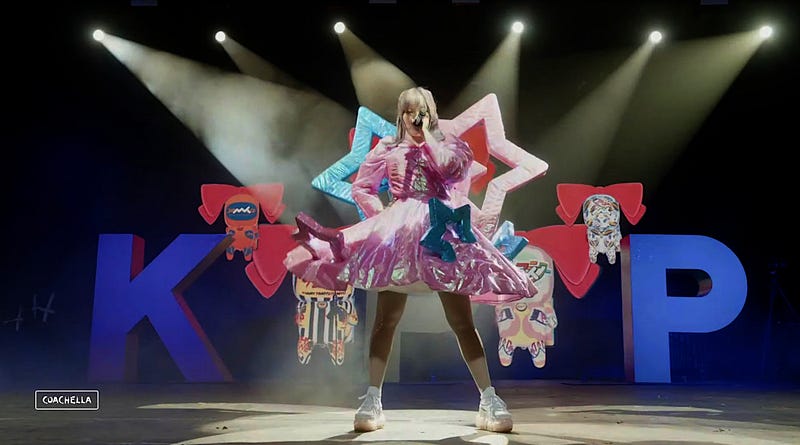
The Shining Star Dress was designed with Mikio Sakabe (ミキオサカベ) who described the concept as a stargate to the world of dreams that celebrates the timelessness of a girlish heart. Sakabe is a long-established Harajuku-based designer that Kyary has wanted to work with since her early days as a fashion blogger.
Also, she feels that the Harajuku scene has given her so much that she wanted to give something back by showcasing an example on the stage of the world’s biggest music festival. An ethos that aligns with her Local Power Japan remit and, rather poetically, brings things full-circle to round-off her first 10 years at the fore of Japan’s public consciousness — already a career that could keep semiotics professors busy for decades to come.
Kyary Pamyu Pamyu concluded her anniversary tour during October 2022 with UMA105 — her live spectacular at Tokyo’s Budokan arena — and is already seeking fresh, Unidentified Media Avenues for her creative explorations...
(Yes, I know UMA actually stands for Unidentified Mysterious Animal, an alternative term for cryptid.)
For Kyary Pamyu Pamyu news and updates check-out her official website.
More information about Local Power Japan can be found on the official project website along with an archive of collaborations in the online store where all LPJ KPP T-shirt designs are back on sale until end of October.
The origins of Pop Art have been discussed by Remy Dean in the Signifier articles, Proto Pop in the UK and Op or Pop? and When Art Went Pop! in the USA.
* Signifier and the author cannot be responsible for third-party content on external sites which may contain advertising and are subject to change without notice. All images are used with license, are promotional material, or presented here for educational purposes under fair usage policy.


