
Proto Pop in the UK
Looking for the beginnings of what would become known as Pop Art
For many, the term Pop Art immediately evokes the colourful, screen-printed canvasses of Andy Warhol, the enlarged comic-book panels of Roy Lichtenstein, perhaps big, soft sculptures by Claes Oldenburg. These are well-known emblems of the movement as it manifested when Art Went Pop! in the USA, where such undeniably important exponents of Pop were progressing the ideas of their British antecedents such as Sir Eduardo Paolozzi — thought of as the progenitor of ‘Pop’, and Richard Hamilton — who coined the phrase ‘Pop Art’. Ironically, the Brit-iteration of Pop Art was itself a response to the overbearing effect that the post-war culture of the USA was exerting in the UK — a trans-Atlantic feedback loop!
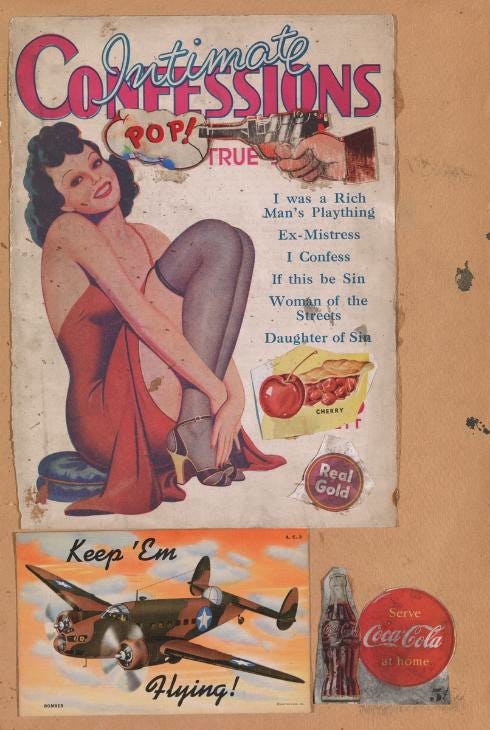

Eduardo Paolozzi is now better known as a sculptor responsible for some high profile public art, such as the colossal figure modelled after William Blake’s Newton outside the British Library since 1995. Shortly after V-E Day marked the end of ‘The War in Europe’, he began producing a series of collages using imagery from American magazines he acquired from US servicemen. He was already aware of how much the popular culture of the USA had invaded British life — Marilyn, Elvis, Rock’n’Roll, Hollywood, bubble-gum, and Coca-Cola — and his collages offered a commentary that both celebrated and satirised this post-war trend. He was producing Pop Art before anyone knew what it was.
Pop Art never had a manifesto though Richard Hamilton’s definition helped to identify common characteristics of most art that may be considered ‘pop’. In 1957 he wrote, “Pop Art is: Popular (designed for a mass audience), Transient (short-term solution), Expendable (easily forgotten), Low cost, Mass produced, Young (aimed at youth), Witty, Sexy, Gimmicky, Glamorous, Big business…”
Because he was one of the first to identify it as a prominent Postmodern movement and attempt to define it, he’s often cited as the first Pop artist. However, his own attitude and approach was born of an emergent style with its roots running back to the First World War and the anti-art agitators of Dada. The practice of reassigning new meanings to everyday objects and then re-presenting them in an unfamiliar context was an innovation of Marcel Duchamp who pioneered the concept of the Readymade, best exemplified by his Roue de Bicyclette of 1913 — a bicycle wheel mounted on a wooden stool.
Duchamp was the ‘Grand-daddy of Dada’ and many of the concepts he introduced were instrumental in defining Modern Art and fed into so many important European movements during the interwar era. The use of found ephemera was embraced by the likes of Kurt Schwitters who used cut-up newspapers and magazines — often combined with other ‘throw-away’ materials like wrappers, tickets, and receipts — to produce his striking collaged compositions that would leave a lasting effect on graphic design. As would the anti-fascist Dadaist photomontages of John Heartfield which pre-empted the visual linguistics of Pop Art by decades.
Their influence was palpable in the post-war UK art scene centered on a group of avant-garde artists known as ‘The Independent Group’. Like Dada, their drive was anti-elitist and in many respects similarly anti-art, or at least antagonistic toward what was generally promoted as art by many dealers and gallerists at the time.
The first cohesive expression of the Independent Group ideology was 1953's Parallel of Life and Art, an exhibition brought together by artist Nigel Henderson at London’s ICA (Institute of Contemporary Art). It was a collaboration between Henderson and fellow artist Eduardo Paolozzi, along with the architectural partnership of Alison and Peter Smithson, civic engineer Ronald Jenkins, and with input from critic Reyner Banham.
It explored the idea of an exhibition as a collaged environment that brought accepted modes of art together with imagery from disparate sources not usually accepted as art. In this way it prefigured the Museum of Modern Art, Department of Eagles (Musée d’Art Moderne, Départment des Aigles) that Marcel Broodthaers toured from 1968–71.
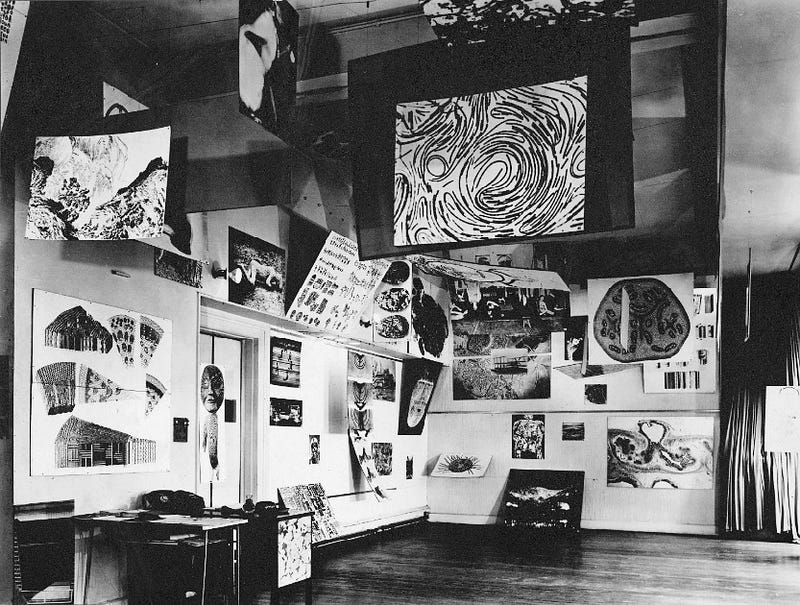
The works displayed in Parallel of Life and Art were nearly all presented through the medium of photography with explanatory writings in the accompanying catalogue. These were original photographs by Henderson and photographs of details taken from Paolozzi’s sculptural reliefs as well as abstract photograms of objects and materials, X-rays and microscopy of cells and other biological structures, ancient historical sites including Pompeii, Modern architecture under construction, and reproductions of the work of other artists they considered important or influential including Paul Klee and Wassily Kandinsky.
Parallel of Life and Art was a ‘poetic’ tool for socio-political exploration intended to blur the boundaries between art and life. It was a confident opening gambit for the Independent Group that then continued to gather around the ICA scene. By 1956, the Independent Group had become a broad association of young radicals from different disciplines, considered important enough to warrant a major exhibition at London’s Whitechapel Gallery under the umbrella title, This is Tomorrow.
This is Tomorrow brought together no less than 40 creatives into a dozen collaborative cells that would each create a component of the exhibition environment. It was an ambitious and exciting concept that curator Bryan Robertson and critic Theo Crosby were already discussing in 1954, inviting artists from the London Constructivists and the Independent Group to work together with designers, critics, and thinkers. The theories of Media Studies guru Marshall McLuhan were a significant guiding influence.
Theo Crosby led Group One in collaboration with Italian graphic designer, Germano Facetti (who would go on to become head of design for Penguin Books in the 1960s), Edward Wright (another graphic designer and typographer), and William Turnbull, the Scottish sculptor. Nigel Henderson and Eduardo Paolozzi were working together again, along with Alison and Peter Smithson, forming Group Six and offering an extension of the collaboration that started with Parallel…
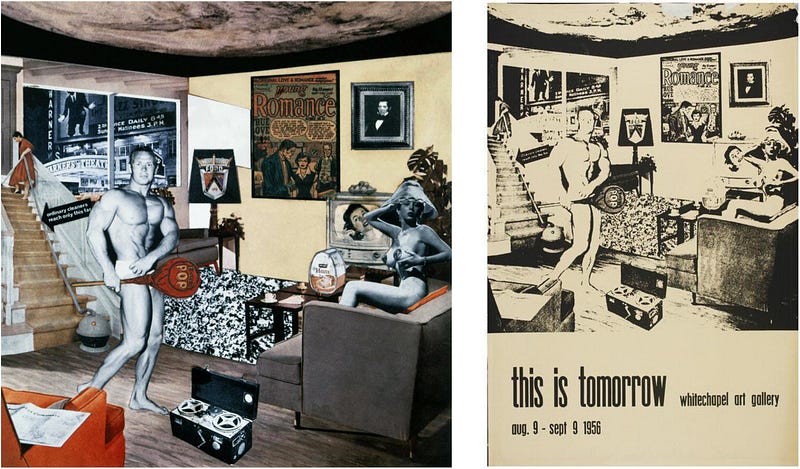
For Group Two, Richard Hamilton was partnered with John McHale (an artist, theorist, sociologist, and one of the pioneers of ‘future studies’), and John Voelcker (who would go on to be Professor of Architecture at Glasgow University). It was the work produced by this ‘creative cell’ that Reyner Banham would identify as the first and definitive manifestation of Pop Art. Their work included Richard Hamilton’s now iconic collage constructed from advertising imagery titled, Just What Is It That Makes Today’s Homes So Different, So Appealing? featuring the memorable muscle man with the phallic lolly labelled ‘Pop’ and the burlesque woman doubling as a lampstand. The work was selected for use on promotional posters for the exhibition.
Richard Hamilton’s collaborative group also produced an immersive walk-through assemblage titled Fun House. With a striking, billboard-scale image of Robbie the Robot lifted from the film poster for the golden age science fiction classic Forbidden Planet (1956), and a life-size print of Marilyn Monroe in her famous billowing skirt pose from The Seven Year Itch (1955). The construction became a focal point of This is Tomorrow.
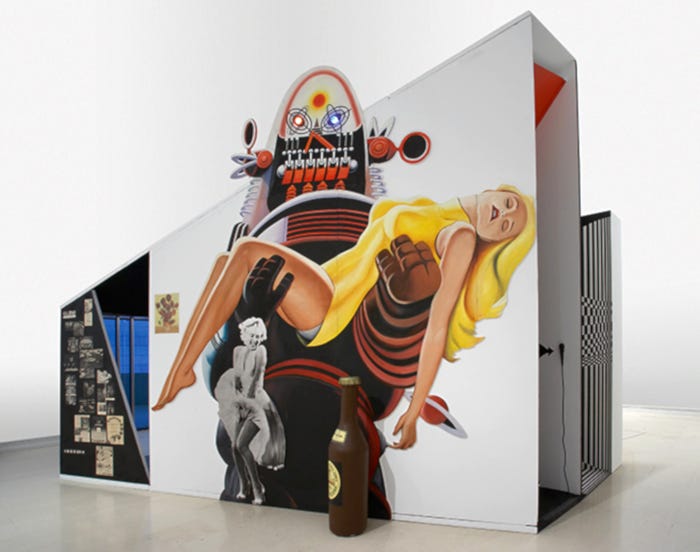
It was also a vivid explainer of what this new take on art was all about. The exhibition recognised and celebrated other creative artforms that had been commonly denigrated, such as commercial art, illustration, graphics and product design. The artists were attempting to make their art more accessible and entertaining, hoping to break through the elitist, overly-intellectual barriers that compartmentalised ‘Modern Art’ as a preserve of the ‘knowing few’.
They saw art not as apart from but as a part of popular culture. Clearly, mainstream media and Hollywood movies were capable of creating appealing imagery that spoke to a broad audience and could be approached from a number of perspectives, which could include the same deep engagement and discussion as so called ‘high art’ without seeming aloof. They also realised the legitimacy of collaboration in contemporary creativity — popular music, film-making, advertising, even the design of home appliances all required team-work that often showcased amazing levels of creativity. Perhaps even more so than the solitary easel painter or studio sculptor…
To proclaim their rebuttal of elitist and embracing of popular culture, the group wanted Marilyn Monroe to open the exhibition in person. However, she was unavailable and so they booked Robbie the Robot instead, who showed up as the iconic film prop was in London to promote Forbidden Planet.
This is Tomorrow is often referred to as a ‘watershed’ moment in Brit Art and it left a long resounding legacy that would fuel and fuse with the nascent Glam Rock scene. Bryan Ferry, the lead singer with Roxy Music, was taught by Richard Hamilton at Newcastle University during the 1960s and would later pen the song This is Tomorrow, in recognition of the exhibition’s cultural impact, for his 1977 solo album In Your Mind.
The whole Brit Art scene of the 1990s owed a great debt to This is Tomorrow — which, by then, it was! — but here’s how the exhibition was reported by British Pathé News back in 1956 — when it was still today!
* All images used here with license or for educational purposes under fair usage policy.