
The Artist as Curator
When a collection becomes an assemblage, the exhibition is installation art — from Marcel Broodthaers to Grayson Perry…
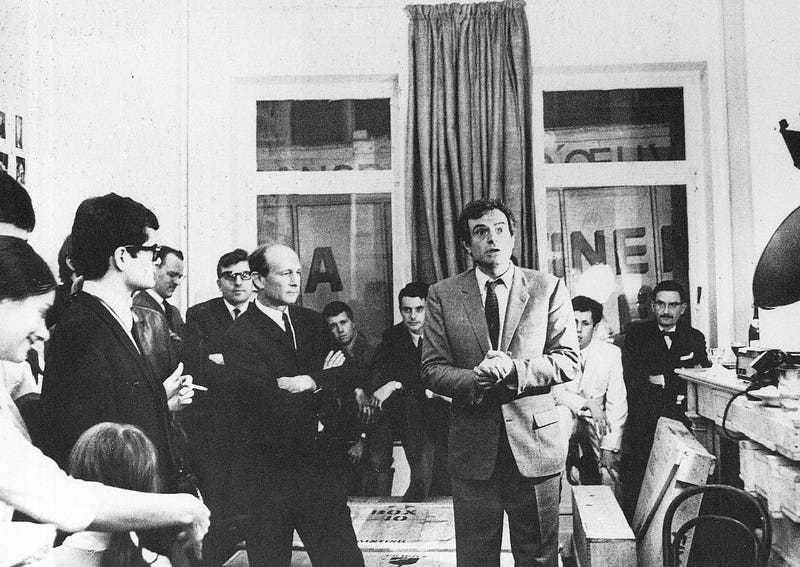
In 1968, Marcel Broodthaers founded the, initially fictitious, Museum of Modern Art, Department of Eagles (Musée d’Art Moderne, Départment des Aigles). Broodthaers had started out as a writer of fiction and poetry before becoming better known as the Belgian artist associated with Dada and Surrealism. His work often included assemblages and collages of found objects along with texts and were often presented with his accompanying talks and lectures.
He worked in similar modalities as that other Marcel, but whereas Duchamp proposes that anything could be art, Broodthaers made an obvious leap of logic and concludes that every(material)thing, including art, was an object. Much of his art from the mid-sixties onward dealt with the debate of what it was that made an object, or collection of materials, into a work of art.
In his Museum of Modern Art, Department of Eagles, he appointed himself curator of the conceptual museum that manifested in exhibitions ‘from its collection’ in various locations, not always galleries. These exhibitions included everyday objects, postcards, reproductions of artworks, and extensive notes. Many of the things were linked by their explicit or implied reference to eagles. In effect, the collections became an artist’s assemblage resembling a curated exhibition.
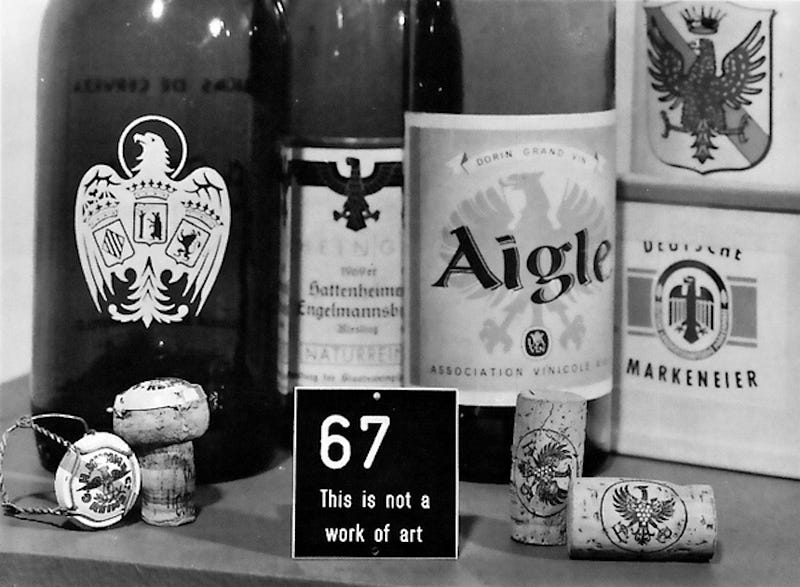
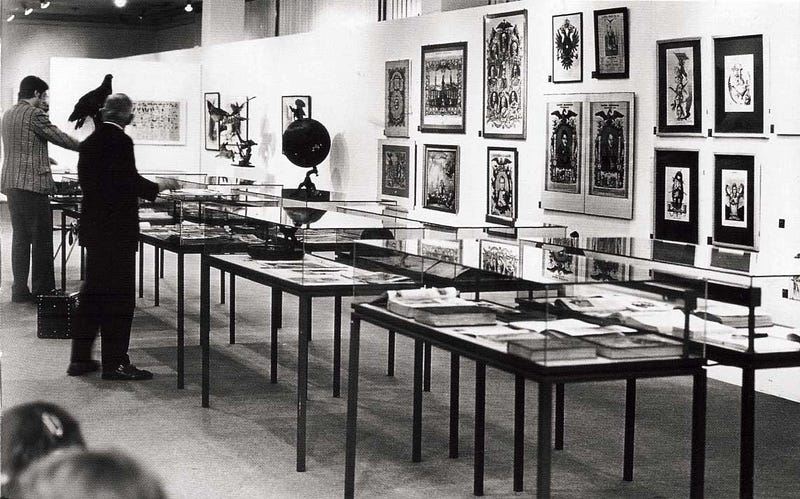
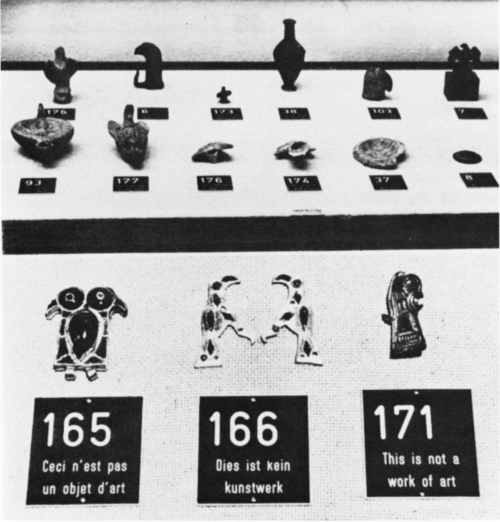
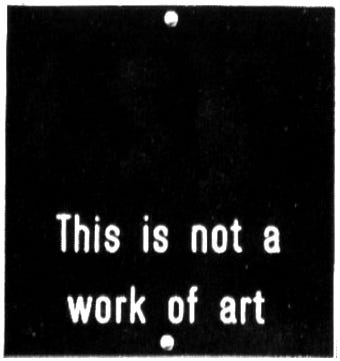
Often the selected exhibits would be labelled, in different languages, “This is not a work of art.” So, here we have an artist presenting us with objects that he claims are not art. Is the implication they only become art when arranged as part of a larger combination? We could just as well ask the question, “At what point does a series of brush strokes, or chisel strikes, become a work of art?”
Most of the items displayed in his touring, changing collections would not have been considered art before being presented as if they were, even when we are told they are not. This begs the obvious question, “Then what is art?”
In 1970, Broodthaers began a process that helped to prove that art actually exists, though it may be intangible. What’s more, he proved it exists separately from the material that mediates it. He did this by extending his Museum of Modern Art with a Financial Section and immediately offered it for sale on the open market. He found no buyers for this concept and declared the museum to be bankrupt.
Then, in 1971, he produced gold ingots, stamped with the eagle motif, a symbol of authority and power as well as being the Museum’s logo. These ingots were numbered and sold at twice the market price of their weight in gold. He claimed this proved that art, including conceptual art, had a material value. Because, the perception of whether they were art or not would be the only reason for these gold bars to sell at more than the value of the material that they were made of… It’s obvious, really.
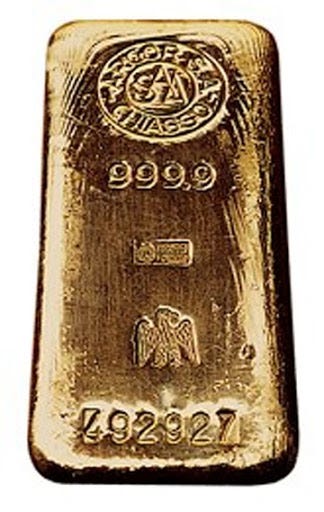
Broodthaers profoundly challenged, and changed, the way museums and curation operated as well as debating the nature of art and the relative standing of critics, curators, and creators. This opened up a whole new way for artists to work as both collectors and curators which has since become a widely accepted practice.
Many artists are now involved with the selection and presentation of objects as an art-form in itself. It’s not uncommon for major museums to invite an artist to select from, and respond to, its collections. It’s an excellent way to question and enrich their interpretations, whilst exploring new ways to engage with the objects, extending their meanings in contemporary contexts.
One excellent example of this process was the Tomb of the Unknown Craftsman. In 2011, with this major work, artist Grayson Perry was both creator and curator of a special exhibition at London’s British Museum.
Although other contemporary artists such as Antony Gormley, Ron Muick and Marc Quinn, have exhibited alongside the museum’s collection with works inspired by or related to it, Perry was granted unprecedented access to the archives being allowed to cast some of the items for the first time. These casts were incorporated as details into the eponymous centrepiece of his show.
Grayson Perry is best known for his pottery, typically large urns decorated in a highly illustrative style. These works are aesthetically appealing, though this is a subversive approach as closer inspection often reveals sinister and serious social themes such as child abuse, war, domestic violence, road accidents…
Although often thought of as a ceramicist, his main interest in pots was that the curved surface allowed a work to exist in a continuous form, free of the frame and with a cyclical visual narrative that has to be seen in a sequence. The pots can be viewed from different angles, but with no definitive beginning or end.
The image on one of these urns, although composed as a whole, cannot be seen in its entirety from a single point of view. This refers back to the first use of framing, found on a ceramic beaker of the Susa dating back seven millennia — a convention established by a potter, now overthrown by a potter. Several of his signature ‘urns’ were displayed alongside ancient vessels from the museum collection.
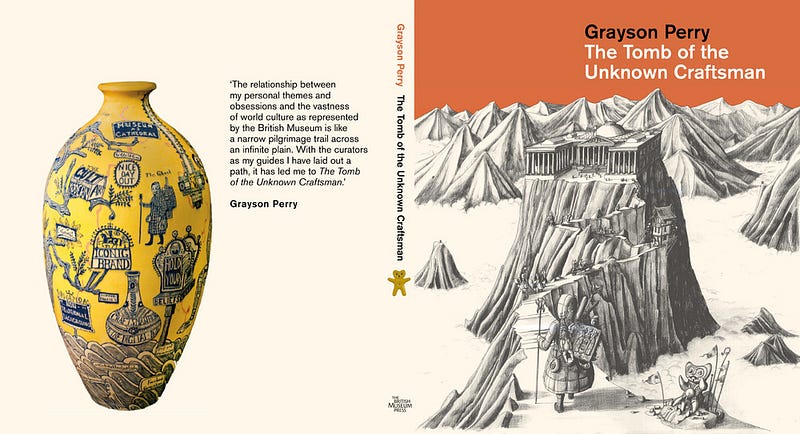
The Tomb of the Unknown Craftsman included a number of recent original works by Perry, many directly inspired by objects he found in the archives and also with connections to his recent travels. These original works were displayed as museum pieces next to items from different periods and cultures from around the world. Perry’s choice was eclectic and didactic — meaning there was lots of different stuff and simply seeing these items next to each other, and reading the accompanying notes written by the artist, the visitor learned quite a lot.
Many of the items he’d selected from the collection would not have been considered as art by the cultures that made them, such as badges and navigation charts. The functions and meanings of some of the objects remain unclear and their makers’ intentions are unknown. Yet all these things were made by someone for some purpose, be that practical or poetic.
Like the exhibitions curated by Marcel Broodthaers, more than four decades earlier in his Museum of Modern Art, Department of Eagles, the objects accrue new meanings that may be subjective — different for each viewer when seen in a new context. This depends on the personal histories and attitudes they bring with them. Objects that were not art may behave as art, and art might be reduced to simple objectivity.
The exhibition as a whole was conceived as an assemblage of items that are in dialogue with each other across the cultural and historic divides. It blurred any boundaries between artefact and art. Not only was this an exhibition about history and craft, it was an exploration of Grayson Perry’s own creative process and highlighted the alchemy of ideas involved in good art. He described it as, “a journey through my own mind”.
Somehow, all the different elements and ideas represented in this collection of objects had a resonance that the artist could listen to and re-interpret in his own work. By experiencing those same items, in conjunction with the work they have inspired, the audience is stimulated to have their own responses that spark off creative thoughts. In this way this work achieves a similar effect to the Vitrines of Joseph Beuys and becomes extended as ‘social sculpture’.
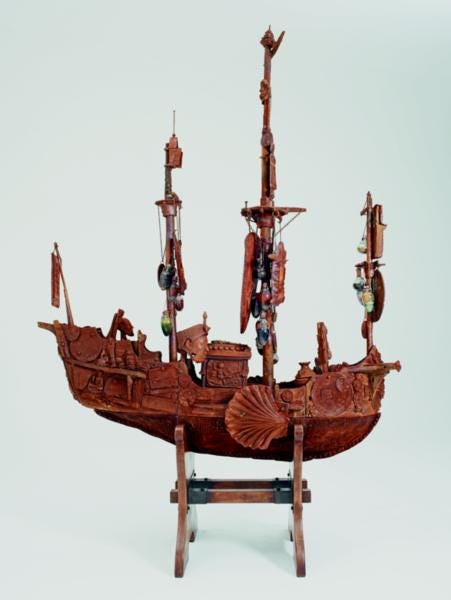
The centrepiece of the exhibition was a large cast iron model of a galleon, embossed with the shapes of many items from the museum archive, from ancient Egyptian statuettes to toothbrushes. Its masts were adorned with blown glass vessels containing liquids (oil paints) that symbolised blood, sweat and tears.
The image of a face cast in repose on the deck suggested that this is a funeral barge, carrying its symbolic occupant onward into eternity. In the middle of the ship an altar-like dais presents an artefact from the museum collection: one of the oldest objects to be crafted by humans, a flint hand-axe made to fit the hand of the unknown craftsperson who once held it, a quarter of a million years ago…
* All images used here for educational purposes under fair usage policy.
A version of this article was first published in my book Evolution of Western Art (questing beast books, 2012)


