
Frame by Frame: an interview with Bonnie Lautenberg
Cinema and canvas join in conceptual collisions for ‘Artistica! Art Meets Hollywood’
Culture is complex. Too complex to comprehend ‘at a glance’ as it continues to change and develop each time we interact with it. After all, that’s what culture is — a very diverse, interrelated, and interdependent network of meanings, interpretations, associations, ideas, and concepts. Any culture is defined by its creativity, in general, and its arts, in particular. Of bygone civilisations, often our understanding of what they believed and valued is surmised solely through their arts as little else remains.
No artist creates within a bubble and every work references some aspect of the culture created by its antecedents, a network of associations, some intentional, some serendipitous, and always dependent on the cultural positioning of the signifier and the signified. Yes, art theorists may write obscure treatises on such things, cultural commentators may dazzle with their clever interpretations, but sometimes it’s the arts themselves that prove best at analysing and reporting their findings…
Artist Bonnie Lautenberg has turned her photographer’s eye on two artforms that are not always as closely related: the mass media of mainstream movies, along with the sometimes elitist and rarefied sphere of the fine art collector and gallerist. Most of us can now stream a cinematic classic into our home or purchase the latest, digitally restored Blu-ray edition, but fewer enjoy that level of accessibility to contemporary art. However, both are aspects of the same creative culture — nodes in that complex network.
Lautenberg’s latest series of works, currently on show in a major exhibition at Florida’s Boca Raton Museum, manages to bring these two ends of the spectrum together and make them equally accessible, circumventing the highbrow barriers of contemporary art and recognising the exceptional cultural value of popular film.
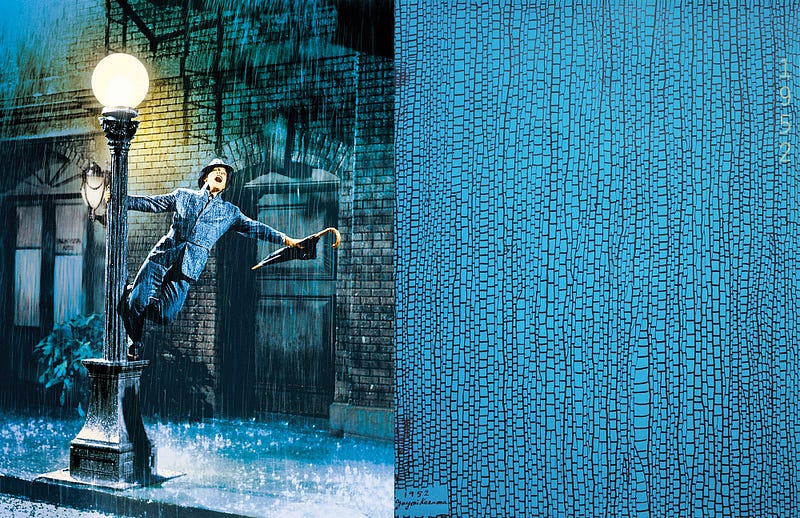
In her series, Artistica! Art Meets Hollywood, single film frames are combined with an artwork from the same year, though they clearly have more in common than that...
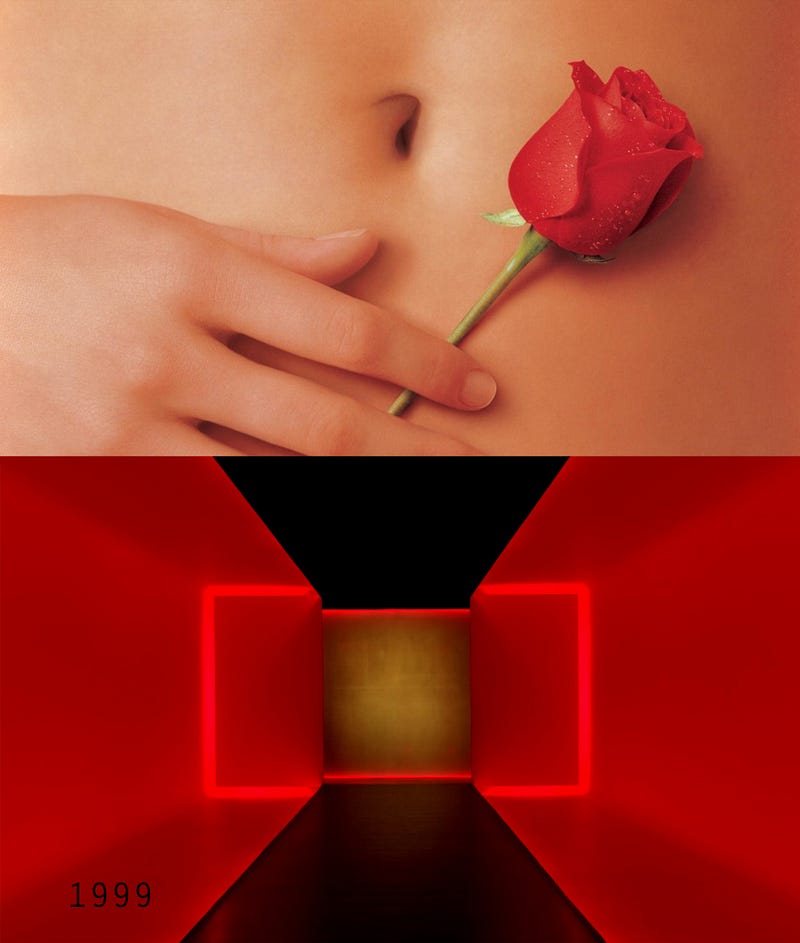
Bonnie Lautenberg explained, “One art form can influence another. I chose a film still and a piece of art done in the same year. To make my statement, I had to select a still from a film and another artist’s work. The image for 1952, of Gene Kelly from Singing in the Rain was one of my early pieces because I loved that iconic image, and paired it with Yayoi Kusama’s painting The Sea. I mostly used paintings but for 1999 I have a James Turrell light room paired with an image from the movie American Beauty and for 2000, a magnificent quilt which I paired with a film still from Ma Rainey’s Black Bottom.”
The concept is elegant in its simplicity. One image enhances the beauty of the other and draws attention to clear comparisons and contrasts in their formal elements. These similarities and differences are often quite literal and obvious, sometimes more poetic and subtle. Often all those things, as the appreciation of the viewer takes a journey through a layered response. Sometimes narratives evolve as the eye wanders across the combo.
For example, the combination of the organic forms of the American Beauty frame and the clean, almost Suprematist, geometry of The Light Inside by James Turrell draw attention to the absence of the human form in the latter, whilst a human presence is required to experience it and emotion to appreciate it. The titles add another layer of meaning: true beauty goes beyond surface and a ‘beautiful’ person is sometimes described as ‘radiant’, or ‘lit from within’… but there’s more to it, still.
All the carefully selected art works — mainly paintings but encompassing sculpture, installation, and photography, as well — benefit from their alignment with a cinematic image. Perhaps it’s because I’m both a film critic and artist that the film stills encouraged me to spend time with paintings I would otherwise dismiss, thereby deepening my appreciation of them.
Which is part of Lautenberg’s motivation for making these pieces, “In my mind, I am honoring all these great film makers and the actors in these films, and all the artists included in this project. My goal is to use as many artists and films as possible so the project, which so far has 90 pieces, is also a history of art and a history of film.”
Art and cinema both rely on varying degrees of intertextuality. If a film is an adaptation of a novel, then clearly there is a text that influenced the movie but film-makers also feel the unavoidable influence of ‘texts’ they have experienced including other artforms and previous movies. Bonnie Lautenberg has certainly nailed intertextuality here, so what drove these insightful selection and presentation choices?
“Thanks for this compliment, Remy. When I choose a film to use, I initially think about the film, but then I really look for an iconic image that the viewer can identify with. It’s not about the story within the film, it is just about that one image. And it’s that one image I hope will speak to the art I have chosen to pair it with or vise versa, if it’s the art I choose first…
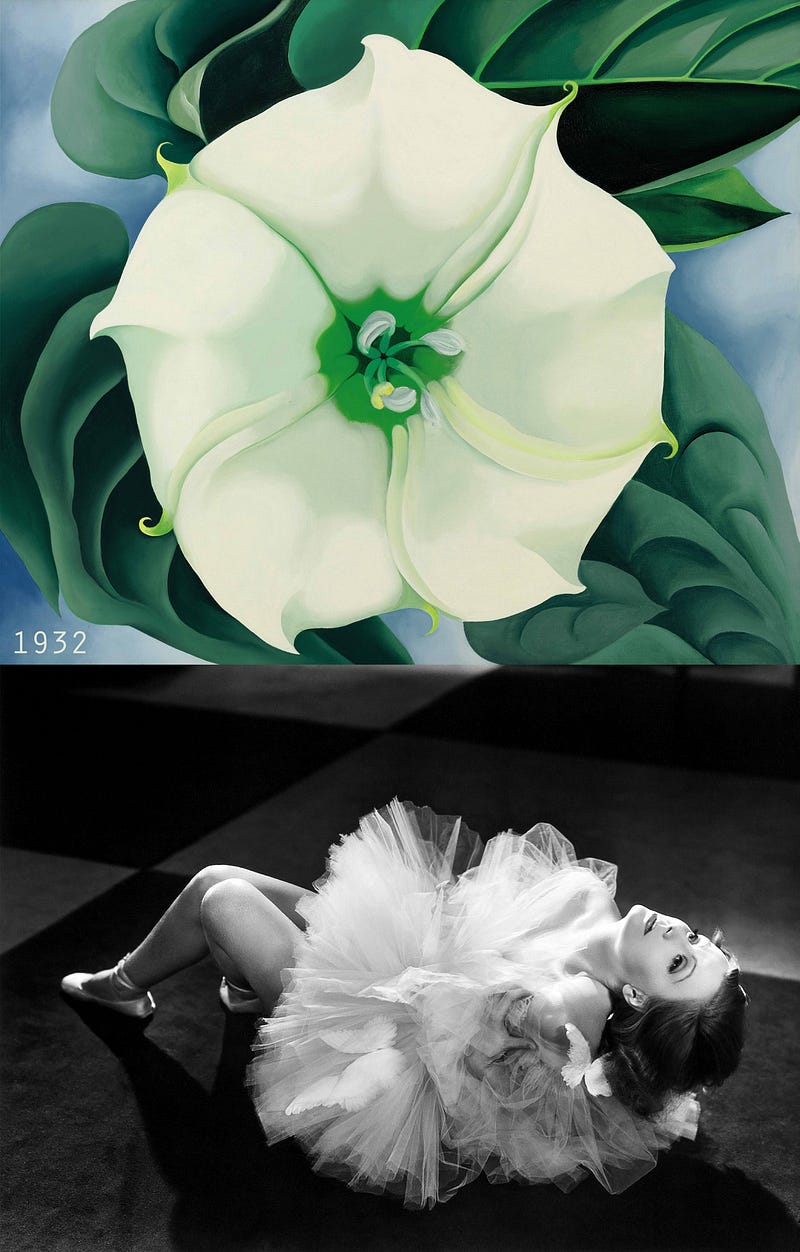
“In my piece called 1932, I loved the artist Georgia O’Keefe’s Jimson Weed/White Flower №1. When I found the movie Grand Hotel and saw Greta Garbo lying on the floor wearing that white tutu, I was so excited that I had this beautiful match for the O’Keefe flower. It’s one of my most favorite pieces in this body of work… although I have many favorites.
“I also did a lot of research in books, museums, on the computer and in catalogs to find interesting work that made sense. If I wanted to use a particular painting in a year I needed, I would study which films were made that year and research the best still from a movie to work with the art I wanted to use.
“Often, I would watch an entire film to find the scene I wanted to use. My goal was to include as many artists as possible. I did use a few artists more than once because they were so prolific and had great pieces that worked with a particular film I was using. René Magritte is an artist I used two different times and I loved the pairing of each piece I used of his. Jean Dubuffet and Roy Lichtenstein were also used twice because the pieces I chose were perfect with the movies I was using.”
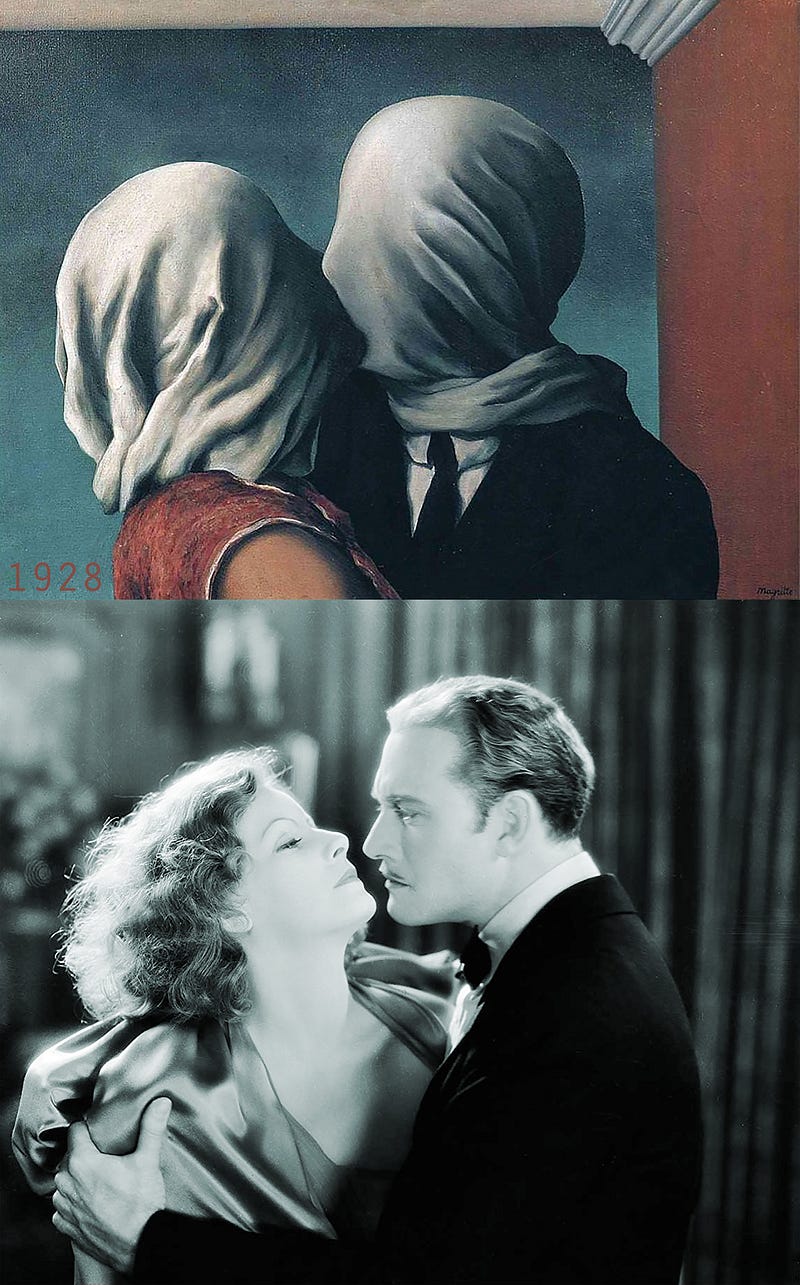
“As far as having painting images in my head, I am an art collector and have studied art so there were many, but if I wanted to use a particular artist, I had to find piece from a particular year to go along with a movie I wanted to use. Say, I wanted to use Marilyn Minter, then I had to find the right paring. I use Marilyn’s work Scrumptious for 2004, and paired it with Eternal Sunshine of the Spotless Mind. Marilyn is not only so talented but so cool. When I asked her if I could use her piece, she was so generous and fabulous and said ‘Of course!’ When I used a scene in the Wedding Crashers, for 2005, I knew I wanted to use a John Baldessari piece, with faces hidden behind circles...
“Much of these pairings are pure luck in that an artist, whose work I was familiar with, had the right piece done in the year the film was made. It was a combination of being aware of all these artists and hoping they had the perfect piece done that same year.”
The re-appropriation of images has a long-established heritage in art, most readily associated with Dada and early Pop Art. Of course, film directors will use famous paintings as ‘concept art’ and often intentionally include homages to other films. The Italian director, Sergio Leone called this ‘cinema-cinema’, meaning movies that deliberately draw upon film history, adding their own new layers of meanings by using visual quotes and reworking established themes.
Lautenberg shared some thoughts on this in relation to her current work, “I refer to Artistica! Art Meets Hollywood as a Conceptual Art project so, I see myself these days as a conceptual artist, not a Pop Artist, although I have recently used the iconic Statue of Liberty in another conceptual project that is currently hanging in the New York Historical Society museum in an exhibit on the Pandemic.”
She goes onto observe that, “artists have been re-appropriating other art sources forever. We can go back to 1919 and Marcel Duchamp’s Mona Lisa. Robert Rauschenberg, Jasper Johns, and of course, Willem De Kooning and the Erased De Kooning Drawing by Robert Rauschenberg, in 1953. I loved learning that De Kooning didn’t want to get in the way of another artist’s work, so he let it go. Originally, there was no inscription on this piece, so Rauschenberg conferred with Jasper Johns, and Jasper’s quote became a permanent part of this artwork. Other artists such as Andy Warhol with his soup cans, Louise Lawler photographing artists’ work hanging in homes or museums, and so on, are all appropriated.”
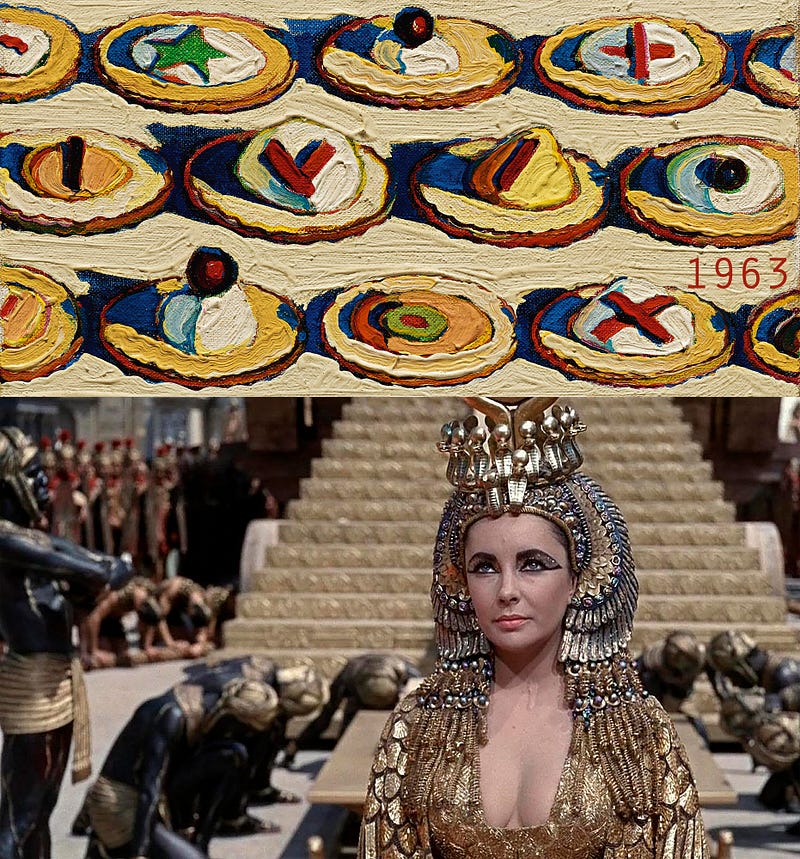
The interplay between the images also creates transmedia narratives. Some of those verge on the surreal — 1963’s Cleopatra frame of Elizabeth Taylor in the titular role beneath an array of Hors d’Oeurves painted by Wayne Thiebaud. Others are comedic and will raise a smile — Bob Hoskins being tickled under the chin by Roger from 1988’s Who Framed Roger Rabbit paired with the colourful tumbling figures in a Keith Haring painting.
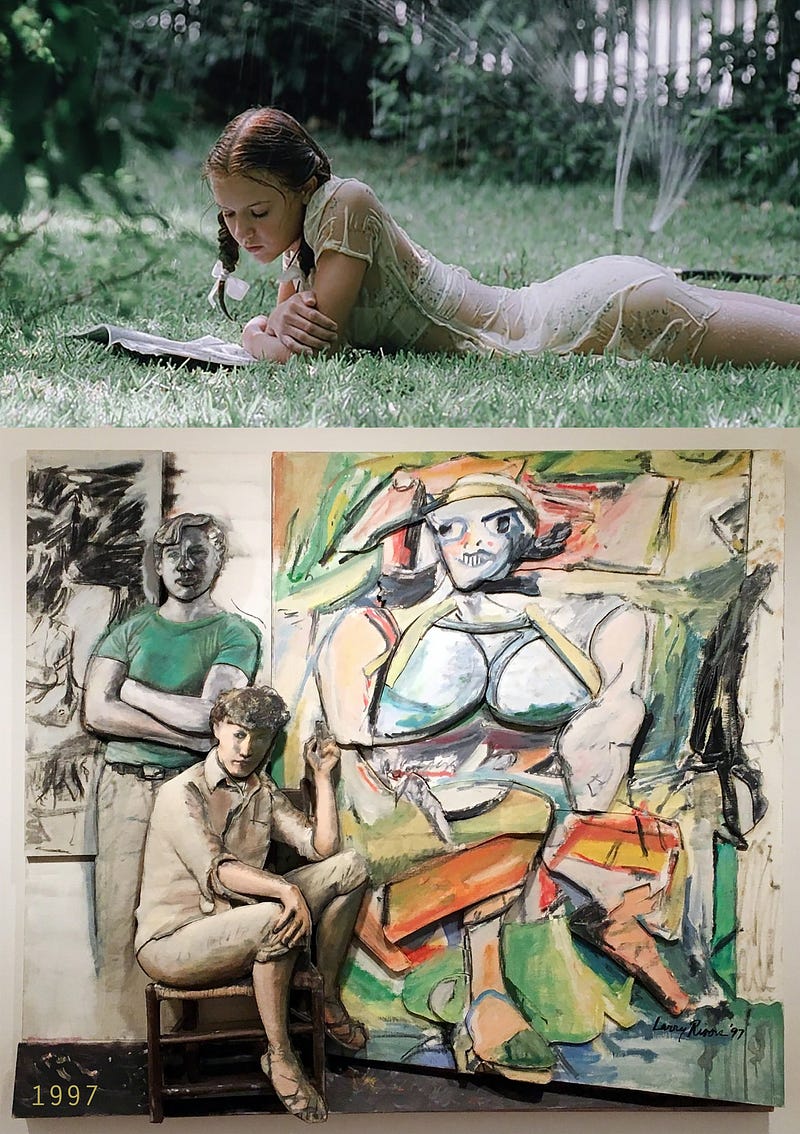
Bonnie Lautenberg is not one to shy away from difficult subjects and one or two can be decidedly unsettling. For example, Dominique Swain cooling under the lawn sprinklers from the 1997 adaptation of Lolita is positioned above the Larry Rivers painting of Bill and Elaine De Kooning and Woman 1 and conjures associations of predatory male sexuality and aggressive misogyny that run from the source material for the film, through De Kooning’s much discussed violent disruptions of the female form, to Rivers controversially exhibiting nude images of his own, prepubescent children who claimed they were emotionally and psychologically damaged by his excuse of art to, perhaps, normalise his veiled paedophilia.
Despite the problematic aspects of the melding of those images and ideas, it’s a good illustration of an established precedent of appropriating and then re-presenting imagery — a method most readily associated with the progenitors of Pop Art. It starts to get a bit ‘meta’ with the De Kooning painting depicted in a painting of its artist within a painting by another artists.
Then one realises that this actually occurs very often in film which relies on the artistry of an entire team coming together in each scene. Usually, a film starts life with the art of writing, expressed through the script. Pre-existent artefacts cannot be avoided when filming in any location including a built environment. There’s the production design and set building team, art direction, costume, hair and make-up — all the things that comprise the mise-en-scène. Are the actors not artists? Then there’s the whole cinematography and technical side of film-making…
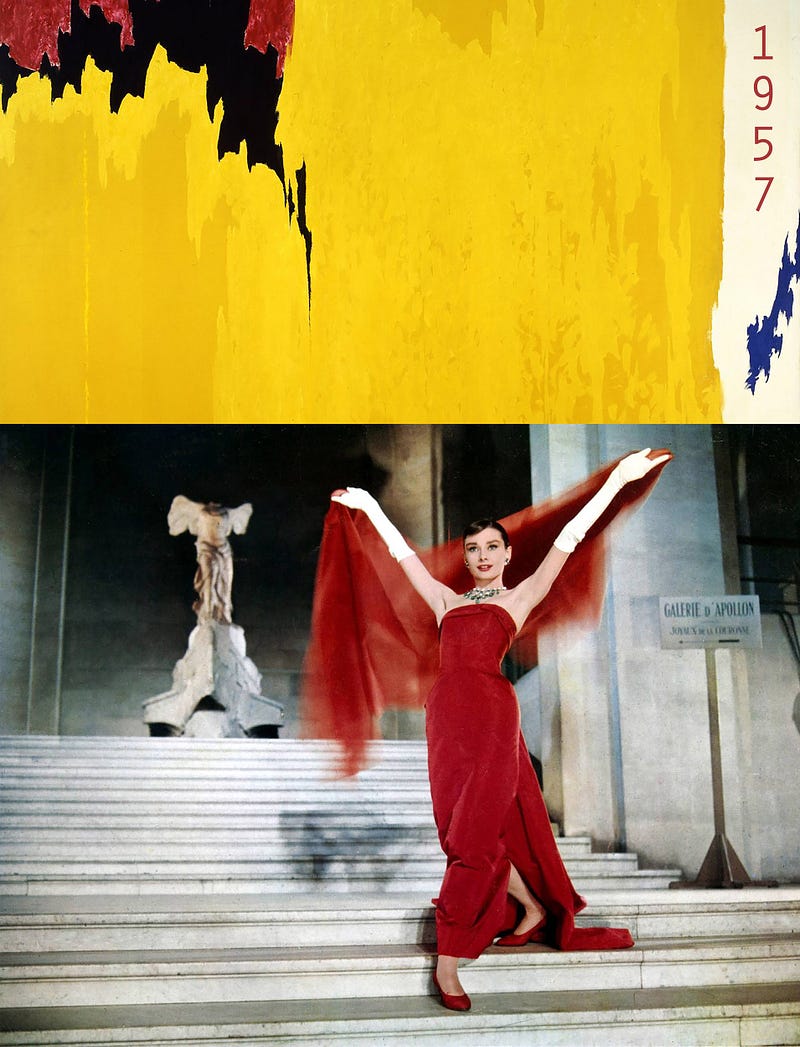
The selected frame from 1957’s Funny Face already has an in-frame juxtaposition with the famous Winged Victory of Samothrace statue, and Audrey Hepburn wears a gown designed by the legendary Edith Head. Clyfford Still’s abstract, PH-971, balances the crimson of the dress with a dominant yellow colour-field, but also the energetic black and blue forms seem to continue the dynamic gestures of the actresses, cleverly creating cohesive balance and bringing the two images together as one pleasing composition.
Sometimes, looking at a work of art with a ‘critic’s eye’ can change one’s appreciation of it, for better or worse. I approach reviewing some of my very favourite films with trepidation for this reason. So, I was curious if Bonnie Lautenberg’s feelings to the movie image and matching art were affected during the selection process?
Her reply is characteristically positive, “I would say this process taught me so much more than I already knew about film and about art,” though she admits that whilst trying to make one piece from each year, “there were early years where I wasn’t enamored by a film still available to me but had to use it to complete my task of one for each year. So, I am still missing a couple of years in the 1940’s because I couldn’t find a film still I really liked, with good resolution.
“Some years were easy to be creative and some were more difficult. Sometimes it took me a very long time to find the art that worked with the film still. My piece 1999 began with an image from the movie American Beauty that I was obsessed with and wanted to use. I could not find the right piece of art to go with it. It took me weeks until I found the Turrell light room and when the color turned red, I knew I had my piece!”
One of the aspects that makes the Artistica! series so successful is the clarity and simplicity of each combined image. A lesser artists may not have been able to resist altering the components in some other way. Did Lautenberg consider doing anything else to the images, such as ‘superimposing’ instead of the juxtaposing?
“No, I didn’t consider superimposing the two images because the overall piece would not have been as sharp and as bold as they are, which I think makes the images stronger. I was considering superimposing sheet music as a third dimension but didn’t do it because it would have taken away from the two sharp images.”
Selecting a single frame from an entire movie must’ve felt a little like a photographer choosing the shot from a set of contact sheets. I wonder how Lautenberg’s experience as a photographer informed or influenced her choices…
“I was an actress before I was a photographer so had the opportunity to be on several film sets,” she explained, “On a film there is a set designer and a costume designer, hair and make-up people… all artists in their own right, so I would say that film is comprised of many artistic and creative people just to make one image. Film is comprised of many different images and each image has different artistic people creating a scene to be filmed. The director coordinates all these people who can create the look they want. It is complex because you are dealing with so many artists, so many egos, so many creative people with their own ideas.
“In photography, the photographer is usually the last person to make the final image and depending on what you are shooting, there are often many other people involved in getting the shot to look exactly like what the photographer wants. The photographer is the director in this instance and he or she often has many people creating the image wanted.
“If you take a photographer like Annie Leibovitz, who is directing those major shoots for Vanity Fair magazine, she’s like a film director because they are complex shoots. Cindy Sherman creates all her own work and creates her characters and photographs herself. Not sure how large a staff she might have.”
How did the making of Artistica! differ from Lautenberg’s previous approach, as a photographer?
“My personal photographs were much less complex. I photographed people without fancy lighting and sets so didn’t need other people surrounding me. When I did landscapes, I worked alone. I use one assistant for my current work who is a wiz on the computer, helping me to create my conceptual artwork. Then I need a good printer and framer to complete the project. Many painters have big studios with several artists working in them as do sculptures. It’s all a process and depending on what kind of studio an artist has, will depend on the depth of artistic people surrounding an artist. I feel more creative these days doing conceptual art and having much more fun.”
Lautenberg has photographed the famous from very different spheres of life, ranging from rebellious rock performers to important political influencers. After a long and successful career as a photographer, are there any previous projects that stand-out for Lautenberg?
“I did love doing my Pop Rocks series where I photographed pop-rock artists performing. All I needed was my camera, a great eye and great timing for capturing the perfect moment, as when I got Miley Cyrus spitting out a mouth full of water. I saw her holding the bottle and I knew she was going to take a swig of water in her mouth and spit it out, so I was ready. What a shot!
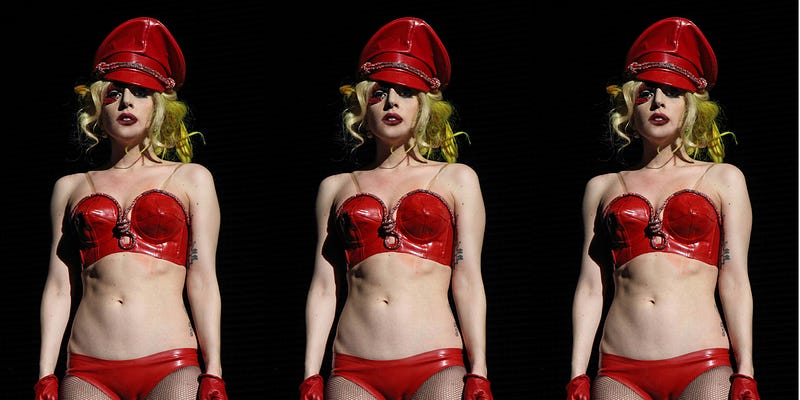
“All the lighting and sets were done before I got there so all I had to do was take the photographs. I photographed Lady Gaga in 2010 at Radio City Music Hall. Those shots were amazing. I photographed Katie Perry when she performed for Hillary Clinton at Radio City Music Hall and got great shots of her… and Justin Bieber, at Madison Square Garden.
“I did of series of United States Senators, also in 2010, which is currently in the Library of Congress in Washington DC, preserved online and in perpetuity. I photographed each Senator at their desk, or wherever they wanted me to photograph them, and all I had was my camera and a flash. It was a great project where I asked each one what their legacy piece of legislation was. I was married to a United States Senator who wrote the law that stopped smoking in airplanes and many other great pieces of legislation, so I was curious what the other 99 Senators were most proud of doing.
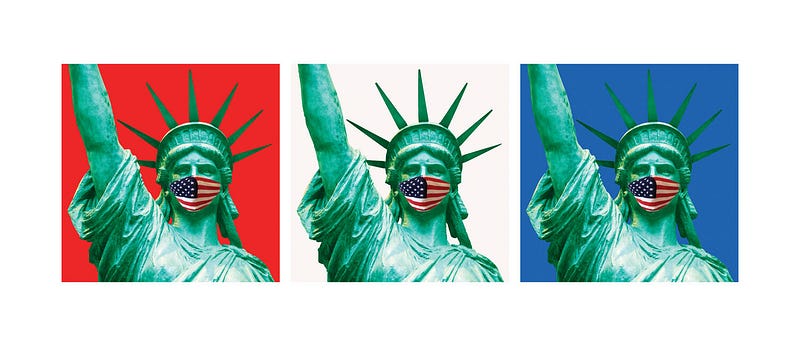
“I did a conceptual art piece in 2020 that is currently in the New York Historical Society in an exhibit about the Pandemic. It’s three images of the Statue of Liberty wearing an American Flag Mask and each of the three images has a different color background. One Red, one White, and one Blue, which I called Even Lady Liberty Lost Some of Her freedom, 2020. Then I made a collage of masks which is a unique piece, also in 2020, and photographed the collage. The New York Historical Society wants that image, too…”
Thank you, Bonnie Lautenberg, for taking the time to talk with Remy Dean for Signifier!
The exhibition, Artistica! Art Meets Hollywood was on show at the Boca Raton Museum of Art, in Florida, April — August 2022.
Lady Liberty, A Bonnie Lautenberg Retrospective is on show at the Jewish Museum of Florida (Florida International University) from 16 November 2022 — 26 March 2023.


