
The Subjective Objects of Claes Oldenburg
Reflecting on the life and works of an artist who elevated the everyday and freed us from the power of things
Often referred to as ‘the soft sculpture guy’, Claes Oldenburg is best remembered for his monumental Pop Art in public spaces — for making the unremarkable remarkable and changing our relationship with everyday things. After all, it’s the ‘little things’ that sometimes matter most…
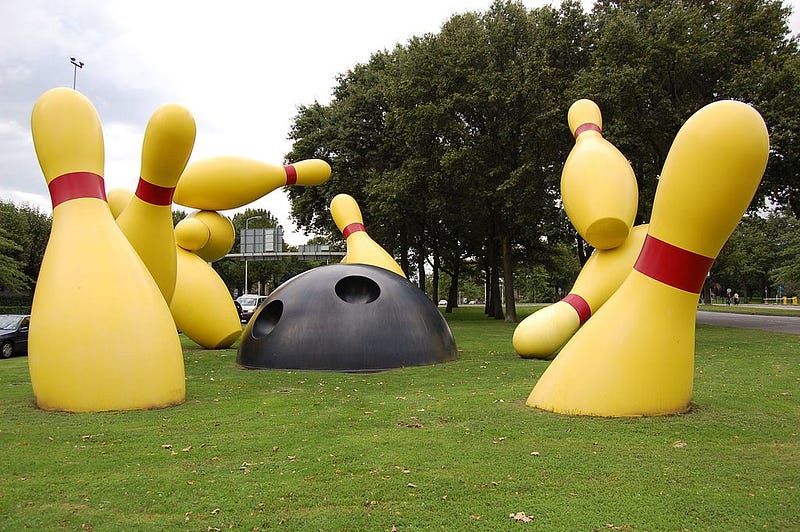
Privileged beginnings and a Punk ethos preceded the Pop aesthetic that remains deceptively profound... Oldenburg was the son of Sweden’s Consul General to Chicago and grew up attending private school before going on to study Literature and Art History at Yale. On his return to Chicago, he enrolled at The School of the Art Institute of Chicago. With this solid grounding in art, he then moved to New York and worked as a librarian at the the Cooper Union Museum for the Arts of Decoration, part of the Smithsonian Museum of Design, enabling him to continue self-guided study. This was in the mid-1950s when the New York scene was dominated by Abstract Expressionism, but Claes knew things could do with a good shake-up to avoid creative stagnation.
He settled in Lower Manhattan and found himself among a group of like-minded avant-garde rebels who gathered around the artist-run Judson Church Gallery. Among them were Jim Dine, Marcus Ratliff, Allan Kaprow, and Red Grooms, who were all involved in pioneering ‘Happenings’ as a Fine Art format. Later, most of these names would be linked to Pop Art but at the time were riffing on approaches pioneered by Dada and concepts more aligned with Surrealism.
Happenings were performed events, often set within a constructed installation or taking place in a public space where the boundaries were only vaguely defined. They endeavoured to remove the fourth wall and incorporate an interactive element where the audience become as much a part of the art as the so-called artist. Some of Oldenburg’s earliest Happenings took place during 1960 within The Street, an installation in the Judson Church Gallery.
He introduced an edgy ‘trash’ aesthetic, decorating a basement room with graffiti and crude figurative cut-outs made from cardboard collected from his neighbourhood streets. He also littered the floor with garbage brought in from back alleys. For the notorious proto-punk performance, Snapshots from the City, he collaborated with fellow artist, Patty Mucha, writhing and cavorting among the detritus wearing rags, ostensibly gathered from the trash. It was a primal, nihilistic display of expressive movement that climaxed with Oldenburg miming failed suicide with impotent cardboard weapons.
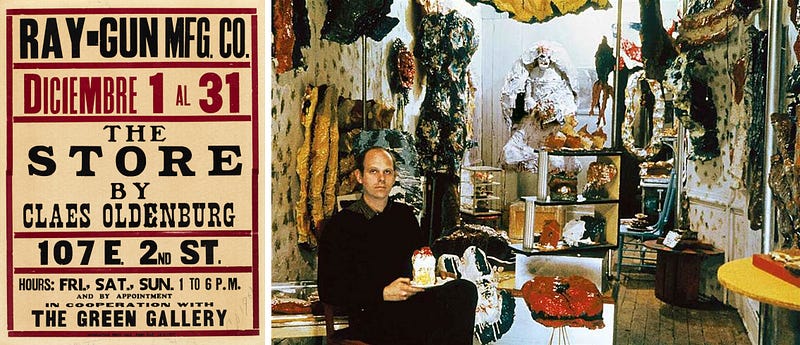
Claes Oldenburg realised that one important feature of Happenings was that they challenged materialism by untethering the concept of the work from any particular object. Together with future wife, Patty Mucha, he formed Ray Gun Theatre, his own performance troupe, but already the environments he constructed using chicken wire, sack-cloth, papier-mâché, plaster, and paint, were beginning to interest him more than the actions.
His breakthrough came the following year when he rented a retail space for the month of December, 1961, spanning the consumer-fest that is Thanks Giving and Christmas. The Store was a shop-like installation stocked with approximations of goods including cakes, burgers, dresses, lingerie, and accessories. The objects, which combined features of sculpture and painting, were removed from their function as food or fashion and reassigned a social role that challenged consumer culture, questioning our relationship with materialism. Those who entered The Store provided the performative element with their emotional responses and discussions.
Swiftly following this innovation, Oldenburg began showing larger-than-life models of consumer goods made from unexpected materials that rendered them totally ‘non-functional’. These included several of his, then controversial and now iconic, soft sculptures — such as the giant Floor Burger, first exhibited in 1962, that seems to reference furniture as much as it does food and preempts the phrase ‘comfort food’.
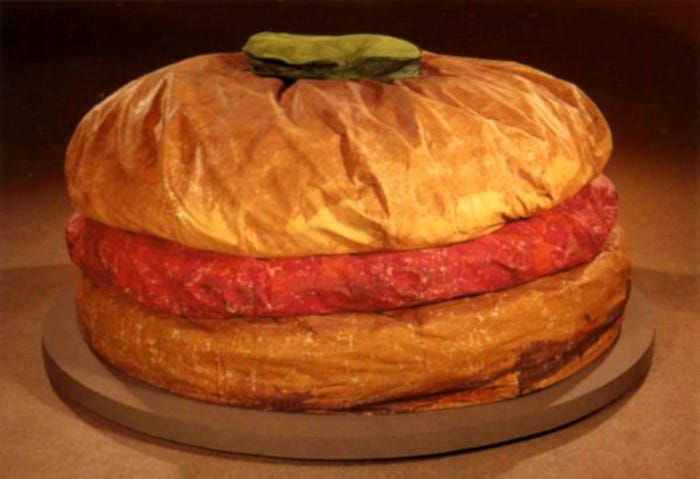
Like much art produced in the 1960s, the influence of eastern philosophies is present and there’s a touch of Zen Buddhism guiding Oldenburg's conceptual approach. By making models of recognisable, everyday things out of unexpected materials — swapping metal for PVC, porcelain for cardboard, foodstuffs for stuffed fabric — he makes the familiar appear weird, challenging the gradients of authority in our relationship with ‘everyday’ things.
Manufactured objects are intended to serve us yet the artifice of fashion adds an additional dimension to their basic functionality. Consumer goods no longer exist solely to serve our needs but to exploit our desires. Consequently, we become enslaved by a society that elevates objects to symbols of self-worth and career success. If a desire is fulfilled by a manufactured object, then a new desire will be manufactured by the machine of consumer culture and attached to another object.
Experiencing an object made from the ‘wrong’ material, presented in an unfamiliar situation and scale, changes our relationship with the thing it represents and encourages the viewer to question their personal response and associated attraction to, or repulsion from, the object. The added sense of fun and childlike wonder cuts through the conditioned desires of experience and reawakens our untainted innocence. We may even see a magical aspect in the humble objects we use on a daily basis.
By re-appropriating the familiar, Oldenburg’s work is instantly engaging although there are layers of meaning beyond the surface should one decide to delve. Examples of his work stimulated lively participation in my art history lectures and are a great way to demonstrate what Pop Art was and how it operated. For example, his overtly political public sculpture Lipstick (Ascending) on Caterpillar Tracks, developed and displayed in two distinct iterations from 1969 to 1974, always got the discussions going just as it had half a century ago when it was first unveiled…
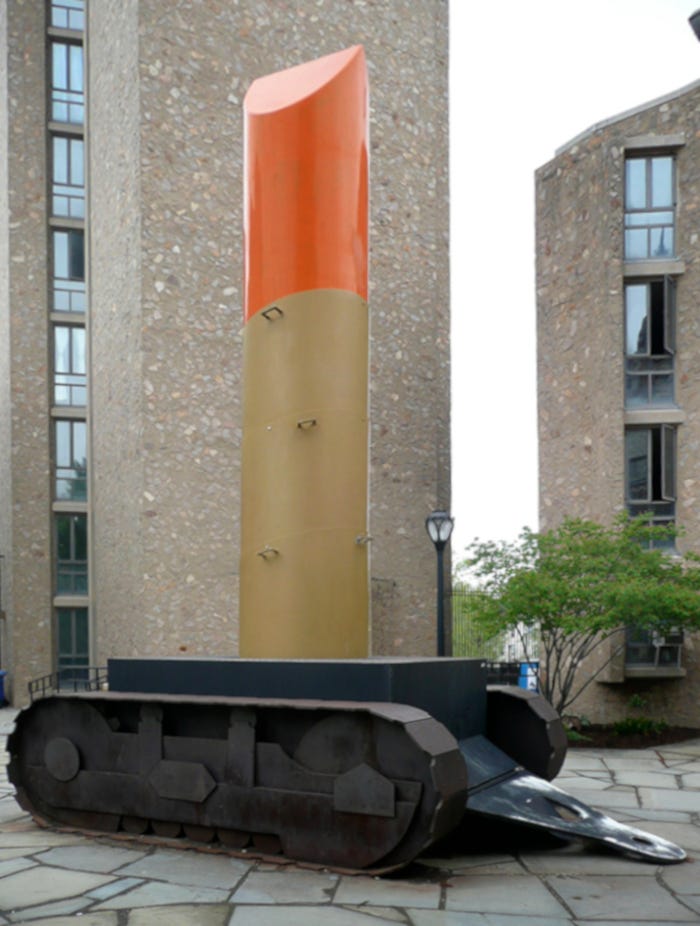
The phallic nature of the lipstick was made even clearer in the first version of the sculpture when it was an inflatable section, rising to a height of 7.5 metres when first erected, yet becoming increasingly flaccid. At first this was a material response to cooler weather and then because of gradual loss of pressure. Soon after, the ‘balloon’ was replace with more rigid materials.
It was placed on a Yale University campus specifically to act as a speaker’s platform for activists protesting against the Vietnam War. At the time, cosmetics represented a huge slice of consumer spending and the military was, by far, the biggest slice of governmental budget. The combined iconography represented the popular adage, “make love, not war,” but also the lipstick suggested a missile and as a (trans)gender signifier it made a traditionally feminine item more masculine and threatening.
Some interpreted the message as one of female empowerment and a celebration of increasing equality at a time of ‘women's lib’ and the ‘war of the sexes’. Whether this reading was intended or not, it became highly relevant as the 1969 intake at Yale was the first to admit women students.
The sculpture was not intended to be permanent and became unsafe as the wooden base section deteriorated. However, as the Vietnam War dragged on, the need for a symbol and place of protest remained. So, Oldenburg replaced it with a robust, steel, aluminium, and fibreglass version in 1974. The following year, the Vietnam War ended.
A later public work, this time produced in collaboration with Oldenburg’s second wife, Coosje van Bruggen, was guaranteed to stimulate even more debate in Art History classes. (I have fond memories of running over-time with the students deciding to stay and talk on, rather than break for lunch!)
Shuttlecocks, completed in 1994, was installed on the lawns of the Nelson-Atkins Museum of Art in Kansas City, USA. Even at the time, there was initial resistance from the county Parks and Recreation Department, further fuelled by the reactionary local press. They objected to the frivolous nature of the subject, deeming it unsuitable for such a prestigious site. Though one wonders if what really upset them was the moral and political connotations of the iconography.
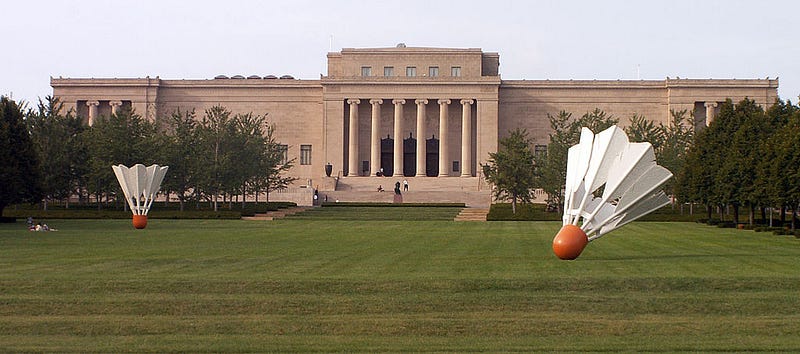
I recall my classes being initially attracted by the fun ‘land of the giants’ toy-like vibe of the piece, but also quick to dismiss it as Pop Art, as if the genre offered nothing more that visual puns and instant gratification. However, lingering on the slide soon elicited deeper engagement, coaxing insightful comments followed by lively discussion.
Some form of shuttlecock had been used in games for centuries but the recognisable racquet game of Badminton was developed in India during the British Raj of the mid-nineteenth-century and was brought back to England by soldiers. The mention of ‘Indians’ along with discussions about Colonial rule abroad inevitably led onto the British rule of North America and the systematic oppression of the indigenous people there, historically referred to as ‘Indians’…
Visual parallels emerged between the feathers of the shuttlecocks and the feathered headdresses associated with the tribal identities of indigenous peoples. It was also noted that the cone of the shuttlecock resembles the traditional tepee tent of the Plains Indians. Then, ideas of an adversarial game where this object that is now both shuttlecock and politicised symbol is batted back and forth come to the fore. Here, they lie fixed to the ground, no longer flying free, though no longer ‘in play’. The game may be over, but these symbols are larger-than-life and cannot be ignored.
A fun, sematic exercise in critical and contextual understanding, perhaps. Yet, after class had been dismissed, those inspired to continue their own research were often surprised that what had seemed a game of inventive associations was in fact supported by the initial intentions expressed by the artists. They had been inspired to incorporate this symbolism after seeing a painting by Fredrick Remington, a revisionist painter of historical subjects known for his Wild West scenes in which Cowboys and Cavalry are heroic and Native Americans are usually portrayed as hostile or savages. The sort of artist those reactionary factions opposed to Oldenburg’s Shuttlecocks would’ve loved…
Claes Oldenburg died last week. His long and successful career produced many well-loved public monuments and he also collaborated with architects to make the facades of buildings more interesting. Along the way, he encouraged us to reconsider ‘the ordinary’ and tackled difficult subjects often with wit and playfulness, proving Pop Art can be profound without pretention, fun without being frivolous.
The origins of Pop Art have been discussed by Remy Dean previously in Signifier.
* All images used here with license or for educational purposes under fair usage policy.


.jpg)

