avatarRemy Dean

Free AI web copilot to create summaries, insights and extended knowledge, download it at here

4828

Abstract

me a defining look for the 1980s, sometimes referred to as ‘Peacock Punk’, though assimilated into the broader, ostentatiously androgynous, New Romantic scene that dominated the decade in the UK.</p><p id="6447">Perhaps the most emblematic manifestation of <i>Pirate</i> were <i>Adam and the Ants</i>, along with <i>Bow Wow Wow</i>, who took the Punk ethos to the next logical step, <i>rebelling</i> against its aggressively <i>rebellious</i> attitude with self-parody and panto antics. Continuity would’ve simply been conformity to a fashion that had, by then, become commercialised. Though elements of the <i>Pirate</i> visual accent were to persist in Westwood’s ready-to-wear designs until the present.</p><figure id="a72a"><img src="https://cdn-images-1.readmedium.com/v2/resize:fit:800/1*_TTlQcSVWqralc-hDFnR6A.jpeg"><figcaption></figcaption></figure><figure id="620c"><img src="https://cdn-images-1.readmedium.com/v2/resize:fit:800/1*fp0G32xRybvrT9SSDSH9Kg.jpeg"><figcaption></figcaption></figure><figure id="54c2"><img src="https://cdn-images-1.readmedium.com/v2/resize:fit:800/1*vYKPpRdXmC4XaEqzlvdr-w.jpeg"><figcaption><b>screenprinted cotton dress with sash from ‘Pirates’ (1981) collection by Vivienne Westwood & Malcolm McLaren</b> [<a href="https://commons.wikimedia.org/wiki/File:1981_Vivienne_Westwood_and_Malcolm_McLaren_dress_and_sash,_Pirates_collection.jpg">view license</a>], <b>grey corset with Thomas Gainsborough dog print (1992) by Vivienne Westwood </b>[catalogue image], and <b>Lochcarron of Scotland Tartan suit (c.1995) designed by Vivienne Westwood </b>[<a href="https://www.nms.ac.uk/explore-our-collections/stories/global-arts-cultures-and-design/vivienne-westwood-suit/">view source at National Museums Scotland</a>] </figcaption></figure><p id="6e0e">Since the early-1980s, she became increasingly interested in re-appropriating historical costume with radical formal disruption and functional reassignment such as flat-cutting Japanese styles for the simpler <i>Savage</i>, a line that ran parallel with <i>Pirate</i> and were often mixed together. Famously, along with her Parisian contemporary Jean Paul Gautier, she was credited for popularising the ‘underwear as outer-wear’ trend involving corsets, bustiers, codpieces, and crinolines. Such styles were often showcased by model Sara Stockbridge who became known as Vivienne’s Muse and later as an actress and author.</p><p id="d3aa">Westwood also re-assigned the signifiers of the British upper-class with costumes that predominantly featured Harris Tweeds, tartans, pinstripes, and luxurious velvetine. Her sumptuous frocks subverted the ‘Tatler Girl’ image, something the famous magazine embraced when they featured Westwood on the cover of their April 1989 issue dressed as a scarily convincing Margaret Thatcher — thus making a political point about appearances being deceptive.</p><p id="5312">She continued to recontextualise familiar styles from broader culture throughout the 1990s. Westwood slashed and tore fine fabrics that quoted seventeenth century styles in a coded deconstruction of the period’s battles and colonial expansionism, whilst also channeling the romantic-revolutionary connotations of <i>The Three Musketeers</i> and the Napoleonic period.</p><p id="aa60">Continuing her historical commentary, she printed eighteenth-century surface patterns onto denim apparel as a herald for a new Enlightenment, entwining symbolism from classical cultures with contemporary street style — a look championed by pop star, Madonna. Then she turned to luxurious forms typifying Hollywood’s heyday as a critique of its mass-media re-packaging of historical and contemporary events.</p><figure id="3254"><img src="https://cdn-images-1.readmedium.com/v2/resize:fit:800/1*yYZcFz3AQEu8jZGmvuj87Q.jpeg"><figcaption><b>Sara Stockbridge modelling Vivienne Westwood ‘corset’, ‘mini-crini’ and ‘strappy platforms’ in a 1985 advertisement for Courtaulds ‘Tricel’ triacetate fabrics</b> and <b>snogging fellow model Susie Bick during a 1990s Vivienne Westwood ‘catwalk’ show </b></figcaption></figure><p id="6679">Westwood’s fashion had started out small-scale and hand-made but breached the mainstream as part of the nascent Punk movement, eventually establishing her as one of the most important and influential designers of international standing. She was self-taught having attended art college for just one term before taking a factory job to fund her teacher-training. In the 1960s she worked as a primary school teacher and sold hand-made jewellery at her stall in London’s Portobello Market. By the turn of the Millennia, Westwood had become a global brand and by 2015 there were 75 dedicated outlets around the world.</p><p id="c689">This huge success seemed to be at odds with her early DIY aesthetic, Punk beginnings and out

Options

spoken anti-consumerist stance as well as her public endorsement and funding of the Green Party and other environmentally aware activism. She was producing up to nine collections per year whilst it’s more usual for a fashion house to produce just two — spring and autumn. The Vivienne Westwood brand also used manufacturers in China and involved processes that were known to be harmful to the environment.</p><blockquote id="2742"><p>“I don’t feel comfortable defending my clothes. But if you’ve got the money to afford them, then buy something from me. Just don’t buy too much.” <i>- Vivienne Westwood, 2007</i></p></blockquote><p id="a484">Perhaps she was hitting-home the Punk point that politics were also a form of fashion and subject to similar vagaries and the only natural state for a conscientious individual was permanent revolution, constant rebellion. Or perhaps she was, at least, using her celebrity standing to proclaim a message of positive change which also included reinvesting a portion of profit in an attempt to affect change with donations to activist organisations. After all, she did express concern with the expansion of her brand and began the deliberate slowing of commercial operations from around 2011, whilst remaining mindful of the thousands of employees who now relied on the brand to make their living.</p><p id="53dd">She drew criticism from the youth wing of the Green Party who declined her offer to speak at the <i>We Are the Revolution</i> 2015 campaigning tour of universities due to her avoidance of corporate tax through the use of off-shore havens. Some environmentalists would criticise her working for Richard Branson’s <i>Virgin Atlantic</i> airlines. Though, when designing the corporate uniforms in 2012, she insisted that only reclaimed and recycled polyester be used. She has redesigned the uniforms several times since, most recently in 2022 which included introducing a new gender-neutral option and the choice to mix and match jackets with either skirts or trousers.</p><p id="2389">As they say, no one’s perfect… and Vivienne Westwood always embraced imperfections — hers, yours, society’s… She may have been contradictory, and controversial, but no one can deny her design intelligence and fierce creativity. Nor overlook her lasting legacy flowing through the mainstream of current fashion. Certainly, when I was a youth of gigging age, the Punk and New Romantic looks she inspired were ubiquitous.</p><figure id="6c33"><img src="https://cdn-images-1.readmedium.com/v2/resize:fit:800/1*kyDS24evU_JHeBsaGbwzwg.jpeg"><figcaption><b>sampler of the ‘Westwood MacAndreas Tartan’ designed by the Vivienne Westwood, for her Autumn-Winter ‘Anglomania’ collection (1993) and woven by Lochcarron of Scotland</b> [<a href="https://www.tartanregister.gov.uk/tartanDetails?ref=5530">view source at The Scottish Register of Tartans</a>] </figcaption></figure><p id="100f">Since the death of Dame Vivienne Westwood last month, on the 29th December 2022, all of her outlets have been closed as a gesture of respect and will re-open for business today. The brand will now be managed by her third husband, and long-term creative partner, Andreas Kronthaler — for whom she created the <i>McAndreas Tartan</i>, which was recognised by The Scottish Register of Tartans in 1993.</p><p id="e3f1"><b></b> <i>All images are used with license, or presented here for educational purposes under fair usage policy.</i></p><div id="a4d0" class="link-block"> <a href="https://readmedium.com/take-a-bow-the-power-of-kyary-pamyu-pamyu-1fc84cc7cf42"> <div> <div> <h2>Take a Bow: The Power of Kyary Pamyu Pamyu</h2> <div><h3>Reviewing the kawaii career of an artist who continues to deliver the most eclectic and positive expressions of Pop Art</h3></div> <div><p>medium.com</p></div> </div> <div> <div style="background-image: url(https://miro.readmedium.com/v2/resize:fit:320/1*Mp_L_HqGmJhV6d4jULtjow.jpeg)"></div> </div> </div> </a> </div><div id="4b70" class="link-block"> <a href="https://readmedium.com/issey-miyake-and-the-endless-thread-fa4f52dabc1a"> <div> <div> <h2>Issey Miyake and the Endless Thread</h2> <div><h3>A very brief overview of a long and influential career in art that transcended fashion, leaving a considerable cultural…</h3></div> <div><p>medium.com</p></div> </div> <div> <div style="background-image: url(https://miro.readmedium.com/v2/resize:fit:320/1*25iMIM0-GGuDxDA_8Sjmmg.jpeg)"></div> </div> </div> </a> </div></article></body>

Westwood Bound

Vivienne Westwood’s inspired and inspiring fashion introduced new forms of beauty and ripped-up British identity

Obscene to the crude, sophisticated to the refined, Dame Vivienne Westwood is remembered as one of the boldest proponents of the Punk aesthetic. Her political T-shirts — featuring provocative slogans, crucifixes collaged with swastikas, gay cowboys, satanic union flags, ripped up royalty, and the like — were sure to amuse your friends and antagonize your enemies. As a bonus, you could get yourself arrested just for strutting down the street in one. Westwood, aka ‘The Queen of Punk’, was among a handful of young Brit designers who clobbered politics with art and made fashion dangerous during the 1970s.
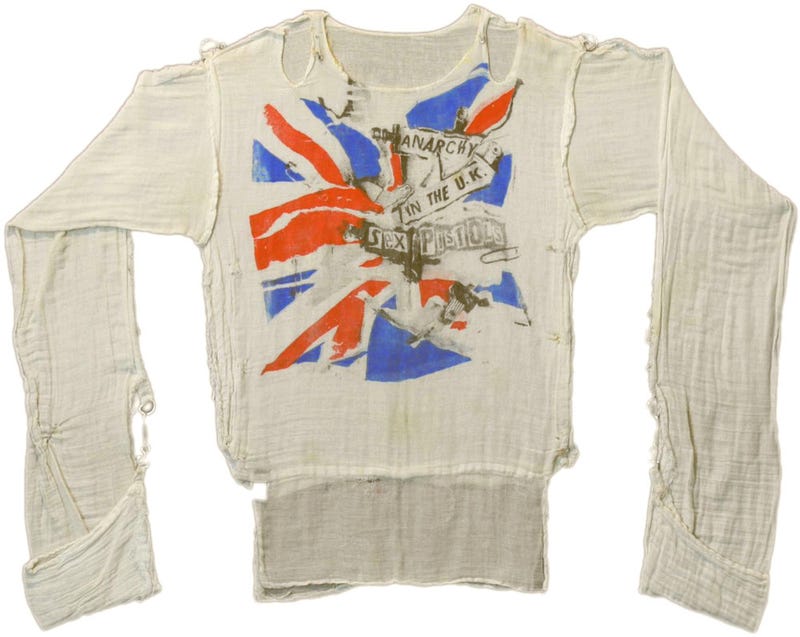
‘Anarchy in the UK Sex Pistols’ print on muslin top (c.1977) as worn by Johnny Rotten, designed by Vivienne Westwood with graphic by Jamie Reid *

Vivienne Westwood took everyday items of clothing, such as the simple T-shirt, in a more Dada direction. After all, the Punk scene was a direct descendant of Dadaist ideology and aesthetics which she fully embraced with her then partner, Malcolm McLaren when they opened their fashion outlet, Let It Rock, in the King’s Road, London. That was in 1971 and, in 1974, the boutique would be re-branded as SEX.

A year after that, McLaren launched The Sex Pistols, a piece of performative hype-art taking the form of a band that came to epitomize the Brit Punk scene. They also served as a touring ‘collection’ using stage as catwalk, showcasing Westwood’s fashion across national media in their torn T-shirts and tartan bondage keks.

“I didn’t consider myself a fashion designer at all at the time of Punk. I was just using fashion as a way to express my resistance…” - Vivienne Westwood

As with most fashion designers, Westwood was not a solo artist but the hub in a wheel of creativity facilitating continuous collaboration. In those early days, she worked closely with her co-collaborators, particularly McLaren and Punk-diva Jordan, aka Pamela Rooke, who was store manager for a time plus a preferred stylist and model. It was also necessary to work closely with an array of makers, suppliers, graphic artists, photographers and, not least, those who wore the products.

The famous ripped shirts sported by The Sex Pistols singer Johnny Rotten featuring the ‘Anarchy in the UK’ messed-up Union Flag and ‘God Save the Queen’ artwork were designed in collaboration with graphic designer Jamie Reid but the DIY, gender-neutral look of such styles was deliberate and aligned with Westwood’s anti-capitalist approach that encouraged mimicry. Any Punk could take a set of marker pens to a ripped shirt or adapt torn charity shop trousers with belts and safety pins!
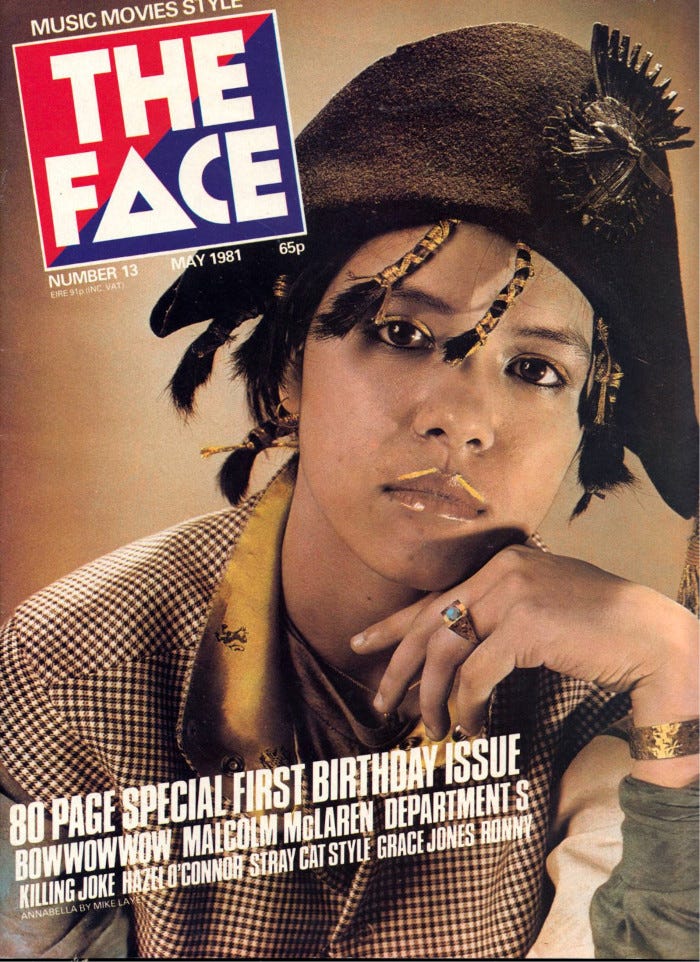
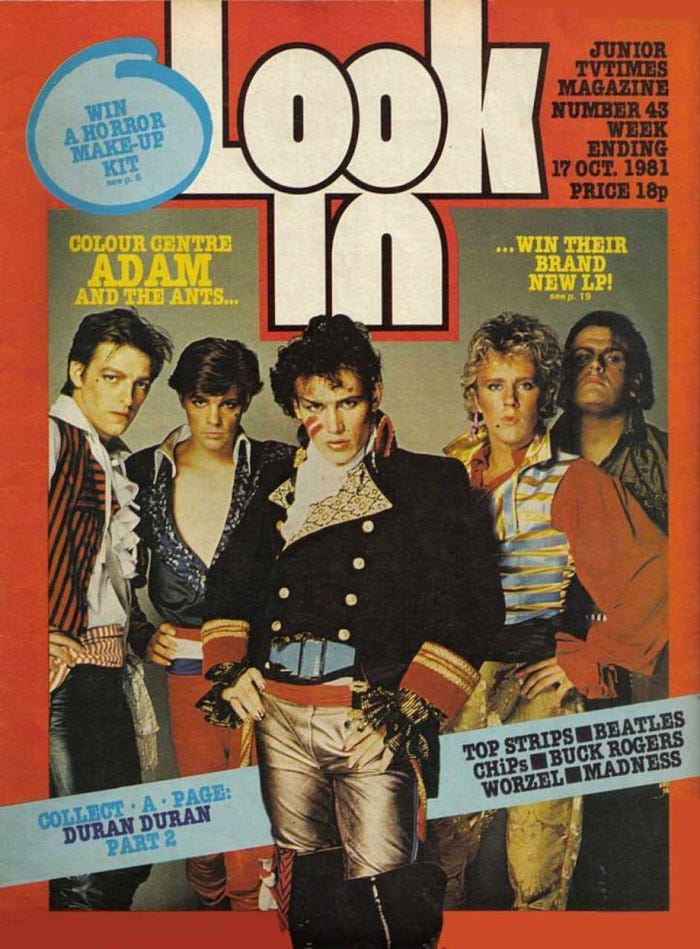
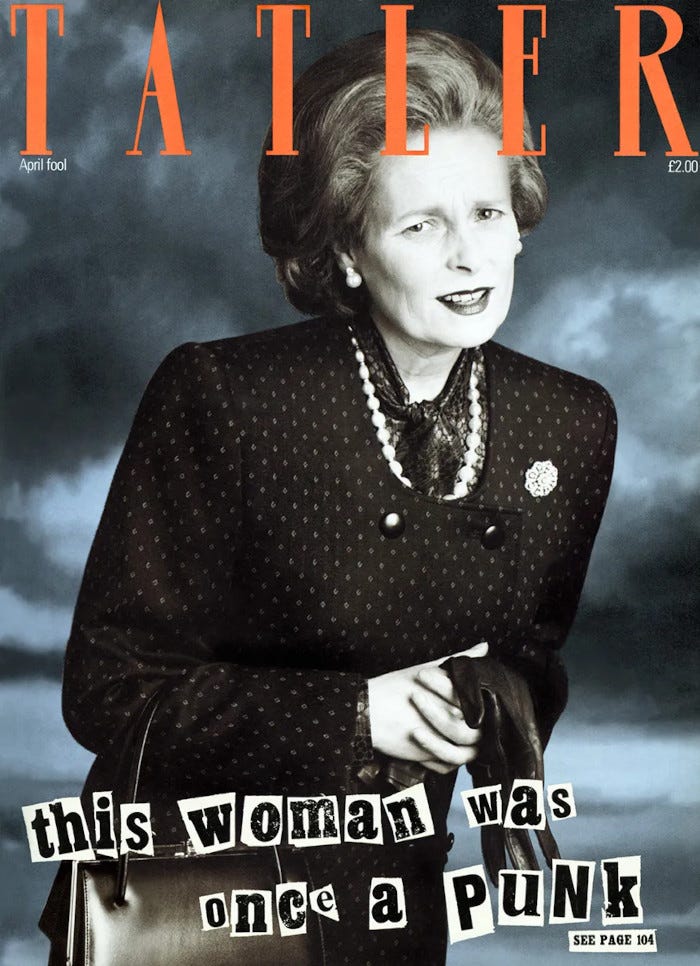
Vivienne Westwood’s ‘Pirate’ styles worn by Annabella Lwin of ‘Bow Wow Wow’ (on the May 1981 cover of ‘The Face’) and ‘Adam and the Ants’ (on an October 1981 cover of ‘Look In’ ), and Vivienne Westwood herself wearing a dress rejected by Margaret Thatcher for the April 1989 cover of ‘Tatler’ making a political statement by pretending to be something she was not, just as Thatcher did *

The King’s Road store regularly re-branded itself to reflect changes in the styles it offered and by 1980 was known as Worlds End. The following year, they staged their first ‘catwalk’ show launching the Pirate collection. This theme, which Westwood intended to reflect the rebellious attitude of the fashions whilst bringing flamboyance back en vogue, was echoed in the boutique’s interior décor based on a rugged galleon. Westwood and McLaren didn’t just offer clothing but provided a mood-board for a whole new image — a lifestyle check-list. It didn’t matter if one understood the politics and rationale, you could join their ‘gang’ just by wearing ‘the look’.

Just as the typical mid-seventies Punk followed her stylings, so the Pirate aesthetic became a defining look for the 1980s, sometimes referred to as ‘Peacock Punk’, though assimilated into the broader, ostentatiously androgynous, New Romantic scene that dominated the decade in the UK.

Perhaps the most emblematic manifestation of Pirate were Adam and the Ants, along with Bow Wow Wow, who took the Punk ethos to the next logical step, rebelling against its aggressively rebellious attitude with self-parody and panto antics. Continuity would’ve simply been conformity to a fashion that had, by then, become commercialised. Though elements of the Pirate visual accent were to persist in Westwood’s ready-to-wear designs until the present.
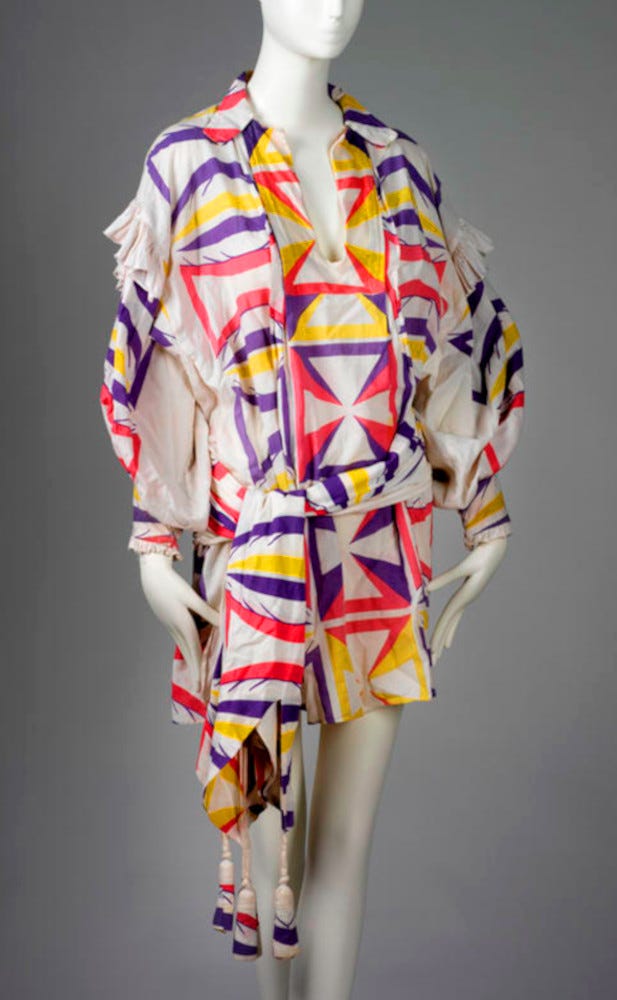
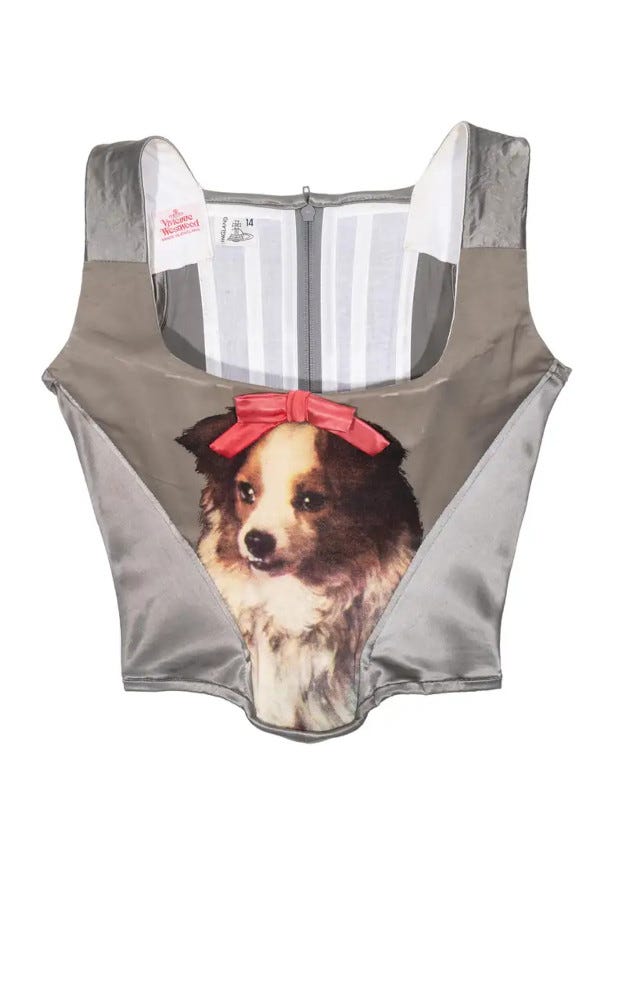
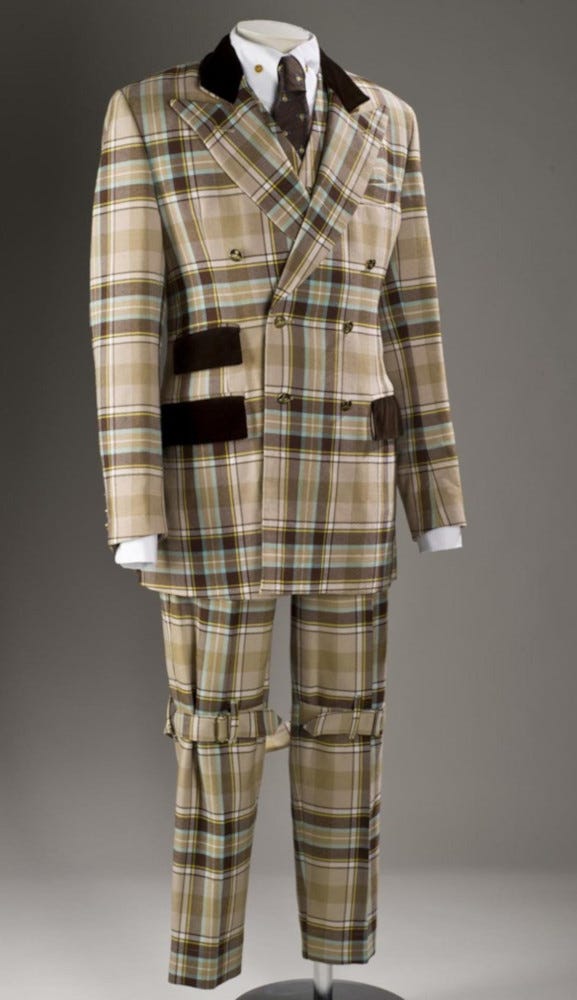
screenprinted cotton dress with sash from ‘Pirates’ (1981) collection by Vivienne Westwood & Malcolm McLaren [view license], grey corset with Thomas Gainsborough dog print (1992) by Vivienne Westwood [catalogue image], and Lochcarron of Scotland Tartan suit (c.1995) designed by Vivienne Westwood [view source at National Museums Scotland] *

Since the early-1980s, she became increasingly interested in re-appropriating historical costume with radical formal disruption and functional reassignment such as flat-cutting Japanese styles for the simpler Savage, a line that ran parallel with Pirate and were often mixed together. Famously, along with her Parisian contemporary Jean Paul Gautier, she was credited for popularising the ‘underwear as outer-wear’ trend involving corsets, bustiers, codpieces, and crinolines. Such styles were often showcased by model Sara Stockbridge who became known as Vivienne’s Muse and later as an actress and author.

Westwood also re-assigned the signifiers of the British upper-class with costumes that predominantly featured Harris Tweeds, tartans, pinstripes, and luxurious velvetine. Her sumptuous frocks subverted the ‘Tatler Girl’ image, something the famous magazine embraced when they featured Westwood on the cover of their April 1989 issue dressed as a scarily convincing Margaret Thatcher — thus making a political point about appearances being deceptive.

She continued to recontextualise familiar styles from broader culture throughout the 1990s. Westwood slashed and tore fine fabrics that quoted seventeenth century styles in a coded deconstruction of the period’s battles and colonial expansionism, whilst also channeling the romantic-revolutionary connotations of The Three Musketeers and the Napoleonic period.

Continuing her historical commentary, she printed eighteenth-century surface patterns onto denim apparel as a herald for a new Enlightenment, entwining symbolism from classical cultures with contemporary street style — a look championed by pop star, Madonna. Then she turned to luxurious forms typifying Hollywood’s heyday as a critique of its mass-media re-packaging of historical and contemporary events.
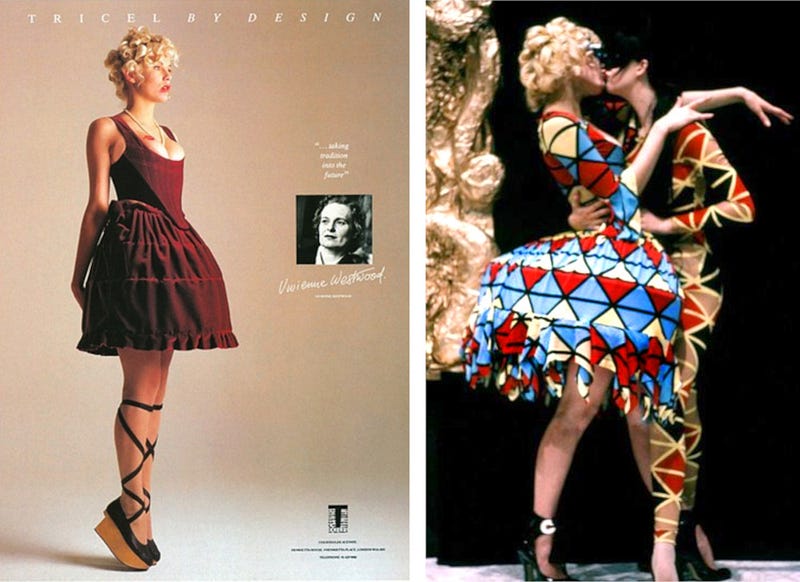
Sara Stockbridge modelling Vivienne Westwood ‘corset’, ‘mini-crini’ and ‘strappy platforms’ in a 1985 advertisement for Courtaulds ‘Tricel’ triacetate fabrics and snogging fellow model Susie Bick during a 1990s Vivienne Westwood ‘catwalk’ show *

Westwood’s fashion had started out small-scale and hand-made but breached the mainstream as part of the nascent Punk movement, eventually establishing her as one of the most important and influential designers of international standing. She was self-taught having attended art college for just one term before taking a factory job to fund her teacher-training. In the 1960s she worked as a primary school teacher and sold hand-made jewellery at her stall in London’s Portobello Market. By the turn of the Millennia, Westwood had become a global brand and by 2015 there were 75 dedicated outlets around the world.

This huge success seemed to be at odds with her early DIY aesthetic, Punk beginnings and outspoken anti-consumerist stance as well as her public endorsement and funding of the Green Party and other environmentally aware activism. She was producing up to nine collections per year whilst it’s more usual for a fashion house to produce just two — spring and autumn. The Vivienne Westwood brand also used manufacturers in China and involved processes that were known to be harmful to the environment.

“I don’t feel comfortable defending my clothes. But if you’ve got the money to afford them, then buy something from me. Just don’t buy too much.” - Vivienne Westwood, 2007

Perhaps she was hitting-home the Punk point that politics were also a form of fashion and subject to similar vagaries and the only natural state for a conscientious individual was permanent revolution, constant rebellion. Or perhaps she was, at least, using her celebrity standing to proclaim a message of positive change which also included reinvesting a portion of profit in an attempt to affect change with donations to activist organisations. After all, she did express concern with the expansion of her brand and began the deliberate slowing of commercial operations from around 2011, whilst remaining mindful of the thousands of employees who now relied on the brand to make their living.

She drew criticism from the youth wing of the Green Party who declined her offer to speak at the We Are the Revolution 2015 campaigning tour of universities due to her avoidance of corporate tax through the use of off-shore havens. Some environmentalists would criticise her working for Richard Branson’s Virgin Atlantic airlines. Though, when designing the corporate uniforms in 2012, she insisted that only reclaimed and recycled polyester be used. She has redesigned the uniforms several times since, most recently in 2022 which included introducing a new gender-neutral option and the choice to mix and match jackets with either skirts or trousers.

As they say, no one’s perfect… and Vivienne Westwood always embraced imperfections — hers, yours, society’s… She may have been contradictory, and controversial, but no one can deny her design intelligence and fierce creativity. Nor overlook her lasting legacy flowing through the mainstream of current fashion. Certainly, when I was a youth of gigging age, the Punk and New Romantic looks she inspired were ubiquitous.
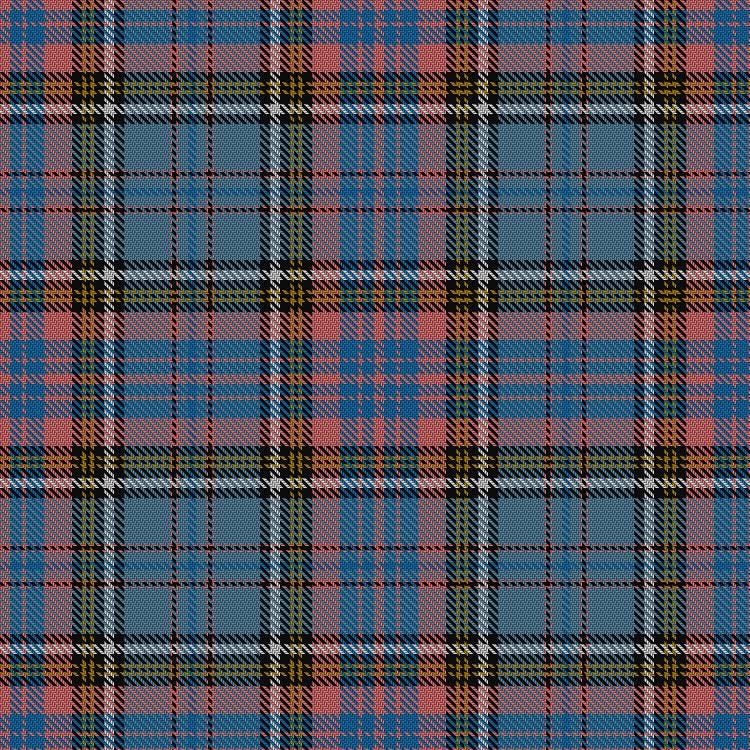
sampler of the ‘Westwood MacAndreas Tartan’ designed by the Vivienne Westwood, for her Autumn-Winter ‘Anglomania’ collection (1993) and woven by Lochcarron of Scotland [view source at The Scottish Register of Tartans] *

Since the death of Dame Vivienne Westwood last month, on the 29th December 2022, all of her outlets have been closed as a gesture of respect and will re-open for business today. The brand will now be managed by her third husband, and long-term creative partner, Andreas Kronthaler — for whom she created the McAndreas Tartan, which was recognised by The Scottish Register of Tartans in 1993.

* All images are used with license, or presented here for educational purposes under fair usage policy.

Art
Art History
Fashion
Design
Pop Culture
Recommended from ReadMedium