
Issey Miyake and the Endless Thread
A very brief overview of a long and influential career in art that transcended fashion, leaving a considerable cultural legacy…
Issey Miyake was one of the few fashion designers I own books about. I regularly loaned them to art students I was teaching, for whom he proved a perennial inspiration — and not only for those specialising in fashion and textiles.
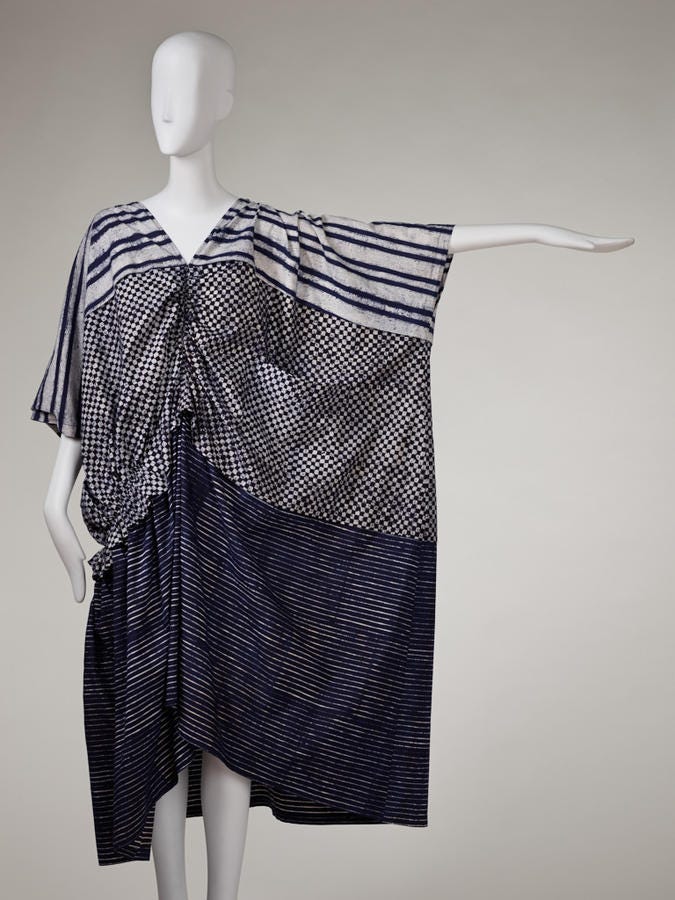
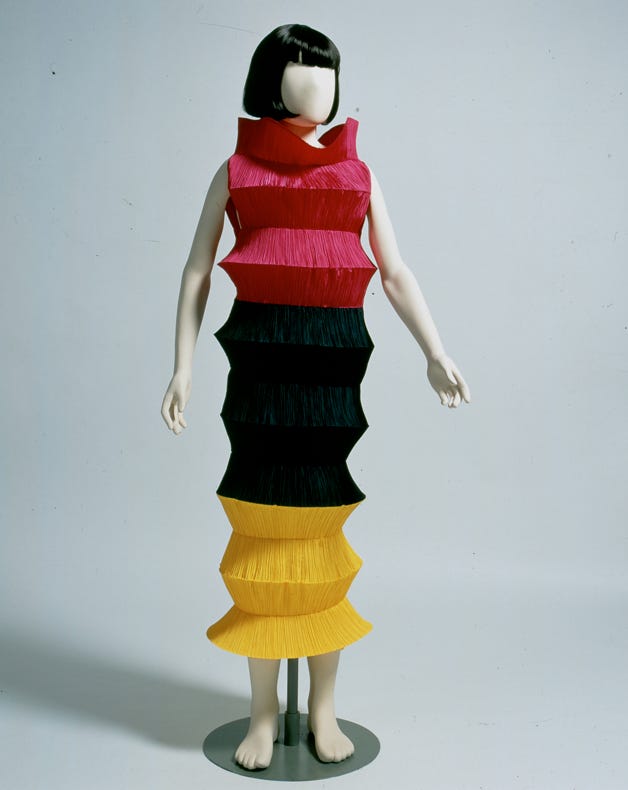
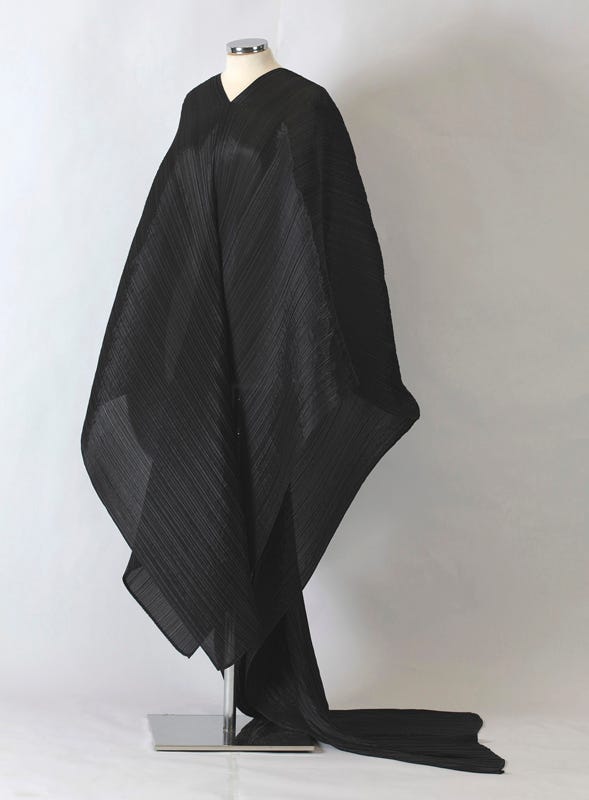
Though he was a remarkable fashion designer with a consistent aesthetic, he was never predictable and always innovative. Miyake expanded the formal linguistics of three-dimensional design, pushing the concept of clothing into the realm of kinetic sculpture. To him, fashion was a collaborative platform for accessible conceptual art.
At the core of his design ideology is the exploration of how two forms interact with each other: how an essentially flat fabric can wrap-around and enclose the volume of the human body. Also, how those two elements may remain distinct yet work in perfect unison.
This is a concept that transcends the practicality of his elegant aesthetic to operate on a meta-level that speaks of the interface between: our internal and exterior lives; personal and public space; the self and the other; fantasy and reality; light and shadow; the corporeal and the spiritual... It also addresses profound eternal questions about how such disparate elements can be reconciled to work in harmony — how such binary notions can be bridged to create unity whilst also valuing individuality.
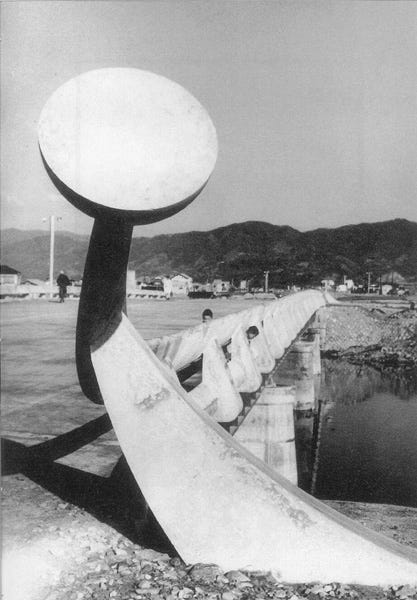
It’s quite fitting then, that bridges in his hometown of Hiroshima were major inspirations to the young Issey Miyake, turning him on to a career in design. The memorial route, known as Peace Boulevard, through the centre of the city crosses five bridges including the two Peace Bridges with features designed by the sculptor Isamu Noguchi, an American with Japanese heritage. Initially, they were named Ikiru / To Live and Shinu / To Die though they were renamed Tsukuru / To Create and Yuku / To Depart, before they were inaugurated in the early 1950s.
It is said that encountering these bridges revealed to Miyake the power of design to serve a practical purpose for the people as well as play a symbolic role for a society. They provided connection and communication, demarked a safer zone around the area of lingering radiation, commemorated terrible past events and the innumerable dead, but built toward a better future whilst exhibiting aspirational and aesthetic principles. His personal response would’ve been deeply felt — he was a seven-year-old at school when he heard the boom of the Hiroshima bomb and by the time he was 10, his mother had succumbed to illness caused by radiation exposure…
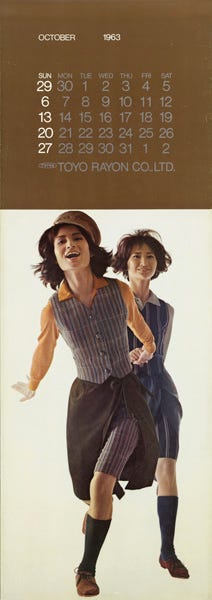
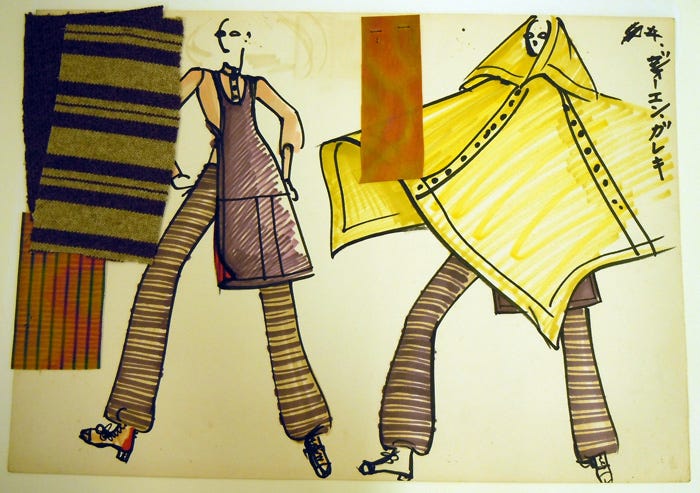
When Japan hosted the prestigious World Design Conference in 1960, Issey Miyake, then a student of Graphic Design at Tokyo’s Tama University, wrote to the organisers pointing out that their programme omitted clothing design, sparking debate about the value of design, rather than simply ‘style’, within the fashion industry.
As a result, he was invited to produce a calendar for Toray (known then as the ‘Toyo Rayon Company’), a manufacturer of synthetic fabrics made from regenerated cellulose. Not only did he oversee the graphics for their 1963 calendar, he designed the clothes featured in it, effectively presenting his first ever ‘collection’. Following his graduation, this impressive showcase was enough to gain him placements at two fashion houses in Paris, France.
It was during his formative years there that he witnessed the volatile events of May 1968 that brought the entire country to a stand-still. His take-aways from these nationwide strikes and riots in the capital were an appreciation of people-power and an understanding of the unrest resulting from class division and inequality. Although he would go on to design for high-end fashion, he was determined to use his skills to serve the many and not just the elite few, striving to offer more affordable alternatives via high street outlets.
Part of this egalitarian ethos involved pushing design in new directions with technological innovation, hoping to benefit the industry as a whole. This led to collaborations across the creative industries and involved traditional Japanese crafts as well as experimenting with new materials and techniques. Whether that material was age-old or futuristic in nature, he always respected and used its innate properties. What the Bauhaus termed ‘truth to materials’.
In keeping with the minimalist approach that typified Bauhaus design, his 1970s output was shaped by a quest to produce clothing from a single piece of cloth. This involved folding, pleating, and cutting in ways that used the tension of the weave and properties of the threads to pull and swirl the fabric around the body. His approach drew upon traditional Japanese forms, such as sashiko embroidery and the kimono. The many and varied results of this exploration were documented in a series of photographs and essays, edited by Kazuko Koike, that would become the first major monograph to be published about a living fashion designer, Issey Miyake: East Meets West, in 1978.
Around this time his studios were also experimenting with unusual materials not associated with worn fashion such as paper, perspex, wire… This line of inquiry led to a collection known as Body Works. Two of the most recognisable results were a set of hats and bodices made from woven rattan and the use of hard plastics to make bodices that mimicked the interplay of subtle curves and smoothness present in the idealised female form but produced in strikingly bright, solid colours.
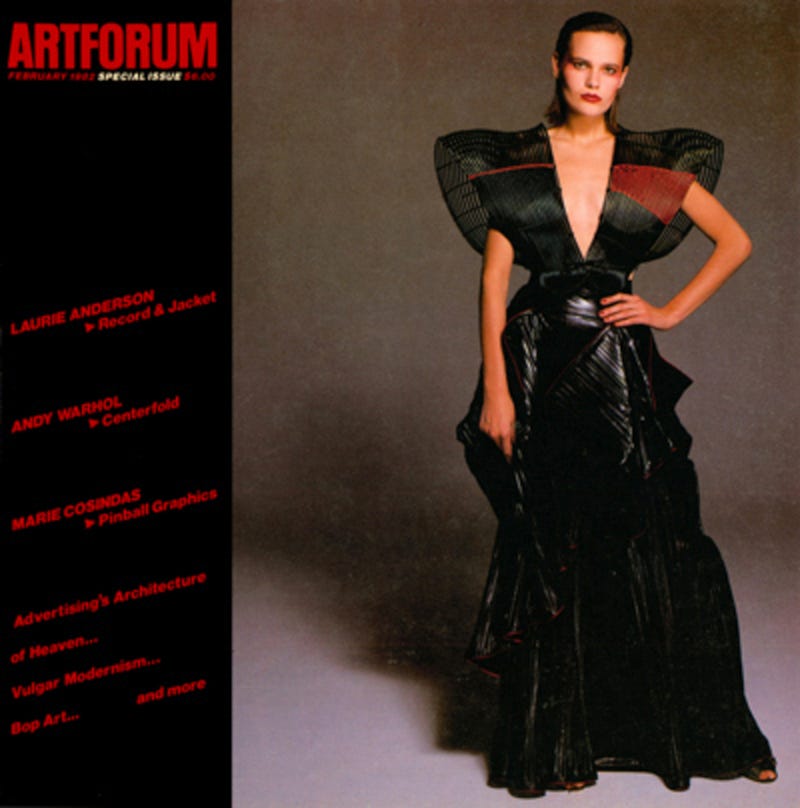
In 1982, a rattan bodice and nylon polyester skirt from Issey Miyake’s Body Works Collection featured on the cover of influential arts magazine, Artforum. The ensemble had been designed in collaboration with bamboo sculptor, Kosuge Shochikudo and artist, Emi Fukuzawa. It marked the first time clothing had featured as the main cover image for any mainstream arts journal and thus influenced the evolution of what would become the emblematic 1980s silhouette.
The outfit was also worn by high-profile pop star Grace Jones at the 1983 Grammy Awards ceremony. She’d been modelling Miyake fashion since the mid-1970s and wore many of his designs for her performances, promotional shoots, and public appearances.
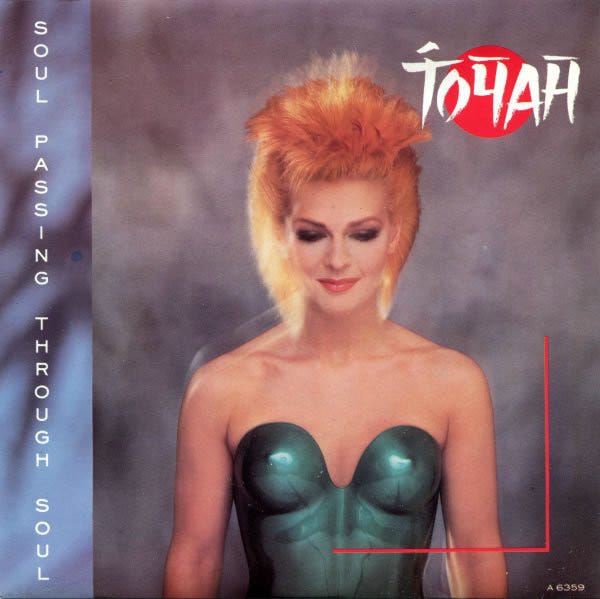
An exhibition of Issey Miyake fashion design was presented as sculpture in the Bodyworks exhibition that toured major museums and art galleries during the mid-1980s. Coinciding with this international exposure a blue edition of the Miyake Plastic Body was worn by Shalamar’s Jody Watley during promotions for Where the Boys Are, her 1984 solo debut as ‘Jody’. She would also wear red and black versions for televised appearances on the music show, Soul Train. Again, Grace Jones was photographed wearing the same design and pop-punk icon Toyah wore a green ‘Plastic Body’ for live shows and on the cover of her 1985 single, Soul Passing Through Soul.
Before Miyake popularised the look in the 1980s, two moulded torsos had been shown on the catwalk in 1969 by Yves Saint Laurent, designed with sculptor Claude Lalanne. Also, there are echoes of similar body forms, some also wearable, produced by controversial artist Allen Jones in the late 1970s. These were moulded in unyielding materials such as plastic, fibreglass, and stiffened leather. The Jones iterations confronted the objectification of women in mass media, aligning the soft female body with the hard curves of classic American automobiles. The results effectively separated the idealised and over-emphasised gender signifiers from the actual gender of the body beneath.
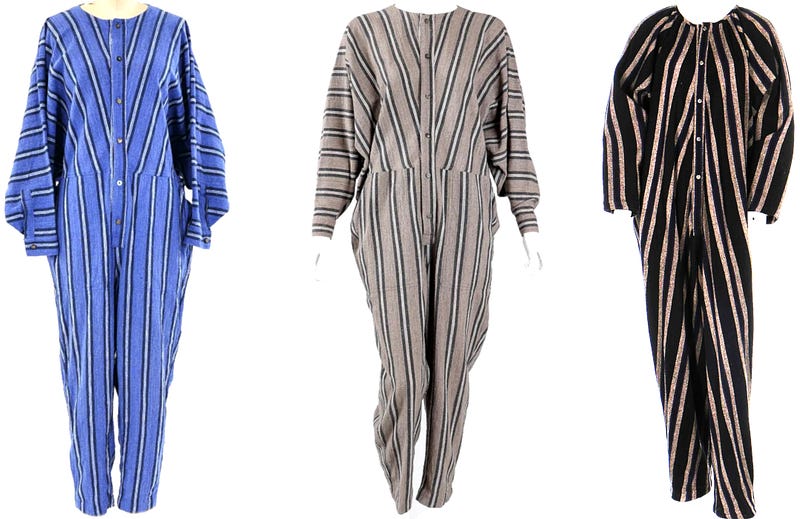
Miyake also explored gender identity and its fluid nature by developing a mix-and-match line of clothes intended as interchangeable menswear and women’s fashion. His ‘Plantation’ brand favoured unisex style and comfort and was not marketed in alignment with any age-range or body-type. It captured the Eighties zeitgeist when ‘gender-bending’ and non-binary sexuality was becoming mainstream and marketable.
Building on the concept of a garment made from a single piece of cloth, using folds and pleats to govern form and flow, Miyake began exploring the possibility of producing clothing from a single, continuous thread. Perhaps he was inspired by Paul Klee’s idea of taking a dot for a walk to produce a line drawing before walking that line off the page and into the three-dimensional world... Miyake certainly took this idea and ran with it.
In the late 1990s, he embarked on a technological journey of exploration and experiment in pursuit of a garment made from a single thread. Sounds like something from a folktale but, to the immense credit of team Miyake in collaboration with Dai Fujiwara, he managed to complete this seemingly impossible quest. This was achieved by approaching the problem as a piece of engineering and uses state-of-the-art computer modelling and manufacture. This innovative suite of technology he named A-POC, a play on the word ‘epoch’ and the initials for ‘a piece of cloth’.
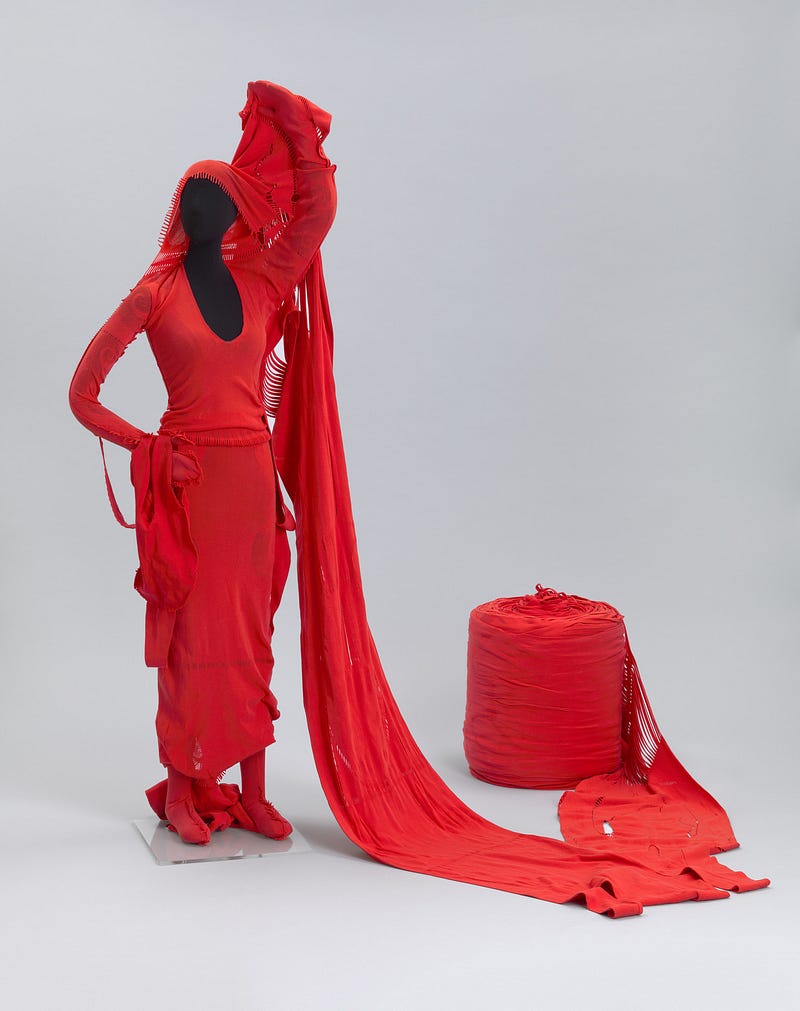
The process involves an industrial weaving machine that creates a potentially endless tube of fabric — from single threads of nylon, polyurethane, or cotton — which has a pattern of seams predetermined by a mathematical progression. A potential customer can cut along any of these seams without causing the continuous fabric to unravel. They may then adapt the detached section of tube into an individual item of clothing. Thus, with minimal cutting and stitching, the end user becomes the designer of their own exclusive, yet mass-produced, garment. The ethos is one of democratic design, personal empowerment, economic efficiency, and minimal material waste. One of the first prototypes to be run off in 1997 was the bright red A-POC Queen, now in the permanent collection of New York’s Museum of Modern Art.
As part of a considerable design legacy, Issey Miyake, established The Miyake Issey Foundation to preserve a definitive archive of his works and also to run a professional training programme. He also set up Reality Lab as an off-shoot of the Miyake Design Studio. Its remit includes continual research and development to address environmental issues and help engender a better, increasingly socially aware, design practice for future generations.
Perhaps fittingly, as a nod to Miyake’s early inspiration, Reality Lab produced a series of sculptural lighting designs reminiscent of Isamu Noguchi’s classic Akari lamps launched in 1951, around the same time as the Hiroshima Peace Bridges were being built. The sculptural Akari lamps were inspired by traditional Japanese cochin paper lanterns that can be stored flat but unfold into variations of a facetted sphere or cylinder. The IN-EI range of lanterns designed by Miyake’s Reality Lab work with low-energy LED light sources and are folded in the style of tessellated origami. They appear to have the lustre of quality paper but are made from recycled PET plastic. The Japanese term in-ei translates as something like “shadow, shadiness, or nuance.”
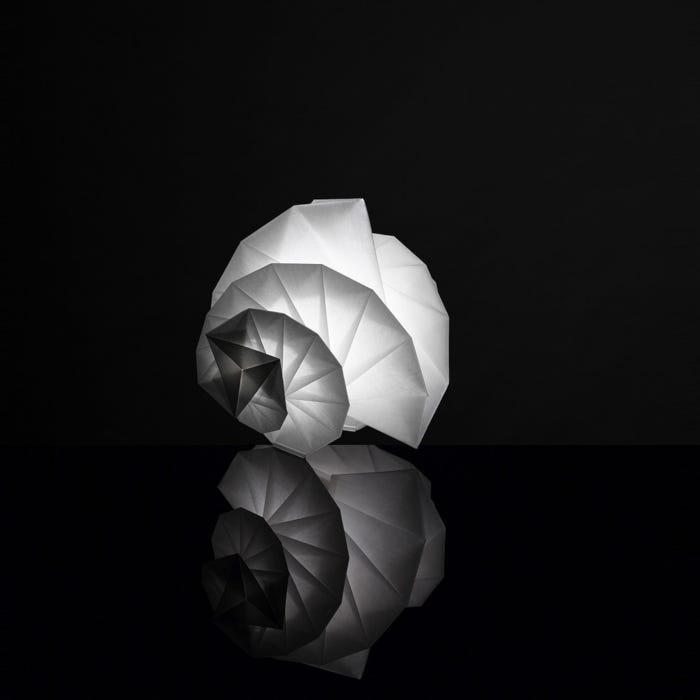
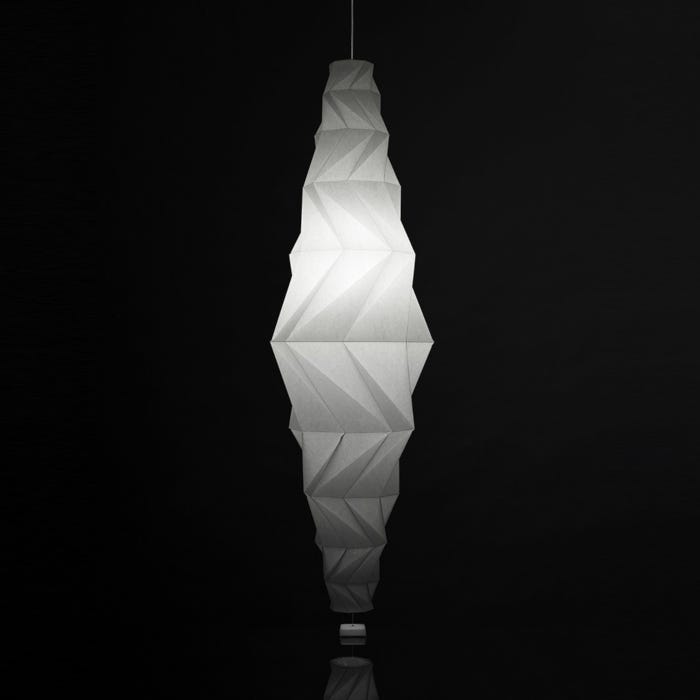
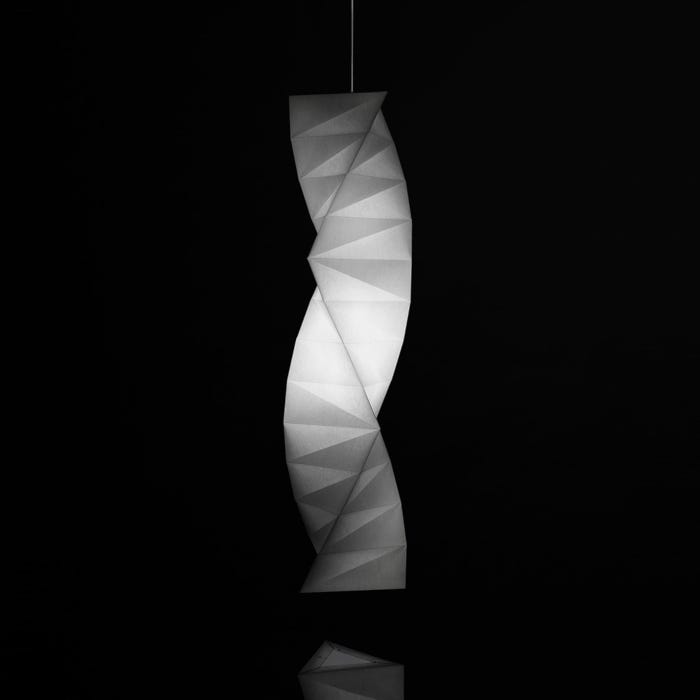
The IN-EI range was developed with the high-end Italian decor dealers, Artemide, who still manufacture and market the lanterns. They may be prohibitively priced, but the principles might just inspire the end user to be the designer, exploring their own geometric progressions of origami-inspired folds and pleats… Issey Miyake, who died earlier this month, would probably be happy with that.
You can still take a virtual tour of the 2016 retrospective exhibition, The Works of Miyake Issey, at Tokyo’s National Arts Centre via Google Arts and Culture.
* All images are used with license, or presented here for educational purposes under fair usage policy.


