
When Ziggy Stardust Fell to Earth
Considering how Bowie’s iconic persona fused multimedia fictions in a Pop Art cycle of creative feedback.
“Man is least himself when he talks in his own person. Give him a mask, and he will tell you the truth.” — Oscar Wilde
The character of Ziggy Stardust was created and played by David Bowie — a parallel personality that is both fictional and biographical. With the 1973 album, The Rise and Fall of Ziggy Stardust and the Spiders From Mars, Bowie examines the outsider role of rock’n’roll stars, and other such artists: characters that exist in extremis for the vicarious enjoyment of the mass audience, an audience who may fantasise about living such a lifestyle, yet welcome the ultimate ‘morality-tale’ in the (self) destruction of such characters.
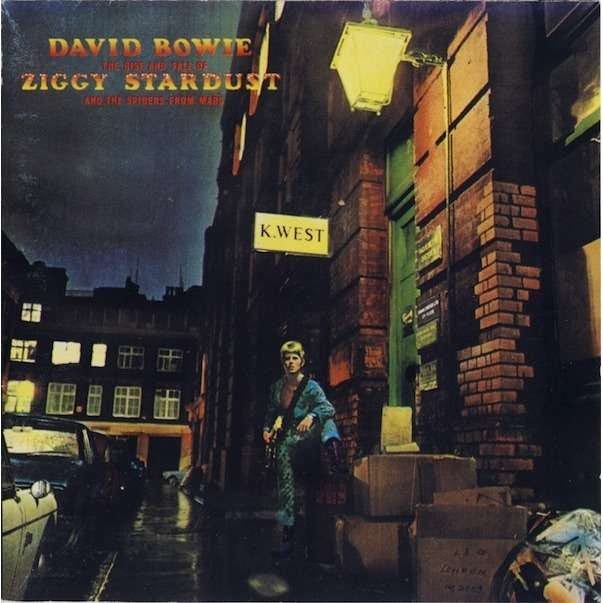
Ziggy has clear parallels with Thomas Jerome Newton, a character created 10 years earlier by Walter Tevis in his 1963 novel, The Man Who Fell to Earth. This strong connection landed Bowie the starring role in Nicolas Roeg’s 1976 film adaptation of the book. He proved to be perfect for the part.
Bowie had hoped to contribute to the soundtrack and some of the music originally composed with the film score in mind later appeared on his album, Low (1977). He used images from the movie as the cover for Station to Station (1976) and Low — one gets the distinct impression he strongly identified with the central character!
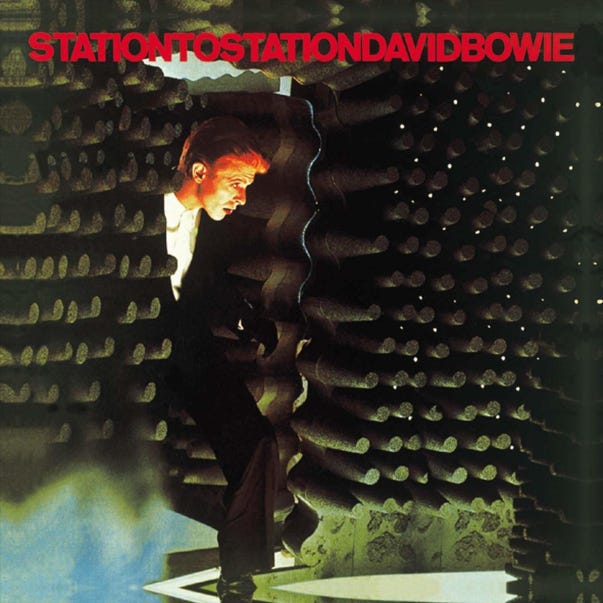
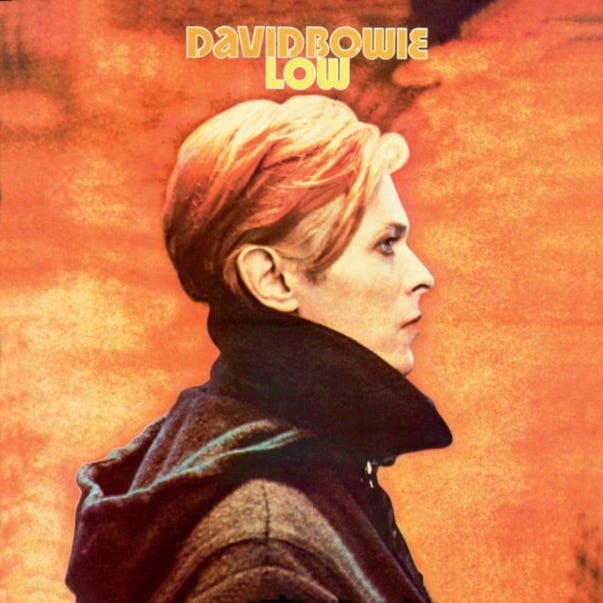
In this way the concept of Ziggy Stardust can be seen as a result of creative collaboration and as part of a cycle that ‘feeds-back’ into and complements one of its influences — the original novel that became the film. This is a fine example of Post-Modern cross-referencing and could also be seen as a near definitive work of Pop Art. The concept spans across different mass media — literature, popular music, theatre, cinema — and spills into the secondary cultural network of criticism, reportage and hype.
In Bowie, the characters of Stardust and Newton instantly became fused and can be seen as facets of the same archaetype. Both characters become seduced by the excesses of the rock ’n’ roll lifestyle and are ultimately ‘loners’. It is ambiguous whether Ziggy Stardust is an alien from outer space or if he is, temporarily, the conduit for an extraterrestrial consciousness. Whichever he is, he is privy to the fact that the world will end in just five years time and chooses to communicate to the human race through the medium of pop, broadcasting a message of peace and harmony. There is hope that, even if the planet is doomed, its inhabitants could be redeemed before their demise.
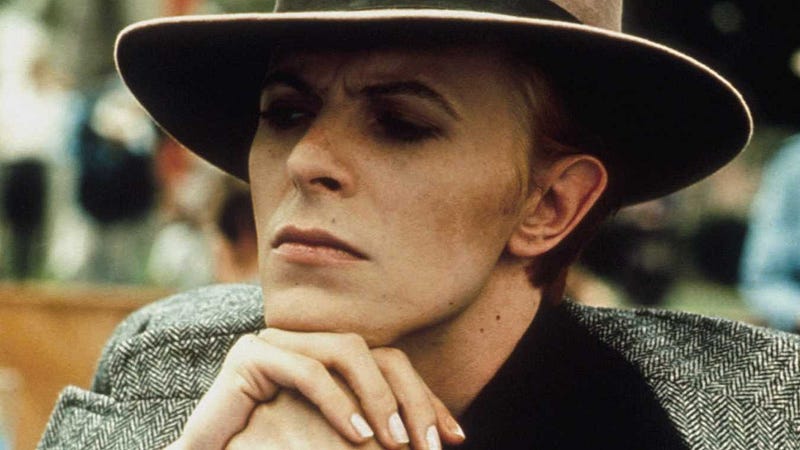
Thomas Jerome Newton is definitely an alien who has been sent to Earth in a last-ditch attempt to save his own parched planet of Anthea. His mission is either to prepare the earth to receive his planet’s refugees, or construct space vessels capable of transporting much needed water back to his home-world.
He quickly builds an impressive business portfolio of cutting-edge technology companies and products, though also begins to realise that he will be unable to complete his mission. Poignantly, he writes songs and records groundbreaking electronic rock music that he hopes will carry his lyrics out into space where his distant family will, perhaps, hear his voice once more…
Newton will live on in the little time-loop bubble of the film. Ziggy Stardust became established in modern mythology. He too lives on as a non-corporeal being whose ghost emanates from the album and its music, across many formats that would have been science fiction when first recorded. Multiple manifestations are resurrected whenever anyone watches the landmark live concert in Donn Alan Pennebaker’s feature length film Ziggy Stardust and the Spiders from Mars (1973).
This blurring of the Ziggy-fiction with the Bowie-real continues in a new graphic novel, Bowie: Stardust, Rayguns & Moonage Daydreams (2020). Illustrated by Michael Allred and scripted by Steve Horton, the artefact attempts to capture the spirit of the Bowie-Ziggy alter-egos that have achieved immortality in the public imagination.
With Ziggy Stardust, David Bowie created the template for the Modern rock star. He was image-conscious in his public projection, utilising theatrical make up and costume design. His definitive manifestation of Glam Rock played with gender ambiguity and contrasted this with ‘cock-rock’ posturing. He changed the face of rock’n’roll, elevating it to an art form and setting a benchmark for those many who were to follow, also foreshadowing important transmedia genres such as Cyberpunk and Futuregoth. Ziggy Stardust remains a pertinent multi-media ‘essay’ about ‘The Other’ and otherness.
The origins of Pop Art have been discussed by Remy Dean in the Signifier articles, Proto Pop in the UK and Op or Pop? and When Art Went Pop! in the USA.
Originally published at https://dean-evolution.blogspot.com.


