
The Hole Story
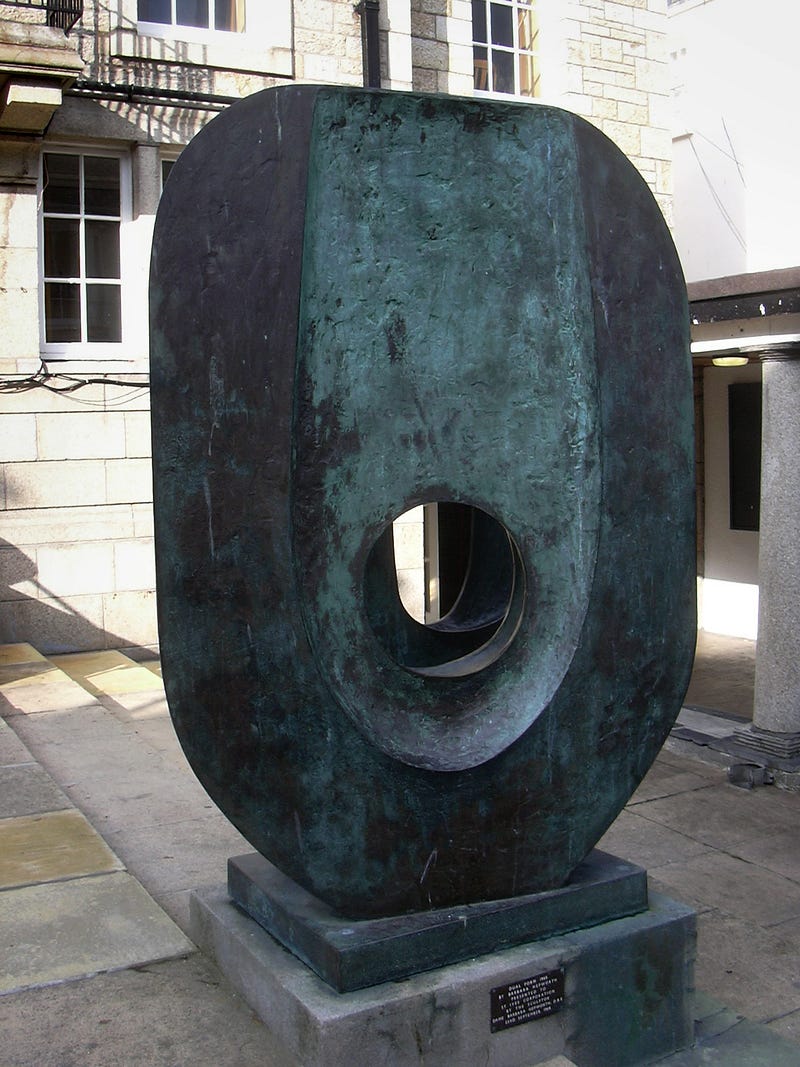
As early as the 1930s, sculptor Barbara Hepworth innovated the flow of space through form as a dialogue between volume and void.
The Pierced Form is a strange term for the lovely curves in many of the rounded sculptures which surround negative space, in the form of a hole, as developed in Barbara Hepworth’s transitional works. Yet it emphasises the revolutionary nature of her exploration of ‘space contained within form’ in this manner. For western art, it was a pioneering development which influenced her contemporary Henry Moore as well as future generations of sculptors.
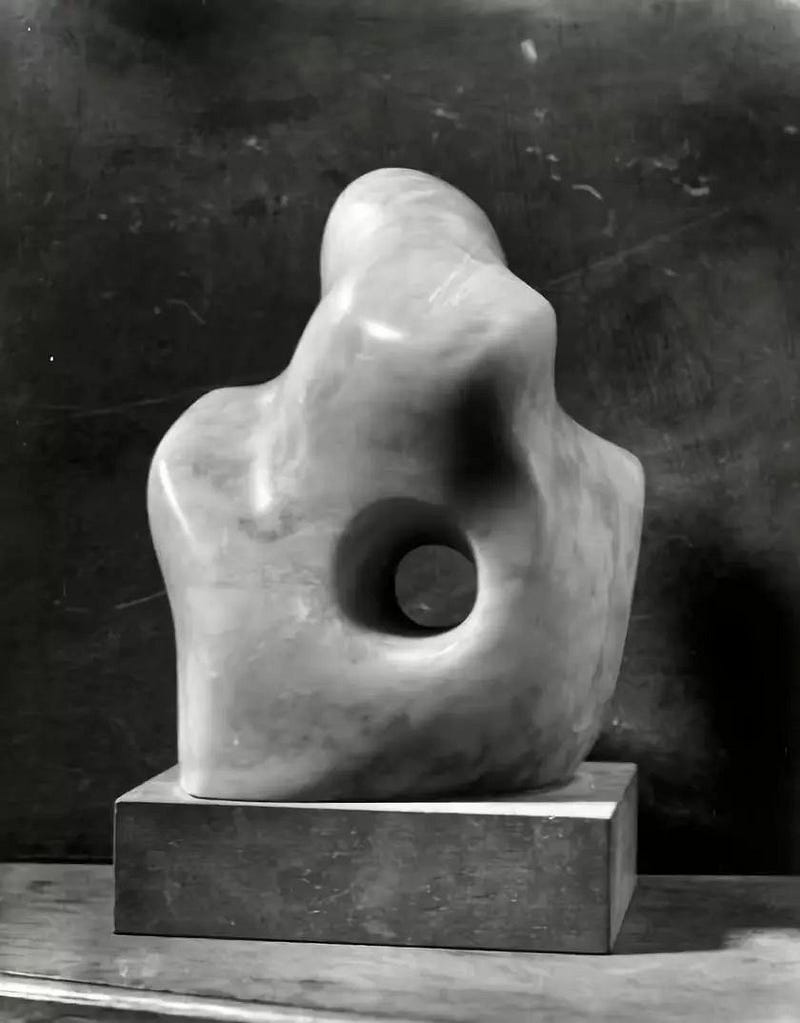
“The holes I make depend on what I want to see… the depth, the thickness, the curvatures, the arc, the swoop, the spiral.” — Barbara Hepworth
Hepworth was born in Wakefield, the West Riding of Yorkshire, in 1903. Her father was a civil engineer, and she would accompany him in his travels around the countryside. She proved a talented artist, attended art school in Leeds (along with Henry Moore) and then won a county scholarship to study at the Royal Academy London. She was runner up to the Prix-de-Rome, won by John Skeaping whom she married while travelling in Italy in 1925. They visited Siena, Florence, Rome, and she learnt how to carve marble from master carver Giovanni Ardini.
On their return to London, the couple exhibited work from their flat in St John’s Wood. Explaining her working process at that time, she wrote:
“By 1930, I felt sure that I could respond to all the varieties of wood growth or stone structure and texture. The Head, carved in 1930, expressed that feeling of freedom, and a new period began in which my idea formed independently of the block. I wanted to break down the accepted order and rebuild and make my own order.”
Then in 1931, while holidaying in Norfolk along with Henry and Irina Moore and Iven Hitchens, Hepworth met and fell in love with the abstract painter Ben Nicholson. Hepworth and Nicholson lived and exhibited together back in London in 1932, when her sculpture Pierced Form was first displayed at the Tooth and Sons Galleries. In retrospect, it’s hard to grasp just how strange and radical this seemingly natural innovation was, even to the artist herself…
She had enjoyed the result of carving a hole through the abstract form she was working on so much, but she doubted its validity in terms of sculptural language. So, she photographed the work and took the pictures to show a set of associates, among them Jean Arp, Pablo Picasso, and most importantly Constantin Brancusi. All of them gave her encouraging comments, but it was in Brancusi’s studio that she had a profound revelation that was to affect the rest of her work that followed. She wrote of her epiphany:
“I encountered the miraculous feeling of eternity mixed with beloved stone and stone dust… the simplicity and dignity of the artist… great millstones used as bases for classical forms; inches of dust and chips on the floor; the whole great studio filled with soaring forms and still, quiet forms, all in a state of perfection in purpose and loving execution, whether they were in marble, brass or wood — all this filled me with a sense of humility hitherto unknown to me.”
Hepworth’s first Pierced Form suggests the of neck and shoulders of the classical sculptures she must have studied in Italy and the hole intimates a wound or, equally, a mouth opened to scream or sing. Yet the form, carved in pink alabaster, is a rounded and beautiful precursor to Hepworth’s future abstracts. Maybe it was a reflection of her emotional life, and her search for a sense of freedom from conformity that led her to this (literal) breakthrough. Although always influenced by natural forms, Hepworth later remarked that she pierced materials simply “to make an abstract form and space: quite a different sensation from that of doing it for the purpose of realism...”
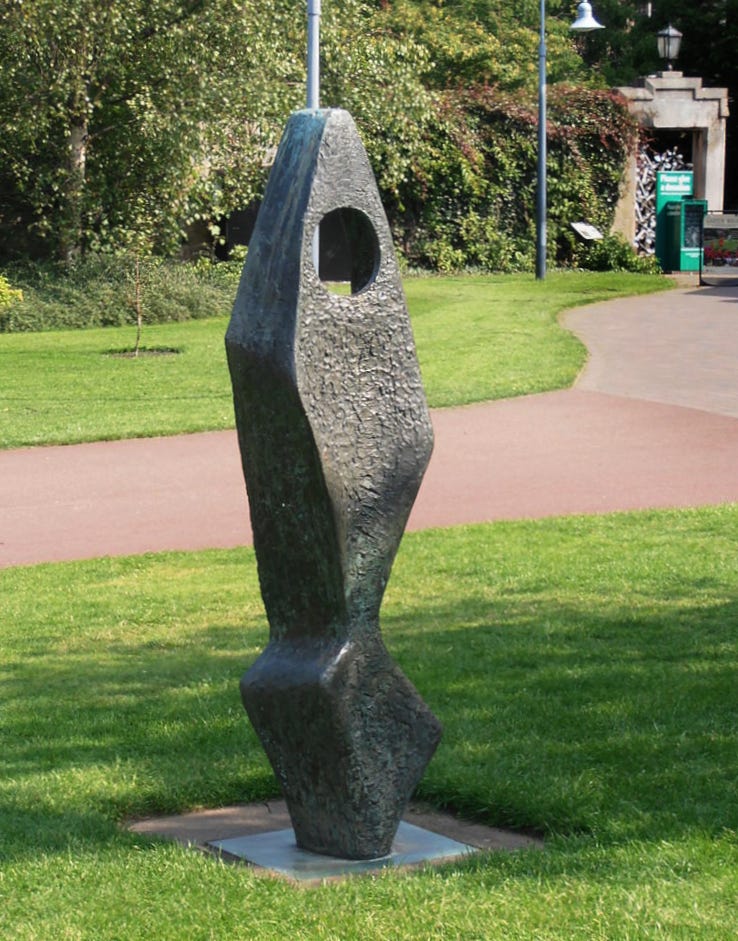
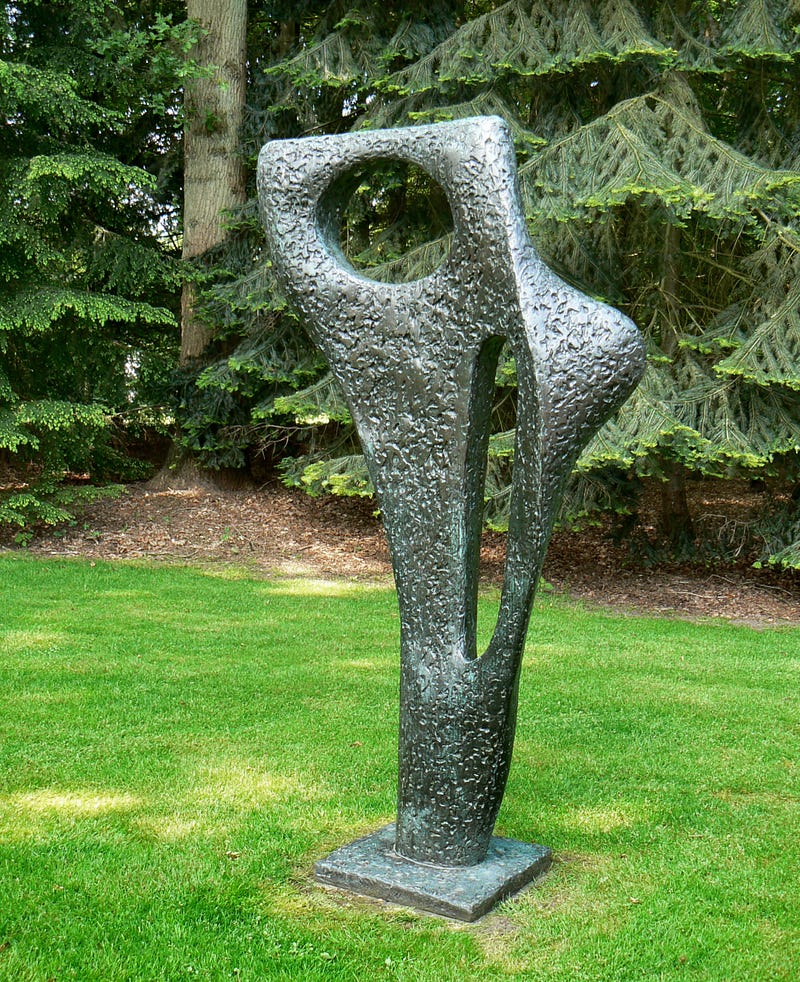
In many ways, Hepworth was transiterating the approach of Eastern potters who saw the making of a vessel as sculpting around the form of the spatial volume to be contained. This attention to the so-called ‘negative’ space was only just beginning to be considered in the abstract sculpture of the west when Barbara Hepworth produced her first Pierced Form in 1931.
Also, the similarity to gongshi stones can’t be overlooked. Such natural stones had been revered in Chinese culture for thousands of years. A gongshi, or ‘spirit stone’ can take many forms but the most sought after are often referred to as ‘scholar stones’. These are large, highly-eroded rocks with holes that transit their form.
Scholar stones were first moved form the natural sites of their origin and presented as sculptural forms as early as the second-century BCE in royal gardens and temples of the Han dynasty. They were admired for their aesthetic beauty but also used as meditation aids by priests and, yes, scholars who would, metaphorically, travel through their portals to another realm of spirit. These stones were physical forms that hinted at the metaphysical, drawing attention to the invisible, and expressing the intangible. Though Hepworth maintained that her approach was purely formal…
“…all traces of naturalism disappeared, and for some years I was absorbed in the relationships in space, in size and texture and weight, as well as in the tensions between forms.”
Throughout the thirties she travelled and met many influential artists, many of them displaced during the onset of war, including Wassily Kandinsky, Piet Mondrian and Georges Braque. She continued to work after giving birth to triplets, saying, of herself, “A woman artist… is in fact nourished by this rich life, provided one always does some work each day; even a single half hour, so that the images grow in one’s mind.”
She was part of the historic Abstract and Concrete exhibition of 1936, which toured the UK and featured works by pioneers such as Mondrian, Kandinsky, Arp, Giacometti, Miró, Calder, Moholy-Nagy, Helion, Nicholson, and Moore.
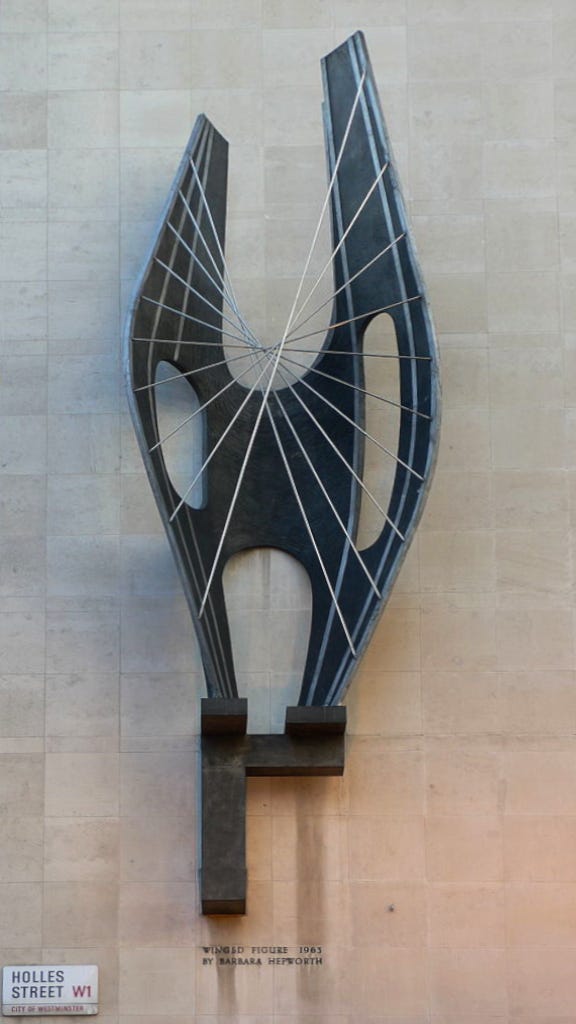
Hepworth and Nicholson moved to St Ives at the outbreak of the Second World War and offered a haven for many artists there, establishing its now famed artists colony. Sadly, the first pierced form sculpture was destroyed during the Blitz and only photographs survive, but she went on to exhibit at the Festival of Britain in 1951. This boosted her fame and she became a fashionable, sought-after artist for public art commissions throughout the 1950s, '60s, and into the '70s. Much of her subsequent work can now be seen at St Ives, collected at the Barbara Hepworth Museum and sculpture garden.
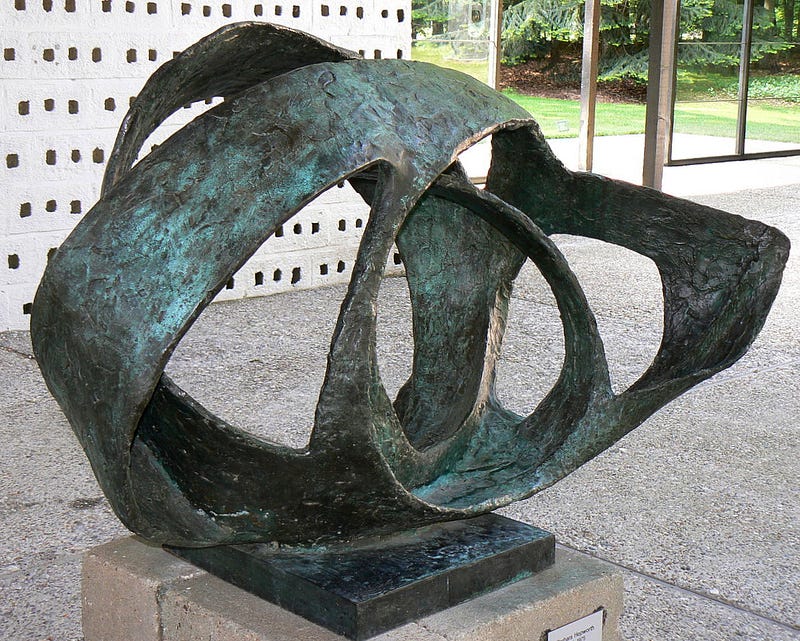


_by_Barbara_Hepworth,_Royal_Botanic_Garden,_Edinburgh.JPG)
.JPG)
.JPG)

