
Better Marketing Style Guide
Formatting tips, what to submit, and what to skip

Note: This is an old version of our style guide. Here's where you can find the newest resources about our publication: Better Marketing Style Guide
Write for Better MarketingAt Better Marketing, we receive close to 1,000 submissions per month. Right now, our rejection rate is about 70%, and we only expect that number to increase.
There is, however, a lot you can do to increase the likelihood of your article being accepted. This style guide is meant to give you all the possible steps you can take to ensure your article is a great fit for Better Marketing. It won’t guarantee your article will be accepted, but it’ll maximize your chances.
We’ll cover grammar, formatting, what topics and stories to avoid, and some ideas of what we’re actually looking for. Let’s begin.
1. Grammar
Every Better Marketing article goes through our copyediting process, in which a professional editor ensures your piece complies with our internal style guide in terms of grammar and formatting. This allows us to have a uniform quality standard for every piece we publish, and it’s part of our commitment to great writing and to you.
We understand many of our authors are not English native speakers, and your article needn’t arrive in perfect Oxford English to be accepted, but there are two advantages to doing a basic grammar check yourself before submitting:
- The less time we need to edit your article, the faster we can publish it.
- The less time we need to edit articles overall, the more articles we can run in any given month — including yours.
There is no need to complicate this step. A free tool like Grammarly will do. They even have a browser extension that works in the Medium editor. Make sure your article doesn’t throw any errors before you submit it, and you’ll have taken the first step in the right direction. A few more pointers:
- Whether you write in British English or American English, we’ll retain the respective spellings throughout the piece, but try to be consistent in one or the other.
- We use the Oxford comma. Lists should have a comma after their second-to-last item. Example: These tips work for blogs, websites, and social media.
- Generally, the Associated Press (AP) Style Guide format is a good reference.
2. Formatting
Besides grammar, the next-easiest thing you can do to make sure your story is up to par is proper formatting.
1. Titles, subtitles, and section headers
Medium has published a great guide on how to format your title. The gist of it is this: Highlight your title in the editor, then click the “Large T” formatting button. Type your subtitle right below, then use the “Small t” formatting, and you’ll end up with this:

At Better Marketing, the sequence of the three first element the reader sees when opening your article is this:
- Title
- Subtitle
- Cover image (more on those in the next section)
Please keep them in the right order, and don’t add a kicker. Use AP style to capitalize your title, meaning minor words are typed in lower case (of, to, the, a, in, by), with all major words being capitalized (Marketing, Facebook, Boost, How, That, From). For your subtitle, use normal sentence case: Only capitalize the first word and any proper nouns (English, Peter Thiel, Google, Paris), and don’t add any punctuation at the end (no periods, question marks, or exclamation marks). The above title is a great example.
We use Title Case Converter to adjust titles. Convert Case can help you convert title case to sentence case for your subtitle if you need to.
Finally, and this is crucial, make sure your title + subtitle combination does not exceed 100 characters. Medium has a 100-character limit in its previews. Breaking it is the number one way we see writers hurting their title’s ability to convince.
How do you come up with a good title to begin with? Medium has published a great guide on that, too, and has addressed it repeatedly in collections of tips on getting curated and best practices. Finally, we have a whole column dedicated solely to titles in Better Marketing, with over 20 in-depth guides on various aspects of good headlining.
Subheads should be formatted in title case and serve the function of breaking up your piece into digestible sections. Depending on the information you give, you can use your subheads to summarize the section that is about to follow or foreshadow its content with a clever metaphor.
Some final notes:
- Use verbs in their direct form in titles, avoid present continuous where possible. For example, Improve Your Google Ranking in 7 Steps rather than Improving Your Google Ranking in 7 Steps.
- The phrase How to should be formatted with a lowercase “t”.
- Don’t add question marks to How to titles. That is how people might google a question, but it’s neither a proper title nor colloquial language. Example: How to Come Up With Article Ideas, not How to Come Up With Article Ideas?
2. Cover images
All articles in Better Marketing have a cover image that follows the title and subtitle. Usually, this image comes from Unsplash, a great source for license-free images, which can be used by anyone for any project and purpose.
The easiest way to add this image is to click into a new line below your subtitle, hit the “+” button on the left, then the magnifying glass icon, and search on Unsplash for a relevant tag right inside Medium’s editor.
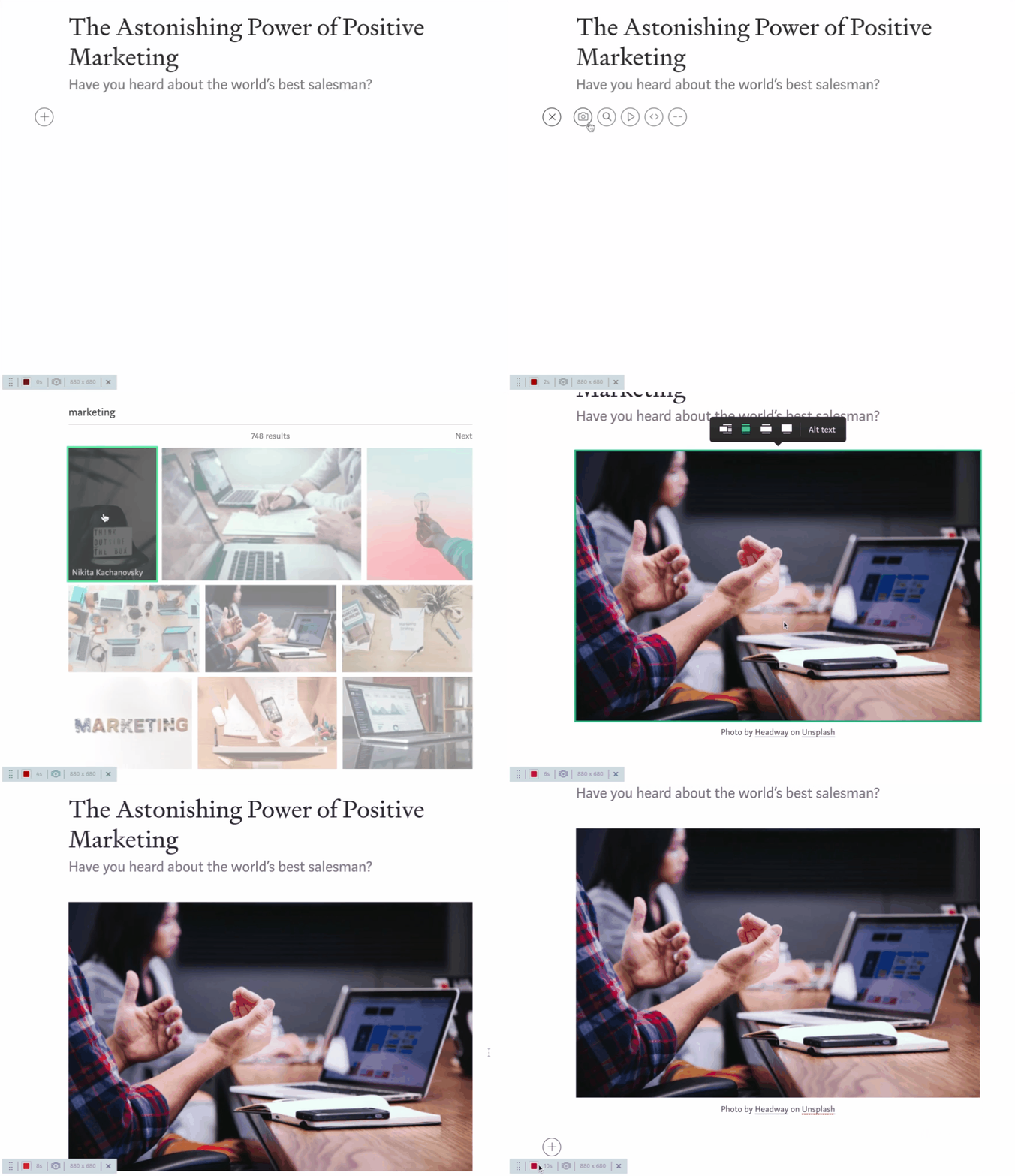
All images in your article must show proper attribution to their respective source. This is one of the most important aspects of a well-crafted article most authors miss. If you import an image via Unsplash using the above method, you’ll automatically see an example of sourcing done right:

Whether you phrase this as “Photo by,” “Image via” or otherwise doesn’t matter as much as naming the actual source of the image and linking to it. You’re free to use other free image sources, like Pixabay, as long as you credit appropriately. Whenever you’re using your own pictures, simply add “Image courtesy of the author” as the caption.
Please make sure you actually have permission to use the image in question. Chances are if you google “Disney Castle” and copy the first result, you won’t. Choose the right Google settings to find images that are free to use. You can see how to do so here.
Always add images in full resolution. When you just copy and paste them from somewhere around the web, sometimes you end up with a shrunken thumbnail version. All images should be as wide as the text body of your article and ideally offer bigger sizes when you click on them in the editor (this is a good sign the image’s resolution is high).
Don’t use the widescreen or expanded formatting for images — keep them all in body-width, as the example above. This way, your whole article has one width all the way through, which makes for a nice reading experience.
Refrain from images that are shocking or disturbing (nudity, violence, creepy costumes), and don’t try to embed advanced metaphors in your images (for example using an image of a rocket at liftoff if you have the word “Boost” in your title). Most readers won’t catch these analogies and just feel confused.
Stick with a simple, relevant image that relates to the main message or core theme of your post. If you’re talking about email newsletters, an image of an envelope is perfectly fine.
3. What to Avoid
A few disclaimers up front:
- Do not send us your first blog post ever.
- Also do not send us your first Medium post ever.
We have nothing against working with beginning authors, but generally, we find a lot of learning happens from one piece to the next for your first 5–10 articles — be it ever or those you publish on Medium’s platform.
By going through that learning curve on your own first, you’ll save yourself and us plenty of valuable time later, as we won’t have to explain so many basics, such as the formatting tips above, and you’ll feel more confident in what you submit to us.
That said, here’s a list of topics and stories you can most likely skip.
1. Topics to avoid
- Self-improvement (How To Be Successful/Make More Money/Get Fit)
- Politics (Should the Supreme Court Ban the Death Penalty)
- Productivity (3 Things You Need to Know About Being Productive)
- Leadership (5 Qualities of Great Leaders)
- Interviews (How to Run an Agency: An Interview With Pete Peters)
- Career advice that’s not highly specific to marketers (How to Ace Your Next Job Interview)
- VC talk (How to Raise Venture Capital During COVID-19)
- Lists of non-marketing resources (25 Podcasts That Have Changed My Life)
- Diary-like personal confession posts (Why I’m Grateful for Losing My Job)
- Trend pieces that mostly rely on statistics (5 Video Trends for 2020, Backed By Research)
- Stories about writing on Medium that we’ve run before (What I Learned Writing on Medium for 30 Days)
- Stories about financial results on Medium that we ran before (How I Made $457 From One Article)
For the last two, a simple search will reveal the many pieces we’ve published about writing and earning on Medium already. Please browse the list to see if what you’ll share hasn’t been said in a very similar way before.
Furthermore, here are some new topics that have emerged as a result of coronavirus that you might feel tempted to write about, but that, for the most part, won’t fit into Better Marketing:
- Working from home tutorials (How to Look Less Tired on Zoom)
- Business pivots (How This Brand Is Adapting to Covid-19)
- Crisis communication (What You Should Tell Your Customers About Coronavirus)
We’re running very few of these stories every month because so many are being shared and posted already. We prefer to focus on more evergreen advice. A good tutorial about communication will always be useful, and it needn’t be disguised as a coping mechanism for our current situation to find the audience it deserves.
There are exceptions to every rule, and, at Better Marketing, the exception is that if your post helps marketers solve a marketing issue as it pertains to the above topics, it might still be a fit for our publication.
This doesn’t mean you can add “politicians are good marketers” to your intro and then hope your post about politics will fly. But it does mean that if you can share a list of seven email hacks specifically aimed at helping marketers do their job, that can — and will — have value to our readers.
2. Types of stories to avoid
The good thing about having lots of data is that patterns emerge. Here are a few of them — particular types of stories we see submitted again and again and again, despite them having, for the most part, poor audience reactions.
1. X Reasons Why You Should Do Y
Let’s say you and I are getting lunch. You’ve looked at the menu and decided to get pancakes. Your mouth is watering. The waiter comes, but I tell him off and say: “Let me tell you why you should have the bean salad.”
Then, I start rattling off the benefits of bean salad. It has protein. It’s good for your gut. It’s healthier than pancakes. On and on. Within two minutes, you’re ready to punch me in the face. No one is changing their mind — and we’re still not eating.
This is what you are doing to your reader when you write a post called “7 Reasons Why You Should Try Affiliate Marketing.”
You’re hardly convincing anyone because people are perfectly happy moving through the world with pre-existing opinions about everything. You’re also not getting many clicks, views, reads, and shares. Mostly because people have already decided, but also because, even if you did convince them, you’re not showing them how to get the result you’ve just dangled in front of their face.
The one time it makes sense to write a “Why You Should Do X” post is when X is something we’ve never heard of — and by now, we’ve heard a whole lot.
We reject 99% of posts arguing to do something without showing how to do it.
Here are some example headlines of articles that were rejected for this reason:
- Why Restaurants Should Focus on Brand
- Why You Should Use Unique Images on Medium
- Why I Believe CEOs Should Personally Manage Their Company’s Social Media
- 4 Reasons All Bloggers Need a YouTube Channel
- Why Your Business Should Be Focusing on Social Media Marketing During This Pandemic
- Niche Brands Will Rule the World — Here’s Why
- Nudge Marketing and Why It Is More Effective
- Why Digital Marketing Sucks for Most Brands
- Why Content Marketing Will Always Remain an Evergreen Marketing Tactic
If everyone already agrees you should be doing something, you’re not doing us a favor by telling us we should “get in on it.”
Affiliate marketing, influencer marketing, social media marketing, a funnel, an email list, Twitter, Snapchat, TikTok. We know these things exist. We know there’s a way to succeed with them. We want to. We just don’t know how.
If you can tell us how, that’s fantastic. Please do it. But until you can, let us have our pancakes and get on with it.
2. Generic steps and tips the reader can’t copy
Slightly better than posts arguing for obvious trends and tactics are posts outlining generic steps on how to follow these trends and tactics. Sadly, that’s still not good enough. I’m sure you’ll recognize some of the following phrases, which give these kinds of posts away:
- “Define your target audience.”
- “Be unique.”
- “Give value.”
- “Be authentic.”
- “Post consistently.”
- “Use data.”
- “Know your customer.”
- “Set a goal for your campaign.”
- “Share on social media.”
- “Create engaging content.”
These aren’t instructions. They’re imperatives, but imperatives we can’t act on. They’re vague, and we commonly resort to them in lieu of actual experience when we realize we don’t have enough of it or, often, none at all.
While real experience in what you’re teaching people is the gold standard at Better Marketing, it’s not the only way to give meaningful advice.
You can also think hard about something, research examples, and try to break down what they did well, or tell a story about how you failed in completing the steps and why you think you did.
All of the above advice can be good, but it needs to meet at least one of the following two criteria, ideally both:
- It provides detailed instructions the reader can follow to implement this step in their own work and business.
- It provides a specific, tangible example of a business or individual who did implement this step and did it well (or badly), and thus serves as instruction on what to do (or what not to).
We know providing these is hard, but that’s exactly what makes them valuable. Crafting good instructions takes work because you either have to test the advice, find someone who did, or do a lot of research.
If you do this work, however, we’re much more likely to accept your article.
Here are some example headlines of articles we rejected for being too generic:
- 6 Rules for Marketing Your Startup
- How to Be More Creative in Your Advertising
- 3 Keys to Marketing Effectively During COVID-19
- The 5 LinkedIn Hacks That’ll Give You the Biggest Advantage in Your Job Search
- New Trends in Marketing Communications and Event Management 2020
- How to Stack Your Offers in a Value Ladder
- 13 Amazing Tactics to Get Premium PR for Your Startup
If you fill in some of the above phrases for the tips behind these titles, you’ll understand why they might have failed to deliver on their promises.
It’s easy to rattle off a list of software tools, copy descriptions from Google, and link to their home pages. So is listing a bunch of trends or statistics without showing how to act on them.
If we can find what you’re showing us on Google in the next 30 seconds, it does not belong in Better Marketing. Do the hard work. It always shows.
4. What to Submit
The easiest way to develop a great gut feeling for what you should submit to Better Marketing is to read Better Marketing. It might sound obvious, but a lot of our submissions show people don’t do it.
Here’s an excerpt from the broad range of topics we cover and always love to see more on.
1. Topics to write about
- Marketing case studies (How I Got My Startup Covered in the New York Times)
- Social media tutorials (How to Build a Writing Community on Facebook)
- Social media case studies (SparkNotes Shows How to Go Viral on Twitter With Humor)
- Paid advertising tutorials (How I Used Facebook Messenger to Sell More Online Courses)
- Retargeting tutorials (The Complete Guide to Pixels & Custom Audiences for Personal Brands)
- Conversion rate optimization (What Are the Key Elements to a High-Converting Landing Page?)
- Data analysis for marketers (Marketing Dashboards: A Complete Guide to the Right Tools, Metrics, and Questions to Ask)
- Copywriting (7 Lessons From Gary Halbert to Make You a Better Copywriter)
- Creativity (Most Writers Will Never Have an Original Idea)
- Branding (How to Rebrand Your Startup in 9 Steps)
- Psychology of sales and persuasion (within ethical reason) (How to Use the “Door-in-the-Face” Technique to Sell More)
- Logo design (Wix Logo Maker vs. Fiverr Designer vs. Strategic Branding Consultant)
- Book publishing (10 Tips for Writing a Query That Will Impress Literary Agents)
- SEO tips, basic and advanced (The Complete Glossary for SEO)
- Automation (How I Automated 38% of My Job as a Content Marketer)
- Technical writing advice (The Ultimate List of 320 Powerful Words to Use in Your Headlines)
- Resources to achieve specific marketing goals (The 6 Best Podcasts on Influencer Marketing)
- Strong, counter-trend opinions, backed with solid arguments (Why Influencers Should Never Work for Free)
As you can see, even with the limitations above, creativity is hardly limited. As long as you help us with the moral obligation of marketing, there are no boundaries on what you can cover.
2. Types of stories to write
Just like we see patterns in what doesn’t hit home with our audience, we’re also lucky to have spotted some in what does. Here are two types of posts that consistently perform well in Better Marketing.
1. Case studies/breakdowns/analyses of real-world examples
After I tell you about my favorite pizza place down the street, you decide whether you’ll eat there or not. Now, we can talk about what worked and what didn’t. This was a real instance of marketing.
If all I do is think about “my target audience” or read a book about persuasion, there’s nothing to assess. Sure, we can hypothesize and dissect theories, but at the end of the day, that’s not what we’re here for, is it?
This isn’t to say theoretical articles aren’t useful. It’s to say that, as the German saying goes, “trying is better than studying.” The beauty of writing is that you can think about what someone else has tried and still end up with a practical, realistic study of what works (or what doesn’t).
There are three sub-categories in the bucket of real-world examples:
- The case study. This is usually a complete, first-person account of an experience or event you were a part of (How We Got Our Food Allergy App on National Press Overnight).
- The breakdown. This type of post covers a resource, ad, or campaign element by element, either chronologically or sequentially. By dissecting what’s good and bad about each one, the reader can then piece together a similar result themselves (Jerry Jenkins Has the Perfect Website).
- The analysis. A deep dive into selected, relevant parts of a marketing effort, sometimes through the lens of a certain framework (A SWOT Analysis of P&G’s Marketing). This could be heavily backed with data (The Effect of COVID-19 on Cost-per-Click for Ads in Various Industries) or more story-driven (How Hooter’s Shady Marketing Tactic Backfired Hard).
How did you find out about your favorite product? Which marketing tactic finally worked for your startup? What cultural trend from your childhood would you love to see revived?
Marketing is all around us. Those who think about it and help us understand it will determine what it looks like tomorrow.
2. How-to tutorials in detailed steps
What’s even better than explaining how you think something works is walking us through how you did it. This is the gold standard at Better Marketing: experience-backed tutorials. A great tutorial builds on three elements:
- A real result. Usually, you show this in the intro, and then give some context on how you’ll try to help your reader replicate this.
- Detailed, clear-to-follow instructions. It might take lots of screenshots, words, and digging in your email inbox or browser history to provide them, but this is what makes good advice actionable — and thus great. Don’t think “back flap text of a book,” think, “IKEA manual.”
- Empathetic fallbacks in case of failure. Show us you understand that we might (and will) fail in recreating your result, and, better yet, give us alternative options of what we can do when it happens.
For more information on empathic, experience-backed tutorials, I highly recommend the Better Humans style guide and submission guidelines.
Here are some articles that have lived up to that standard well and that we are extremely proud to have published in Better Marketing:
- How to Make Big Money Writing for Tech Startups: A Step-by-Step Guide
- How to Properly Promote Your Blog Posts on Twitter
- How to Schedule, Manage, and Analyze Your Next Reddit Campaign
- How to Write Killer Opening Lines: 6 Principles the Best Writers Know
- The Wiki Strategy: How to Grow Your Blog to 100k+ Monthly Visitors
- How to Grow a Facebook Page to 10,000 Followers (and Beyond)
- Facebook Advertising Decoded in 15 Minutes
- The Complete Guide to Building a Personal Brand in 2020
- The Complete Guide to Attracting a Loyal Audience for Your Writing
- The Complete Guide to Uploading a Marketable Book on Amazon KDP
Once again, creating a great how-to is hard work — but it’s good and honorable work, and the results speak for themselves.
5. Loose Ends
Once you’ve done the hard part — writing something that matters — all you have to do is format your work and submit it to Better Marketing. Here are some final things to look at before doing so.
1. Your Medium profile
Medium themselves said it best: “You are your story’s best asset.” In a quick guide on how to make the most of your 160 characters, they explain everything you need to know: Include your full name (unless you’re using an alias), some relevant information about yourself, a clear picture of your face, and a link to anything you might want to promote to your readers, like your website, a book, or one of your social media channels.
2. Links and graphics
There are many ways to use links and graphics in your writing on Medium. Each publication has its own rules as to what works best for them, and so do we.
- All links should be placed within context, right inside your text. Don’t use Medium’s embed feature.
- If something isn’t well-known to the reader — a technical term, a website, brand, or person, a software tool, framework, or historical event — link to it (or more information about it).
- Don’t link to the same resource twice. Linking the first instance is enough.
- Our audience consists of marketers, trained salespeople, and seasoned professionals. Not everyone is a veteran, but most people are familiar with common marketing lingo and terminology, so there’s no need to over-explain terms like “content marketing,” “copywriting,” or “social media.”
- Graphics and images are welcome if they help illustrate a point or make something clearer for the reader. There is, however, no need for multiple Unsplash images within your article, next to the cover image up top. Please don’t use GIFs, memes, and emojis.
3. Self-promotion and calls-to-action (CTAs)
All articles in Better Marketing are part of the Medium Partner Program. The article is the product. People are paying $5/month to read articles inside Medium’s paywall. That means they’re not here to go elsewhere, and they don’t want to wade through a thinly disguised pitch fest in exchange for some potentially valuable information. Hence, our promotion policies are strict.
- Don’t include any affiliate links to books, courses, or anything else you or someone else is selling. We know how to recognize them, and we will either remove them or replace them with non-affiliate versions.
- Per Medium’s best practices: “Avoid CTAs. Readers tell us that they find repeated calls to action — to sign up for a newsletter, to clap — annoying.” At Better Marketing, we have decided to eliminate CTAs altogether. That means no “Please clap for my story,” “Join my newsletter,” or “Buy my book” at the end of your post. For more on our reasoning behind this decision, see here.
- It is okay to reference your other work in your article where relevant, but if we see excessive link-spamming to your blog or other articles, we’ll tone down the number of links in your piece.
4. Plagiarism
We do not accept, tolerate, or condone plagiarism at Better Marketing. If you don’t give credit where due, you’re stealing it.
It is very easy to give credit and, contrary to what repeat plagiarizers believe, it does not make you look like less of an original thinker. To the contrary, it makes you look like someone who knows how to assemble a new idea based on multiple sources. We’ll also think you’re generous, as will the originator of your quote, resource, or image. It’s win-win-win.
When in doubt, give credit. Give more than you think you need to, and you’ll be on the safe side. Mention people by name and link original sources. Quote, research, and remix to your heart’s content — but cite everything properly.
Here’s a good guide as to how, which is aimed at technical articles but works for other, non-technical topics as well:
Plagiarism is one of the most common reasons why we remove authors from our publication and prohibit them from publishing with us in the future. We have a one-strike policy here. If you plagiarize, we’ll ban you.
Don’t plagiarize.
5. Diversity and Inclusion
Better Marketing strives to be an inclusive place. Everyone is welcome to read what we publish, to submit articles to our publication, and to teach others in the process.
If you’re part of an underrepresented group — in the world of marketing, writing, business, or any other field — we highly encourage you to submit an article to us.
At Better Marketing, we seek clear, useful advice — and that advice can come from anyone.
6. How to Submit
When your post is ready, submit it via this form. We both accept drafts and already published articles. A few notes on good form submission manners:
- Don’t submit two posts in a row, unless you think the second piece is a much better fit for Better Marketing.
- Don’t spam the form with submissions you know are irrelevant.
- If you’re already a writer for Better Marketing, submit right on Medium. Stop using the form.
If you don’t hear back from us within three business days (we don’t work on weekends), please assume we kindly passed on your submission.
We get around 1,000 submissions per month, and it’s impossible for us to respond to all of them.
Thank you for reading. I hope this style guide has been helpful. If you follow the steps outlined here, you will maximize your chances of your post being accepted in Better Marketing.
We look forward to seeing your work, and if you have any questions, just leave a response below. Thanks and have fun writing for Better Marketing!


