
10 Tips for Writing a Query That Will Impress Literary Agents
From an agent who’s read about 10,000 of them

As a literary agent, I’ve read about ten-thousand queries. I’m sure there are people who have read more, but it’s kind of a lot. And if there’s one thing I’ve learned from evaluating so many, it’s that most authors would rather face Daenerys Targaryen’s angry dragon, endure the twelve labors of Hercules, or even clean the bathroom than write a fresh query. Believe me, it shows. But it shouldn’t be that hard or scary.
Agents want your queries. They need your queries and read each one hoping they’ll discover fresh, exciting, and marketable material. But they (and their assistants) have a lot of other duties as well. At the same time they’re wrangling dozens of queries a day, they must also negotiate contracts, submit manuscripts, and help edit promising material, among other important tasks, like lunch. So, the following points will help your email stand out in the proverbial crowd.
1. Avoid Shot-Gun Queries
Nothing will make an agent scroll down to the next email faster than reading a “Dear Sir/Madam” salutation (or frequently these days, no addressee at all). Spell the agent’s name correctly and be careful that you’re sending it to the right person. I can’t tell you how many queries I’ve received addressed to another agent at a different agency. Personalize your query for each agent, at least with a specialized intro or final paragraph. But don’t cheat by using generic statements such as “I am querying you because of your well-known list of great titles.” Agents will see through that ruse like Waterford crystal. There’s just no Jedi mind trick you can play to get around doing the proper research to find a suitable agent. You can mention books they’ve sold that you admire, a quote from an interview they gave, something they said at a conference you attended, or even a point they made on their website. Give some reason your project should interest them. Because, while agents go through a lot of trouble to attract queries, they also need to find ones that will be right for them.
2. Don’t Tell the Agent How Great Your Book Is
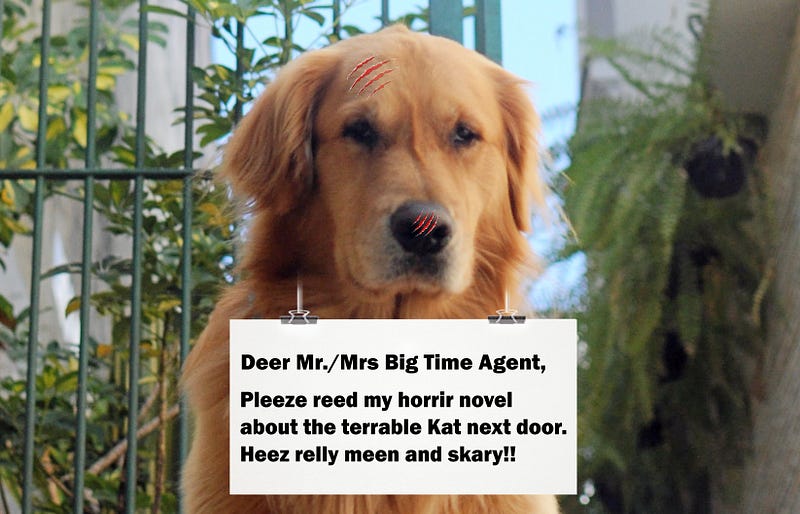
Show them. No one cares if your family, friends, and other writers in your writer’s group think you’re a genius. Make the agent admire your cleverness for themselves. If the book is a thriller, the query should be exciting. If it’s humorous, it should make them laugh. If it’s wise and philosophical, make the agent nod their head in appreciation. And don’t be coy. None of this, “Is the killer Sarah’s own husband, and can she stop him before he murders all his high-school bullies? Read the manuscript to find out!” That’ll go straight into the pass queue. Be confident, yet modest. Don’t be afraid to show your outstanding personality without going over the top. An example of over-the-top might be writing in the vernacular of your protagonist or babbling on and on like you’ve just downed a few espressos at Starbucks.
3. Research Each Agent’s Submission Guidelines
It’s to your benefit to follow individual guidelines because every agent or agency has its own system. Some may ask for a summary and bio because they’re flooded with new material every day, and it’s the only way to keep up with it. Others, like myself, may ask for a longer synopsis and writing sample. That’s because many prospective authors write awful queries for excellent material; or vice versa, write compelling queries for books that turn out to be full of plot holes and lazy writing.
In my case, my process is to give a preliminary scan of the letter to get a sense of the author, the word count, and the genre in which they’re submitting — maybe something like, “I’ve used my decade of experience as an analyst for the CIA to write this 101,000-word international thriller, The Russian Connection” — then jump directly to the writing sample. Yes, yes…I eventually read the entire query, but I pay more attention if I’m already impressed by the writing sample.
Also, authors have to realize that while their work might be well written, it may still rack up passes because there are always certain memes and scenarios making the rounds that might appear fresh or marketable to the author, but which agents have already seen in one form or another many times. Any topic that has been in the news lately, for instance, will end up as ripped-from-the-headlines stories making their way to agent inboxes. So, you have to create some kind of unique and intriguing twist involving unforgettable characters. Also, anytime a bestseller has impacted the public psyche, there will be hundreds of similar ideas shotgunned out: “My book is like Eat, Pray, Love, but in Tibet,” or, “It’s like American Dirt meets Where the Crawdads Sing.”
4. Avoid Using Rhetorical Questions
This once-popular style has been overused and is outdated: “Did you ever wonder what it would be like if you woke up and discovered you’d been transformed into a giant bug? Well, that’s exactly what happens to Gregor Samsa.” You might as well be scraping your nails down a mental blackboard in the agent’s head.
5. Don’t Call Your Book a “Fiction Novel”
A novel is by definition a work of fiction. Likewise, don’t refer to your memoir as a “novel.” A memoir is nonfiction.
6. Resist Writing Your Author Bio in Third Person Trying to Make It Sound Like the Back-of-the-Book Author Blurb
Unless this is a story about your family life, your bio should contain only subjects that pertain to your platform, experience, and expertise that make you qualified to have authored this book. Sorry, but mentioning your adorable pets, rambunctious kids and wonderful spouse won’t move an agent an inch closer towards reading your manuscript about a CSI protagonist or a soldier in a galactic war.
So unless this is a book about how someone can juggle their professional and family life, a bio like the following doesn’t you much good:
“Susan Smith is a CSI who lives in Minneapolis with her husband Bob, and their three amazing daughters, Charlotte, Emily, and Anne, who, like their mother, simply won’t take no for an answer. The family is filled out by two massive fur children, Ghost and Nymeria, that look like ferocious wolves but are playful as puppies.”
Better to save this for when the book is published.
Instead, you’d be better off with something more like: “As the head of the CSI unit for the Pittsburgh Bureau of Police for the past decade, I’ve investigated some 50 murders a year, so bring an insider’s expertise and eye for detail to this bizarre murder mystery.”
7. Research Word-Counts for the Genre in Which You Are Submitting
This one’s important, folks, because it’s amazing how many queries I read for “novels” that come in at 50,000 words or less — especially a couple of months after NaNoWriMo (and I’ve seen as low as 12,000 words recently!). Most works for the adult trade market should be no shorter than 65,000 words and no longer than 125,000 words, and even that’s pushing it, though certain genres may be more lenient in either direction. Epic fantasy, for instance, can be, well, truly epic! George R. R. Martin and Brandon Sanderson scoff at the word counts to which we mere mortals are subject. But most long submissions could easily stand to lose 50%, sometimes more, of their enormous length. As for short works, sure, 55,000 for a YA manuscript may be okay, and a few publishers have been revisiting novella length and serial ebooks these days, mostly in the romance genre. But it’s not the norm for commercial fiction.
8. Proofread Your Material
Agents will look past a few innocent typos if not too egregious. But be careful with those devious gremlins who live to spoil your masterpiece by inserting the wrong spelling of “your” and “you’re,” “whose” and “who’s,” “who and whom,” and “its” and “it’s,” especially in the first sentence! An amazing number of writers have expressed the hope that they’ve “peaked” or “peeked” my interest instead of “piqued.” Even English professors.
9. Don’t Claim Your Book Will Be a Bestseller
Being positive and confident is one thing, but boasting that your book will become a bestseller that interests millions of readers around the world, especially everyone who “has a mother,” is another. These statements are just too broad to wrap your head around.
While agents need to pay the bills, and love to put money in the bank, most prefer to do so by discovering books they think readers will fall in love with, rather than taking on something conceived and written for one purpose only — to make money. For instance, I love a great thriller, and can tell when one was written by an author who’s an adrenaline junkie having fun trying to keep me up all night worrying about how this great cast characters will overcome some terrible predicament. I can also tell when one was written by someone who’s just making a power-grab for the reader’s wallet with cardboard characters driving down a well-traveled and familiar road.
So, instead of a worldwide bestseller, focus on a smaller demographic. For nonfiction, for instance, a particular subject might interest “the million members of XYZ organization which hosts 400 groups in all 50 states.” But it might be a must-read for a certain subgroup of just 10,000 headhunters or project managers, for instance, who must keep up some yearly accreditation.
Or for fiction, try to narrow it down to a subgenre. Instead of saying the book will “interest millions of people who love thrillers,” consider something more like “this book will interest readers of legal thrillers or medical thrillers, or international espionage.” Or maybe “Chocolate to Die For is humor, set in a village bistro, that will be of special interest to bakers as it includes twelve original mouth-watering cupcake and cookie recipes.” It should be obvious that each of these are separate categories and not something that blends all of them together!
And while I’m on that subject: blending categories can be very problematic, as it can make focusing on a particular market more difficult. Where is the bookseller supposed to shelf the epic-fantasy, time-traveling, vampire-romance space-opera?
Also, while you might be tempted to compare your work to some wild bestsellers in the market, be careful with that. While it’s usually fine to say your thriller should interest readers of Dan Brown or Gillian Flynn, avoid saying your book is the next Da Vinci Code or Gone Girl.
10. Send Out Strong Queries With Compelling Writing Samples
A lot of authors send out material that still needs work, thinking agents or editors are responsible for polishing the prose. Or sometimes the query is too mundane, explaining a series of events that happen to a character rather than an active plot. So, if you’ve emailed a dozen agents, let’s say, and just receive form responses, you might try tweaking your query a bit before sending it out to your next group because the query is probably weak and now you’ve burned your first tier of agents. However, if you’ve sent out a dynamic query with a strong writing sample that receives requests for the full manuscript, but then everyone ends up passing on it or you simply never hear back, then that’s probably the time to think about rewriting your story as the material can’t be as strong or original as you thought it was.
No Charge Extra: When to Consider Doing That Rewrite
Whatever you do, don’t go off on a tangent spending months rewriting your manuscript from one offhand remark by a single agent unless they’ve given you specifics, saying something like, “Try doing such-and-such, strengthen this or that, and I will be happy to revisit.” But if several readers focus on a similar point, such as “an unsympathetic protagonist,” or the villain is “not evil enough” or is “just too darned evil and cartoonish,” or the dialogue needs to be sharper, then definitely contemplate rewriting before sending out to more agents — but only if the advice rings true to you. Ideally, however, you should have resolved these types of weaknesses through a series of beta-readers long before sending out your manuscript for the first time, as many agents won’t be interested in re-reading the material unless they have asked you to resubmit.


