
How to Write an Empathic Tutorial for Better Humans
Using behavioral science to write articles that change lives
Updated July 1, 2020.
If you’ve already read our Write for Better Humans page, you might want more information on writing an empathic tutorial.
We have two fundamental principles for articles published by Better Humans. If you can follow these two principles, your article — based as it is on both trustworthiness and effectiveness — will stand out in the sea of free personal development writing:
- We only want advice that the author has personal experience with. For that reason, our authors are either academics, coaches, or aggressive self-experimenters. The good news is that you are, by definition, an expert in your own experience, and there are always other people like you out there.
- The point of these articles is to change lives. Empathic tutorials are not thought pieces, philosophy, or news. All pieces should be one part inspiration and one part clear, detailed advice.
We love publishing articles in this empathic tutorial more than anything. The reader wants to know how to do something. As the author, you guide them through the entire process compassionately. Since you’ve done it yourself, you anticipate where problems will arise and can tell the reader how to prevent or solve them. You know the common bits of advice that don’t work, and you reassure the reader that it’s not them, it’s just time-worn advice that turns out to be wrong in their situation. You’re the kind teacher who’s hanging out with them and showing them all the little tips and tricks you learned that will make it easier for them.
This is important work. As an author, you have an opportunity to completely transform people’s lives. How much value can you create for them? Many readers are paying Medium $5 a month. Can you do better than provide $5 worth of value? Can you provide $100 of value? $100,000? If people read your article and practice your advice for the rest of their lives, will they live an hour longer? A year? A decade? Will they experience an extra hour, or maybe even an entire year, of joy? Will they quit their job and build a company that provides joy to a million people?
If you’ve got an empathic tutorial in you to share, these are the details that will help you reach the next level as an author with it.
1. Follow Medium’s Guide for Curation
All Better Humans articles are curated by Medium. Curation is a huge benefit you have as a writer for us: it means that your article gets in front of as many people as possible. With this power comes responsibility. Medium has specific standards for curation: read and follow these guidelines.
At their core, both the Medium guidelines and our own at Better Humans are built around the goal of cultivating trust. You’re part of a cohort of writers who are being asked to aim for a higher standard of writing. When they are executed well, readers will interact with your article with more trust than they would have otherwise.
2. Frame Your Article in Terms of Who the Reader Will Become
A good rule of thumb in writing a Better Humans article is to not ever say that you’re trying to fix people. Avoid framing your article around what’s wrong with readers. Yes, some people do need fixing, but it’s not our job to point out their flaws.
We’re only human, and we sometimes forget what’s possible through hard, smart work. Conveying that wonderful possibility to readers is your job as an author.
Another way to say this is that you are seeking to connect with readers’ fantasy of who they want to become. That fantasy will be the motivational driver for all the work they are going to have to do.
Here’s a simple example: Imagine that the same article is published with the following two different headlines. One is about what’s wrong with the reader, while the other focuses on the reader’s potential for achievement.
How to Stop Multitasking Vs. How to Achieve Radical Focus
According to quantitative data on page views and qualitative data in the form of reader responses, this kind of reorientation can produce a huge win, easily helping a story reach twice as many people. And often it can be done 100% through how you frame your title and introduction.
3. Give Empathic Advice
We’re looking for specific advice that takes into account the real challenges that the reader is going to face.
Consider the following three statements that aim to teach a reader Stephen King’s technique for prolific writing:
- Stephen King writes every day.
- Stephen King sits down to write at 8 a.m. every day and doesn’t get up until he’s completed 2,000 words.
- Although Stephen King’s goal is to write 2,000 words every day, the key concept here is consistency. To adopt this technique for yourself, pick a set starting time and a target number of words. Your writing target should feel like a light challenge, not a struggle. If you do struggle, simply adjust the word count down.
The statement in #1 just tells us something Stephen King does; it lacks specific steps that a reader can take. The statement in #2 lacks empathy; it doesn’t tell your reader what to do if he or she struggles to replicate King’s method. The statement in #3 is what we’re looking for.
How do you develop empathy? If you’ve never tried the advice you’re offering yourself or helped someone else try it, then you probably shouldn’t be giving it at all.
Part of the trust we’re building at Better Humans is readers’ trust that the articles we publish work. You wouldn’t enjoy a cookbook full of recipes that had never been tested. It’s the exact same for personal development. Nothing is more frustrating to a reader than getting psyched to follow advice, only to find out that the advice is impossible to follow.
From a behavior design angle, clear, specific advice also helps remove inertia. Unclear advice makes the reader do a lot of extra work before he or she even has a chance to get started. So take as much time as you need to write a tutorial that includes every detail
4. Demonstrate Expertise
In order to write with empathy, you’re going to need to have some expertise. We want you to mention this expertise explicitly in the article, even if it’s just the product of your own self-experimentation. This also furthers our goal of making sure that readers see our content as trustworthy, they know exactly where it’s coming from.
If you’ve ever read a personal development book, you’ll have noticed that authors in this field sprinkle their books with a steady stream of social proof. That social proof isn’t there to sell readers on the book, they’ve already bought it. Rather, it’s there to sell readers on themselves: they can achieve this goal because other people have.
If you have written an empathic tutorial, then you now have the moral high ground to sell readers on themselves. You know when, where, and why the advice works. Now build readers’ confidence by sharing where your own confidence comes from.
There are three ways to demonstrate expertise in an article:
- Describe what happened when you tried the advice on yourself
- Described what happens when other people have tried your advice
- Do original research
Hopefully, you’re writing an article because you already fall into one of those three categories.
5. Match Your Advice to the Source of Expertise
If you’ve only tested the advice on yourself, then write a first-person account: “This is who I am, these are the situations I was in, this is what I tried, and this is how things worked out.”
Readers of your personal experience should understand that the advice you’re giving is not necessarily universal. Consider how your advice is shaped by your perspective and be explicit about that. “This supplement works well for me, but I am a cis-gendered man and it may not be appropriate for everyone.”
To give advice that goes beyond personal experience, you will need to demonstrate thorough research or thorough experience coaching other people to achieve the goal you’re writing about.
6. Cite Your Sources
We vastly prefer that the evidence you give in your article is from your own experience.
Phrases like “research shows” or “science says,” however, if you decide to include them, need to be backed up with a link to the primary research, (not to a popular article interpreting the research—please no links to articles from Healthline or other sources that earn money through advertising and sponsorships.).
A list of “References” at the end of an article often is a tell that the article is a book report and not a true empathic tutorial. The same is true of links to papers about studies on rodents instead of people. Linking to research papers that are inconclusive or lack proper peer review is a quick route to having your article rejected by us.
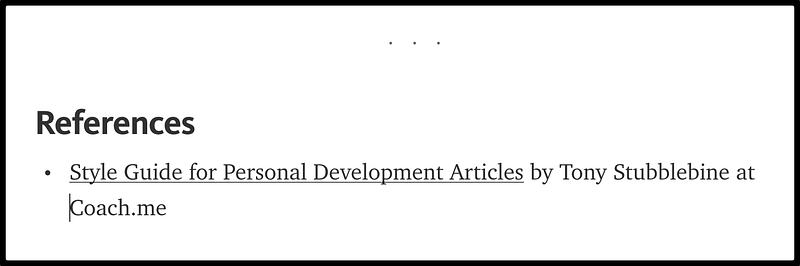
We do love citations to research and outside resources when they make sense, but we’d prefer that they be formatted simply as text links, like this. Only if your article is heavy on outside resources that the reader needs for further work or evidence, should you include a “References” or “Recommended Reading” section at the bottom of your piece as a bullet list in this format:
7. Editing
Better Humans articles are edited for content and then get a final pass from a copy editor before they are published. Given all that editing, you may be wondering: Do I need to do any editing of my own? Hell yes! Please do two things at a minimum to help your article get accepted.
- Do whatever you consider your best job of editing a piece that you want to publish. We work with a lot of authors who aren’t professional writers, so we can fix a lot. But we’d always rather be starting with your best.
- Ask yourself what the main point of your article is and then cut everything else. Two common problems that we encounter are a disjointed article that should really be split into multiple articles and a lengthy introduction that includes multiple approaches to the body of the article. Just consider saving that stuff for a different post.
Once your article is ready to go, you’re ready to submit it for consideration. Get all the details on doing that here.
We look forward to reading your work and sharing your expertise with our community.


