
How to Make Big Money Writing for Tech Startups: A Step-by-Step Guide
A proven system to convince startup owners to pay you to write for them

There’s a well-known secret in the world of content marketing, especially within tech:
Many, perhaps even most, successful companies and entrepreneurs pay writers to create some, if not all, of their content for them. Billion-dollar companies, early-stage startups, and professionals of all sorts pay people to research and ghostwrite their ‘original’ content for them — at least some of the time.
Why should you care? Because:
There’s a massive opportunity right now for talented writers to start making big money creating first-rate content for professionals and businesses in the tech/startup space.
How can you capitalize on this opportunity?
That’s exactly what I’m going to show you today.
First, though, how do I know that the above is true, i.e., that ghostwriting is a staple of content creation/marketing?
I know it’s true because:
- I’ve personally ghostwritten over 100,000 words of content for tech companies and entrepreneurs in the startup space.
- I have friends/acquaintances who run content marketing agencies that generate, publish, and market original content for some of the most popular businesses in the world — businesses that, if you’re reading this, you’ve absolutely heard of (if not already purchased products or services from).
This doesn’t mean that all content in the tech/startup space is ghostwritten or that prosperous ventures and respected entrepreneurs don’t deserve the success they’ve worked hard to achieve.
Instead, what it means is this:
Content creation is a service like any other: it’s a response to a demonstrated need, i.e., a form of supply that matches demand.
And in the tech/startup world, this supply and demand dynamic exists because CEOs, founders, public speakers, and other professionals depend on — but are usually too busy growing their companies and working with clients to personally create — high-quality and engaging content.
There’s never been a bigger demand for content than there is right now in 2019 (1, 2, 3, 4, 5).
Across countless industries, we’re witnessing an insatiable demand for the creation (and promotion) of high-quality, well-researched, and accessible content that:
- Engages the reader and keeps their attention
- Teaches (or otherwise offers) something of value, such as how to solve an irksome problem or how to learn a new skill
- Helps build trust and authority for the companies or professionals behind it by actively demonstrating the latter’s expertise.
Content Marketing Institute’s B2B 2019: Benchmarks, Budgets, and Trends — North America found that the majority of the most successful B2B companies:
- Are extremely/very committed to content marketing
- Have a documented content marketing strategy
- Use content marketing to effectively 1) nurture subscribers, audiences, and/or leads, 2) build loyalty with existing clients/customers, and 3) build credibility and trust with audiences
- Measure the ROI on content marketing
- Expect their content marketing budget to increase over the next 12 months.
With respect to tech companies in particular, Content Marketing Institute’s Technology 2019: Benchmarks, Budgets, and Trends found that the *majority of the most successful tech companies report similar findings to those described above and, moreover, that they:
- Frequently prioritize audiences’ informational needs over their organization’s sales/promotional messages
- Have used content marketing to successfully 1) generate sales/revenue in the last 12 months and 2) build loyalty with existing clients/customers in the last 12 months
- Have increased spending on content creation more so than on other areas of content marketing in the last 12 months
- Use educational content, including long-form articles and storytelling (*47% of respondents), to nurture audiences.
More generally, branding via storytelling is playing an increasingly important role in content marketing, especially in the startup scene.
Ali Mese, founder of growthsupply.com and The Startup, has explained it like this:
“Stories. They move people. And moving people is a powerful way to move…businesses. An increasing number of today’s top startups [are] turn[ing] to [storytelling] to…build a sustainable growth engine. These startups are often frustrated because they have wasted time and resources trying to buy their audiences’ attention through ads or other inorganic marketing channels. That’s where [storytelling] come[s] in.” (source)
“Content is a long game and it isn’t for those who quickly lose their interest and jump on the next ‘killer growth hack’ to ‘skyrocket’ their growth by ‘286%’. Even if [these people want] to stick with [content], their mindset often is geared towards finding hacks or shortcuts. Little do they know that if they put the same amount of effort into storytelling, they would never need any of that.” (source)
Putting it all together, here’s what we get:
The tech/startup space makes it possible for ambitious, determined, and skilled writers to earn fantastic money creating top-notch content for leading businesses and professionals.
Not just any kind of skilled writer, however.
I’m talking about writers who are fired-up self-starters: writers who are driven, independent, motivated, hard-working, and — to quote Gary Vaynerchuk — “willing to eat shit” in the short-term in order to succeed in the long-term.
Essentially, if you’re willing to:
- Think outside the box
- Give away high-quality content for free
- Steadily work your way up over time…
…then I can virtually guarantee that you will eventually start earning big bucks writing content for tech startups.
Why do I say this?
Because I did it myself by following a system I invented (with a lot of inspiration from others) — a system I’m going to outline for you today.
But first, here’s some proof that the system works.
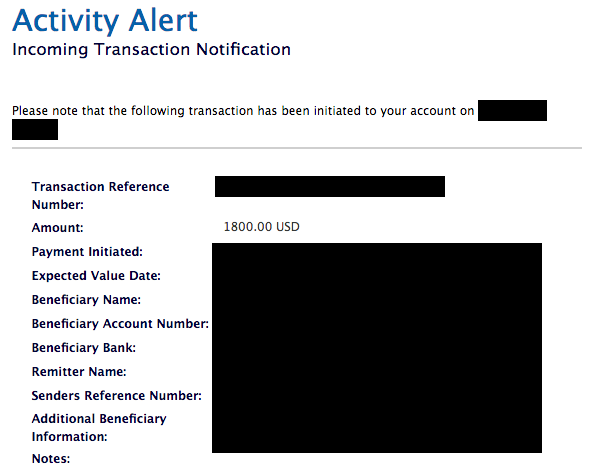
- An $1800 payment I received for ghostwriting four blog posts (1500–3000 words each):
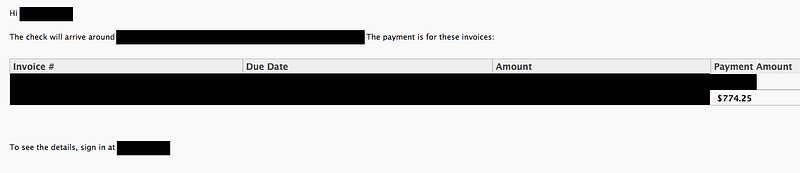
- A $775 payment I received for ghostwriting one blog post (3000 words) and promoting it:
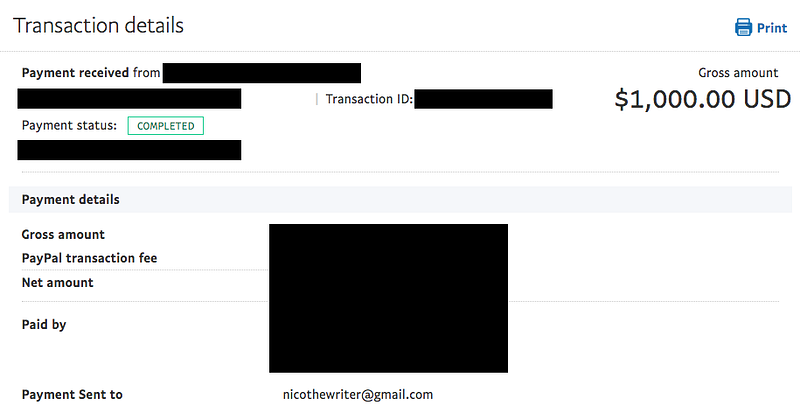
- And a $1000 payment I received for ghostwriting a master guide/eBook (6000+ words):
I’m not suggesting these are the kinds of amounts you should expect to earn if you’re just starting out as a content writer.
No, you’ll have to begin by earning far less money whilst you build up your reputation as a dependable, humble, and hungry writer who over-delivers every single time.
However, the more content you create, the more connections you form, and the more you work on big projects, the more in demand your services will become and the more you will be able to charge big money for your work.
As a preview, here are the nuts and bolts of the system, which are inspired by Brian Dean’s Skyscraping Technique and Fred Wilson’s Freemium Business Model:
- Choose your niche.
- Make a list of the top companies and professionals (as well as those close to the top) in your niche.
- Collect email addresses for the businesses and individuals identified in #2.
- Create a high-quality piece of original content targeted specifically to one of the companies or professionals identified in #2 — OR — re-write and vastly improve an existing piece of content published by one of the companies or professionals identified in #2.
- Email the new or enhanced content to your potential client using my custom email script (see below).
- Repeat #1–5 as many times as necessary until somebody agrees to pay you to create content for them.
If you follow these steps, you will absolutely start landing more, and better-paying, writing gigs as time goes on.
I promise you, there’s no ‘hack’ to succeeding as a content writer — you simply have to:
- Work harder than everybody else
- Be strategic with who you target, how you contact them, what you say to them, and what you present them with
- Stay patient in the beginning, recognizing that it’s an uphill battle at the start but that things do indeed become easier over time
- Refuse to give up.
Let’s flesh out each of these 6 steps in a bit more detail.
Step 1: Choose Your Niche
Tech is a broad space, consisting of many different domains, including:
- Augmented reality
- Automation
- Artificial intelligence
- Building a startup (advisory boards, bootstrapping, business development, culture, economics, growth strategies, legal issues, minimum viable product, product-market fit, public relations, raising capital, team, working with mentors, etc.)
- Cloud computing
- Content marketing
- Cryptocurrency
- Cybersecurity
- Design
- Education technology
- Film
- Financial technology
- Information technology
- Internet of Things
- Machine learning
- Marketing technology
- Mobile apps (design, development, onboarding, monetizing, patenting, testing, etc.)
- Programming
- Software-as-a-service (SAAS)
- Social media
- Technology addiction
- Videogames
- Virtual reality
- Wearable technology
- Web development and design.
Before you can start pitching potential clients, you first need to decide on the specific niche(s) for which you would like to write.
I don’t want to get off topic, so you’ll have to look elsewhere for detailed advice on what to consider when choosing your target niche(s).
For now, I’ll simply mention three suggestions:
- Pick something about which you’re already at least somewhat knowledgeable — if you have no clue how artificial intelligence or cryptocurrency or augmented reality works, then it’s probably best to stay away from these niches unless you’re able to devote considerable time to learning about them. Remember, your goal will be to blow away your potential client with a killer piece of content: you likely won’t be able to write such an article if you’re literally learning about the subject for the first time.
- Choose an area in which you can see yourself working far into the future — this is partly about putting some thought into which tech niches will likely continue to be popular as time goes on and partly about being honest with yourself in terms of whether you’re sufficiently passionate/interested to keep pushing when things get tough.
- Avoid niches that are so new, so underdeveloped, and/or so fringe that little, if any, research on them exists—as a content writer, you likely won’t be conducting original data analysis (at least not early in your career) and so you need to ensure that you can draw on plenty of existing articles, reports, and other kinds of publications when researching and crafting your own articles; some niches have been researched far more extensively than others — keep this in mind when choosing.
Step 2: Make a List of the Top Companies and Entrepreneurs in Your Niche(s), Alongside Their Competitors/Runner-Ups
After deciding on which niche(s) you’d like to target, you have to do the time-consuming but essential work of creating a list of all the possible companies and/or entrepreneurs for whom you’d like to write.
I suggest targeting two basic groups:
- The main thought leaders and the most successful companies in your niche(s), i.e., those at the top who have profitable businesses, popular websites, large social media followings, who are regularly featured in or interviewed by magazines/websites like bloomberg.com, economist.com, entrepreneur.com, inc.com, forbes.com, who regularly produce viral (i.e., highly-shared) content, and so on.
- The major, and up-and-coming, competitors to those in group 1, i.e., those who might not yet be as well-known, popular, or successful as the clear leaders in the industry, but who are still doing well in their own right by generating sales on a consistent basis, building an audience, constantly publishing content, and generally heading in the right direction.
Why should you compile a list featuring both those at the very top and those occupying positions a few rungs lower?
Because:
- You’ll likely find it very difficult, if not impossible, to convince somebody like Dharmesh Shah (founder and CTO of HubSpot) or Reid Hoffman (co-founder of LinkedIn) to hire you to produce content for him, especially if you can’t leverage tons of experience and plenty of impressive business relationships.
- You don’t want to waste your time pitching individuals or startups that aren’t yet at a point where they need (and can afford to pay decent rates for) top-notch, engaging content on a regular basis.
I’m not saying you shouldn’t ever work with new companies.
Sometimes, a new company is simply what a specific team of already-successful entrepreneurs is now working on.
With such backing, the startup likely 1) already knows what kind of content it wants to produce and how it will use the content to tell its story and build an audience and 2) can afford to pay writers reasonable rates to create such content.
In general, though, I suggest trying to work with professionals or businesses that are already established authorities with a customer base and a product or service that sells.
Benji Hyam, co-founder of Grow and Convert, a marketing agency that offers its clients a “fully done-for-you content marketing service”, has a rule that his agency won’t take on new clients if they haven’t yet achieved product-market fit.
I see this as solid advice for our purposes here as well. You want to write for companies that 1) know exactly who their customers are and 2) understand what they’re trying to accomplish with their brand.
Trust me when I say that it can be very frustrating trying to write leading content for a business that hasn’t yet figured out what it wants.
So, how do you find the thought leaders, most successful businesses, and up-and-coming startups in your niche(s)?
No surprises here: you use the power of the Internet to find them.
I recommend the following (obvious) strategies.
1. Start by Googling phrases like:
- “Most influential tech entrepreneurs”
- “Most successful Internet startup companies”
- “List of top tech companies”
- “Thought leaders in [name of niche]”
- “Top tech startups for 2017/2018/2019”
- “Most successful/popular Internet startups/companies”
- “Companies to watch for in [name of niche]”
- “[Name of niche] authors”
- “[Name of niche] experts”
- “[Name of niche] public speakers”
- “[Name of niche] top bloggers”
- “Top earners in [name of niche]”.
You get the idea.
You can also add words like ‘Quora’ and ‘Reddit’ to every one of the above search phrases in order to target your queries to these websites in particular.
2. Use Medium to help you find top writers, prominent publications, and popular stories in your niche(s).
Your goal here should be to locate the most popular and active people and companies in your niche(s), i.e., those who post articles that consistently receive lots of attention and engagement.
Here’s a partial list of some of the most popular tech/entrepreneurship subsections on Medium:
- Artificial Intelligence;
- Business
- Cryptocurrency
- Design
- Economy
- Productivity
- Programming
- Startups
- Tech
- UX
- Venture capital
- Work
Here’s a partial list of some of the most popular tech/entrepreneurship publications on Medium:
3. Make use of these two Wikipedia pages: list of Internet entrepreneurs; and list of unicorn startup companies.
4. Use paid search services like Ahrefs, Buzz Sumo, Ninja Outreach, and Social Animal.
These services make it easy for you to search for popular keyword-specific content, which you can use to find the people and companies behind the most shared content in your niche(s).
Step 3: Find the Email Addresses for the Individuals and Companies You Identified in Step 2
I’m not going to provide lots of detail on how to accomplish this.
You find people’s email addresses exactly how you think you would:
- Searching Google
- Searching social media sites (including LinkedIn)
- Searching company websites (especially their About pages)
- Using free or paid search tools.
Here are a few links worth checking out if you’re struggling to find one or more specific email addresses: 1, 2, 3, 4.
Step 4: Create a Fantastic Piece of Original Content or Re-Write an Existing Piece of Content and Make It Way Better
Now that you’ve chosen one or more niches, compiled a list of potential clients, and gathered a bunch of email addresses, it’s time to undertake one of the most important tasks of the entire process.
This involves creating a new piece of top-notch content for your potential client or re-writing one of your potential client’s existing pieces of content and making it way better.
Let’s start with creating an original piece of content.
The primary goal here is to write a comprehensive, easy-to-read, engaging, error-free, informative, up-to-date, well-referenced, and clearly organized piece of content that’s valuable to your potential client precisely because it’s helpful and relevant to his/her audience/user base.
In order to grab your potential client’s attention, your content must not only be stylistically and technically correct but, crucially, it must also be targeted directly to the needs of his/her business.
This means you need to do some research in order to develop a proper understanding of what this company or person is trying to achieve and how they’re going about that:
- Read as many of your potential client’s blog posts as you can.
- Familiarize yourself with his/her company website from front to back.
- Think hard about the meaning and objectives of the company’s mission statement.
- Watch videos of your potential client speaking about his/her product or service, and so on.
Essentially, you need to be able to answer three key questions:
1. What is this company (or professional) trying to accomplish, i.e., what are their stated objectives and big-picture goals?
For example, Jack Dorsey of Twitter recently told Joe Rogan that the former’s top aim is to help as many people as possible communicate as freely and openly as they can whilst simultaneously keeping people safe online and offline.
This is the kind of broad mission statement to which you should pay attention when considering this first question.
2. What kind of product or service does this company (or professional) offer, and what is it meant to do?
Why does this product or service exist? Why does your potential client believe in it?
3. What are this company’s (or professional’s) pain points and/or what are this company’s (or professional’s) clients’ pain points?
Here, you can focus either on what your potential client might be struggling with (e.g., how to use content marketing to convert more readers into paying customers) or on what the people whom your potential client serves might be struggling with (e.g., how to achieve greater integration between various pieces of standalone software).
Thinking about these three questions will help you to effectively frame, structure, and target the original piece of content you create.
By ‘original’, I don’t mean that you should try to conduct a full-scale study or anything like that (although doing so would likely impress your potential client greatly.)
Instead, I mean writing an article from scratch by making use of existing research in order to create a blog post (or a white paper or eBook) that’s sufficiently different from what your potential client already has on his/her or its website.
One major benefit of creating an original piece of content for somebody for whom you’d like to work is that it actively demonstrates your mastery of the specific topics on which the content is based.
For instance, if you were to write a comprehensive post on dApps, i.e., decentralized applications on the blockchain, the person to whom you send your post would clearly recognize that you’re familiar with blockchain technology, centralized vs. decentralized networks, and so on.
The second option involves re-writing and significantly improving an existing piece of content.
Rather than putting together an original post or eBook or white paper, you find a piece of content that 1) your potential client has already published (e.g., on his/her personal or company blog) and 2) could be made much stronger, whether conceptually, grammatically, organizationally, stylistically, etc.
When looking for a piece of content to re-write, I suggest trying to find something that is:
- Too short, generic, or imprecise
- Out of date, i.e., no longer relevant or less relevant than it could otherwise be
- Factually inaccurate
- Under-referenced
- Difficult to read or understand
- Boring
- Generally unhelpful.
The goal is to find a happy medium between ‘trash’ on the one hand — i.e., a really bad piece of content that has little, if anything, worth saving — and ‘excellence’ on the other — i.e., a fantastic piece of content that you can’t strengthen in any meaningful way.
(If you can’t locate an article that’s worth re-writing, then it’s probably easier and less of a hassle to simply construct something from scratch.)
Once you’ve found the content you’d like to expand and polish, I recommend following this process:
- Research the topic anew: Develop a fresh understanding of the key issues involved by reading authoritative sources, familiarizing yourself with relevant stats, and learning what other thought leaders in your niche have to say about the topic.
- Decide what to keep from the original article: Save the most important ideas (i.e., whatever is still relevant, persuasive, insightful, and well-written), and discard the rest.
- Write a brand new post on the topic as if you were constructing it for the first time: Create a new title, outline, structure, and introduction. Use up-to-date stats, and reference authoritative sources. Work the content that you saved in #2 into the new piece as appropriate.
Generally, and in comparison to the original piece, the improved article should be longer and more developed, more up-to-date, easier to grasp, better written, and more grounded in authoritative sources.
Whether you’re writing something from scratch (option 1) or re-writing an existing article (option 2), be careful not to deviate too much from your potential client’s ‘voice’ or ‘tone’.
It’s important to try to emulate the writing style of the company or person for whom you’d like to work because, after all, the entire purpose of this undertaking is to convince this particular business or individual to hire you to personally write (at least some of) their content henceforth.
Part of being an effective content writer is learning how to effectively mimic the voice of the person or company for whom you’re writing.
Step 5: Email the New or Enhanced Content to Your Potential Client Using This Custom Email Script
Once you’ve finished creating your original or re-written piece of content and ensured that it’s highly relevant and useful to your potential client, you need to email it over.
The objective here is to send your potential client the blog post (white paper, eBook, etc.) in a way that’s personal, polite, sincere, and easy to respond to — not one that comes across as intimidating, overwhelming, impatient, or spammy.
In short, your aim is to have the person on the other end of your email do three things when they’re ready to do so:
- Read your message
- Read your content
- Send you a reply.
If you’re sending an original piece of content, I suggest using the following custom email script:
Subject: I’ve Created an Original Piece of Content for You
Hi [name],
My name is Nico Ryan.
I’m a big fan of your work, and have been for some time.
Last week I noticed that your blog, [name of blog], doesn’t seem to feature any content on [topic].
I found this odd because it seems like [topic] would be right up your alley — OR — I found this odd because it seems like [topic] would definitely be something that [name of company] would want to publish articles on.
I was so surprised that I decided to create an original piece of content for you on this very topic.
Specifically, the article looks at [description of what the post does and why].
Here’s a link to the piece (Google Docs).
I haven’t shared this with anybody else because I wrote it specifically with you in mind — OR — because I wrote it specifically with [name of company] in mind.
I figured that if you like the article, you might consider publishing it on your blog as one of your own posts — or working it into something you’re already writing.
Either way, it’s yours to do whatever you like with. I don’t want anything in return — no need to credit me or anything like that.
If you’re pleased with the article then maybe we could talk about working together at some point.
Cheers, Nico.
That’s it.
Read through the message one last time to ensure that it’s error-free and addressed to the right email address, and then send it.
If you’re sending a re-written piece of content, I suggest using the following custom email script:
Subject: I’ve Re-Written and Updated One of Your Articles
Hi [name],
My name is Nico Ryan.
I’m a big fan of your work, and have been for some time.
Last week I read your article, [name of article], which I found at [link].
I really enjoyed the piece, especially the part where you talk about [interesting/important point ← be genuine here: don’t randomly choose something you don’t actually care about!].
However, I found the article a bit difficult to follow in places. It contains some grammatical errors, awkward sentences, and a few confusing claims. It also discusses some older research that’s now out of date.
I liked the piece so much that I decided to re-write it for you from scratch. I’ve given it a new introduction, cleaned up the grammar, included more recent data, added a new section on [topic], and expanded the article by about 20% in total.
Here’s a link to the new draft (Google Docs).
I truly don’t mean any disrespect by sending you this email: on the contrary, the message of your article is so important that, in my opinion, the post deserves to be as accurate, polished, and detailed as possible.
I figured that if you like the re-write, you might consider using it to update your original post — or perhaps working it into something you’re already writing.
Either way, it’s yours to do whatever you like with. I don’t want anything in return — no need to credit me or anything like that.
If you’re pleased with the article then maybe we could talk about working together at some point.
Cheers, Nico.
Simple, right?
Again, check the message for errors and make sure it’s being sent to the right email address, and then hit ‘send’.
Do not do any of the following when emailing your potential client, regardless of whether you’re sending an original piece of content or a re-written article:
- Mention your desire for paid work (remember: you’re contacting a total stranger — you have no reason at this point to expect this person or company to start paying you for your services).
- Write a long, hyper-detailed message (spilling your life story will make you look desperate, and will likely overwhelm or annoy your potential client).
- Make your recipient feel obligated to respond to you (don’t write anything like, “looking forward to your response!” — doing so is tacky, unnecessary, and off-putting).
- Write anything that makes you seem arrogant, entitled, or smarter than everybody else (humility is key).
- Say anything to insult your potential client (the idea you’re trying to convey here is, “your article is awesome but it could be even more awesome with these changes/updates!” — not, “your article is mediocre at best, but with my help, it could be something special”).
I’ve personally committed most, if not all, of the above errors at some point in time, scaring away potential clients in the process.
Stick to the scripts, and you should be just fine.
(Michael Thompson has provided additional email scripts here that are worth checking out.)
Step 6: Repeat Steps 1–5 Until You Secure as Many Paying Clients as You Can Handle
Once you’ve emailed the original or re-written piece of content to the individual or company for whom you’d like to work, you need to accept the following:
- Your email may be ignored, i.e., you might not ever receive a response
- You may receive a “thanks, but no thanks” response, a “we’re happy to publish some of your work, but we can’t pay you” response, or a “so, you’re basically telling me that you’re a better writer than I am” response
- Your content may be used but without you ever hearing back from the person or business you emailed.
Before (or directly after) you send your email, you need to explicitly think about how you would feel and how you would (or wouldn’t) respond if one of the above things were to happen.
In other words, you need to mentally and emotionally prepare yourself for the possibility that your email might not result in the specific outcome for which you’re hoping, i.e., an offer for paid work.
The system I’ve outlined here is based on the idea that you need to play the long game in order to succeed.
Short-term sacrifice for long-term gain could be its motto.
It’s not founded on some unrealistic belief that you can start earning many hundreds of dollars per project immediately after sending a single email.
Like I said earlier, as an aspiring writer you must be willing to ‘eat shit’ at the start if you want to be able to afford ‘fine dining’ at some point down the road.
You might have to repeat steps 1–5 several times over until you land your first paying client. This is nothing but a numbers game: as long as you produce exceptional work, follow the system, and remain persistent, you will land paying clients. It might take several weeks or longer, and you might feel like you’re spinning your wheels at times, but it will work if you work it.
I landed my first paying client after cycling through the system three times.
In other words, my third attempt to use high-quality, free work to convince somebody in the tech/startup space to hire me to write content for him was successful.
You might knock it out of the park on your first try; you might still be without a client five pieces of content later.
If the latter occurs, don’t give up:
Talented, motivated, self-driven people who take life by the horns by creating opportunities for themselves are virtually always rewarded.
Frequently Asked Questions (FAQs)
Here are some (quick) answers to various questions I tend to receive whenever I discuss my journey to earning $500-$1000 per post as a content writer:
1. How long will it take me to land my first paying client?
See above, Step 6.
2. What can I do to increase the odds of receiving a positive response to my initial email?
Create the best damn piece of content you can.
You get only one chance to make a good first impression: don’t ever sacrifice it by under-researching your potential client’s business and/or delivering sub-par work.
And don’t forget that working for free really does work:
Gary Vaynerchuk’s personal videographer DRock convinced Gary to hire him after he cold-emailed Gary a high-quality video for free. DRock’s life hasn’t been the same since.
3. What should I expect if I receive a positive response to my initial email?
My experience suggests that, if you receive a welcoming response to your first email, the person or company whom you contacted will reply by saying something like the following:
- “What do you have in mind in terms of us working together?”
- “What can you offer us?”
- “What are you looking for?”
- “How much would you charge for…?”
In the first case, you would explain that you’re looking for some paid writing opportunities in the tech industry and that you’d really like a chance to produce some content for his/her company.
In the second case, your email recipient would likely specify exactly what they might want from you.
For instance, they might ask you what you would charge for four, 1500-word blog posts per month.
You’d provide a price and then take things from there.
4. How much should I charge for my writing?
What you charge depends on your abilities as a writer, on the length and sophistication of your content, on your willingness to consistently over-deliver results, on the credibility/experience/recognition you’ve earned so far, and on many other factors.
For starters, I don’t recommend charging by the hour.
Clients usually don’t want to pay by the hour because doing so introduces a ton of uncertainty into their efforts to manage their budgets.
Instead, I recommend charging either per word or per blog post (or per set of blog posts).
If charging by the word, I don’t see why you couldn’t justify charging $0.05-$0.15 USD per word at minimum.
$0.05-$0.15 per word equates to $50-$150 for a 1000-word piece — definitely not big money, but it’s a start, and that’s what you’re looking for at this early stage.
If you have more experience under your belt, you should be able to charge twice that amount, if not more.
If charging by the post, you’re probably looking at an introductory rate around $100–$200 per 1000-word post.
These rates are nothing but generic, ball-park figures; you absolutely shouldn’t interpret them as the be-all and end-all regarding what you should charge.
5. Do you recommend looking for work on platforms like upwork.com?
No, I don’t.
Upwork and sites like it are race-to-the-bottom websites where you’re constantly having to under-bid others in order to land jobs.
Plus, such platforms heavily favor people who have been using them the longest and who have, thus, accumulated the most exposure and experience.
It’s not a ‘fair’ market in this respect.
I’m not saying there’s no chance you could succeed on Upwork, but I believe you’d have a much better shot at earning decent money if you were to follow the system outlined herein — particularly if you’re new to content writing.
Plus, I doubt that the kinds of tech companies and entrepreneurs for whom you’d like to write are relying on sites like Upwork to fulfill their content creation needs.
6. How do I effectively increase my rates over time?
This is a complicated topic that deserves its own post.
For now, I’ll just say the following:
- You shouldn’t expect to be able to raise your rates with a current client without first providing lots of top-notch content over a significant period of time (again, I’ve learned this lesson the hard way).
- You can try increasing your rates by a percentage point (e.g., 5%) every time you acquire a new client. The amount of the increase and whether you’re successful in implementing it will depend on various dynamics (again, a topic for another day).
- You should leverage your experience and make use of social proof when negotiating with new clients. Do this by collecting testimonials from every one of your clients and then providing those testimonials to potential clients during negotiations (or you can mention that you’ve written for so-and-so and then invite your potential client to contact so-and-so if they wish — as long as you have so-and-so’s permission to do so, of course).
- You should try to leverage any relevant metrics to which you have access (e.g., number of views per article, number of website visits per article, etc.). However, it’s not always possible to access these kinds of data.
7. Do you have any other suggestions or bits of advice?
Sign up for, and carefully read through, Brennan Dunn’s Double Your Freelancing free email course. It’ll teach you a bunch of powerful ways for understanding and talking to others about what it is that you do and can offer as a content writer — or, as Brennan would put it, as a consultant who solves problems.
One last thing: Get more stories like this one here.


