
How to Rebrand Your Startup in 9 Steps
A director’s guide to overhauling your brand with just 5 people and no agency involvement
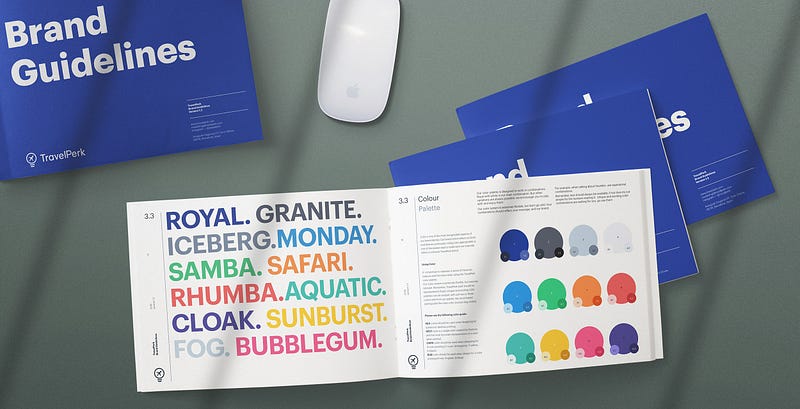
At the beginning of this year, my team (of just 5 people) and I finished our overhaul of the tenth fastest-growing software product in the world: TravelPerk. If you want to see our work before you take the time to read the story of how we did it, check out the link in my bio. If you like it, flip back to this tab and read on. If you don’t like it, hey that’s okay, come back anyway and read about all the mistakes we made.
“Rebrand”
Just the word evokes powerful emotional reactions. Reactions that differ depending on who hears the word. Try it out for yourself. In those awkward moments while you’re waiting for everyone to join your video meeting, throw out this little conversation starter.
“Hey, don’t you think we should rebrand next year?”
I predict you’ll get answers that go something along the lines of:
Marketing Manager: Yaaaaassss. Definitely, we NEED this.
CFO: Over. My. Dead. Body. No way, I did this before, agencies cost a fortune, it’s a horrible time drain and you have NO way of measuring the impact.
Sales Director: Some better sales materials would be nice. But I don’t think there’s much wrong with the current brand.
Product Owner: Oh for sure, we need to, it’ll help our retention. But we need to make sure Product and Marketing are 100% aligned. Let’s put three brainstorm sessions, a retrospective, and a pitch session on the calendar. In 6 months we can be ready to start this.
Engineer: Does that mean you’re going to change the logo? Great, I hate our logo.
So why bother doing it at all if it evokes such a mixed reaction? Well, that’s the first step.
1. What Even Is a “Rebrand” and Do You Really Need to Do It?
The good news is that there is no hard and fast rule on what a “rebrand” is. There’s no rule that says you have to get a new logo, a new color palette, throw a launch party, and hand over a fortune to an agency. The bad news is that the world seems to think a good “rebrand” is all of those things and more. In the TravelPerk experience, not recognizing that, and more importantly not clarifying what we were going to do and why was my first mistake:
Mistake 1: Inviting senior leadership to a presentation on why we should rebrand when I didn’t know EXACTLY what I wanted to do
You’re not some kind of business messiah. Telling everyone that you’re going to come in and make everything sparkle, glisten, and sing won’t excite everyone. When I stepped into the meeting room, I had a presentation all around the power of branding. I used the case study of Apple vs Microsoft, the iPod vs the Zune, revolutionary product that changed the world vs. “what’s that?” I went down in flames as soon as two people in my exec team said, “Actually, I owned a Zune. It was a better product.”
People in C-level positions aren’t like other people. They don’t think how “normal” people think, if they did, they wouldn’t have a C at the beginning of their title. They all have their different quirks, but for sure they all don’t suffer fools. If you want to get your leadership team on board with your efforts (and you definitely do) you need to come with a clear plan. That means a comprehensive scope of what you’re going to do, a rock-solid list of reasons as to why, a timeline, the cost, and most importantly the impact that it will have. If you’re going to have all of those things ready, there’s a lot of prep that you need to do.
I’ve found that wanting to rebrand is like an instinct for marketers. You look at a webpage, a slide, or an email and say to yourself, “this isn’t beautiful, this doesn’t speak to me. It can be better.” That’s certainly what I thought when I looked at TravelPerk’s material before I took my current position. It’s what I think when I look at 90% of the assets put in front of me every day, and you can always find someone next to you who feels the same. Designers can talk about design all day, copywriters can rip into any prose. But while that’s fun, it’s rarely productive. You have to get to the root of what you want to change and why. It’s something of a cliché, but Maya Angelou was right when she said people will remember how you made them feel. So, ask yourself, how do you want your brand to make people feel?
2. Know How You Want Your Brand to Make People Feel
Answer this first. You can get to the “how,” “who,” and “when” later. First, you need the “what.” During the rebranding process at TravelPerk, I got asked this question a lot, and as I searched to answer it, I did two things that turned out to be really effective.
First, I asked the people in our team who spoke to customers regularly what they thought the brand should be. I sent them all a survey and asked them every question I could think of. The one that turned out to be useful was asking them to rank a list of adjectives from “terrible” to “perfect.”
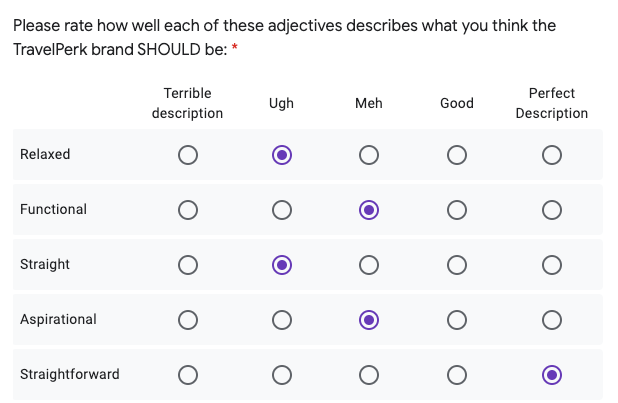
When I looked at the answers, the results were clear, and because they came from those who knew why our customers loved us, they made a lot of sense. They went on to become the pillars of our brand values.

The other effective exercise was to fill out a brand pyramid. This is something that I stole from my days at Prezi. One day, our senior management presented us with a filled-in pyramid and told us to read it. After doing that, I found that it informed a lot of the communication I worked on at Prezi, and I wanted something that useful for my new team.
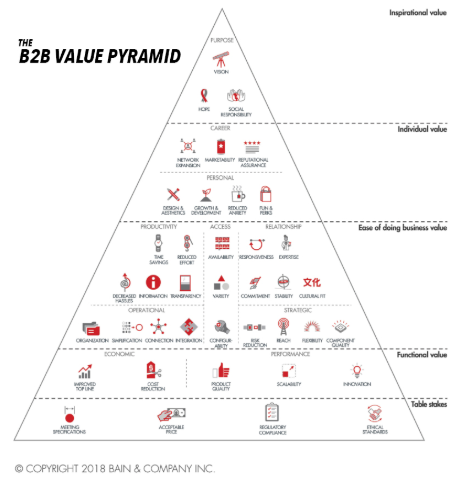
Don’t worry, there’s one for B2C brands too. It’s essentially a comprehensive list of everywhere your product provides customers with value. If you’re looking to kick-off your rebrand, you may find that your exec or product teams have already done this. If not, lock yourself in a room until you fill it out. It’s worth the time investment. The process forces you to know the product and the customers. And beyond that, what value do those customers get from your product. And, it helps you segment that value too, which makes it easier to send the right message to the right person at the right time, which is what marketing is.
- Table Stakes is value that people can’t live without. It’s like oxygen, no one talks about it, but take it away and everything dies.
- Functional Value is like clothes. You’re not going to die without them, but you’re not going to be in a good place either.
- Ease of doing business is the everyday stuff that makes your life easier. Like having a smartphone. Without it, you could use your computer or borrow a phone, but that’s annoying for everyone.
- Individual value. Now we’re into the tasty emotional stuff. The previous layers of the pyramid were all functional. Emotions are where brand marketers live, the juicy stuff is here. It’s like that perfectly fitting pair of jeans that every time you put on you feel good. This stuff is what’s likely going at the top of your homepage.
- Inspirational Value. Now we’re into the life-changing stuff. The value that takes you to a whole new level. You’re lucky if you have value here. At Prezi we had it. We were the presentation tool that would help you nail that pitch, land that huge contract, ace your thesis presentation, in my case, give a TED Talk.
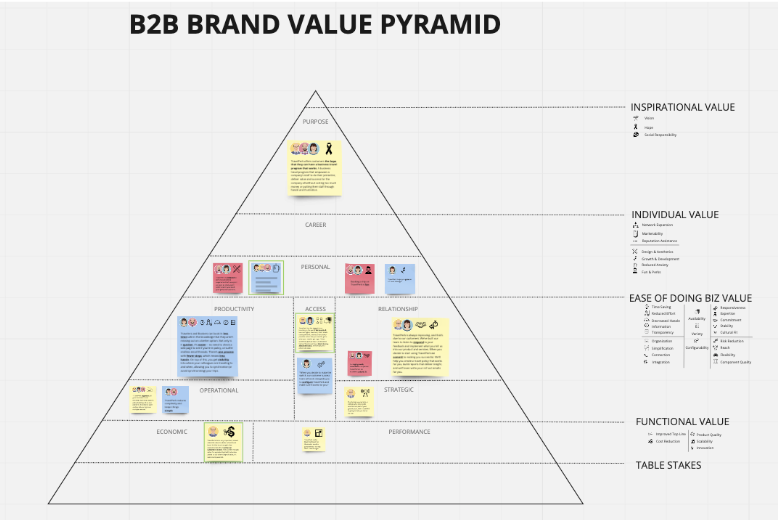
When you have your pyramid. Keep it somewhere safe. It’s going to inform every communication your brand makes. I still have it bookmarked and use it once or twice a month to make (and win) arguments. In TravelPerk’s case we have three very distinct personas; traveler, travel admin, financial controller. So our pyramid is probably a little more complex than yours:
Mistake 2: Not sharing the pyramid
After putting it together, I circulated it to marketing and a few people in the product team. Big mistake. It’s useful for everyone. Even now, I’m thinking of a few people I didn’t share this with who would really benefit from seeing it.
The full pyramid is probably too much information for everyone in your company who comes onboard. But a version of it and the value proposition document that it helped build, makes up my presentation to every new TravelPerker. They tell me they enjoy it, but more importantly, it’s essential for everyone to know why people love and use your product.
If you know that, you know how you want people to feel. For us at TravelPerk, it was obvious that we provided a lot of value around reducing anxiety. Fantastic support, simple booking, integrated travel policies. This was our practical value, and it informs a lot of our brand style. Simple visuals. Block colors, straight lines, sentences that are to the point.
Meanwhile, our emotional value is around opening new worlds. For the traveler this is obvious. New cities, people, opportunities, and experiences are unlocked by TravelPerk. But it’s also about giving time back to people like Mandy Mill. Mandy is the office manager at GetYourGuide. Mandy used to spend three days of her week booking travel for other people. Thanks to TravelPerk she now spends half an hour approving other people’s trips. That time back is life-changing for Mandy. She gets really emotional about it, she can’t imagine her life the old way anymore. She told us that! We did everything we could to reflect this in our new brand styling. The best reflection of the combination of emotion and practicality comes out in our first brand video.
We wanted people to feel calm and reassured, yet excited about travel. Now that we knew that, we were ready to go do some stuff.
3. Meet Your Audience
This is an obvious cliche, but it’s true. I won’t say anything about why you need to do it, just a couple of tips on how.
- Meet as many customers as you can. Attend as many sales calls as possible. Before I joined TravelPerk, I wanted to test out the sales team and so posed as a customer. My company at the time needed a better way of booking travel, so I was only kind of pretending. That exercise of “being a customer” got me through my first 6 months, earned me some respect with the sales team, and came up in 70% of my meetings. Our sales team records a lot of calls for training purposes, I listen to them when I can, even now.
- Ask the data team for information on who the users are. Ask them everything. Who are they, what titles do they have, how long are they on the platform. Gather everything, you might not use most of it, but there will be a nugget or two in there. For my team at TravelPerk, we managed to work out that about 70% of our users were millennials. Our commercial team thought it was lower, probably because they met most regularly with decision-makers who tend to be older. But you can’t argue with the data. I still use that stat in meetings every week. It informed a huge number of decisions. I think people are sick of me saying it.
4. Build a Solid Budget and Timeline
Budgets and timelines are essential for sign off from the C-level. How much will this cost? When will it be out? If you can’t answer these, no one is going to let you do it. No one should let you do it.
But it’s okay because you know how you want people to feel, and you have the whole company excited about the value your product brings and how that makes everyone feel great. You also know who your customer is, and so by now, you know what you want your brand to say and how you want it to look. And that means you can make plans.
For example, with TravelPerk, we knew our existing visual language wasn’t inspiring enough. We knew it didn’t speak to opportunity. We knew that our font, our color palette, our photo choices didn’t speak to our core audience of upwardly mobile millennials.
It’s why we chose to use as much photography as possible. This was an expensive and impractical choice. The main alternative was to go with illustrations. A lot of startups do this, and do it really well; Atlassian, Asana, MailChimp, and others. But our value, our inspiration, our audience meant that we had to choose photography. After all, we’re a travel brand.
We knew we wanted to have our own photography too. That meant photoshoots, hiring a photographer, models, outfits, and makeup. We found ways to bring down the cost. We convinced TravelPerk employees to be our models (luckily 90% of our workforce are millennials), we hired an amazing local photographer with an awesome portfolio who cut us a discount because we were local and that mattered to him. We used our own office as a backdrop where possible, and we saved on outfits because we have some amazingly chic people working at TravelPerk. But even with this ingenuity, all this took more time and cost than hiring an illustrator. We still had to find Dani, persuade employees to model, convince their managers to give them an afternoon off, edit the photos, and a ton of other logistics. But the prep work we had done meant that everyone knew this was the right path to take, and we were able to put all this in our budget.
Now we have a unique set of amazing photos from a world-class photographer that are ours and only ours. We still use some stock photography to top up in some places, but in our most prominent spots, we use our photos. The result was great, but I did make another mistake getting there.
Mistake 3: Overpromising on the timeline
Having got your key stakeholders convinced and then excited about our rebrand — by now we were calling it “Brand 1.5” as the word “rebrand” still scared my CFO — it was then super easy to tell everyone that we’d be done soon. It went something like this:
CEO: Looks good! When can it be done, could you be ready by the end of the quarter?
Me: Hmm, yeah, I guess.
CEO: Great, get it done.
My Team: You told him what? There’s no way we’ll hit that deadline.
When you build your timeline, put in some buffer time for things to go wrong. People get sick. Holidays need to be taken. These need to be factored in. But trust me, giving yourself too much time is always going to be better than being five months late and having to explain why to your CEO.
5. Embrace Having a Small Team (and No Agency)
During that now-infamous meeting where I tried to convince the C-levels that we should rebrand, the subtext was definitely that I was asking for a budget to hire an agency. I never said those words, but everyone in the room knew that it was on the table. If I’m honest, I didn’t want to do it that way. I had experiences with agencies previously, and I didn’t enjoy it. Essentially the agency was paid a lot of money to produce research and propose a direction. The research turned out to be a nicely packaged version of stuff we already knew, and the design and tone of voice direction was good, but our in-house teams ended up tweaking it and doing most of the hard work to deliver it.
Inevitably whispers go around as to how much the agency was paid, and this makes people resentful, especially the ones doing most of the work. Furthermore, there’s nothing a creative hates more than refining someone else’s vision. If you believe in your team, give them the power to do it. It’s one of the huge benefits of working for a startup, you get to lay out the vision, why take that away from some of your most creative hires?
Small teams are great. Sure, there’s a mountain of work to do, and a lot of the conversations are around “getting some help,” but providing you selected a group of people centered around the same values and you did a good job of laying out the mission and vision, the journey you go on is an incredibly rewarding experience. It certainly was for me, and I believe that the bond we have in the team now would not exist if we hadn’t gone through the hard work and come out on the other side.
Our team looked like this: A copywriter, an art director (willing to do a lot of painful small design tasks), a web designer, and a front-end developer.
Two tips I’d pass on for working in a small team:
First, know what your team likes. You’re doing creative work, and all creative output is influenced by something, as the team leader you should know what gets your people excited. My art director and I spent hours going through websites we like, drooling over Squarespace’s animation, while also pointing out that WiX’s new look is really good. Have you seen what MixCloud did? Love the marriage of colors and typefaces. While my copywriter and I send Simpsons lines back and forth every day.
Second, make time to discuss the work. I have to admit I was reluctant to do this one at first. If I approved it, why does the team need to discuss it? It sounds like a time drain. It’s not. It’s pretty much the only way to get from good to great. Also, it makes everyone feel involved and invested. Halfway through our process, my art director put a two-hour meeting on our calendars called “creative forum.” I was as skeptical as it’s possible to be, but I gave in and let him run the meeting. Today, we still have it every week, and it’s awesome, the one meeting everyone attending looks forward to.
6. Don’t Wait for It All to Be Done
For a few months, we were working in two brands. We put out material using our existing brand and continued to develop “Brand 1.5” in secret. That was dumb.
Mistake 4: Developing two brands at one time
Don’t do this, it’s double the work for half of the reward. As soon as you have agreement on the direction, put everything out in the new brand. Don’t wait until you have the website, sales deck, Twitter image, Insta filters, business cards, hoodies, roll-ups, Facebook ads, and everything else done. You’ll never get there. You don’t have a massive team, and you’ll have to plan stages.
First, pick some small things that you can track easily and compare them to the old brand. For us, it was LinkedIn ads. We put old design and wording against new and saw what performed better. When the new stuff won, this snippet of data helped silence anyone who wasn’t quite sure.
Next, armed with the confirmation from your data, you’re now ready to identify some key assets that have high visibility. Once those are done, you’re Rebranded. At TravelPerk and at most startups, that’s your website. As we’re B2B and have a large sales team, it was also the sales deck and business cards.
But won’t there be legacy stuff? Inconsistency will kill your brand. Yes, there will, and no it won’t. You’re not McDonald's or Coca Cola, you haven’t built a reputation yet and a modern audience is used to Facebook testing 100 different headers every week. Of course, you’re going to fix all those assets in circulation as soon as you can. But you’re not going to let it stop you from getting the most important stuff done and putting it out to the world. And a brand is a living thing, it’s never “done.”
7. Shelter Your Team
Creative people hate interruptions. Most marketing managers are like me, constantly talking, moving around, social people who get bored easily. Creatives (including web developers) are not. They need long periods of uninterrupted work. Do everything you can to give them as much of that as you can. Slack them only when you have to, and try to give them three days a week with no meetings. Call yourself a “shit umbrella” and keep all the excrement off your team.
8. Indulge Yourself, a Little
One afternoon, my art director told me that we should make a video to explain our design system. I thought it was probably unnecessary, but I listened as he outlined his vision, and soon I was writing a script. Shortly after we had made a full-blown storyboard.
We thought it would be so cool, but didn’t know where it would go. We needed an animator to make it, and that meant money, and so I was close to shutting it down. But it had inspired us, and we were under budget, so we made it. It was a great decision.
Avi, our CEO, saw it by accident. I hadn’t intended to send it to him, and he told me he thought it was awesome. It ended up being the signature piece we used to announce at our all-hands meeting.
9. Let People Know What’s Coming Next
At this point, we chose not to change our logo. It was too much hassle to change it everywhere that we needed to change it. Plus it would have given our product design team a headache they didn’t need. We’ll change it one day, and when we do I’ll doubtlessly learn a lot from that process too, but armed with everything the team and I already learned, I feel like it’s going to be a lot smoother.


